Good leadership can make room for gifts that would otherwise remain unnoticed. St. Hilda of Whitby led a religious community that became an important place of learning in early medieval England. Her story invites us to consider who gets heard, who receives encouragement, and how a community learns together.
The abbess on the Northumbrian coast
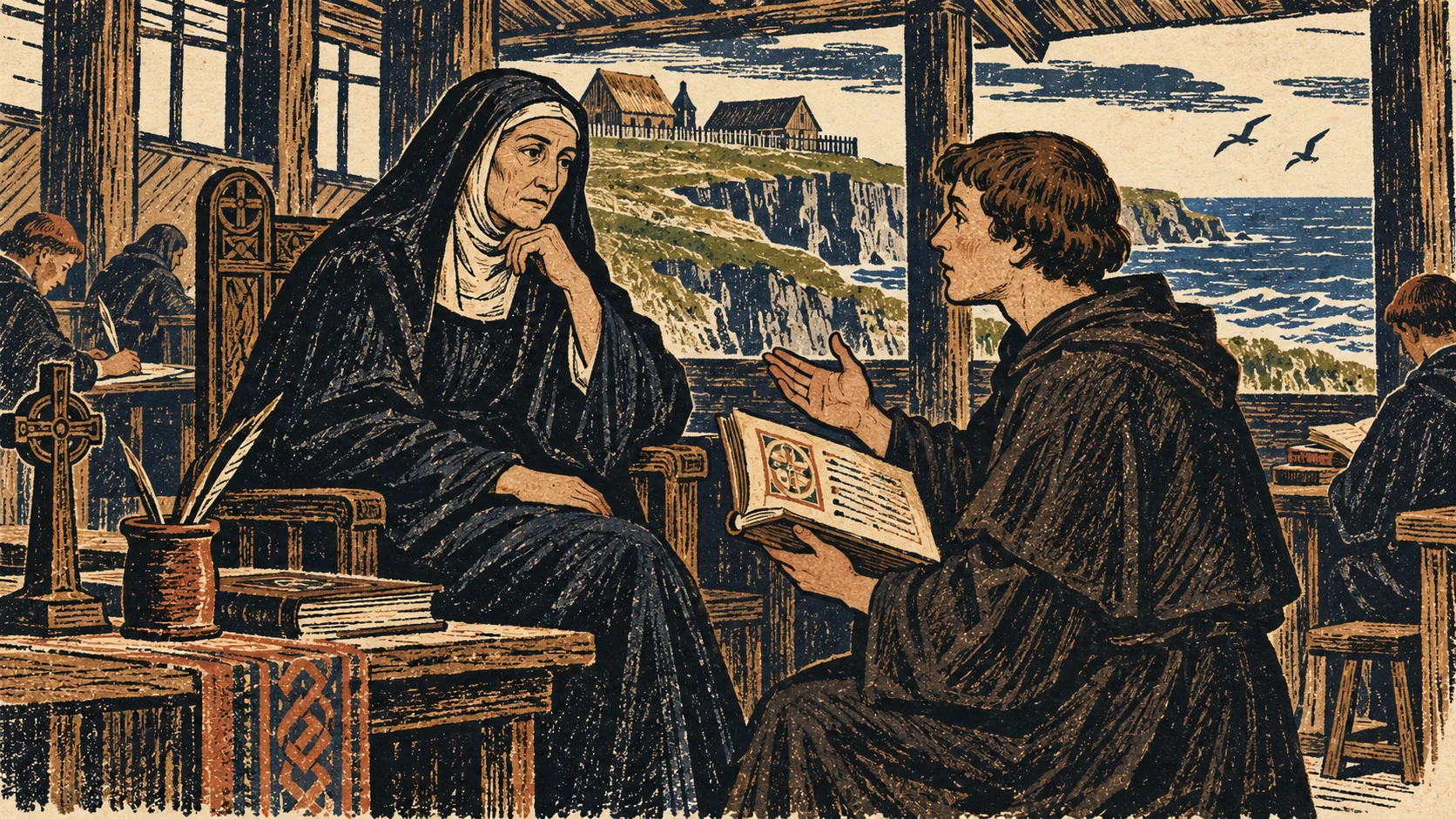
Hilda, also called Hild, lived from about 614 to 680. She became abbess of the community at Whitby, a double monastery with both women and men under her leadership. In 664 the monastery hosted the Synod of Whitby, which addressed differences in Christian practice, particularly the calculation of Easter. Much of her story comes through the historian Bede. The dramatic ruins visible at Whitby today belong to a later monastery, not Hilda’s original buildings. English Heritage explains her life and the site’s history.
Listening is a leadership task
A meeting can appear open while a few confident voices determine every outcome. If you lead a parish group, pause before closing a discussion. Invite people who have not spoken to contribute, while allowing them to pass. Offer another way to respond afterward for those who need time to think.
Pay attention to whose knowledge is treated as valuable. The person who sets up the room may understand an access problem better than the person chairing the meeting. A new volunteer may notice confusion that longtime members have stopped seeing.
Build a small culture of learning
- Explain the purpose. People learn a task more easily when they understand whom it serves.
- Make questions welcome. Answer the question without making the person apologize for asking.
- Share responsibility gradually. Demonstrate, practice together, and then allow someone to try.
- Give specific encouragement. Name the effort or skill you noticed rather than offering only general praise.
These suggestions are for contemporary communities; they are not claims about Hilda’s daily management. They are ways to bring a historical interest in learning into the places where we have responsibility now.
When a group disagrees
The Synod of Whitby reminds us that religious communities have long faced serious disagreements. Before a difficult discussion, state the question clearly. Agree on who will make the decision and how participants can raise concerns. Confusion about the process often adds unnecessary tension to the disagreement itself.
After a decision, explain what was decided and what remains open. People may still disagree, but they should not have to guess whether they were heard.
One person to encourage
Think of someone whose ability is still developing. Offer a concrete opportunity suited to that person: reading a passage, helping plan an event, learning a practical task, or contributing an idea. Then provide the support needed to succeed. Hilda’s story gives us a reason to take that quiet work of encouragement seriously.