
St. Lucy: Bearing Light in the Face of Darkness

Click to share this post

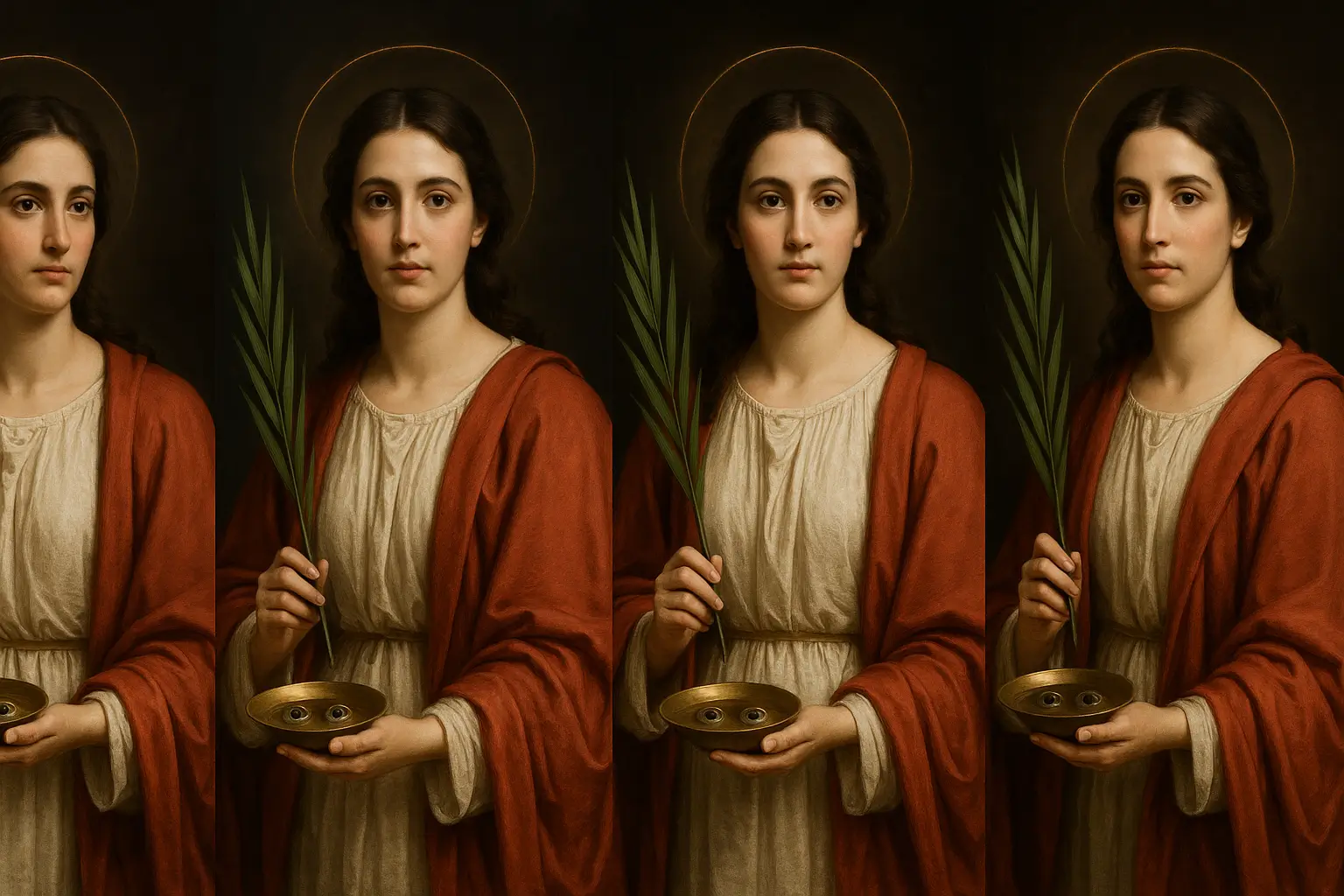
studio-quality portrait set of Saint Lucy of Syracuse, captured in a cinematic 16 : 9 composition. The serene young martyr is shown with her palm of victory and the traditional dish bearing eyes—symbols of her patronage—set against a dramatic, painterly backdrop and illuminated with soft, directional lighting for lifelike detail.

Explore the powerful story of St. Lucy of Syracuse, a virgin martyr whose name means light and whose courage shines through the ages as a beacon of faith and hope.
Keywords: St. Lucy, Santa Lucia, patron saint of the blind, virgin martyr, St. Lucy’s Day, light in darkness, Diocletian persecution, saints for eye trouble, Roman Canon, St. Lucy symbols, Catholic saints

Quick Facts

KeyDetail
Birthc. 283 in Syracuse, Sicily (Roman Empire)
Deathc. 304 in Syracuse, Sicily
Feast DayDecember 13
PatronageThe blind, eye ailments, opticians, writers, martyrs, and the city of Syracuse, Italy.
CanonizedRecognized as a saint from antiquity (pre-congregation); her name is included in the Roman Canon (Eucharistic Prayer I).

Historical Context & Early Life

Saint Lucy’s story unfolds in Syracuse, Sicily, at the dawn of the 4th century. This was a dark and dangerous time to be a Christian. The Roman Emperor Diocletian, in a final, desperate attempt to unify his sprawling empire under the old pagan gods, had unleashed the “Great Persecution” in 303 A.D. This was the most systematic and brutal persecution Christians had yet faced. Edicts were issued demanding the destruction of churches, the burning of scriptures, and that all citizens, on pain of death, offer sacrifice to the Roman gods.

It was in this climate of terror that Lucy was born into a wealthy and noble Greek family. Her name, Lucia, derives from the Latin word lux, meaning “light”—a name that would prove prophetic. Her father died when she was young, leaving her in the care of her mother, Eutychia. As a devout young Christian woman, Lucy had secretly consecrated her virginity to God, promising to live her life for Christ alone.

This personal vow, however, ran directly counter to the plans of her mother. Unaware of Lucy’s promise, Eutychia, who suffered from a long-term bleeding disorder, arranged for her daughter to marry a young man from a wealthy pagan family. This set the stage for a dramatic conflict between familial duty, Roman law, and Lucy’s unshakeable faith.

Calling & Key Milestones

Lucy’s path to sainthood is a story of profound trust, miraculous intervention, and unyielding courage in the face of brutal opposition.

The Pilgrimage and the Miracle

Seeing her mother’s suffering and hoping to gently dissuade her from the arranged marriage, Lucy proposed a pilgrimage. They would travel to the tomb of Saint Agatha in the nearby city of Catania. St. Agatha, another Sicilian virgin martyr who had died 50 years earlier, was renowned for her powerful intercession.

At the tomb, while deep in prayer, Lucy fell into a slumber and received a vision. Saint Agatha appeared to her, saying, “Lucy, my sister, why do you ask from me what you can yourself obtain for your mother? Your faith has cured her.” Agatha then foretold Lucy’s own fate: “Just as the city of Catania has been blessed through me, so the city of Syracuse will be glorified through you.”

When Lucy awoke, she found her mother had been instantly and completely healed. Bolstered by this miracle, Lucy revealed her vow of virginity to her mother. Overjoyed and grateful, Eutychia gave her blessing and agreed to Lucy’s request: that her large dowry be distributed to the poor of the city rather than saved for a husband.

Betrayal and Trial

When Lucy’s spurned suitor discovered that she had no intention of marrying him and that her fortune was being given away, his affection turned to rage. Seeking revenge, he denounced Lucy to Paschasius, the Governor of Syracuse, exposing her as a Christian in defiance of the emperor’s edict.

Summoned before the governor, Lucy was steadfast. Paschasius demanded she offer a sacrifice to the pagan gods to prove her loyalty to the empire. Lucy refused, boldly proclaiming her faith. In a famous exchange, the governor mocked her chastity, to which Lucy replied that the body is only defiled if the will consents to the evil act. She then declared:

“Those who live chastely and purely are temples of the Holy Spirit.”

When Paschasius threatened that the Holy Spirit would leave her if she were taken to a place of sin, Lucy made a profound theological statement: “If you were to lift my hand to your idol and so make me offer against my will, I would still be guiltless in the eyes of the true God, who judges according to the will.”

The Miracles of Martyrdom

Enraged, the governor sentenced her to be taken to a brothel for defilement. But when the guards came to drag her away, a miracle occurred: Lucy became miraculously immovable. She was rooted to the spot, and even a team of oxen could not budge her.

Thwarted and furious, Paschasius ordered a great fire to be built around her, but the flames had no effect and did not harm her. Finally, seeing that fire and force were useless against her divine protection, the governor ordered her to be executed by the sword. According to tradition, a soldier plunged a dagger or sword into her throat. Even after this mortal wound, she continued to prophesy about the end of the persecution and the coming peace for the Church under Emperor Constantine. She did not die until she had received Holy Communion.

Spiritual Legacy & Theological Themes

St. Lucy’s legacy is, first and foremost, a testament to spiritual light in a world of darkness. Her feast day on December 13, historically the winter solstice in the Julian calendar, is celebrated as a festival of light, symbolizing the light of Christ that no darkness can overcome.

She is a powerful model of courage and conviction. As a young woman facing a terrifyingly powerful state, she did not waver in her faith. Her articulate and fearless defense before the governor shows a wisdom and strength that she attributed directly to the Holy Spirit.

Her story is also one of purity of heart and body. Her resolve to preserve her consecrated virginity was not about mere physical status, but about the total dedication of her life—body and soul—to God. Her statement that the will, not the body, is the source of sin was a remarkably sophisticated theological insight for her time.

Symbols and Iconography

Saint Lucy is one of the most recognizable saints in Christian art, thanks to a few powerful symbols that tell her story.

  • Eyes on a Golden Plate: This is her most famous and dramatic symbol. Although the story of her eyes being gouged out by her persecutors is a later addition to her legend (appearing centuries after her death), it became her primary attribute. It likely arose from her name, Lucy, meaning “light,” and her patronage of the blind. Seeing her holding a dish with two eyes on it is an immediate identifier.
  • A Palm Branch: Like all martyrs, she is often depicted holding a palm branch, an ancient symbol of victory, triumph, and eternal life, signifying her victory over death through faith in Christ.
  • An Oil Lamp or Candle: This symbol directly relates to her name and her role as a “light-bearer.” In many cultural traditions, especially the Swedish Sankta Lucia festival, she is represented by a girl wearing a wreath of lit candles on her head.
  • A Dagger or Sword: Often shown piercing her neck, this symbol represents the instrument of her martyrdom and the ultimate cause of her death.
  • A Wreath: The wreath of candles worn in Scandinavian celebrations is a powerful symbol of the halo of a saint and the light of Christ she brings into the darkest time of the year.

These symbols are found in countless paintings, statues, stained-glass windows, and on medals worn by the faithful praying for her intercession.

Devotion Today

St. Lucy is venerated throughout the Christian world. Her name is one of only seven female saints (besides the Blessed Virgin Mary) mentioned in the Roman Canon (Eucharistic Prayer I), a testament to her ancient and enduring importance.

  • Feast Day Celebrations: December 13 is a major feast day, especially in Italy and Scandinavia. In Syracuse, her relics are carried in a great procession. In Sweden, Norway, and other Nordic countries, “St. Lucy’s Day” is a major cultural event where a young girl, chosen to represent Lucia, leads a procession in a white gown with a red sash (symbolizing martyrdom) and a crown of candles, bringing sweet buns and coffee to her family and community.
  • Patronage and Prayer: As the patroness of the blind and those with eye trouble, many people pray to her for physical healing. She is also invoked for spiritual sight—the ability to see the truth of God’s will in one’s life. A traditional prayer asks for this dual grace:

“Saint Lucy, you did not hide your light under a bushel, but let it shine for the whole world, for all the centuries to see. We may not suffer torture in our lives, but we are blinded by our sins and darkness sometimes seems to be all around us. We ask you to pray for us, that we might have the grace to courageously bear witness to the light of Christ in our own lives. Amen.”

Reflections for Modern Readers

St. Lucy’s ancient story offers timeless wisdom for our contemporary lives.

  1. Be a Light in Your Environment. Lucy lived in a time of intense cultural darkness and fear. Instead of hiding her faith, she allowed it to shine brightly. We are called to do the same in our own families, workplaces, and communities—to be sources of hope, truth, and charity.
  2. Spiritual Vision is More Important than Physical Sight. While we pray to St. Lucy for the health of our eyes, her deeper lesson is about spiritual blindness. She helps us to see beyond surface appearances, to recognize God’s presence in our lives, and to have a clear vision of what truly matters.
  3. Courage is a Gift of the Holy Spirit. Lucy was a young woman, but she spoke with the authority and fearlessness of a seasoned prophet. Her story reminds us that when we stand for our faith, we are not alone. The Holy Spirit provides the words and the courage we need.
  4. Generosity Flows from a Grateful Heart. The first thing Lucy did after her mother’s healing was to commit to a life of radical generosity, giving away her fortune. It’s a powerful reminder that gratitude for God’s gifts is best expressed through our own generosity to others.

Timeline Summary

  • c. 283: Lucy is born to a noble Christian family in Syracuse, Sicily.
  • c. 301-303: Lucy secretly consecrates her virginity to God. Her mother arranges her marriage to a pagan suitor.
  • c. 303: Lucy persuades her ailing mother, Eutychia, to go on pilgrimage to the tomb of St. Agatha in Catania.
  • c. 303: At the tomb, Eutychia is miraculously healed. St. Agatha appears to Lucy in a vision, foretelling her martyrdom.
  • c. 304: Lucy begins distributing her dowry to the poor. Her angered suitor denounces her as a Christian to the Governor of Syracuse.
  • c. 304: Lucy is put on trial. She refuses to sacrifice to pagan gods and miraculously cannot be moved to a brothel or burned by fire.
  • December 13, c. 304: Lucy is martyred by a sword thrust into her throat.
  • By the 6th Century: She is widely venerated, and her name is included in the Canon of the Mass in Rome.
  • Middle Ages: The legend of her eyes being gouged out is added to her story, leading to her patronage of the blind.

Further Reading & References

  1. “St. Lucy.” Catholic Encyclopedia. New Advent, www.newadvent.org/cathen/09414a.htm.
  2. Jacobus de Voragine. The Golden Legend: Readings on the Saints. Translated by William Granger Ryan, Princeton University Press, 2012.
  3. “Saint Lucy, Virgin and Martyr.” Franciscan Media, 13 Dec. 2020, www.franciscanmedia.org/saint-of-the-day/saint-lucy.
  4. Kirsch, Johann Peter. “The ‘Great’ Persecutions.” The Catholic Encyclopedia, Vol. 11. Robert Appleton Company, 1911.
  5. Catechism of the Catholic Church. 2nd ed., Libreria Editrice Vaticana, 2012, paras. 2471-2474 (on bearing witness to the truth).

Reflection Quiz

What does the name “Lucy” (Lucia) mean in Latin?

It means “light.”

What famous miracle occurred after Lucy was sentenced to be defiled in a brothel?

She became miraculously immovable. The guards, and even a team of oxen, could not budge her from the spot.

What is St. Lucy’s most famous symbol in religious art?

A pair of eyes resting on a golden plate or dish.

St. Lucy’s feast day is a major cultural celebration of light in which region of the world?

Scandinavia (Sweden, Norway, etc.), where young girls dress as “Lucia” with a wreath of candles.

St. Lucy is one of the few female saints whose name is mentioned in which important part of the Catholic Mass?

The Roman Canon, also known as Eucharistic Prayer I.

Picture of LocalCatholicChurches

LocalCatholicChurches

LocalCatholicChurches.com connects individuals to Catholic parishes across the United States, offering free web listings for churches and schools. The site also features select local businesses that support Catholic communities. It aims to be a comprehensive Catholic Church directory, helping users find churches in their area and providing up-to-date information such as Mass times and church events.

Search

About Local Catholic Churches

LocalCatholicChurches.com helps individuals find Catholic churches, schools, and local Catholic-owned businesses, fostering a faith-based community while offering comprehensive listings and resources.

Recent Resources

Follow Us

Sign up for our Newsletter

Sign up to receive our monthly newsletter and stay updated!

Join Our Newsletter

beautiful modern catholic church

Subscribe to LocalCatholicChurches.com Newsletter!

Join our community and receive uplifting prayers, inspiring messages, bible resources, and spiritual support delivered to your inbox every month. This newsletter is not endorsed or affiliated with any Catholic Church.