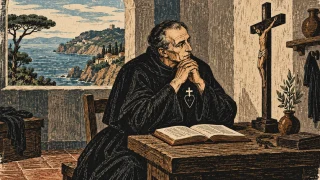

In the vibrant, bustling city of Alexandria, Egypt, during a tumultuous period for early Christians, a remarkable woman named Apollonia lived a life of unwavering faith. Her story, though steeped in the brutal realities of Roman persecution, shines as a beacon of courage, steadfastness, and devotion to Christ. This article will delve into the historical backdrop of her time, recount the harrowing events of her martyrdom, explore the profound spiritual legacy she left behind, and consider how her inspiring witness continues to resonate with believers and even those in the dental profession today.
Quick Facts
| Fact | Detail |
|---|---|
| Birth | Unknown (likely 3rd century AD, Alexandria, Egypt) |
| Death | c. 249 AD (Alexandria, Egypt) |
| Feast Day | February 9 |
| Patronage | Dentists, dental hygienists, those suffering from toothache, oral diseases, and all dental-related issues. |
| Canonized | Pre-Congregation (Venerated as a martyr from early Church history) |
Historical Context & Early Life
To truly appreciate the bravery of St. Apollonia, we must first understand the world in which she lived. The 3rd century AD was a challenging era for the Roman Empire, marked by political instability, economic crises, and frequent changes in imperial leadership. For Christians, it was often a time of intense and unpredictable persecution. While Christians had faced intermittent periods of oppression since the time of Nero, the mid-3rd century saw a particularly vicious campaign under Emperor Decius.
Decius, who reigned from 249 to 251 AD, believed that the empire’s troubles were due to the neglect of traditional Roman gods and the rise of Christianity. He launched a systematic, empire-wide persecution designed to force all citizens to demonstrate their loyalty to the Roman state by sacrificing to the pagan gods. This was not merely a local crackdown but a comprehensive decree, requiring everyone to obtain a certificate (a libellus) proving they had performed the sacrifice. Those who refused faced torture, imprisonment, confiscation of property, and even death.
Alexandria, Egypt, where Apollonia lived, was one of the largest and most culturally significant cities in the Roman Empire. A melting pot of Greek, Egyptian, and Jewish cultures, it also had a thriving and visible Christian community. The city was a center of learning, philosophy, and trade, but its diverse population also made it a breeding ground for social tensions. When Emperor Decius’s decree came down, the existing anti-Christian sentiment in Alexandria, fueled by local priests and pagan mobs, erupted into widespread violence even before the official imperial edict was fully enforced.
Unfortunately, specific details about St. Apollonia’s family background and early life are scarce, a common challenge when researching early martyrs. Many accounts of their lives were passed down orally before being committed to writing, and the focus was often on their heroic witness rather than biographical minutiae. What we do know comes primarily from the firsthand account of St. Dionysius, Bishop of Alexandria, who described the horrific persecution in a letter to Fabius, Bishop of Antioch. Dionysius portrays Apollonia as an elderly deaconess, a woman of mature age and respected standing within the Christian community. This suggests she had likely spent many years dedicated to service and prayer, building a deep spiritual foundation that would later enable her to face unimaginable suffering with unwavering faith.
Calling & Key Milestones
The Outbreak of Persecution in Alexandria
The Decian persecution began in Alexandria with a fury, even before the imperial edict officially reached the city. Bishop Dionysius recounts how a pagan prophet stirred up the crowds, leading to a spontaneous outbreak of violence against Christians. Mobs seized Christians, dragged them through the streets, plundered their homes, and subjected them to various forms of torture. Many Christians, intimidated by the brutal attacks, either fled or publicly apostatized (renounced their faith) to save their lives. Yet, others, like Apollonia, chose a path of courageous defiance.
Apprehension and Torture
Amidst this chaos, Apollonia, described by Bishop Dionysius as a “marvellous aged virgin,” was seized by the enraged mob. Her age and her role as a deaconess would have made her a prominent and visible target. The pagans considered her an enemy of their gods and a symbol of the burgeoning Christian community they sought to eradicate. The crowd’s intention was not merely to kill but to inflict maximum suffering and humiliation, hoping to break her spirit and force her to recant.
The Extraction of Her Teeth
The tormentors subjected Apollonia to a particularly brutal and horrifying ordeal. They repeatedly struck her face, likely shattering her jaw, and then, with cruel determination, proceeded to extract all of her teeth, one by one, with pliers or other implements. This act was not just physical torture; it was a deliberate attempt to disfigure, humiliate, and terrorize her, forcing her to scream in pain and perhaps beg for mercy. The aim was to force her to blaspheme Christ and acknowledge the Roman gods. Yet, through this unimaginable suffering, Apollonia remained steadfast, her faith unshaken.
The Ultimate Test: Fire or Apostasy
After this agonizing ordeal, the mob built a large pyre and threatened to throw Apollonia into the flames unless she uttered impious words against Christ. This was the ultimate test: abandon her faith or face a fiery death. The crowd watched, expecting her to finally break under the weight of her pain and the terror of the imminent conflagration. They sought not just her death, but her apostasy, believing it would be a public victory for their gods.
Her Valiant Leap into the Flames
What happened next stunned her tormentors and etched Apollonia’s name into the annals of Christian martyrdom. Instead of hesitating or capitulating, she paused briefly, as if in silent prayer. Then, with a sudden surge of divine courage, she pulled away from her captors and, of her own volition, leaped into the burning pyre, offering herself as a living sacrifice to God. Her final act was a powerful testament to her profound faith and an unequivocal refusal to deny Christ. Bishop Dionysius’s account emphasizes that she was not coerced into suicide, but rather, by an inner divine impulse, freely accepted death by fire, choosing it over blasphemy.
Spiritual Legacy & Theological Themes
St. Apollonia’s martyrdom, while undeniably gruesome, left an indelible mark on the early Church and continues to inspire centuries later. Her story powerfully illustrates several core virtues and theological themes central to Catholic teaching.
Fortitude and Unwavering Faith
The most prominent virtue exemplified by St. Apollonia is fortitude, or courage. Faced with immense physical pain and the terrifying prospect of a fiery death, she refused to abandon her convictions. Her steadfastness echoes the words of St. Paul in Romans 8:38-39: “For I am convinced that neither death nor life, neither angels nor demons, neither the present nor the future, nor any powers, neither height nor depth, nor anything else in all creation, will be able to separate us from the love of God that is in Christ Jesus our Lord.” Apollonia’s actions demonstrate a faith so profound that it transcended the fear of death, making her a true witness to Christ (the Greek word for martyr, martys, literally means “witness”).
The Integrity of Witness
Her refusal to utter blasphemous words, even under duress, highlights the sacredness of one’s witness to Christ. For early Christians, confessing Christ’s name publicly, even unto death, was the ultimate act of worship and fidelity. Apollonia understood that to deny Christ, even by a single word, would be to betray the very essence of her being and her relationship with God. Her integrity in the face of such pressure serves as a powerful reminder of the importance of living out one’s faith authentically and without compromise.
Redemptive Suffering
The Church has always held a deep understanding of suffering endured for Christ. While we do not seek suffering, when it comes, especially in defense of faith, it can be redemptive. St. Apollonia’s suffering was not in vain; it became a testament to the power of God’s grace working within her. Her willingness to embrace death rather than deny Christ aligns with the Paschal Mystery—Christ’s suffering, death, and resurrection—and offers a profound example of how personal sacrifice can bear spiritual fruit, inspiring countless others.
Lasting Influence and Devotion
St. Apollonia’s unique and painful martyrdom quickly led to her veneration as a patron saint for those suffering from toothache and dental issues. The very instrument of her torture became the symbol of her intercessory power. Dentists and those in the dental profession often invoke her patronage, recognizing her as a powerful intercessor for their work and for the comfort of their patients. Her story is also depicted in art, often showing her holding a tooth in pincers, a palm branch (symbol of martyrdom), or both. Churches and altars dedicated to her appeared throughout Europe, testifying to the enduring respect and devotion she commanded.
Devotion Today
St. Apollonia’s legacy continues to thrive, particularly within the dental community and among those who suffer from oral pain. Her feast day on February 9th is observed by Catholics worldwide, but it holds special significance for dentists, dental hygienists, oral surgeons, and their patients. Many dental clinics and schools display her image or a small statue, invoking her intercession for successful treatments and the relief of suffering.
While there are no major pilgrimage sites exclusively dedicated to St. Apollonia in the same way as, say, Lourdes or Fatima, her relics are venerated in several locations across Europe. Portions of her teeth and jawbone, or other bone fragments believed to be hers, are housed in various churches, including the Basilica di Santa Maria in Trastevere in Rome, the Church of St. Apollonia in Naples, Italy, and in churches in Brussels, Antwerp, and Cologne. These relics serve as focal points for prayer and veneration, reminding the faithful of her sacrifice and inspiring them to seek her intercession.
In many Catholic cultures, particularly in parts of Italy, France, and Spain, it is common to pray to St. Apollonia during times of toothache or dental distress. Small medals or holy cards bearing her image are often used in such devotions. Annually, on her feast day, many dentists and dental organizations hold special Masses or prayer services, reflecting on her life and asking for her guidance and protection in their challenging profession. Her story serves as a constant reminder of faith, resilience, and the power of prayer in the face of pain.
Reflections for Modern Readers
St. Apollonia’s ancient story offers surprisingly relevant and actionable takeaways for our lives in the 21st century. Her journey from ordinary deaconess to extraordinary martyr provides profound lessons on faith, courage, and perseverance.
1. Stand Firm in Your Convictions: In a world constantly shifting with trends and pressures, Apollonia’s unyielding commitment to her faith reminds us of the importance of having core values and the courage to uphold them.
Real-world example: When faced with social pressure to compromise your ethical beliefs or participate in something that goes against your conscience, remember St. Apollonia’s steadfastness. It might be speaking up against injustice at work, declining to engage in gossip among friends, or simply living out your faith authentically in a secular environment, even when it’s unpopular.
2. Embrace Courage in the Face of Adversity: While most of us won’t face physical torture for our faith, we all encounter various forms of adversity—illness, job loss, difficult relationships, or personal struggles. Apollonia’s fearless leap into the fire symbolizes a radical trust in God’s providence and a willingness to face our fears.
Real-world example: If you are struggling with a difficult diagnosis, a challenging family situation, or the fear of a new chapter in life, reflect on Apollonia’s courage. Ask for her intercession to help you confront your challenges with fortitude and trust that God is with you, even in the “fire” of your trials.
3. Find Strength in Suffering: Apollonia transformed horrific suffering into a powerful witness. Her story teaches us that even in our pain, God can work through us, and our suffering can be an offering.
Real-world example: When you experience physical pain, emotional heartache, or spiritual dryness, consider offering that suffering to God for a specific intention, uniting it with Christ’s Passion. This perspective can transform seemingly meaningless pain into a profound act of love and prayer.
4. The Power of a Quiet Witness: Before her dramatic martyrdom, Apollonia was an “aged deaconess,” a woman of quiet service. Her ultimate act of bravery was built upon a lifetime of faithful, humble living.
Real-world example: Don’t underestimate the impact of your daily faithfulness—the small acts of kindness, consistent prayer, and integrity in your routine life. These build the spiritual muscle that enables great courage when it’s truly needed.
5. Empathy for the Suffering: St. Apollonia’s patronage of those with dental pain fosters empathy. Her story reminds us to pray for those who suffer from any form of pain, both physical and emotional, and to be sources of comfort and care.
Real-world example: Next time you have a dental appointment, or if you know someone experiencing tooth pain, offer a prayer to St. Apollonia for them. Extend this empathy to others suffering in different ways, recognizing the universal human experience of pain and the Christian call to compassion.
Symbols and Representations
In art and jewelry, St. Apollonia is commonly depicted with specific symbols that vividly recall her martyrdom:
- A Tooth or Teeth: This is her primary and most recognizable attribute. She is often shown holding a single tooth with small pincers or forceps, or sometimes a collection of teeth in her hand. This directly references the cruel removal of her teeth. It serves as a stark reminder of her suffering and is the reason for her patronage.
- Pincers or Forceps: These dental instruments are frequently seen in her hand or nearby, signifying the tools of her torture. In some depictions, she holds them without a tooth, with the implication understood.
- Palm Branch: Like many martyrs, St. Apollonia is often depicted holding a palm branch, a traditional symbol of martyrdom and victory over death through faith in Christ. It signifies her triumph in joining the heavenly host of saints.
- Fire or a Pyre: Less commonly, but still present, she may be shown near or pointing to a pyre or flames, symbolizing her final act of leaping into the fire.
- Crown: Sometimes, she is depicted wearing a crown, symbolizing her heavenly reward and her status as a martyr-saint.
Timeline Summary
- Early 3rd Century AD: St. Apollonia is born in Alexandria, Egypt (exact date unknown). She likely lives a life of service and devotion as an aged deaconess within the Christian community.
- 249 AD: Emperor Decius begins his empire-wide persecution of Christians.
- Late 249 AD: Anti-Christian riots erupt in Alexandria, even before the official imperial edict.
- Late 249 AD: St. Apollonia is seized by a pagan mob in Alexandria.
- Late 249 AD: She is brutally tortured; her teeth are extracted, and her jaw is shattered.
- Late 249 AD: She is threatened with being burned alive unless she blasphemes Christ.
- Late 249 AD: St. Apollonia, by divine inspiration, leaps into the fire, choosing martyrdom over apostasy.
- February 9: Her feast day is established and celebrated annually, commemorating her martyrdom.
- Post-Martyrdom: Veneration of St. Apollonia begins; she is invoked as the patroness against toothache and by the dental profession.
Scripture for Reflection
St. Apollonia’s life and martyrdom beautifully illustrate several scriptural themes:
Matthew 5:10-12 (NABRE): “Blessed are they who are persecuted for the sake of righteousness, for theirs is the kingdom of heaven. Blessed are you when they insult you and persecute you and utter every kind of evil against you falsely because of me. Rejoice and be glad, for your reward will be great in heaven. Thus they persecuted the prophets who were before you.”
Connection: This passage, from Jesus’ Beatitudes, directly addresses the suffering of those persecuted for their faith. St. Apollonia’s experience is a powerful embodiment of this promise, as she endured insult, persecution, and false accusations, ultimately receiving the promised “great reward in heaven.” Her willingness to suffer for Christ’s sake exemplifies the righteousness Jesus speaks of.
1 Peter 4:12-16 (NABRE): “Beloved, do not be surprised that a trial by fire is occurring among you, as if something strange were happening to you. But rejoice to the extent that you share in the sufferings of Christ, so that when his glory is revealed you may also rejoice with exuberance. If you are insulted for the name of Christ, blessed are you, for the Spirit of glory and of God rests upon you. But let no one among you be made to suffer as a murderer, a thief, an evildoer, or as an undesirable meddler. But whoever is made to suffer as a Christian should not be ashamed but glorify God because of the name.”
Connection: St. Peter’s words speak directly to the experience of persecution, likening it to a “trial by fire.” St. Apollonia literally faced such a trial. Her story is a perfect example of “sharing in the sufferings of Christ” and enduring insults for His name. Far from being ashamed, she glorified God through her steadfastness, becoming a beacon of Christian witness.
Romans 8:35, 37-39 (NABRE): “What will separate us from the love of Christ? Will anguish, or distress, or persecution, or famine, or nakedness, or peril, or sword? … No, in all these things we conquer overwhelmingly through him who loved us. For I am convinced that neither death, nor life, nor angels, nor principalities, nor present things, nor future things, nor powers, nor height, nor depth, nor any other creature will be able to separate us from the love of God in Christ Jesus our Lord.”
Connection: This triumphant passage from St. Paul beautifully encapsulates St. Apollonia’s unwavering faith. Despite facing extreme anguish, distress, and persecution, she demonstrated that absolutely nothing—not even the most horrific torture or the threat of death—could separate her from the love of Christ. Her life is a testament to the conquering power of divine love through faith.
Prayers to St. Apollonia
Prayer to St. Apollonia for Toothache
O glorious St. Apollonia, you were martyred for your faith by having your teeth cruelly extracted. We humbly implore your powerful intercession for all who suffer from diseases of the teeth and gums, and for those who experience the dreadful pain of toothache. Through your prayers, we ask God to grant us relief from our suffering, to bring comfort to those in agony, and to inspire dental professionals to care for their patients with skill and compassion. May your unwavering faith strengthen us to bear our crosses with patience and to always remain steadfast in our love for Christ, who is our comfort and our hope. Amen.
Another Prayer to St. Apollonia
Dear St. Apollonia, virgin and martyr,
who didst suffer torments in thy teeth,
we devoutly have recourse to thee,
beseeching thee to intercede for us with God,
that we may be preserved from all pains of the teeth and mouth.
Grant us, we pray thee, a lively faith, a firm hope,
and a burning charity, that we may glorify God
in all our actions, and obtain eternal happiness.
Through Christ our Lord. Amen.