St. Thomas the Apostle, often remembered for his initial doubt, is a figure who truly comes alive in the pages of the New Testament and the ancient traditions of the Church. His story is one of unwavering loyalty, courageous questioning, and ultimately, profound faith that carried him to the ends of the known world. This article will journey through Thomas’s life, from his initial calling by Jesus to his intrepid missionary work and martyrdom, exploring the deep historical context of his era, his spiritual legacy, and how his witness continues to inspire believers today. We’ll uncover the lessons his life offers us, reflect on his enduring symbols, and understand why he remains a beloved and powerful intercessor for Christians worldwide.
Quick Facts
| Category | Detail |
|---|---|
| Birth | 1st Century AD, Galilee, Roman Empire |
| Death | c. 72 AD, Mylapore, Chennai, India |
| Feast Day | July 3 |
| Patronage | Architects, builders, carpenters, surveyors, doubts, India |
| Canonized | By acclamation (one of the original Apostles) |
Historical Context & Early Life
To understand St. Thomas, we must first picture the world he lived in. The 1st century AD was a time of immense change and tension in the Middle East. The region of Galilee, where Thomas likely hailed from, was part of the Roman Empire, yet it remained a deeply Jewish land. Roman rule was often harsh, characterized by heavy taxes and the presence of foreign soldiers. This created a fertile ground for messianic expectations – the hope that a deliverer, a Messiah, would come to liberate Israel and restore its ancient glory.
The Jewish people, despite Roman occupation, held fiercely to their traditions, guided by the Torah (God’s law) and the teachings of their rabbis. Synagogues were centers of community life, learning, and prayer. Life for most was agricultural, simple, and rooted in strong family bonds. While the Gospels don’t give us many details about Thomas’s family background, tradition suggests he may have been a fisherman, like several other apostles, or perhaps even a carpenter or builder, which would explain some of his later patronage. What we do know is that he was a Jew living in a society yearning for a spiritual and political savior, a yearning that Jesus of Nazareth would both fulfill and profoundly reframe.
The cultural landscape was a mix of Aramaic (the common language spoken by Jesus and his disciples), Hebrew (the language of sacred texts), and Greek (the language of commerce and the wider Roman world). For Thomas and his fellow apostles, this was a world where ancient prophecies met contemporary political realities, where the everyday challenges of earning a living were interwoven with deep spiritual longings. It was into this vibrant, expectant, and often turbulent environment that Jesus called his first disciples, including Thomas, inviting them to leave behind their old lives and follow Him into a new, transformative journey.
Calling & Key Milestones
The Call to Discipleship
Like many of the first apostles, Thomas was called by Jesus early in His public ministry. The Gospels list him among the Twelve, marking his immediate response to Christ’s invitation to “come, follow me.” While we don’t have a specific narrative of his individual call, his presence among this chosen group signifies a willingness to abandon his former life and commit to Jesus’s revolutionary teachings. He became a firsthand witness to Jesus’s miracles, parables, and profound messages of love, mercy, and the Kingdom of God. This initial decision to follow was a radical act of faith, trusting an itinerant preacher with his future and his very soul.
“Let us also go, that we may die with Him”: Thomas’s Loyalty
One of the most revealing glimpses into Thomas’s character comes from the Gospel of John (11:16). When Jesus decides to return to Judea, a region where His life had recently been threatened, the disciples are understandably hesitant. It is Thomas who, despite the danger, bravely declares to his fellow disciples, “Let us also go, that we may die with Him.” This isn’t a statement of naive optimism, but rather a profound expression of loyalty and courage. It shows Thomas as a man willing to face death alongside his Lord, even when fear might have urged caution. This moment reveals a deep devotion and a willingness to commit fully to Christ, even in the face of grave danger.
“Lord, we do not know where you are going”: Thomas’s Question
Another significant moment showcasing Thomas’s honest, practical mind occurs during the Last Supper. Jesus is speaking of His departure and preparing a place for His disciples, saying, “You know the way to the place where I am going” (John 14:4). Thomas, ever direct, interrupts with a question that many might have been thinking but were afraid to ask: “Lord, we do not know where you are going; how can we know the way?” (John 14:5). This question, far from being a sign of ignorance, actually prompts one of Jesus’s most profound declarations: “I am the way, and the truth, and the life; no one comes to the Father except through me” (John 14:6). Thomas’s honest inquiry served as a catalyst for Jesus to reveal a central truth of Christian faith, benefiting all future generations.
Doubting Thomas: The Resurrection Encounter
The most famous episode involving Thomas, and the one that has unfortunately overshadowed much of his other virtues, is his initial refusal to believe in Jesus’s resurrection (John 20:24-29). When the other disciples tell him they have seen the Risen Lord, Thomas declares, “Unless I see the nail marks in his hands and put my finger where the nails were, and put my hand into his side, I will not believe.” Eight days later, Jesus appears again to the disciples, and this time Thomas is present. Jesus invites Thomas to touch His wounds, saying, “Stop doubting and believe.” Thomas, overwhelmed, responds with a powerful confession of faith: “My Lord and my God!” This moment is not just about doubt; it is about a journey from doubt to a deeply personal and profound encounter with the Risen Christ, culminating in the first explicit declaration of Jesus’s divinity by an Apostle. His doubt was not a rejection, but a human need for tangible proof, which, once satisfied, led to unshakeable belief.
Missionary to India: Tradition and Legacy
After Pentecost, the apostles dispersed to spread the Gospel to the nations. While many went west, tradition holds that Thomas traveled east, journeying far beyond the boundaries of the Roman Empire to India. Ancient Christian writings, particularly the “Acts of Thomas,” describe his missionary endeavors in the Parthian Empire and then in India, specifically in the regions of Kerala and Tamil Nadu. He is credited with establishing the first Christian communities in India, which are known today as the “St. Thomas Christians” or the “Syro-Malabar Church.” He preached, performed miracles, and converted many, including kings and Brahmins, establishing churches and a vibrant Christian presence that continues to thrive to this day. His mission to India represents one of the most remarkable and furthest-reaching apostolic journeys.
Martyrdom: His Ultimate Sacrifice
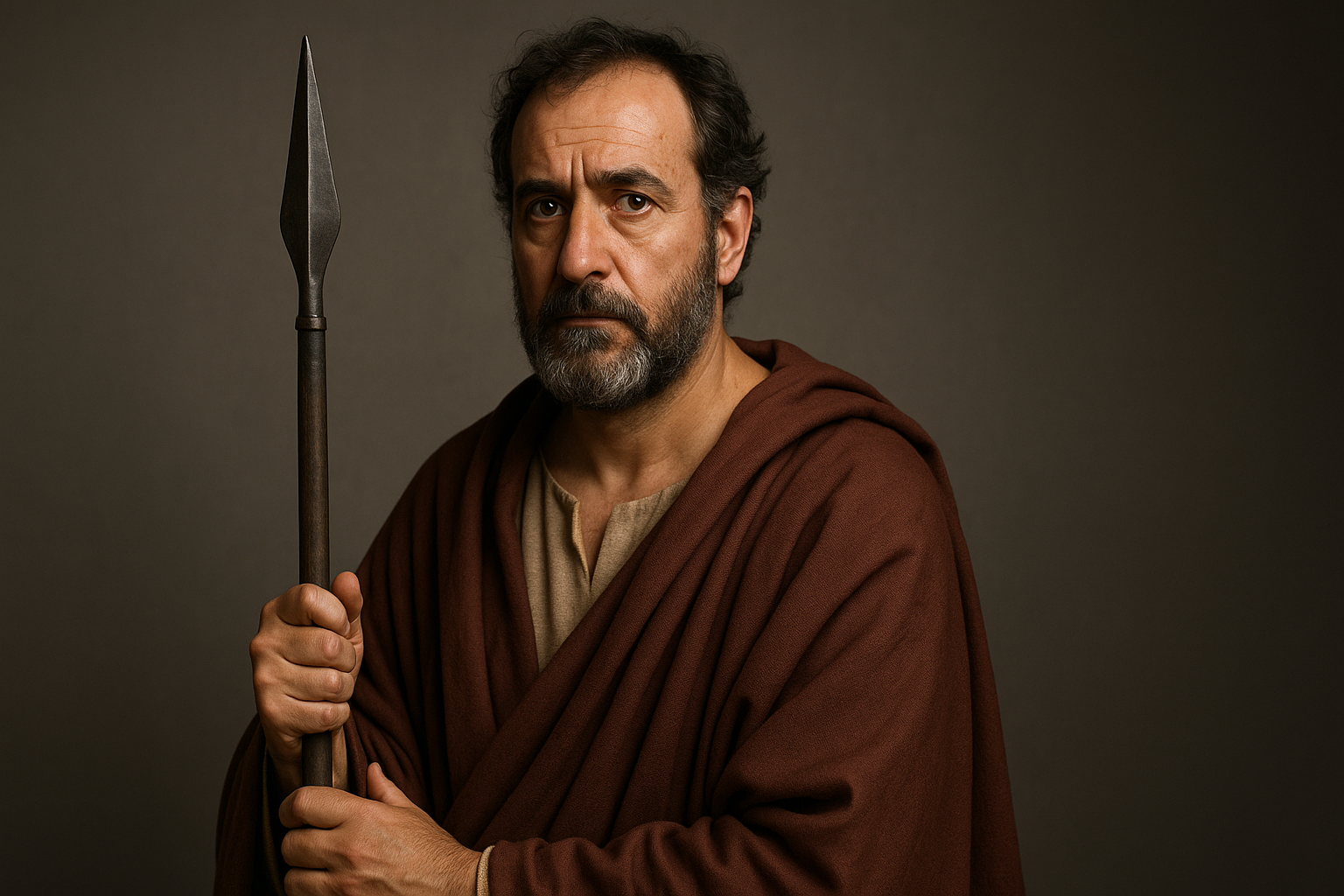
Like many of the apostles, St. Thomas sealed his witness with his blood. Tradition states that he was martyred in Mylapore, Chennai, India, around 72 AD. He was reportedly killed with a spear, possibly by local priests who felt threatened by his success in converting people to Christianity. His tomb is believed to be located at St. Thomas Mount in Chennai, a site that has been a place of pilgrimage for centuries. His martyrdom signifies the ultimate commitment to his faith and his Lord, mirroring his earlier brave declaration, “Let us also go, that we may die with Him.”
Spiritual Legacy & Theological Themes
St. Thomas’s spiritual legacy is rich and multifaceted, offering profound lessons for all believers. At his core, Thomas exemplifies the virtue of **courageous loyalty**. From his willingness to die with Jesus on the way to Bethany to his fearless missionary journey to distant India, Thomas consistently demonstrated a deep, unwavering commitment to Christ, even when it meant facing danger or making immense sacrifices. This loyalty aligns beautifully with biblical themes of faithfulness, such as found in 2 Timothy 2:13, “If we are faithless, he remains faithful—for he cannot deny himself.”
He is also a powerful symbol of **honest inquiry leading to deeper faith**. His famous “doubt” was not an act of disbelief but a human desire for tangible proof, a longing to fully grasp the extraordinary truth of the Resurrection. When Jesus met him in his doubt, Thomas responded with the most profound confession of Christ’s divinity recorded in the Gospels: “My Lord and my God!” This teaches us that asking sincere questions, grappling with the mysteries of faith, and seeking personal encounter with God can lead to an even stronger, more personal, and articulate belief. It reminds us that faith is not blind obedience but an informed and heartfelt response to truth revealed, echoing the words of Psalm 27:8, “My heart says of you, ‘Seek his face!’ Your face, Lord, I will seek.”
Furthermore, Thomas embodies **missionary zeal and universal evangelization**. His journey to India highlights the apostolic call to spread the Good News to all nations, fulfilling Jesus’s Great Commission (Matthew 28:19). The vibrant Christian community he established in India stands as a living testament to his tireless efforts and the power of the Holy Spirit working through his courageous witness. His life encourages us to be brave in sharing our faith, even when it means stepping out of our comfort zones, as stated in Romans 10:14-15, “How, then, can they call on the one they have not believed in? And how can they believe in the one of whom they have not heard? And how can they hear without someone preaching to them? And how can anyone preach unless they are sent?”
St. Thomas’s influence on Catholic devotion is particularly strong in the Syro-Malabar Catholic Church and other St. Thomas Christian communities, who venerate him as their apostolic father. His story is a staple in catechesis (religious instruction), especially when discussing the Resurrection and the importance of faith. In art, he is often depicted with a builder’s square or a spear, symbols of his traditional profession and his martyrdom, reminding us of his practical nature and ultimate sacrifice. His legacy truly calls us to embrace a faith that is both deeply personal and courageously outward-looking.
Devotion Today
Devotion to St. Thomas the Apostle remains strong, particularly in the places where his missionary work flourished. In India, he is revered as the patron saint and founder of Christianity in the country. The St. Thomas Christians, comprising various Eastern Catholic and Orthodox denominations (such as the Syro-Malabar Catholic Church, the Syro-Malankara Catholic Church, and the Malankara Orthodox Syrian Church), trace their origins directly to his evangelization. Their vibrant liturgy, ancient traditions, and continuous presence for nearly two millennia are a living testament to his enduring legacy.
Major sites of pilgrimage associated with St. Thomas are predominantly found in Chennai (formerly Madras), India. San Thome Basilica, a Roman Catholic minor basilica, is believed to house the tomb of St. Thomas. This magnificent church stands as a testament to centuries of devotion and is a significant pilgrimage site for Christians from around the world. Nearby, St. Thomas Mount is another sacred location where he is traditionally believed to have been martyred. A cross on the mount is said to have miraculously bled, and it remains an object of veneration. These sites draw thousands of pilgrims annually, especially around his feast day on July 3rd, where special Masses, processions, and devotional prayers are held.
Beyond India, St. Thomas is also venerated globally. Relics attributed to him are found in various churches, notably in Ortona, Italy, at the Basilica of San Tommaso Apostle, where a significant portion of his remains is believed to be interred. This basilica also attracts pilgrims and is a center for his devotion in Europe. Catholics worldwide, especially those engaged in evangelization, construction, or struggling with doubt, invoke his intercession. His story continues to be shared in parishes and Catholic schools, reminding believers that even honest questions can lead to profound faith and that courageous witness can transform the world.
Reflections for Modern Readers
St. Thomas the Apostle, despite living two millennia ago, offers incredibly relevant insights for our lives today. His journey of faith provides several actionable takeaways:
- Honest Questioning Can Lead to Deeper Faith: Thomas’s initial doubt wasn’t a flaw but a human need for assurance. His insistence on direct experience led him to declare, “My Lord and my God!” This teaches us that it’s okay, even healthy, to wrestle with questions of faith. Instead of shying away from doubts, we can bring them to God with an open heart, trusting that He will meet us and lead us to a deeper, more personal understanding. For example, a young person struggling with the Church’s teachings on a difficult topic can take inspiration from Thomas, seeking out answers, praying, and engaging with their faith rather than simply walking away.
- Courageous Loyalty in Challenging Times: When others hesitated, Thomas declared, “Let us also go, that we may die with Him.” This powerful statement of loyalty reminds us to stand by our convictions and by those we love, especially when it’s difficult or dangerous. In a world that often encourages us to take the easy path or abandon principles, Thomas’s example calls us to steadfastness. This could mean defending a friend being unfairly criticized, standing up for a moral principle in our workplace, or continuing to practice our faith even when it’s unpopular.
- Embrace the Call to Mission: Thomas’s journey to India was an extraordinary act of missionary zeal. He didn’t wait for ideal conditions or comfortable assignments; he went where the Gospel needed to be heard. This inspires us to look beyond our immediate circles and consider how we can share the Good News, even in small ways, with those around us. It might be by showing kindness to a new neighbor, inviting someone to church, or simply living a life that reflects Christian values, showing others the joy and peace of Christ.
- Personal Encounter Transforms Belief: Thomas’s conversion from doubt to profound belief happened through a personal encounter with the Risen Christ. This highlights the importance of fostering our own personal relationship with Jesus. While doctrines and traditions are vital, it’s our direct experience of God’s love and presence that truly solidifies our faith. This means taking time for prayer, quiet reflection, receiving the sacraments, and actively seeking to encounter Christ in our daily lives.
In art and jewelry, St. Thomas is commonly depicted with several meaningful symbols:
- The Carpenter’s Square or Rule: This symbol is often associated with Thomas, linking back to a tradition that he was a builder or carpenter by trade. It also represents his practical and direct nature, someone who might have appreciated precision and tangible evidence. It makes him the patron saint of architects, builders, and surveyors.
- A Spear or Lance: This is the most common symbol of his martyrdom. It reminds us of his ultimate sacrifice in India, where he was traditionally killed by a spear. It signifies his courage and unwavering commitment to Christ, even unto death.
- A Book or Scroll: As an Apostle, Thomas is often shown holding a book, representing his role as a bearer of the Good News, a preacher of the Gospel, and one who contributed to the early Christian tradition. It symbolizes the divine truth he carried to distant lands.
These symbols visually reinforce the powerful messages of his life: his practical faith, his courageous witness, and his role in spreading the foundational truths of Christianity.
Timeline Summary
- Early 1st Century AD: Born in Galilee, likely working as a fisherman, carpenter, or builder.
- c. 27-30 AD: Called by Jesus to be one of the Twelve Apostles, becoming a close companion and witness to Christ’s ministry.
- c. 30 AD: Displays loyalty before Jesus’s journey to Bethany, stating, “Let us also go, that we may die with Him” (John 11:16).
- c. 30 AD: Asks Jesus for clarification during the Last Supper, prompting Jesus’s declaration, “I am the way, and the truth, and the life” (John 14:5-6).
- c. 30 AD: Initially doubts the Resurrection accounts but profoundly confesses, “My Lord and my God!” after encountering the Risen Christ (John 20:24-29).
- c. 30-33 AD: Present at Pentecost, receiving the Holy Spirit along with the other Apostles.
- Post-Pentecost (c. 30-40s AD onwards): Embarks on missionary journeys, traditionally to the Parthian Empire and then to India.
- c. 52 AD (Traditional date): Arrives in India, beginning his extensive evangelization efforts in Kerala and Tamil Nadu.
- c. 72 AD: Martyred by a spear in Mylapore, Chennai, India.
- Centuries Onward: Veneration grows, especially among the St. Thomas Christians in India, and his relics are later transferred to Ortona, Italy.
Scripture for Reflection
St. Thomas’s story is deeply interwoven with several key Scripture passages that illuminate his character and impact:
John 11:16 (NIV): “Then Thomas (also known as Didymus) said to the rest of the disciples, ‘Let us also go, that we may die with him.'”
Reflection: This verse reveals Thomas’s fierce loyalty and courage. Even when faced with the real threat of danger and death, his devotion to Jesus was paramount. It challenges us to consider our own commitment to Christ and to stand firm in our faith, especially when circumstances are difficult or unpopular.
John 14:5-6 (NIV): “Thomas said to him, ‘Lord, we don’t know where you are going, so how can we know the way?’ Jesus answered, ‘I am the way and the truth and the life. No one comes to the Father except through me.'”
Reflection: Thomas’s honest, direct question led to one of Jesus’s most profound and foundational statements about Himself. This teaches us that asking sincere questions and seeking clarity in our faith is not a weakness but can open the door to deeper revelation and understanding of God’s truth. Our honest inquiries can draw us closer to the Way, the Truth, and the Life.
John 20:24-29 (NIV): “Now Thomas (also known as Didymus), one of the Twelve, was not with the disciples when Jesus came. So the other disciples told him, ‘We have seen the Lord!’ But he said to them, ‘Unless I see the nail marks in his hands and put my finger where the nails were, and put my hand into his side, I will not believe.’ A week later his disciples were in the house again, and Thomas was with them. Though the doors were locked, Jesus came and stood among them and said, ‘Peace be with you!’ Then he said to Thomas, ‘Put your finger here; see my hands. Reach out your hand and put it into my side. Stop doubting and believe.’ Thomas said to him, ‘My Lord and my God!’ Then Jesus told him, ‘Because you have seen me, you have believed; blessed are those who have not seen and yet have believed.'”
Reflection: This famous passage beautifully illustrates the journey from doubt to profound faith. Thomas’s desire for tangible proof was met with divine compassion, leading him to an unparalleled confession of Jesus’s divinity. It reminds us that God meets us where we are, even in our uncertainties, and that a personal encounter with the Risen Christ can transform our skepticism into unshakeable belief. For those who feel they need more proof, Thomas’s story is a comfort, showing that true faith can be found even after questioning and seeking.
Prayers to St. Thomas the Apostle
Here is a traditional prayer to St. Thomas the Apostle:
O Glorious Saint Thomas, whose faith was strengthened by seeing the risen Christ, and whose zeal for souls led you to distant lands, we implore your powerful intercession. You bravely declared, “My Lord and my God!” and by your words and deeds, you showed us how to seek and find Christ. Help us, we pray, in our moments of doubt and uncertainty. Guide us to an honest and courageous faith, ever seeking the truth that leads to life. Inspire us to be fervent missionaries of the Gospel in our own lives, sharing Christ’s love with those around us. Obtain for us, O Saint Thomas, the grace to serve God faithfully, and at the end of our earthly pilgrimage, to join you in the eternal joy of heaven. Through Christ our Lord. Amen.
Another common invocation:
St. Thomas the Apostle, pray for us.