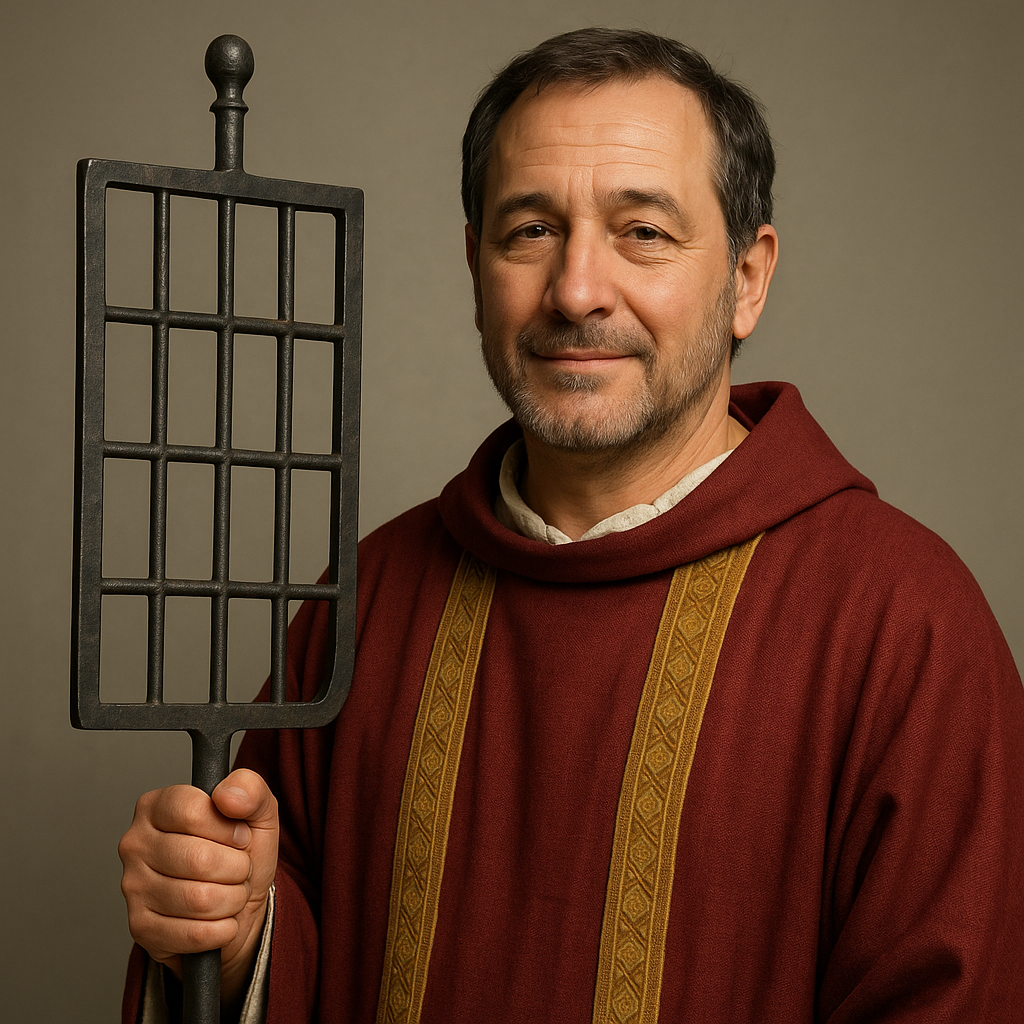
In the vibrant tapestry of early Christian history, certain figures shine with an extraordinary brilliance, embodying faith, courage, and selfless love in the face of immense adversity. Among these luminous saints is St. Lawrence of Rome, a deacon whose unwavering devotion and remarkable wit in the midst of brutal persecution have inspired believers for nearly two millennia. His story, set against the dramatic backdrop of imperial Rome, is a powerful testament to the enduring strength of the human spirit transformed by divine grace. This article will delve into his life, the turbulent times he lived in, his profound spiritual legacy, and how his witness continues to resonate with and challenge modern readers today, offering timeless lessons in charity, stewardship, and fidelity.
Quick Facts
| Category | Detail |
|---|---|
| Birth | Born around 225 AD in Huesca, Aragon (part of modern-day Spain) |
| Death | Martyred on August 10, 258 AD in Rome, Roman Empire |
| Feast Day | August 10 (celebrated widely by the Catholic Church and other Christian traditions) |
| Patronage | Deacons, cooks, chefs, comedians, librarians, the poor, Rome, vintners |
| Canonized | Venerated as a saint from ancient times, following his martyrdom; formal canonization processes as we know them today did not exist at that time. |
Historical Context & Early Life
To truly appreciate the heroism of St. Lawrence, we must first understand the world he inhabited. The 3rd century AD was a tumultuous period for the Roman Empire, marked by political instability, economic crises, and frequent changes in emperors. For the burgeoning Christian community, these times were particularly precarious. Though Christianity had spread widely throughout the empire, it remained an illicit religion, often viewed with suspicion and hostility by Roman authorities who saw Christian monotheism and refusal to worship pagan gods or the emperor as an affront to Roman traditions and a threat to imperial unity.
It was into this volatile environment that Lawrence was born around 225 AD in Huesca, a city in the Roman province of Hispania Tarraconensis (modern-day Spain). Details of his family background are scarce, but tradition holds that he received a good education, likely in rhetoric and philosophy, typical for young men of his social standing. His path eventually led him to Rome, the heart of the empire and, increasingly, the center of the Christian world. There, his exceptional intelligence, piety, and organizational skills caught the attention of the Church leadership.
In Rome, Lawrence became a student and protégé of the future Pope Sixtus II. The Church in Rome, despite facing intermittent persecution, was growing rapidly. It managed extensive charitable operations, caring for a vast number of poor, widows, and orphans, often supported by donations from wealthy converts. This complex network required skilled administration, and it was in this capacity that Lawrence would find his calling. The era was defined by a constant tension: the vibrant, expanding faith of Christians living under the shadow of a powerful, often hostile, state. This backdrop of both spiritual flourishing and imminent danger set the stage for Lawrence’s remarkable life and ultimate sacrifice.
Calling & Key Milestones
Lawrence’s journey to sainthood began with his ordination as a deacon, a role that placed him at the heart of the Roman Church’s mission of service. Deacons in the early Church were not merely liturgical assistants; they held significant administrative responsibilities, particularly concerning the Church’s charitable works and finances. Among the seven deacons of Rome, Lawrence was designated the “archdeacon,” a position of immense trust and responsibility, making him the chief administrator of the Church’s material goods and its extensive charitable operations.
The Administration of the Church’s Treasures
As archdeacon, Lawrence was entrusted with the Church’s “treasures” – not glittering gold or precious jewels in the secular sense, but rather the resources used to care for the poor. He meticulously managed funds, organized almsgiving, and oversaw the distribution of food and aid to thousands of needy Christians in Rome. This was a monumental task, demanding both compassion and shrewd organizational ability. His work exemplified the early Church’s profound commitment to social justice and its understanding that true wealth lay in service to the most vulnerable members of society.
The Persecution of Valerian
The peaceful period for Christians came to a sudden and brutal end in 258 AD with the ascension of Emperor Valerian. His persecution was particularly severe, targeting the Church’s leaders, its wealth, and its organizational structure. An imperial edict commanded that all bishops, priests, and deacons be immediately executed. Pope Sixtus II, along with six other deacons, was apprehended while celebrating Mass in the Catacombs of Praetextatus. Lawrence, though witnessing the horrific arrest of his spiritual father and brothers, managed to escape for a short time. Tradition tells us that as Sixtus was led to his execution, Lawrence cried out, “Where are you going, father, without your son? Where are you hurrying, holy priest, without your deacon?” Pope Sixtus reportedly consoled him, saying, “Do not weep, my son. In three days, you will follow me.”
The True Treasures of the Church
Following Pope Sixtus’s martyrdom, Lawrence was apprehended by the Roman prefect. Aware of Lawrence’s role as archdeacon, the prefect demanded that he surrender the “treasures of the Church” within three days. The prefect envisioned gold, silver, and precious artifacts that could enrich the imperial coffers. Lawrence, however, had a very different understanding of the Church’s wealth. He gathered the poor, the sick, the blind, the lame, and the widows whom the Church supported. On the appointed day, he presented them to the prefect, declaring, “These are the true treasures of the Church!” This defiant act, born of deep faith and a radical understanding of Christian charity, was a direct challenge to the Roman authorities and a powerful proclamation of the Church’s values.
Martyrdom on the Gridiron
Enraged by Lawrence’s audacious response, the prefect condemned him to a particularly cruel execution. Lawrence was reportedly placed on a large iron gridiron over slow-burning coals, intended to prolong his suffering. However, even in the midst of this excruciating torment, Lawrence’s faith and wit remained unbroken. Tradition famously recounts that after a period of suffering, he is said to have declared to his tormentors, “Turn me over; I’m done on this side!” This legendary statement, while possibly embellished, perfectly captures the spirit of cheerful defiance and unwavering faith that characterizes St. Lawrence. His martyrdom on August 10, 258 AD, made him one of the most celebrated and beloved martyrs of the early Church, cementing his place as a model of courageous witness.
Spiritual Legacy & Theological Themes
St. Lawrence’s life and death encapsulate several profound spiritual and theological themes that continue to inspire and instruct the Church. His core virtues of charity, fidelity, and courage stand as pillars of Christian discipleship.
The most striking aspect of Lawrence’s legacy is his radical commitment to charity. His famous declaration, “These are the true treasures of the Church,” perfectly aligns with Jesus’s teaching in Matthew 25:40: “Whatever you did for one of the least of these brothers and sisters of mine, you did for me.” Lawrence understood that the Church’s wealth was not for accumulation but for distribution, not for power but for service. He embodied the Christian call to see Christ in the poor and to pour out resources—both material and personal—in their service. This profound understanding of stewardship reminds us that all we have is a gift from God, to be used for His glory and the good of our neighbors.
Fidelity to his vocation and to Christ defines Lawrence’s story. As archdeacon, he was entrusted with sacred responsibilities, and he carried them out with unwavering devotion, even to the point of death. His readiness to follow Pope Sixtus into martyrdom demonstrates a deep loyalty not just to a person, but to the entire Body of Christ and its mission. This echoes the biblical call to “be faithful unto death, and I will give you the crown of life” (Revelation 2:10). His steadfastness offers a powerful witness against the temptation to compromise one’s faith under pressure.
His courage in the face of torture and death is perhaps his most enduring trait. Lawrence’s defiance of the Roman prefect, his witty retort on the gridiron, and his peaceful endurance of suffering reveal a profound interior strength born of grace. This courage is not recklessness but a supernatural fortitude that allows one to face evil and death with serene trust in God’s ultimate victory. His example encourages believers to stand firm in their convictions, even when it demands great personal sacrifice, knowing that “perfect love casts out fear” (1 John 4:18).
Lawrence’s lasting influence extends to liturgy, devotion, and art. His name is prominently featured in the Roman Canon (Eucharistic Prayer I) of the Mass, a testament to his ancient and enduring veneration. His martyrdom also became a popular subject in Christian art, depicted by masters like Gian Lorenzo Bernini and Fra Angelico, often showing him with his iconic gridiron. Churches and institutions worldwide bear his name, and his story has shaped the understanding of the diaconate as a ministry of service and charity. He remains a powerful symbol of Christian witness and a model for all who seek to serve God by serving others.
Devotion Today
Devotion to St. Lawrence of Rome remains vibrant and widespread across the globe, a testament to the enduring power of his witness. His feast day on August 10 is celebrated with particular solemnity, especially in Rome, where he is one of the city’s principal patron saints. Several important churches are dedicated to him, including the magnificent Basilica di San Lorenzo fuori le Mura (St. Lawrence Outside the Walls), one of Rome’s seven pilgrimage churches. This basilica houses his tomb and is a significant site of pilgrimage for Catholics. Another prominent church is San Lorenzo in Panisperna, traditionally believed to be the site of his martyrdom.
Beyond Rome, countless parishes, schools, and hospitals around the world bear his name. In many dioceses, deacons look to St. Lawrence as their special patron, gathering on his feast day for Masses and events that honor his selfless service. Cooks and chefs, recognizing his association with the gridiron, also claim him as their patron, often invoking his intercession in their culinary pursuits.
Annual celebrations often involve processions, special Masses, and acts of charity inspired by Lawrence’s example. For instance, in some places, communities might organize food drives or dedicate resources to local charities around his feast day, embodying his spirit of giving to the “true treasures of the Church.” His story continues to be told and retold in homilies and catechetical lessons, ensuring that his legacy of courage, wit, and charity remains alive for new generations of believers.
Reflections for Modern Readers
St. Lawrence of Rome, though living nearly two millennia ago, offers incredibly relevant and actionable takeaways for modern readers navigating the complexities of the 21st century.
- The True Meaning of Wealth and Stewardship: In a world often obsessed with material possessions and financial accumulation, Lawrence’s declaration, “These are the true treasures of the Church!” is a powerful counter-cultural statement. For us, this means re-evaluating what we truly value. Is our “wealth” measured by bank accounts, or by the relationships we nurture, the good we do, and the lives we touch? It calls us to be conscientious stewards of all our resources – our time, talents, and money – using them not just for personal gain, but for the benefit of others, especially the marginalized. For example, instead of always buying the latest gadget, perhaps consider donating to a local food bank or volunteering your time at a shelter.
- Courage in Conviction: Lawrence faced immense pressure to renounce his faith and betray the Church. His steadfastness reminds us that standing up for what is right, even when unpopular or challenging, is a fundamental aspect of Christian discipleship. This could mean speaking out against injustice in your community, holding firm to ethical principles in your workplace, or simply living your faith authentically in a secular world, even when it feels uncomfortable. It’s about having the moral backbone to do the right thing, no matter the cost.
- Joy and Wit in Adversity: Perhaps one of the most surprising lessons from St. Lawrence is his legendary wit on the gridiron. While an extreme example, it highlights the Christian capacity for joy and even humor in the face of suffering, rooted in an unshakeable hope in God. For us, this might translate into maintaining a positive attitude during difficult times, finding moments of grace and gratitude amidst challenges, or using humor to lighten heavy situations without trivializing them. It’s about remembering that even in darkness, God’s light and our hope in Him can shine through.
- Service as a Way of Life: Lawrence’s entire ministry was defined by service to the poor and needy. His life teaches us that true Christian living is not just about personal piety, but about actively serving others. This could manifest in countless ways: volunteering at a soup kitchen, mentoring a young person, caring for an elderly neighbor, or simply being attentive to the needs of those around you. Every act of service, no matter how small, reflects the heart of Christ and builds up the Kingdom of God.
Symbols of St. Lawrence
In art and jewelry, St. Lawrence is most commonly identified by specific symbols that narrate his life and martyrdom:
- The Gridiron: This is his primary and most recognizable symbol. It represents the instrument of his martyrdom, recalling the excruciating suffering he endured. In art, he is often depicted lying on or standing near a large iron grill. It symbolizes his courage, endurance, and fidelity unto death, and ironically, his “fiery” wit.
- A Bag of Coins or a Purse: As the archdeacon responsible for the Church’s treasury and almsgiving, Lawrence is frequently shown holding a bag of money or a purse. This symbolizes his role as a steward of the Church’s resources and his radical charity, distributing wealth to the poor. It also harks back to his famous act of presenting the poor as the “true treasures.”
- A Censer (Incense Burner): Occasionally, Lawrence is depicted with a censer, an object used in liturgical ceremonies. This symbol reflects his role as a deacon assisting at Mass and performing sacred duties, emphasizing his liturgical function within the early Church.
Timeline Summary
- c. 225 AD: Born in Huesca, Hispania Tarraconensis (modern-day Spain).
- Unknown Date: Moves to Rome and becomes a protégé of the future Pope Sixtus II.
- Unknown Date: Ordained a deacon, eventually becoming the archdeacon of Rome, responsible for the Church’s treasury and care of the poor.
- August 6, 258 AD: Emperor Valerian’s persecution intensifies; Pope Sixtus II and six other deacons are martyred.
- August 6-9, 258 AD: Lawrence is arrested and commanded by the Roman prefect to hand over the Church’s treasures.
- August 10, 258 AD: Lawrence gathers the poor and presents them as the “true treasures” of the Church to the prefect.
- August 10, 258 AD: Martyred on a gridiron over slow fire.
- Immediately After Death: Buried in the Catacomb of Cyriaca, on the Via Tiburtina, Rome.
- 4th Century Onwards: Venerated as one of the most prominent martyrs of the Roman Church; basilicas and churches are built in his honor.
Scripture for Reflection
St. Lawrence’s life illuminates several scriptural passages, particularly those concerning charity, stewardship, and enduring suffering for Christ.
Matthew 25:34-40 (The Judgment of the Nations):
“Then the King will say to those on his right, ‘Come, you who are blessed by my Father; take your inheritance, the kingdom prepared for you since the creation of the world. For I was hungry and you gave me something to eat, I was thirsty and you gave me something to drink, I was a stranger and you invited me in, I needed clothes and you clothed me, I was sick and you looked after me, I was in prison and you came to visit me.’
“Then the righteous will answer him, ‘Lord, when did we see you hungry and feed you, or thirsty and give you something to drink? When did we see you a stranger and invite you in, or needing clothes and clothe you? When did we see you sick or in prison and go to visit you?’
“The King will reply, ‘Truly I tell you, whatever you did for one of the least of these brothers and sisters of mine, you did for me.’”
This passage perfectly encapsulates St. Lawrence’s understanding of the Church’s “treasures.” He recognized Christ in the poor and marginalized, dedicating the Church’s resources and his own life to serving them. His act of presenting the poor as the Church’s wealth is a direct, living commentary on these words of Jesus.
1 Corinthians 13:4-7 (On Love):
“Love is patient, love is kind. It does not envy, it does not boast, it is not proud. It does not dishonor others, it is not self-seeking, it is not easily angered, it keeps no record of wrongs. Love does not delight in evil but rejoices with the truth. It always protects, always trusts, always hopes, always perseveres.”
Lawrence’s charity was not merely an administrative task; it was an outpouring of Christian love. His patience in managing the Church’s vast charitable network, his kindness to the poor, and his perseverance in faith even unto death are all profound expressions of the love described by St. Paul. This love empowered him to overcome fear and embrace sacrifice.
Romans 8:35, 37-39 (God’s Indelible Love):
“Who shall separate us from the love of Christ? Shall trouble or hardship or persecution or famine or nakedness or danger or sword? …No, in all these things we are more than conquerors through him who loved us. For I am convinced that neither death nor life, neither angels nor demons, neither the present nor the future, nor any powers, neither height nor depth, nor anything else in all creation, will be able to separate us from the love of God that is in Christ Jesus our Lord.”
St. Lawrence’s martyrdom is a powerful witness to this truth. No amount of persecution, pain, or threat of death could separate him from the love of Christ. He remained confident in God’s love, enabling him to face his tormentors with peace and even humor, knowing that his ultimate victory lay in Christ.
Prayers to St. Lawrence of Rome
Here are popular prayers seeking the intercession of St. Lawrence:
Prayer to St. Lawrence (General)
O glorious St. Lawrence, Archdeacon of Rome, you were entrusted with the care of the poor, the suffering, and the Church’s sacred treasures. You courageously chose to present the poor as the true treasures of the Church, thus defying your persecutors and proclaiming the true essence of Christian love. You endured unspeakable tortures with steadfast faith and even wit, offering your life as a perfect sacrifice to God.
We implore your powerful intercession, especially for those who serve the Church, for deacons, and for all who minister to the poor and needy. Inspire us, O St. Lawrence, to a greater love for Christ and a more generous service to our brothers and sisters, especially the most vulnerable among us. Help us to be good stewards of God’s gifts and to face trials with courage, patience, and a joyful spirit, always trusting in the boundless love of our Heavenly Father. Amen.
Short Invocation to St. Lawrence
Saint Lawrence, patron of deacons and the poor, pray for us.
Saint Lawrence, model of charity and courage, pray for us.
Saint Lawrence, faithful steward of God’s gifts, pray for us.
Saint Lawrence, martyr for Christ, pray for us.