In a world bustling with different ideas and beliefs, it’s easy to feel overwhelmed when trying to understand what you believe and why. Imagine living in a time when being a Christian could cost you your life, and yet, you felt compelled to explain and defend your faith with brilliant reasoning and unwavering courage. This was the reality for Saint Justin Martyr, one of the earliest and most important Christian thinkers. This article will take you on a journey through Justin’s fascinating life, from his early search for truth to his profound conversion, his tireless efforts as a defender of the faith, and his ultimate sacrifice. We’ll explore his lasting spiritual legacy, the ways he inspires us today, and the powerful lessons his life offers modern readers.
Quick Facts
| Category | Detail |
|---|---|
| Birth | Circa 100-110 AD, Flavia Neapolis (modern Nablus, West Bank) |
| Death | Circa 165 AD, Rome, Roman Empire |
| Feast Day | June 1 (Latin Church); June 14 (Eastern Church) |
| Patronage | Philosophers, apologists, lecturers |
| Canonized | Pre-Congregation (Venerated as a saint and martyr from early Christianity) |
Historical Context & Early Life
Saint Justin lived during the second century AD, a complex and dynamic period within the vast Roman Empire. This was a time of relative peace, known as the Pax Romana, but it was also an era marked by diverse philosophical schools, widespread pagan religions, and the slow, often persecuted, growth of Christianity. The Roman Empire was a melting pot of cultures, ideas, and gods, but it viewed Christianity with suspicion. Christians were often misunderstood, accused of strange practices like cannibalism (due to their belief in the Eucharist) and atheism (because they refused to worship the Roman gods or the Emperor). This made their lives precarious, constantly under threat of persecution.
Justin himself was born into a pagan family in Flavia Neapolis, a city in Samaria, which today is modern Nablus in the West Bank. He was not Jewish, but his background was Hellenistic, meaning he was immersed in Greek culture, language, and philosophy. From a young age, Justin showed a keen intellect and a restless spirit. He was deeply interested in the big questions of life: what is truth? What is the meaning of existence? Where can one find true happiness and knowledge of God? He pursued these questions with great zeal, studying various philosophical schools of his day.
He immersed himself in Stoicism, a philosophy that emphasized virtue, reason, and living in harmony with nature, but he found it lacking in its understanding of God. He then turned to the Peripatetics, followers of Aristotle, but was disappointed by their focus on worldly gain. He also studied Pythagoreanism, which focused on mathematics and spiritual purification, but found its requirements too demanding. Finally, he found solace in Platonism, a philosophy that suggested the existence of an eternal, unchanging realm of ideas and a divine, ultimate Good. Platonism seemed to offer a path to understanding God through intellect and contemplation, and Justin believed he was close to finding the ultimate truth he craved.
Calling & Key Milestones
The Search for Truth
Justin’s early life was a continuous journey of intellectual exploration. He moved from one philosophical school to another, always seeking a deeper, more satisfying answer to life’s fundamental questions. He was a serious student, not just dabbling in ideas but fully committing himself to each system, trying to live by its tenets. His desire was not merely academic; it was a deeply spiritual longing for ultimate wisdom and peace. He genuinely believed that philosophy held the key to understanding the divine and achieving true human flourishing. His dedication to this search would prepare him for the dramatic change that was about to occur in his life.
Conversion to Christianity
One day, while walking by the sea and contemplating philosophical ideas, Justin met an elderly, wise-looking man. This encounter proved to be a turning point. The old man challenged Justin’s philosophical assumptions, gently pointing out the limitations of human reason alone in grasping divine truth. He spoke of prophets who, inspired by God, foretold the coming of Christ, and he spoke of Jesus as the fulfillment of all truth. The old man encouraged Justin to turn to the Scriptures and to pray for an understanding of God that only the Holy Spirit could grant. This conversation profoundly impacted Justin. It was as if a light had been switched on. He realized that the truths he had been seeking in philosophy were fully revealed in Christ. He discovered that Christianity wasn’t just another philosophy, but the “true philosophy” – a living truth that answered all his questions and offered a pathway to God’s love and eternal life. His conversion was intellectual and spiritual, a profound shift from seeking truth through human wisdom to finding it in divine revelation.
Teacher and Apologist
After his conversion, Justin didn’t abandon his philosophical training; instead, he embraced it as a tool for explaining and defending his newfound faith. He continued to wear his philosopher’s cloak, but now he taught about Christ. He traveled to Rome, the heart of the Empire, and established a school there. His purpose was clear: to articulate Christian beliefs in a way that would be understandable and persuasive to educated pagans and to defend Christians against false accusations. He became an “apologist,” a term derived from the Greek word “apologia,” meaning “a defense” or “an explanation.” Justin’s apologies were not apologies in the modern sense of saying “I’m sorry,” but rather eloquent and reasoned defenses of the Christian way of life.
The First Apology
Around 155 AD, Justin wrote his most famous work, the “First Apology,” addressed to Emperor Antoninus Pius, his sons, and the Roman Senate. In this powerful letter, Justin aimed to dispel the common misunderstandings and slanders against Christians. He explained Christian practices, such as baptism and the Eucharist, in detail, showing them to be reasonable and morally upright. He argued that Christians were loyal citizens, praying for the emperor and upholding moral laws. He even dared to suggest that many philosophical ideas, particularly those of Plato, contained “seeds of the Word” (Logos), anticipating the full truth found in Christ. He showed that Christianity was not a new, dangerous cult, but the culmination of all truth that philosophers had glimpsed. This work is invaluable today for understanding early Christian liturgy and beliefs.
The Second Apology
Sometime after the “First Apology,” Justin penned another defense, the “Second Apology,” addressed to the Senate. This shorter work arose from specific instances of unjust persecution of Christians in Rome. Justin bravely called out the hypocrisy of persecuting Christians simply for their name, without evidence of wrongdoing. He pleaded for justice, arguing that Christians should be judged by their actions, not by popular prejudice. He reiterated his message that Christians were not a threat to the Empire but rather contributed to its moral fabric. His courage in directly challenging the authorities on behalf of the persecuted is a testament to his deep faith and commitment to truth.
Dialogue with Trypho
Another monumental work by Justin is the “Dialogue with Trypho.” This extensive writing records a fictionalized debate between Justin and a Jewish scholar named Trypho. In this dialogue, Justin aimed to explain how Jesus was the Messiah foretold by the Jewish prophets and how Christianity was the fulfillment of the Old Covenant. He used Old Testament prophecies to demonstrate Christ’s divinity and mission, arguing that the Mosaic Law was a temporary measure pointing towards Christ. This work provides incredible insight into early Christian-Jewish relations and the theological arguments used by Christians to explain their faith to a Jewish audience. It highlights Justin’s profound knowledge of both Jewish Scriptures and Christian teachings.
Martyrdom
Justin’s bold and public defense of Christianity eventually led to his arrest. Around 165 AD, he was brought before Rusticus, the Roman Prefect of the City, along with several of his students. The prefect questioned them about their beliefs and demanded that they sacrifice to the Roman gods. Justin and his companions steadfastly refused, declaring their allegiance to Christ alone. Their trial, recorded in the “Acts of the Martyrs,” shows Justin’s unwavering resolve and serene confidence in his faith. When asked if he thought he would ascend into heaven after being scourged and beheaded, Justin famously replied, “I hope that I shall enter into His habitations, if I endure these things; for I know that, to all who have thus lived, there is the divine gift of that nature.” He and his companions were condemned to death and beheaded. Thus, Justin, the philosopher who found truth in Christ, became Justin the Martyr, a powerful witness to the ultimate truth he defended.
Spiritual Legacy & Theological Themes
Saint Justin Martyr’s spiritual legacy is immense, profoundly shaping early Christian thought and continuing to inspire believers today. The core virtues he exemplified were intellectual courage, a relentless pursuit of truth, and unwavering steadfastness in faith. His life perfectly illustrates the scriptural call in 1 Peter 3:15: “Always be prepared to give an answer to everyone who asks you to give the reason for the hope that you have. But do this with gentleness and respect.” Justin did precisely that, not with aggression, but with profound reason and respect for the intellect of his audience.
Theologically, Justin is most famous for his “Logos theology.” He was one of the first Christian thinkers to systematically explain Christ as the “Logos” or “Word” of God, present in creation and in human reason, even before His incarnation. This idea helped bridge the gap between Greek philosophy and Christian revelation, suggesting that the divine reason that governed the universe was fully embodied in Jesus Christ. For Justin, Christ was the fulfillment of all philosophy, the ultimate source of truth that philosophers had only partially glimpsed. This concept deeply influenced later Church Fathers and the development of Trinitarian doctrine.
His writings also provide invaluable insights into the early Church’s practices. He offers the earliest detailed descriptions of Christian baptism and the Eucharist outside of the New Testament. His accounts show that the basic structure of the Mass – readings, homily, prayers, offering, consecration, communion – was already established in the mid-second century. This makes him a vital source for understanding the continuity of Catholic liturgy and tradition. Justin’s emphasis on reasoned argument and intellectual engagement also established a powerful precedent for Christian apologetics, showing that faith is not blind, but reasonable and intellectually defensible.
Devotion Today
While Saint Justin Martyr may not have major shrines or pilgrimage sites like some other saints, his devotion today is primarily intellectual and inspirational. He is especially revered by scholars, philosophers, and apologists who see him as a patron and model for engaging the contemporary world with Christian truth. Many theological institutes and academic programs bear his name. His feast day, June 1 in the Latin Church and June 14 in the Eastern Church, is a time for Catholics to reflect on the importance of intellectual inquiry, courage in defending the faith, and understanding the Church’s ancient roots.
His writings are still widely studied in seminaries and universities, offering a direct window into the beliefs and practices of the early Church. For many, his story encourages a deeper understanding of their faith and the ability to articulate it thoughtfully and clearly. He reminds us that faith is not opposed to reason but encompasses and elevates it, and that engaging with the world’s ideas, even those that seem contrary, can be a path to deeper understanding and evangelization.
Reflections for Modern Readers
Saint Justin Martyr’s life offers profound lessons for believers living in the 21st century, a time when diverse viewpoints and skepticism about faith are commonplace.
- Seek Truth Diligently: Justin spent his early life restlessly searching for truth. In a world full of conflicting information, his example calls us to be persistent and sincere in our own search for what is real and meaningful. Don’t settle for easy answers; pursue truth with an open mind and heart. For instance, if you’re struggling with a doubt about your faith, don’t just ignore it. Research, read, pray, and discuss it with trusted spiritual guides, just as Justin tirelessly sought answers from different philosophers.
- Defend Your Faith with Reason and Charity: Justin was a masterful apologist, using logic and clear explanations to defend Christianity. We may not face beheading, but we are often called to explain our beliefs to friends, family, or colleagues who don’t understand or agree. Justin teaches us to do this with respect, using sound reasoning and a gentle spirit, rather than anger or condemnation. For example, if a friend questions why Catholics believe in the Real Presence of Christ in the Eucharist, rather than just saying “it’s true,” you could explain its scriptural basis and how it’s been understood since the early Church, perhaps referencing Justin’s own descriptions of early Christian worship.
- Embrace Intellectual Inquiry: Justin didn’t shy away from engaging with the dominant philosophies of his time; he saw them as stepping stones or partial truths pointing towards Christ. This reminds us that faith is not anti-intellectual. We can use our minds to understand and articulate our faith better, seeing how science, philosophy, and other disciplines can, when understood properly, often deepen our appreciation for God’s creation and revelation. Consider exploring how Catholic thinkers have engaged with modern scientific discoveries, demonstrating faith and reason working hand-in-hand.
- Stand Firm in Your Convictions: In the face of persecution and death, Justin never wavered in his belief in Christ. While most of us won’t be called to physical martyrdom, we might face social pressure, ridicule, or career setbacks for upholding our Catholic values. Justin’s steadfastness encourages us to remain faithful to Christ and His Church, even when it’s difficult or unpopular. If you’re challenged at school or work for your moral stance on a cultural issue, remember Justin’s courage to stand for truth.
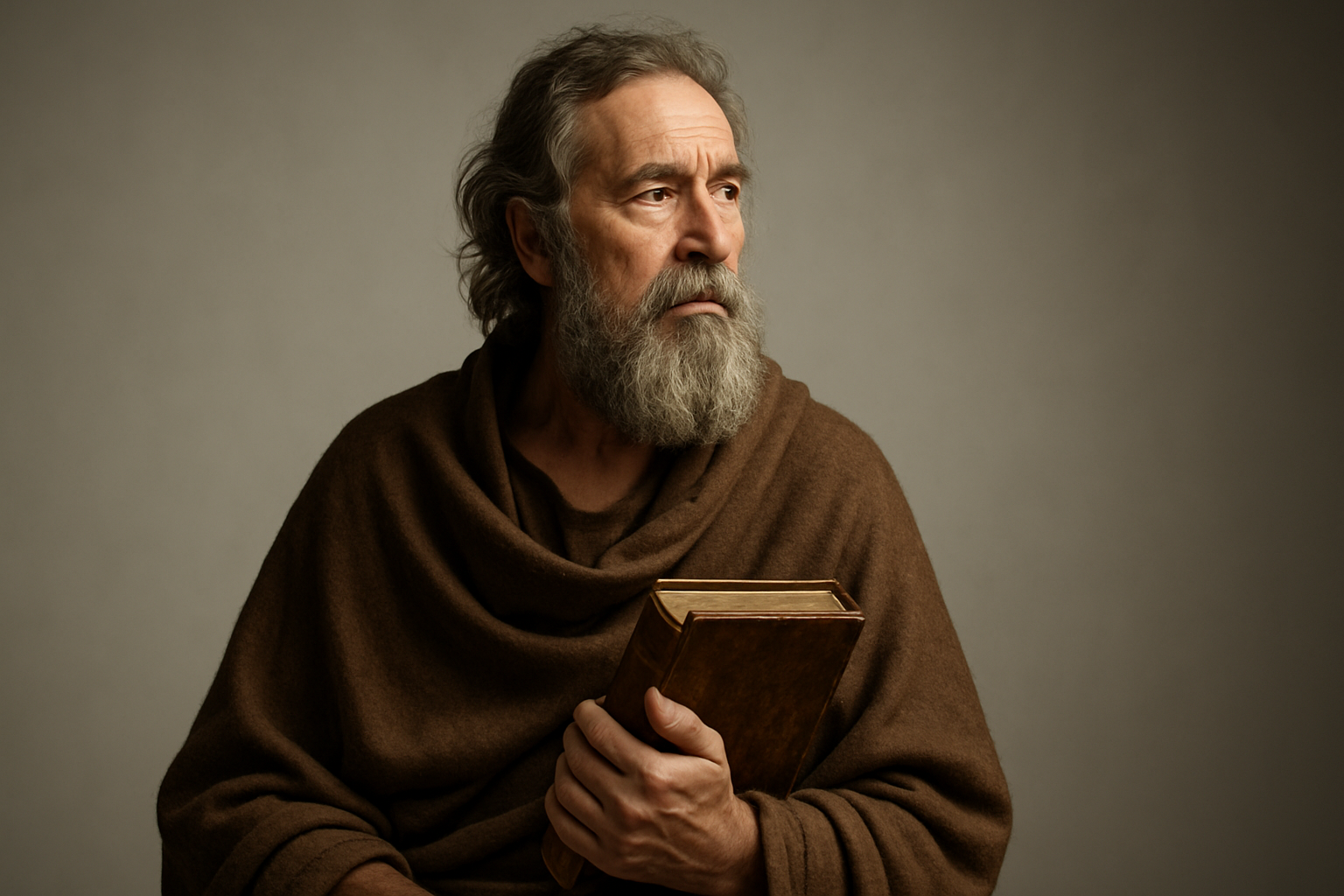
In art and jewelry, Saint Justin Martyr is often depicted with symbols that reflect his life and martyrdom. He is frequently shown holding a book or scroll, representing his profound learning, his philosophical background, and his influential writings, especially his Apologies. Sometimes, he is shown holding a pen, further emphasizing his role as a writer and defender of the faith. A sword or a palm branch is another common symbol; the sword signifies the instrument of his martyrdom (beheading), while the palm branch is a universal symbol of martyrdom in Christian art, representing victory over death through faith. These symbols remind us of his dual identity as a learned philosopher and a brave witness to Christ.
Timeline Summary
- Circa 100-110 AD: Born in Flavia Neapolis (modern Nablus, West Bank).
- Early Life: Pursues philosophical studies in various schools (Stoicism, Peripateticism, Pythagoreanism, Platonism).
- Circa 130 AD: Converts to Christianity after an encounter with an old man and studying the prophets.
- Mid-2nd Century: Establishes a Christian philosophical school in Rome.
- Circa 155 AD: Writes the “First Apology,” addressed to Emperor Antoninus Pius.
- Mid-Late 150s AD: Writes the “Second Apology,” addressed to the Roman Senate.
- Late 150s – Early 160s AD: Writes the “Dialogue with Trypho.”
- Circa 165 AD: Arrested, tried, and martyred by beheading in Rome under Prefect Rusticus.
Scripture for Reflection
Saint Justin Martyr’s life beautifully embodies several scriptural themes:
- 1 Peter 3:15: “But in your hearts revere Christ as Lord. Always be prepared to give an answer to everyone who asks you to give the reason for the hope that you have. But do this with gentleness and respect.” This verse perfectly encapsulates Justin’s mission as an apologist. He was prepared, reasoned, gentle, and respectful in his defense of Christ, offering a clear explanation of the Christian hope to a skeptical world.
- John 1:1-5: “In the beginning was the Word, and the Word was with God, and the Word was God. He was with God in the beginning. Through him all things were made; without him nothing was made that has been made. In him was life, and that life was the light of all mankind. The light shines in the darkness, and the darkness has not overcome it.” This passage connects directly to Justin’s Logos theology, where he identified Christ as the divine Word (Logos) that permeates creation and reason, offering true light to humanity.
- Matthew 10:32-33: “Whoever acknowledges me before others, I will also acknowledge before my Father in heaven. But whoever disowns me before others, I will disown before my Father in heaven.” Justin’s martyrdom is a powerful testament to this teaching. He boldly acknowledged Christ before Roman authorities, choosing death rather than disowning his Lord, trusting in the promise of eternal life.
Prayers to St. Justin Martyr
O glorious Saint Justin,
You diligently sought truth through philosophy,
and by divine grace, found the fullness of truth in our Lord Jesus Christ.
Inspired by the Holy Spirit, you courageously defended the Christian faith,
explaining its mysteries with profound wisdom and clarity,
and bore witness to its truth even unto death.
We pray for your intercession, that we too may have hearts open to truth,
minds eager to understand our faith, and the courage to articulate it with conviction.
Help us to be unafraid in a world that often misunderstands,
and to speak with both reason and charity.
May your example inspire us to live lives worthy of the Gospel,
and to remain steadfast in our love for Christ, even in the face of challenges.
Through your prayers, may we grow in holiness and draw closer to God,
who is the source of all truth and goodness.
Amen.
Saint Justin Martyr, brilliant philosopher and courageous defender of faith, pray for us!