In the vibrant, often tumultuous, early centuries of Christianity, a towering figure emerged from the city of Lyon who would profoundly shape the very definition of Catholic faith. St. Irenaeus, a name perhaps less familiar than some other saints, stands as a crucial bridge between the Apostles and the great theologians who followed. He was a student of a disciple of St. John the Apostle, making him a living link to the Church’s foundational truths. This article will journey through his fascinating life, exploring the turbulent world he inhabited, his tireless work in defending the authentic Christian message, his enduring spiritual legacy, and how his wisdom continues to speak to believers today, offering clarity and hope in an ever-changing world.
Quick Facts
| Attribute | Details |
|---|---|
| Birth | c. 130-140 AD, Smyrna (modern-day Izmir, Turkey) |
| Death | c. 202 AD, Lyon (modern-day France) |
| Feast Day | June 28 |
| Patronage | Theology, Unity of the Church |
| Canonized | Ancient, venerated as a saint. Declared a Doctor of the Church by Pope Francis on January 21, 2022, with the title “Doctor of Unity.” |
Historical Context & Early Life
Imagine a world without the New Testament as we know it, where Christian communities were scattered and often isolated, and false teachings were swirling through society like strong currents. This was the landscape of the 2nd century AD, the era into which St. Irenaeus was born. The Roman Empire was at its height, a vast network of cities and trade routes, but also a place where Christians were frequently viewed with suspicion, sometimes persecuted fiercely for their refusal to worship the Roman gods or Emperor.
Irenaeus was born in Smyrna, a significant city in Asia Minor (modern-day Turkey), around 130-140 AD. This region was a cradle of early Christianity, having received direct missionary efforts from apostles like St. Paul and St. John. Growing up in Smyrna meant Irenaeus had a unique privilege: he sat at the feet of St. Polycarp, the revered Bishop of Smyrna. Polycarp himself was a disciple of St. John the Apostle. This direct, personal connection to the apostolic age was incredibly rare and profoundly shaped Irenaeus. He often recounted Polycarp’s stories of John, of Jesus, and of the teachings he received directly from those who walked with Christ. This living memory of the apostles would become the bedrock of Irenaeus’s entire theological approach.
The greatest challenge facing the Church during Irenaeus’s youth and early ministry was the rapid spread of Gnosticism. This was not a single, unified religion but a collection of diverse philosophical and religious systems that blended elements of Christianity, paganism, and mystery cults. Gnostics claimed to possess a “secret knowledge” (gnosis in Greek) that was superior to ordinary faith. They often taught that the material world was evil, created by a lesser, ignorant god, not the supreme good God. They believed that only a select few, those with this special knowledge, could escape the entrapment of the body and ascend to the divine realm. These teachings were highly appealing to some, but they fundamentally distorted the Christian message, undermining the goodness of creation, the reality of Christ’s Incarnation (God becoming human), and the resurrection of the body.
The Church, still young and developing its structures, needed clear voices to articulate its true faith amidst this confusion. Irenaeus’s formative years, steeped in authentic apostolic tradition and surrounded by the intellectual challenges of Gnosticism, prepared him perfectly for this vital task. He understood not only what the Church believed but also why it believed it, and how to defend those beliefs against sophisticated, seductive errors.
Calling & Key Milestones
Student of the Apostles
Irenaeus’s unique calling began with his deep immersion in the oral tradition passed down directly from the apostles. His teacher, St. Polycarp, was not just a historical figure to him but a living link to the very source of Christian revelation. Irenaeus would later emphasize the importance of “apostolic succession”—the idea that the true teachings of Christ were preserved by bishops who could trace their authority and faith back to the apostles themselves, an unbroken chain. This personal connection gave him immense authority and confidence in his mission to preserve and explain the true faith.
Priest in Lyon
At some point, likely in his early adulthood, Irenaeus traveled west, eventually settling in the bustling Roman city of Lugdunum (modern-day Lyon, France), a major center of trade and Roman administration in Gaul. Here, he served as a priest in a vibrant, yet vulnerable, Christian community. The Church in Lyon was a relatively new outpost of faith in the Roman world, composed of a mix of native Gauls, Greeks, and Romans. In 177 AD, this community faced a horrific persecution under Emperor Marcus Aurelius. Many Christians were martyred, including their beloved bishop, St. Pothinus, who died from the cruelties inflicted upon him.
Mission to Rome
During the persecution of 177 AD, Irenaeus played a crucial diplomatic role. He was sent to Rome, carrying a letter from the suffering Christians of Lyon to Pope Eleutherius. This letter was not only to report on the persecution but also to advocate for peace within the Church itself, concerning the controversial Montanist movement. Montanism was an ecstatic prophetic movement that claimed new revelations, sometimes undermining Church authority. Irenaeus’s mission showcased his pastoral heart and his desire for unity and order within the wider Christian community, even amidst intense external pressure.
Bishop of Lyon
Following the martyrdom of Bishop Pothinus, Irenaeus was chosen by the community to succeed him as Bishop of Lyon. This was a tremendous responsibility. He now led a scarred but resilient flock, needing comfort, guidance, and strong leadership to rebuild and grow. As bishop, he was not only a spiritual leader but also a teacher and protector of the faith against the intellectual challenges of the day, particularly Gnosticism.
“Against Heresies” (Adversus Haereses)
Irenaeus’s most significant and lasting contribution to the Church is his monumental five-volume work, Adversus Haereses, or “Against Heresies.” Written around 180-185 AD, this treatise systematically dismantled the complex arguments of various Gnostic sects. It wasn’t merely a negative critique; it was a profound positive articulation of authentic Christian doctrine. In this work, Irenaeus meticulously laid out the Gnostic errors, then presented the Church’s unified teaching, rooted in Scripture and apostolic tradition. He showed that there is only one God, the Creator of all things, visible and invisible. He emphasized the reality of Christ’s Incarnation – that God truly became flesh and dwelt among us – and the importance of the resurrection of the body. This work became a cornerstone of orthodox Christian theology, providing a clear framework for understanding and defending the faith that would influence generations of Church Fathers.
Defender of Orthodoxy and Peacemaker
Beyond his writings, Irenaeus was a tireless advocate for the purity of Christian belief. He emphasized the “rule of faith,” a simple creed-like summary of essential Christian doctrines, which was consistent across all true churches. He stressed the importance of the four Gospels as divinely inspired accounts of Christ’s life and teachings, and his work played a significant role in solidifying the canon (the official list) of New Testament books. He also acted as a peacemaker during the “Quartodeciman controversy,” a disagreement about the correct date for celebrating Easter. When Pope Victor I of Rome threatened to excommunicate churches in Asia Minor that followed a different dating tradition, Irenaeus intervened, writing to the Pope and urging patience, charity, and unity, reminding him that diversity in practice could coexist with unity in faith. His appeal helped to avert a major schism.
Spiritual Legacy & Theological Themes
St. Irenaeus’s spiritual legacy is vast and foundational, influencing the very way the Catholic Church understands itself and its core beliefs. He was a champion of unity, truth, and the interconnectedness of God’s saving plan throughout history.
One of his most profound theological contributions is the concept of “recapitulation” (from the Greek anakephalaiosis), which means “summing up” or “heading up anew.” Irenaeus taught that Jesus Christ, the New Adam, recapitulates, or sums up, all of human history and creation in himself. Where the first Adam introduced sin and death, Christ reverses the curse, restoring humanity to communion with God and making all things new. Through the Incarnation, Christ enters into every stage of human life, sanctifying it and redeeming it. This idea highlights the profound impact of Jesus on the entire cosmos and on every human life, revealing God’s consistent plan of salvation from creation to consummation. This theme beautifully aligns with Scripture, particularly passages like Ephesians 1:10, which speaks of God’s plan “to unite all things in him, things in heaven and things on earth.”
Irenaeus also passionately defended the goodness of creation. Against the Gnostics who despised the material world, he insisted that the one true God, the Father of Jesus Christ, is the Creator of everything visible and invisible. He saw the material world, including the human body, as good and intended by God, thus paving the way for a holistic understanding of salvation that involves both soul and body, culminating in the resurrection. This emphasis underscores the Catholic teaching on the sacredness of human life and the material world, preparing the ground for Sacramental theology where God uses tangible signs (like water, bread, and wine) to convey spiritual grace.
His unwavering defense of apostolic succession and the “rule of faith” laid crucial groundwork for understanding Church authority and tradition. He argued that the true faith was preserved in those churches whose bishops could trace their lineage directly back to the apostles, particularly the Church of Rome. This wasn’t about power, but about fidelity to the original message given by Christ. He taught that Scripture and Tradition are inseparable, two wings on which the Church flies towards truth. The virtues he exemplified – intellectual rigor, pastoral care, faithfulness to tradition, and a deep love for unity – are enduring models for all Christians.
Irenaeus’s influence on doctrine is immense. His writings contributed significantly to the formation of the New Testament canon by emphasizing the authority of the four Gospels. His articulation of the Trinity, though not yet fully developed in precise terminology, clearly spoke of God as Father, Son (Word), and Holy Spirit acting together in the economy of salvation. He also provided early insights into Mary’s role as the New Eve, whose obedience reversed the disobedience of the first Eve. His theological depth and clarity earned him the title “Doctor of Unity” from Pope Francis, recognizing his crucial role in articulating the unified Christian faith and advocating for peace within the Church.
Devotion Today
While St. Irenaeus may not have widespread popular devotion in the same way as, say, St. Francis or St. Thérèse, his intellectual and spiritual contributions are highly revered within theological circles and among those who appreciate the foundational figures of the Church. His feast day is celebrated on June 28th, offering a yearly opportunity for Catholics to remember his life and work.
As a Doctor of the Church, he is recognized for his extraordinary theological insights and the lasting impact of his teachings. Pope Francis bestowed this title upon him in 2022, specifically honoring him as the “Doctor of Unity.” This designation has brought renewed attention to his life and writings, highlighting his relevance for a Church often challenged by divisions in the modern world.
There are no specific major shrines dedicated solely to St. Irenaeus, as his relics are believed to have been destroyed during the persecution of Septimius Severus around 202 AD. However, he is honored in the Archdiocese of Lyon, France, where he served as bishop. Churches and theological institutions around the world bear his name, and his writings are central to the study of Patristics (the study of the Church Fathers) and early Christian theology. Those seeking to understand the origins of Catholic doctrine and the Church’s response to early heresies will invariably turn to St. Irenaeus’s works. His prayers and intercession are sought by those striving for theological clarity, Christian unity, and a deeper understanding of God’s plan of salvation.
Reflections for Modern Readers
St. Irenaeus’s life and teachings offer a powerful compass for navigating the complexities of the 21st century. His insights are not confined to ancient theological debates but provide timeless wisdom for our spiritual journeys.
- Stand Firm in the Truth Amidst Confusion: Irenaeus lived in a time of competing narratives and attractive, yet false, spiritualities. He didn’t shy away from engaging with these ideas intellectually and pastorally. In our modern age, flooded with information, misinformation, and diverse spiritual claims, Irenaeus reminds us of the importance of grounding our faith in the consistent, unchanging truth revealed by God through Scripture and Tradition. When we encounter new philosophies or trends that challenge core Christian beliefs, we can emulate Irenaeus by seeking to understand them clearly and then articulating the authentic Catholic faith with conviction and clarity. For example, when faced with online content promoting New Age spiritualities that deny objective truth, we can reflect on Irenaeus’s methodical defense of a coherent, unified Christian narrative.
- Cherish Unity in Diversity: Irenaeus was known as a peacemaker, notably in the Quartodeciman controversy. He understood that while core doctrines must be protected, there can be legitimate diversity in practices and expressions of faith. In a globalized Church with diverse cultures and liturgical traditions, Irenaeus encourages us to embrace this richness while always striving for deeper communion. When differences arise within our parishes or Catholic communities, we can ask ourselves: Is this a matter of essential faith, or a legitimate difference in practice that can be embraced with charity and understanding? His legacy calls us to bridge divides, not deepen them.
- See God’s Hand Throughout History: Irenaeus’s concept of “recapitulation” encourages us to see all of history, from creation to our present moment, as part of God’s unified plan of salvation culminating in Christ. This perspective helps us find meaning and purpose even in difficult times. Instead of viewing history as random events, we can reflect on how God is continually working to restore and renew all things in Christ. This can be applied to personal struggles: recognizing that even our challenges can be “recapitulated” by Christ, transformed into opportunities for growth and grace.
- Value Both Scripture and Tradition: For Irenaeus, Scripture wasn’t a standalone text, but illuminated by the living Tradition passed down from the apostles, and Tradition found its authentic voice in Scripture. He teaches us that a deep, prayerful engagement with the Bible, coupled with an understanding of how the Church has understood it through the ages, is essential for a mature faith. In an age where individual interpretation can sometimes overshadow collective wisdom, Irenaeus calls us to a balanced approach, enriching our scriptural study with the wisdom of the saints and the guidance of the Church.
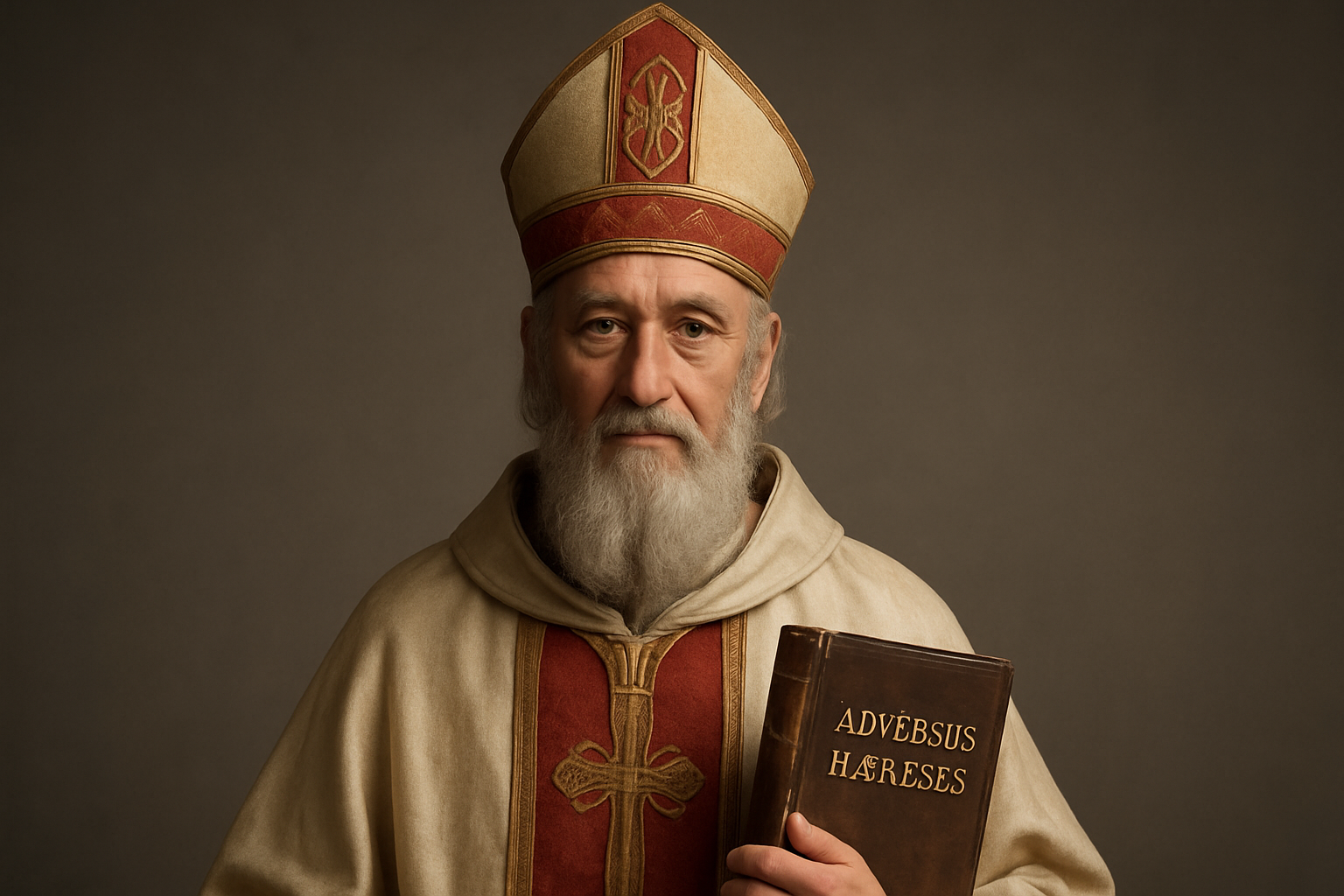
In art and jewelry, St. Irenaeus is typically depicted as a bishop, wearing a mitre (bishop’s hat) and carrying a crozier (pastoral staff), symbolizing his role as a shepherd of the Church. His most common attribute is a book or scroll, often titled “Adversus Haereses,” which represents his monumental theological work and his unwavering commitment to defending the truth of the faith through writing. Sometimes, he is shown with a pen or quill, further emphasizing his role as a great writer and teacher. These symbols highlight his dual role as a wise pastor and a profound theologian, whose words continue to enlighten the Church.
Timeline Summary
- c. 130-140 AD: Born in Smyrna, Asia Minor.
- Childhood/Adolescence: Becomes a disciple of St. Polycarp, Bishop of Smyrna, who was a disciple of St. John the Apostle.
- c. 170s AD: Migrates to Gaul (modern-day France), becomes a priest in Lyon.
- 177 AD: Sent to Rome by the suffering Christians of Lyon to Pope Eleutherius to advocate for peace and report on the persecution.
- 177 AD: Becomes Bishop of Lyon after the martyrdom of St. Pothinus during the persecution under Marcus Aurelius.
- c. 180-185 AD: Writes his seminal work, Adversus Haereses (“Against Heresies”), a comprehensive defense of orthodox Christian doctrine against Gnosticism.
- c. 190s AD: Acts as a peacemaker in the Quartodeciman controversy, urging Pope Victor I to exercise charity and unity regarding the date of Easter.
- c. 202 AD: Believed to have died (possibly martyred) in Lyon during the persecution under Emperor Septimius Severus.
- June 28: Feast Day celebrated by the Catholic Church.
- January 21, 2022: Declared a Doctor of the Church by Pope Francis with the title “Doctor of Unity.”
Scripture for Reflection
St. Irenaeus’s theology is deeply rooted in the concept of God’s unified plan of salvation, often called the “economy of salvation,” and the pivotal role of Christ in “recapitulating” all things. The following passages resonate strongly with his teachings:
Ephesians 1:9-10 (NRSVCE): “He has made known to us the mystery of his will, according to his good pleasure that he set forth in Christ, as a plan for the fullness of time, to gather up all things in him, things in heaven and things on earth.”
Connection: This passage perfectly encapsulates Irenaeus’s idea of recapitulation. God’s ultimate plan, revealed in Christ, is to “gather up” or “sum up” all of creation and history in Him. Irenaeus saw Christ as the New Adam who reverses the fall, restoring humanity and the cosmos to God’s original intention, making all things new and bringing them to their ultimate fulfillment in Him.
John 1:14 (NRSVCE): “And the Word became flesh and lived among us, and we have seen his glory, the glory as of a father’s only son, full of grace and truth.”
Connection: Against the Gnostics who denied the goodness of the material world and the true Incarnation of Christ, Irenaeus passionately defended the reality that “the Word became flesh.” This verse was central to his arguments, emphasizing that God truly entered human history, took on human flesh, and sanctified our material existence. For Irenaeus, the Incarnation was not a mere appearance but a real, transformative event that began the process of our salvation and deification (our being made like God).
Prayers to St. Irenaeus of Lyon
As the “Doctor of Unity” and a profound theologian, prayers to St. Irenaeus often focus on seeking wisdom, clarity of faith, and the unity of the Church.
A Prayer for Unity and Truth:
O Glorious St. Irenaeus, Doctor of Unity and faithful defender of the apostolic truth, you stood as a beacon of light in a time of confusion, carefully guarding the deposit of faith passed down from the Apostles themselves. We humbly ask for your intercession. Help us, your spiritual children, to discern truth from error in our own age, to embrace the unity of the Church, and to live in communion with Christ and one another. Inspire theologians and all believers to pursue wisdom with humility and charity, that the Church may always proclaim the one, saving Gospel with clarity and conviction. Through your prayers, may we grow in our love for God, the Creator of all, and for Jesus Christ, who recapitulates all things in Himself, living and reigning forever and ever. Amen.
A Short Invocation:
Saint Irenaeus, Doctor of Unity, pray for us.
From the Liturgy: Collect for the Feast of St. Irenaeus (June 28):
O God, who graciously called the Bishop Saint Irenaeus to confirm the truth of the true Faith, grant, we pray, through his intercession, that we may be renewed in charity and faith and strengthened in unity and peace. Through our Lord Jesus Christ, your Son, who lives and reigns with you in the unity of the Holy Spirit, God, for ever and ever. Amen.