In the vibrant tapestry of early Christianity, where intellectual giants wrestled with profound theological questions and saints stood firm against waves of controversy, stands St. Gregory Nazianzen. Often hailed as one of the three Cappadocian Fathers—a title he shares with St. Basil the Great and St. Gregory of Nyssa—Gregory Nazianzen was a brilliant orator, a gifted poet, and a tireless defender of the Catholic faith. His life, spanning the 4th century, was marked by intense scholarship, reluctant leadership, and a profound spiritual depth that continues to inspire. This article will journey through his remarkable life, exploring his pivotal role in shaping Christian doctrine, his enduring spiritual legacy, and how his wisdom still speaks to us today.
Quick Facts
| Category | Detail |
|---|---|
| Birth | c. 329 AD, Arianzus, Cappadocia |
| Death | c. 390 AD, Arianzus, Cappadocia |
| Feast Day | January 2 (Roman Catholic Church), January 25 (Eastern Orthodox Church) |
| Patronage | Theologians, poets, writers |
| Canonized | Pre-Congregation (Venerated from ancient times) |
Historical Context & Early Life
St. Gregory Nazianzen was born into a world undergoing immense transformation. The 4th century witnessed the Roman Empire’s gradual decline in the West and its flourishing in the East, where Christianity, once persecuted, had become the favored religion of the state under Emperor Constantine. However, this newfound freedom brought its own challenges, particularly internal theological disputes that threatened to tear the Church apart. The most significant of these was Arianism, a teaching that denied the full divinity of Jesus Christ, claiming he was a created being, subordinate to God the Father. This controversy ignited passionate debates, councils, and even violence, shaping the very landscape of Christian thought and practice.
Gregory’s family background was steeped in both the traditional Roman elite and the nascent Christian aristocracy. His father, also named Gregory, was a wealthy landowner who initially belonged to a pagan sect but was later converted to Christianity by his devout wife, Nonna. Gregory the Elder eventually became Bishop of Nazianzus, a testament to the respect he commanded. His mother, Nonna, was a woman of extraordinary faith and influence, often credited with guiding both her husband and her children towards profound spiritual commitment. Gregory had two siblings: a brother, Caesarius, who became a prominent physician and statesman, and a sister, Gorgonia, known for her piety and charitable works. This family environment, marked by both intellectual rigor and deep Christian devotion, laid a powerful foundation for Gregory’s future.
Recognizing his exceptional intellect, Gregory’s parents ensured he received the finest education of his time. He studied rhetoric and philosophy in the most renowned centers of learning: Caesarea in Cappadocia, Caesarea Maritima, Alexandria in Egypt, and finally, Athens. In Athens, he befriended two other brilliant young men who would become lifelong companions and fellow pillars of the Church: St. Basil the Great and Basil’s brother, the future St. Gregory of Nyssa. This period of intense study and profound friendship forged Gregory into the eloquent theologian and writer he would become, equipping him with the tools to articulate complex truths with clarity and beauty.
Calling & Key Milestones
The Call to the Priesthood and Friendship with Basil
Despite his prestigious education and a promising career in rhetoric, Gregory felt a strong pull towards a life dedicated to God. However, he was notoriously hesitant about accepting official Church positions, preferring a life of quiet contemplation and study. His friend, St. Basil, who had already embraced monasticism, urged Gregory to join him in a secluded retreat in Pontus. There, they lived a simple, austere life, studying Scripture and the Church Fathers, and together compiled the Philocalia, an anthology of Origen’s works. This period was crucial for their spiritual and intellectual development.
In 361 AD, against his will and feeling unprepared, Gregory was ordained a priest by his own father. This ordination was a source of great inner conflict for him; he even fled into the wilderness for a time before returning to his duties. This reluctance was not a lack of faith, but a profound humility and an overwhelming sense of the immense responsibility that came with ministering the sacraments and shepherding souls. He eventually accepted his priestly office, viewing it as an act of obedience to God’s will, though he never lost his desire for monastic solitude.
The Cappadocian Fathers and Trinitarian Theology
The Arian controversy continued to rage, threatening the very heart of Christian belief. The Council of Nicaea (325 AD) had affirmed the divinity of Christ, declaring him to be homoousios, or “of the same substance” as the Father. However, the exact nature of the Holy Spirit remained a point of contention. It was St. Gregory Nazianzen, along with St. Basil the Great and St. Gregory of Nyssa, who would become known as the Cappadocian Fathers, who provided the crucial theological clarity needed to defend and articulate the doctrine of the Most Holy Trinity. They refined the understanding of “one God in three Persons,” emphasizing the distinctness of the Father, Son, and Holy Spirit, while affirming their co-equality and co-eternity.
Gregory Nazianzen’s masterful “Theological Orations,” delivered in Constantinople, were particularly instrumental in explaining the divinity of the Holy Spirit. He argued eloquently and logically that if the Holy Spirit sanctifies, guides, and inspires, then He must be God, for only God can perform divine acts. These orations were not just academic exercises; they were powerful spiritual defenses of the true nature of God, delivered to a city deeply divided by theological disputes.
The Struggle in Constantinople
By 379 AD, the imperial capital of Constantinople had largely fallen under the influence of Arianism. The Nicene Christians were a small, beleaguered minority. Emperor Theodosius I, a staunch supporter of Nicene orthodoxy, called upon Gregory Nazianzen to go to Constantinople and revive the true faith. This was a daunting mission for a man who preferred solitude to public life, but Gregory, once again, answered the call. He began preaching in a small house church, which he named Anastasia (meaning “Resurrection”), symbolizing the resurrection of orthodox faith in the city.
His eloquent sermons, filled with profound theological insight and spiritual fervor, quickly drew crowds. He became known as “The Theologian” in the Eastern Church, a title shared only with St. John the Apostle. Yet, his ministry was fraught with peril. He faced fierce opposition from Arian bishops, riots from hostile mobs, and even assassination attempts. Despite the danger and his own desire for peace, Gregory persevered, tirelessly proclaiming the orthodox faith.
The Council of Constantinople (381 AD) and Resignation
Gregory’s success in Constantinople led to his recognition by Emperor Theodosius, who formally installed him as the Nicene Bishop of Constantinople. Soon after, in 381 AD, Theodosius convened the Second Ecumenical Council in Constantinople to resolve the lingering Arian controversy and other theological issues. Gregory was initially chosen to preside over this momentous council.
However, tensions arose. Some bishops challenged the legitimacy of his appointment to Constantinople, citing canon law that prohibited a bishop from moving sees. Though his appointment had been widely accepted, Gregory, ever the man of peace and humility, saw that his continued presence might hinder the council’s work and unity. In a remarkable act of self-sacrifice, he delivered a powerful farewell address, recounting his struggles and reaffirming his commitment to unity, and then dramatically resigned from his see and the presidency of the council. He chose spiritual peace and the good of the Church over personal position and honor.
Retirement and Writings
After his resignation, Gregory returned to his family estates in Arianzus. He spent his remaining years in contemplative retirement, managing his family property, and most importantly, dedicating himself to prayer, theological reflection, and writing. It was during this period that he produced a significant portion of his literary output: numerous letters, poems (including his autobiography, De Vita Sua, or “Concerning His Own Life”), and further theological treatises. These writings offer invaluable insights into his spirituality, his struggles, and his profound theological understanding, serving as a lasting testament to his intellectual and spiritual genius.
Spiritual Legacy & Theological Themes
St. Gregory Nazianzen’s spiritual legacy is immense, profoundly shaping Christian thought and devotion, particularly in the Eastern Church. He exemplified several core virtues that resonate deeply with Scripture and Catholic teaching.
Humility and Reluctance for Power: Gregory consistently resisted positions of authority, viewing them as heavy burdens rather than honors. His repeated attempts to withdraw from public life illustrate a profound humility, reminding us that true leadership in the Church is about service and self-sacrifice, not personal gain or glory. This echoes Christ’s teaching in Matthew 20:26-28, “whoever wishes to be great among you shall be your servant.”
Intellectual Rigor and Fidelity to Truth: Gregory’s life was a testament to using one’s intellect in service of God. He painstakingly studied, debated, and wrote to articulate the precise truths of the Christian faith, particularly regarding the Trinity. He believed that fuzzy theology led to fuzzy faith, and that defending the true nature of God was paramount to salvation. His eloquent defense of the divinity of the Holy Spirit was crucial for the Church’s understanding, aligning with passages like John 16:13, where Jesus promises the Spirit will guide them “into all truth.”
Courage in Controversy: Despite his desire for peace and quiet, Gregory bravely faced hostility and persecution in Constantinople, standing firm for orthodox belief. He risked his life to preach the truth when it was unpopular and dangerous. This courage reflects the call to be “wise as serpents and innocent as doves” (Matthew 10:16) and to “stand firm in the faith” (1 Corinthians 16:13).
Spiritual Friendship: His deep and transformative friendship with St. Basil the Great highlights the importance of spiritual companionship and mutual support in the Christian journey. Their intellectual and spiritual camaraderie strengthened both men and bore immense fruit for the Church. Proverbs 27:17, “Iron sharpens iron, and one man sharpens another,” perfectly captures this aspect of their relationship.
His lasting influence on liturgy, devotion, art, and doctrine is undeniable. In the East, he is revered as one of the “Three Holy Hierarchs” alongside Basil the Great and John Chrysostom, celebrated for their monumental contributions to theology and liturgy. His “Theological Orations” remain foundational texts for understanding the Trinity. His liturgical prayers and hymns are still used today, particularly in Eastern Orthodox and Eastern Catholic traditions. In art, he is often depicted as a bishop holding a book or scroll, symbolizing his role as a teacher and writer of sacred doctrine. His profound insights into the nature of God, expressed with both precision and poetic beauty, continue to inspire theologians and laypeople alike.
Devotion Today
St. Gregory Nazianzen is universally venerated as a saint in both the Eastern and Western Christian traditions. While there aren’t many specific large-scale pilgrimage sites dedicated solely to him, his spiritual presence is felt deeply through his writings and the theological foundations he laid. Churches, particularly in the Orthodox world, bear his name, and his icons are widely revered. He is honored annually on his feast day with special liturgical celebrations that recount his life and theological contributions.
His legacy is primarily alive in the classrooms of seminaries and universities, where his “Theological Orations” and other writings are studied as essential texts for understanding Trinitarian doctrine, Christology (the study of Christ), and the nature of the Holy Spirit. His wisdom continues to nourish scholars and students striving for a deeper grasp of Christian truth. Many who seek to understand the intricate nuances of early Church theology or who are called to preach with eloquence and conviction turn to St. Gregory Nazianzen as a guide and patron.
Reflections for Modern Readers
St. Gregory Nazianzen’s life, though lived in a distant past, offers incredibly potent lessons for us in the 21st century:
- Stand Firm in Your Convictions (Even When It’s Hard): Gregory faced intense opposition, even violence, for defending the truth of Christ’s divinity. In a world that often pressures us to compromise our beliefs for convenience or social acceptance, Gregory reminds us of the profound importance of fidelity to truth, especially when it comes to fundamental matters of faith. We can apply this by speaking up for justice, defending core Catholic teachings, or simply living authentically according to our values in our daily lives.
- Use Your Gifts for God’s Glory: Gregory was a brilliant orator and writer. He could have pursued a highly successful secular career, but he chose to use his immense intellect and eloquence to articulate God’s truth. What talents or abilities has God given you? Whether it’s creativity, problem-solving, teaching, or compassion, St. Gregory challenges us to direct our unique gifts towards building God’s Kingdom, in our workplaces, homes, and communities.
- Embrace Humility and Detachment from Power: Gregory repeatedly sought to avoid positions of power, viewing them as burdens for service rather than opportunities for personal advancement. In a culture often obsessed with status and influence, his example encourages us to examine our own motivations. Are we seeking recognition, or are we truly serving? This can mean stepping back from an argument to preserve peace, or letting someone else take credit for a good idea, or simply discerning when to say “no” to commitments that pull us away from our true calling.
- Cultivate Spiritual Friendships: His bond with St. Basil the Great was a source of immense strength and intellectual growth for both men. In an increasingly isolated world, Gregory’s life highlights the vital role of deep, faith-filled friendships that challenge us, support us, and draw us closer to God. This could mean intentionally seeking out friends who share your faith, joining a small faith group, or committing to regular spiritual conversations with a trusted companion.
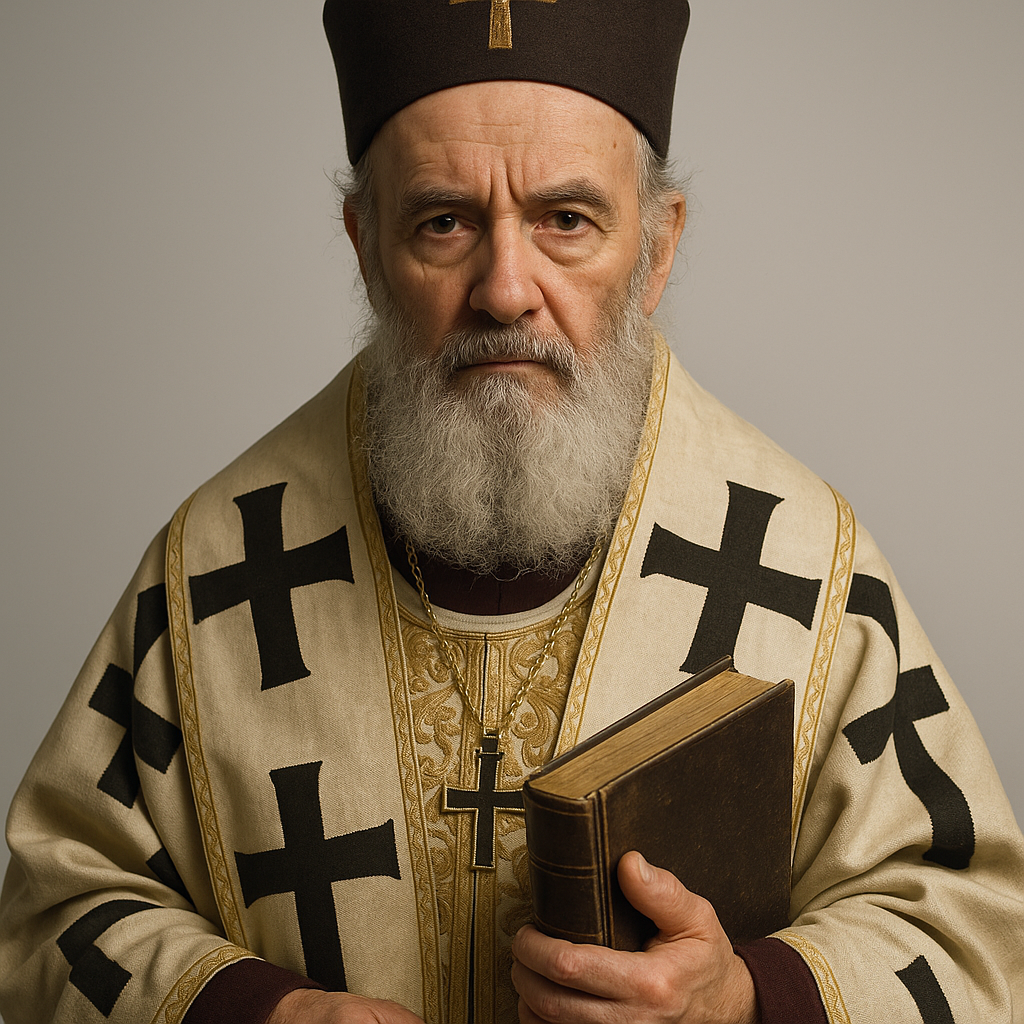
In art and jewelry, St. Gregory Nazianzen is most commonly depicted as an older man with a beard, dressed in the liturgical vestments of a bishop, often wearing a pallium (a woolen band worn over the shoulders, signifying metropolitan jurisdiction). His key symbols include:
- A book or scroll: This signifies his profound scholarship, his eloquent writings, and his role as a Doctor of the Church. It reminds us of the importance of studying and understanding our faith.
- A quill or pen: Another symbol of his literary prowess and his prolific output as a theologian and poet. It represents the power of words in spreading divine truth.
- A dove: Occasionally, a dove may be depicted near him, especially in connection with his “Theological Orations,” which were crucial in defending the divinity of the Holy Spirit. It symbolizes the Holy Spirit, the source of inspiration and truth.
Timeline Summary
- c. 329 AD: Born in Arianzus, Cappadocia, to St. Gregory the Elder and St. Nonna.
- c. 345-357 AD: Receives extensive education in Caesarea, Alexandria, and Athens; befriends St. Basil the Great.
- c. 357 AD: Returns home, dedicates himself to monastic study with Basil in Pontus.
- 361 AD: Reluctantly ordained a priest by his father.
- 370 AD: Basil consecrated Bishop of Caesarea; Gregory assists him.
- 372 AD: Consecrated Bishop of Sasima by Basil, a position he again reluctantly accepted and quickly abandoned.
- 374 AD: Returns to Nazianzus to assist his aging father, serving as bishop after his father’s death.
- 379 AD: Called to Constantinople to revive the Nicene faith, preaches in the Church of Anastasia.
- 381 AD: Becomes Bishop of Constantinople; presides over the Second Ecumenical Council of Constantinople; resigns due to controversy and returns to Arianzus.
- c. 381-390 AD: Spends his final years in prayer, contemplation, and extensive writing.
- c. 390 AD: Dies in Arianzus.
Scripture for Reflection
2 Timothy 4:2-4 (NRSV): “Preach the word; be urgent in season and out of season; convince, rebuke, and encourage, with all long-suffering and teaching. For the time is coming when people will not endure sound teaching, but having itching ears, they will accumulate for themselves teachers to suit their own likings, and will turn away from listening to the truth and wander into myths.”
This passage strongly resonates with St. Gregory Nazianzen’s life. He was a tireless preacher of “sound teaching” in a time when many preferred “myths” (like Arianism). His patience, persistence, and commitment to clear instruction, even in the face of hostility, embody St. Paul’s exhortation.
John 16:13 (NRSV): “When the Spirit of truth comes, he will guide you into all the truth; for he will not speak on his own authority, but whatever he hears he will speak, and he will declare to you the things that are to come.”
St. Gregory was known as the “Theologian” primarily for his profound defense of the divinity of the Holy Spirit. This verse beautifully captures the role of the Holy Spirit as the guide to all truth, a truth that Gregory meticulously and eloquently articulated for the Church, ensuring the full understanding of the Triune God.
Prayers to St. Gregory Nazianzen
Prayer to St. Gregory Nazianzen (Traditional):
O glorious St. Gregory Nazianzen, divine Theologian and eloquent Doctor of the Church, you who eloquently defended the mysteries of the Holy Trinity and enlightened the faithful with your profound wisdom, look upon us with favor. You preferred solitude and contemplation, yet bravely answered the call to preach truth amidst persecution and controversy. Grant us, we pray, a portion of your intellectual fortitude and spiritual humility. Help us to understand and love the truths of our faith more deeply, to articulate them clearly, and to defend them courageously when necessary. Inspire us to use our own talents for the glory of God and the building up of His Church, always seeking His will above our own desires. Through your intercession, may we grow in grace and wisdom, and finally attain the eternal joy of heaven. Amen.