In the bustling Roman city of Milan in the late 4th century, an extraordinary event unfolded that would forever change the course of Church history. A respected governor, not yet even baptized, was suddenly called by the people to become their bishop. This was the improbable beginning of St. Ambrose of Milan, a figure whose courage, intellect, and deep faith profoundly shaped the early Church. From his unexpected rise to power to his unwavering defense of Christian doctrine and his pivotal role in the conversion of St. Augustine, Ambrose left an indelible mark. This article will explore his fascinating life, the turbulent times he lived in, his enduring spiritual legacy, and how his lessons continue to inspire believers today.
Quick Facts
| Category | Detail |
|---|---|
| Birth | c. 339, Trier, Gallia Belgica (modern-day Germany) |
| Death | April 4, 397, Milan, Italy |
| Feast Day | December 7 |
| Patronage | Milan, beekeepers, candlemakers, civil servants |
| Canonized | Pre-Congregation (Venerated from ancient times) |
Historical Context & Early Life
To understand St. Ambrose, we must first step back into the world of the late Roman Empire, a period often called late antiquity. The 4th century was a time of immense change and upheaval. The vast Roman Empire, while still powerful, was beginning to show cracks, facing external threats from barbarian tribes and internal political instability. Emperors often ruled from various cities, and Milan (Mediolanum) had become a key imperial residence, a bustling hub of commerce, politics, and culture in the Western Empire.
Crucially, Christianity, once persecuted, had been legalized by Emperor Constantine the Great in 313 AD with the Edict of Milan. By Ambrose’s time, it was rapidly gaining prominence, eventually becoming the official religion of the empire under Emperor Theodosius I. However, the Church itself was deeply divided by theological controversies. The most prominent and divisive was Arianism, a heresy that denied the full divinity of Jesus Christ, claiming he was created by God the Father and thus subordinate to him. This theological debate wasn’t confined to scholars; it sparked riots and political maneuvering, threatening the very unity of the nascent Christian faith.
Ambrose was born around 339 AD in Trier (modern-day Germany), a significant Roman city. He came from a highly distinguished and aristocratic Roman Christian family. His father, also named Ambrosius, served as the Praetorian Prefect of Gaul, one of the highest administrative positions in the empire, overseeing a vast territory. His mother was a woman of intellect and deep faith, and his siblings, Satyrus and Marcellina, also pursued lives of Christian devotion, with Marcellina becoming a consecrated virgin.
Tragically, Ambrose’s father died when he was young, and his mother moved the family to Rome. Here, Ambrose received an excellent classical Roman education, focusing on law, rhetoric, and literature – subjects essential for a career in public service. He quickly excelled, demonstrating remarkable intelligence and eloquence. His skills led him to a successful career in law and administration, culminating in his appointment as governor of Liguria and Aemilia, with his seat in Milan. In this role, he was known for his just and compassionate governance, traits that would define his later ecclesiastical career. Despite his Christian upbringing, at this point, Ambrose was still only a catechumen – someone preparing for baptism but not yet fully initiated into the Church.
Calling & Key Milestones
An Unlikely Call to Episcopacy
Ambrose’s life took an utterly unexpected turn in 374 AD. The Arian bishop of Milan, Auxentius, had died, and the city was thrown into turmoil over the election of his successor. The Catholic and Arian factions were deeply divided, leading to escalating tensions that threatened to erupt into violence. As the Roman governor, Ambrose was responsible for maintaining civil order. He went to the basilica where the election was taking place to calm the crowd and prevent a riot. While he was addressing the assembly, a child’s voice, possibly divinely inspired, reportedly cried out, “Ambrose for bishop!” The cry was immediately taken up by the entire crowd, both Catholics and Arians, who saw in the respected and impartial governor a figure who could unite them.
Ambrose was utterly astonished and resisted with all his might. He was not baptized, had no formal theological training, and was deeply committed to his administrative career. He even tried various desperate measures to prove himself unworthy, including fleeing the city. However, the people’s will was unwavering, and they appealed directly to the emperor, Valentinian I, who saw it as God’s will and confirmed the election. Within a week, Ambrose was baptized, received all the orders from deacon to priest, and was consecrated as Bishop of Milan on December 7, 374 AD.
A Bishop’s Rapid Transformation
Once consecrated, Ambrose fully embraced his new role with astonishing dedication. He immediately divested himself of his personal wealth, giving it to the poor and to the Church, and devoted himself entirely to his episcopal duties. Recognizing his lack of theological background, he immersed himself in the study of Scripture and the works of Greek theologians like Origen and Basil the Great, mastering them with incredible speed. He applied his formidable intellect and rhetorical skills, honed in his legal career, to theological debates and powerful preaching. His sermons were renowned for their eloquence, clarity, and deep scriptural insight, drawing large crowds and significantly influencing the spiritual landscape of Milan.
Champion Against Arianism
One of Ambrose’s most significant contributions was his unwavering defense of orthodox Nicene Christianity against Arianism. Despite the initial support he received from Arians in his election, Ambrose quickly made it clear where he stood. He vigorously combated Arian influence in Milan and throughout the empire, using his powerful preaching and persuasive writing to articulate the full divinity of Christ. He engaged in theological disputes with Arian leaders, often outmaneuvering them with his superior understanding of Scripture and tradition. His staunch defense helped solidify the Nicene Creed’s victory in the West and ensured that Christianity remained faithful to its core Trinitarian belief. He famously declared, “The emperor is within the Church, not above the Church.”
Confrontation with Emperor Theodosius
Ambrose was not afraid to challenge even the most powerful secular authorities when he believed justice or the integrity of the Church was at stake. His most famous confrontation was with Emperor Theodosius I. In 390 AD, Theodosius ordered a massacre of thousands of citizens in Thessalonica in retaliation for a riot. Appalled by this brutality, Ambrose wrote a courageous letter to the emperor, demanding public penance for his grave sin. He famously refused to offer Theodosius communion until the emperor publicly confessed his sin and submitted to a period of penance. Theodosius, a devout Christian but also a powerful ruler, eventually humbled himself, dressed in sackcloth, and performed public penance in the basilica of Milan, an unprecedented act that demonstrated the spiritual authority of the Church over even the emperor.
Influence on St. Augustine
Perhaps Ambrose’s most renowned personal triumph was his instrumental role in the conversion of St. Augustine, one of the greatest Doctors of the Church. Augustine, a brilliant but troubled intellectual, was a professor of rhetoric in Milan and deeply entangled in Manichaeism and a dissipated lifestyle. He initially came to hear Ambrose preach out of intellectual curiosity and admiration for his oratorical skills, rather than spiritual seeking. However, Ambrose’s sermons, which deftly combined classical rhetoric with profound Christian teaching, slowly began to penetrate Augustine’s skeptical heart and mind. Ambrose’s explanations helped Augustine understand Scripture in a non-literal, allegorical way, addressing some of his intellectual objections to Christianity. Through Ambrose’s preaching, personal counsel, and the witness of his holy life, Augustine found himself drawn closer to the Catholic faith, eventually leading to his transformative conversion and baptism by Ambrose himself in 387 AD.
Liturgical Reforms and Hymnody
Ambrose was also a prolific writer and a significant innovator in Christian worship. He introduced and popularized the singing of hymns in the Western Church, often composing both the lyrics and the melodies himself. These hymns, written in a clear, engaging style, were powerful tools for teaching doctrine and fostering communal prayer, and they quickly spread throughout the West. He also developed the Ambrosian Rite, a distinct liturgical tradition still used in Milan today, which emphasizes a strong scriptural focus and unique prayers and chants. His contributions to liturgy enriched the spiritual lives of his flock and left a lasting impact on how the Church worships.
Spiritual Legacy & Theological Themes
St. Ambrose exemplified a powerful blend of intellectual rigor, pastoral care, and unwavering courage. The core virtues he lived out resonate deeply with Scripture and Catholic teaching. His rapid transformation from a secular governor to a zealous bishop demonstrates profound humility and obedience to God’s unexpected call, echoing figures like Jeremiah who felt inadequate but answered God’s summons. His integrity in leadership, exemplified by his stand against Emperor Theodosius, speaks to the biblical imperative for justice and righteousness, reminding us that no earthly power is above divine law. He consistently prioritized truth and justice, even when it was dangerous or unpopular, embodying the Christian call to be “salt and light” in the world.
Ambrose’s lasting influence on the Church is immense. He is recognized as one of the four original Latin Doctors of the Church, alongside Saints Augustine, Jerome, and Gregory the Great. His theological writings, though often sermons transcribed by others, covered a vast range of topics including the Sacraments, the nature of Christ, the role of Mary, and Christian ethics. His emphasis on the allegorical interpretation of Scripture helped bridge the gap between classical learning and Christian truth, making the Bible more accessible to educated Romans. His powerful sermons laid much of the groundwork for Augustine’s own theological developments.
Beyond theology, Ambrose’s legacy endures in liturgy and devotion. The Ambrosian Rite in Milan stands as a testament to his distinct contributions to worship. His hymns, still sung today in various forms, were revolutionary, bringing congregational singing into the Western Church and providing a model for future hymnody. His life continues to inspire courage in the face of injustice, a commitment to truth, and the boundless potential for growth and conversion, even in the most unexpected circumstances.
Devotion Today
St. Ambrose remains a beloved and highly venerated saint, particularly in Milan, the city he so faithfully served. The Basilica of Sant’Ambrogio in Milan, where his relics are interred, is a major pilgrimage site. It is a stunning example of Lombard Romanesque architecture and a spiritual heart of the city. Visitors can venerate his tomb alongside the relics of Saints Gervasius and Protasius. The Ambrosian Rite, a distinct liturgical tradition, continues to be celebrated in the Archdiocese of Milan and some neighboring dioceses, a unique living testament to his liturgical innovations. This rite features different prayers, a different lectionary cycle, and sometimes even different liturgical colors than the Roman Rite.
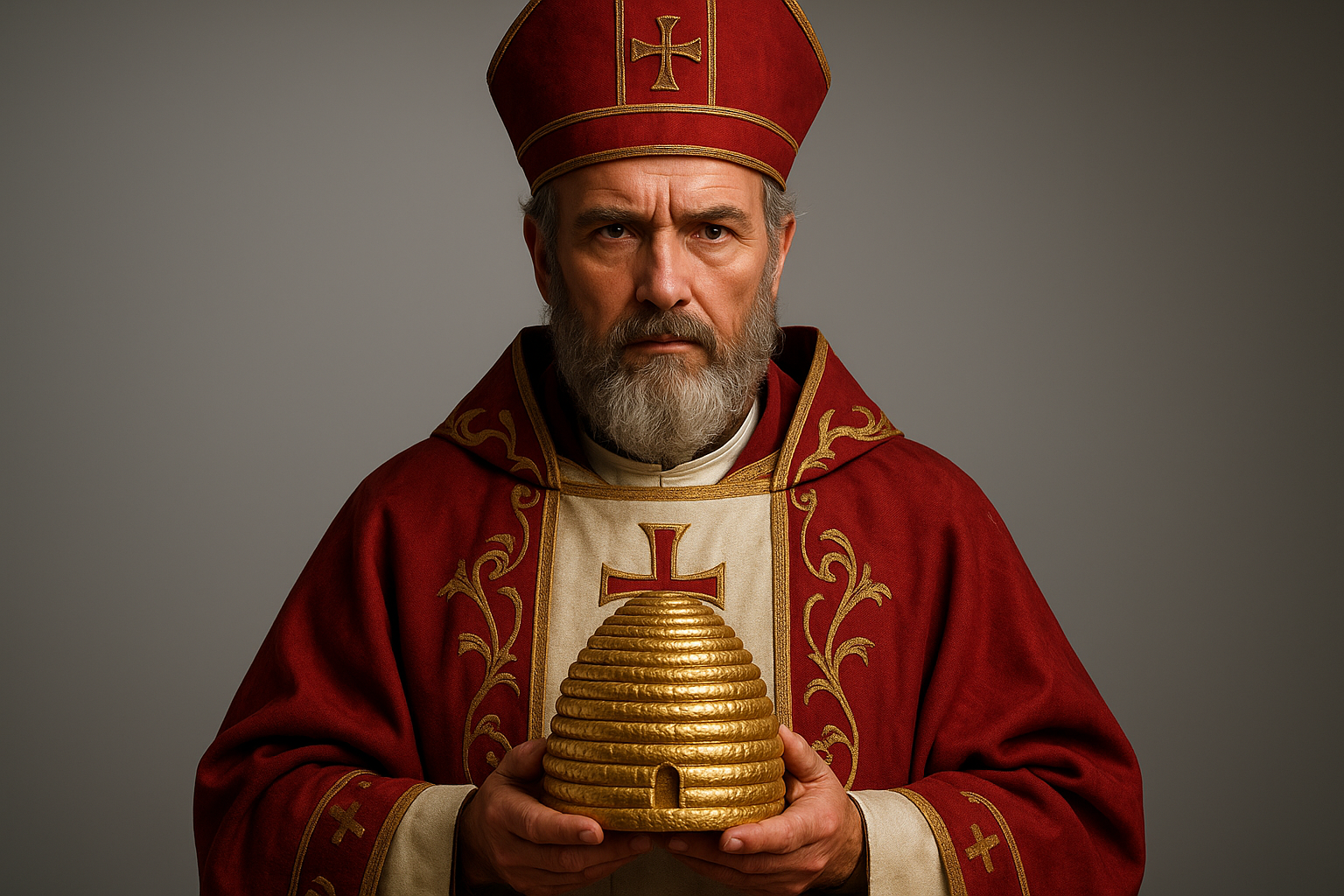
His feast day, December 7th, is a significant celebration in Milan, often marked by special Masses and cultural events. St. Ambrose is also widely recognized as the patron saint of beekeepers, a patronage stemming from a legend that as an infant, a swarm of bees settled on his face without harming him, leaving behind a drop of honey. This was interpreted as a sign of his future eloquence, as his words would be as sweet as honey. For this reason, he is also associated with candlemakers. Additionally, given his background, he is a fitting patron for civil servants, inspiring integrity and justice in public life.
Reflections for Modern Readers
St. Ambrose’s life, though lived centuries ago, offers timeless lessons for us in the 21st century. His journey reminds us that God often calls the most unlikely people to do His work, demonstrating that divine grace can equip anyone for any task.
- Embrace Unexpected Calls: Ambrose was a governor, not a priest. His dramatic call to the episcopacy shows us that God’s plans for our lives can be surprising and entirely different from what we envision.
Real-world example: Perhaps you feel a quiet nudge to volunteer for a cause you know little about, or to take on a leadership role you feel unqualified for in your parish or community. Ambrose’s story encourages us to say “yes” to these unexpected opportunities, trusting that God will provide the grace and wisdom needed.
- Stand for Truth with Charity: Ambrose fiercely defended the truth of the Catholic faith against powerful heresies and confronted emperors when they acted unjustly. Yet, he did so with wisdom and a genuine desire for their conversion and the good of the Church.
Real-world example: In an age of strong opinions and social media debates, we can learn from Ambrose to defend our faith and moral convictions with courage and clarity, but always striving for respectful dialogue and understanding, rather than simply condemnation.
- Integrity in Leadership: Ambrose’s willingness to challenge Emperor Theodosius, a figure of immense power, for his moral failings is a powerful example of integrity. He placed spiritual and moral principles above political expediency.
Real-world example: Whether in a professional setting, community leadership, or within our families, we are often faced with decisions where the easy or popular path compromises our values. Ambrose inspires us to choose the path of integrity, even when it’s difficult.
- Lifelong Learning and Growth: Despite his advanced education, Ambrose became bishop without formal theological training. He then dedicated himself to intense study, becoming a Doctor of the Church. This shows a profound commitment to continuous learning and spiritual growth.
Real-world example: In our fast-paced world, it’s easy to stop learning once formal education ends. Ambrose encourages us to remain intellectually and spiritually curious, to deepen our understanding of our faith, and to always seek growth through reading, prayer, and reflection.
- The Power of the Word: Ambrose’s eloquent preaching touched countless hearts, most famously that of St. Augustine. His ability to communicate complex truths in an accessible way demonstrates the transformative power of words spoken and lived with conviction.
Real-world example: This applies not only to formal preaching but also to how we share our faith with others, articulate our beliefs, and even how we listen and engage with meaningful communication in our daily lives.
In art and jewelry, St. Ambrose is most commonly depicted with symbols that reflect his life and legacy:
- Bees or a Beehive: This is perhaps his most recognizable symbol, stemming from the legend of bees swarming his cradle. It symbolizes his eloquent speech, wisdom, and honey-sweet words of wisdom that “fed” his flock.
- Bishop’s Mitre and Crozier (Staff): These are standard symbols for a bishop, representing his authority, pastoral role, and spiritual leadership over his diocese.
- Book or Quill Pen: As a Doctor of the Church and a prolific writer, a book or pen signifies his intellectual contributions, theological writings, and sermons.
- Scourge: This unusual symbol sometimes appears, referring to his role in making Emperor Theodosius do penance, signifying his stern moral authority and willingness to correct even the most powerful figures.
Timeline Summary
- c. 339 AD: Born in Trier, Gallia Belgica (modern-day Germany).
- c. 372 AD: Appointed Governor of Liguria and Aemilia, with his seat in Milan.
- 374 AD: Unexpectedly elected Bishop of Milan by popular acclamation; baptized, ordained, and consecrated within a week (December 7).
- 375-380s AD: Dedicated himself to theological study and became a prominent defender of Nicene orthodoxy against Arianism.
- 379 AD: Authored influential works like “On the Duties of Ministers” and “On the Sacraments.”
- 385-386 AD: Successfully resisted Empress Justina’s attempts to turn over basilicas to Arian worshipers, asserting Church autonomy.
- 387 AD: Baptized St. Augustine of Hippo after a period of profound spiritual guidance.
- 390 AD: Demanded and received public penance from Emperor Theodosius I for the Thessalonica massacre.
- 397 AD: Died in Milan on April 4.
- Pre-Congregation: Canonized as a saint and later declared a Doctor of the Church.
Scripture for Reflection
St. Ambrose’s life beautifully illustrates several scriptural themes, particularly the call to serve God regardless of one’s perceived qualifications and the importance of courageous witness.
- Jeremiah 1:7-8: “But the Lord said to me, ‘Do not say, “I am too young.” You must go to everyone I send you to and say whatever I command you. Do not be afraid of them, for I am with you to rescue you,’ declares the Lord.”
Connection: This passage powerfully resonates with Ambrose’s unexpected call. He was not “too young,” but certainly “unqualified” in the traditional sense, being a catechumen and a governor. Yet, God called him, and with God’s presence, Ambrose was able to fulfill his mission fearlessly, speaking God’s truth to all, even emperors.
- Matthew 16:18: “And I tell you that you are Peter, and on this rock I will build my church, and the gates of Hades will not overcome it.”
Connection: Ambrose’s life was a testament to the Church’s divine foundation and authority. His unwavering defense against Arianism and his insistence on the Church’s autonomy from imperial power demonstrated his firm belief that the Church, built by Christ, would stand against all challenges, both doctrinal and political.
Prayers to St. Ambrose
As a Doctor of the Church and a powerful intercessor, St. Ambrose is frequently invoked for guidance, courage, and intellectual clarity. Here is a prayer for his intercession:
Prayer to St. Ambrose
O glorious St. Ambrose, whose eloquent words and courageous deeds proclaimed the truth of Christ, we seek your powerful intercession. You were called by God from the halls of government to the sacred altar, showing us that all vocations can be transformed by divine grace. Inspire us, we pray, to always seek wisdom and understanding, especially in matters of faith. Grant us the courage to stand firm in our convictions, to defend the Church with zeal, and to uphold justice in our communities, even when it demands great sacrifice. Like you, may we be faithful shepherds and eloquent witnesses to the Gospel.
Through your prayers, help us to live lives of integrity, compassion, and unwavering devotion to Jesus Christ, our Lord. Amen.