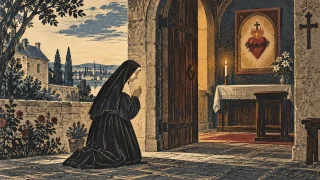
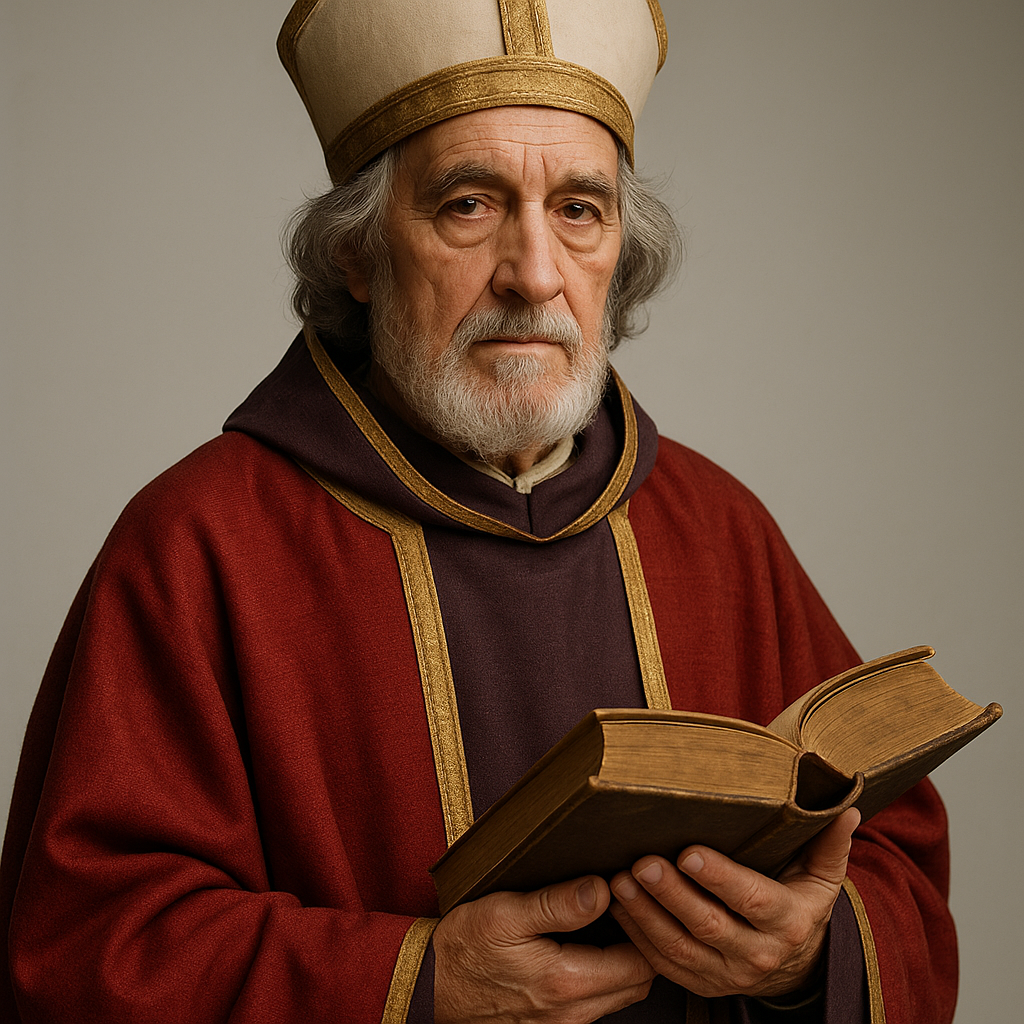
In the bustling intellectual landscape of the 11th century, a figure emerged who would forever change the way Christians understood their faith: St. Anselm of Canterbury. More than just a bishop, Anselm was a brilliant philosopher and theologian, a man whose mind sought to bridge the gap between belief and reason, famously stating that he sought “faith seeking understanding.” His life was a remarkable journey from a reluctant monk to a courageous archbishop, marked by profound intellectual contributions and unwavering defense of the Church’s freedom. This article will delve into his early life, his pivotal role in Church history, his enduring spiritual and theological legacy, and how his wisdom continues to illuminate the path for modern believers.
Quick Facts
| Category | Details |
|---|---|
| Birth | c. 1033, Aosta, Kingdom of Burgundy (present-day Italy) |
| Death | April 21, 1109, Canterbury, England |
| Feast Day | April 21 |
| Patronage | Philosophers, theologians, educators, students, the Diocese of Aosta |
| Canonized | 1494 by Pope Alexander VI (declared a Doctor of the Church in 1720 by Pope Clement XI) |
Historical Context & Early Life
St. Anselm was born around 1033 in Aosta, a town nestled in the Alps, then part of the Kingdom of Burgundy. His homeland lay at a crossroads of cultures, influenced by Italian, French, and Germanic traditions. This was a time of significant transition across Europe. The Viking Age was giving way to established kingdoms, feudalism was deeply entrenched, and the Church was undergoing a period of intense reform, notably championed by figures like Pope Gregory VII. This Gregorian Reform movement aimed to free the Church from secular control, particularly concerning the appointment of bishops, a conflict that would later define much of Anselm’s public life.
Anselm’s family was well-to-do. His father, Gundulph, was a Lombard nobleman, initially stern and worldly. His mother, Ermenberga, was a devout and virtuous woman of Burgundian descent, who instilled in young Anselm a deep love for God and the Church. From a young age, Anselm showed a brilliant mind and a strong inclination toward religious life. He recounted a childhood dream where he climbed a mountain to reach God’s throne, which seemed to foretell his spiritual aspirations. However, his desire to enter a monastery at the age of fifteen was thwarted by his father, who disapproved of his religious zeal. This paternal opposition led to a period of youthful wandering and, by his own admission, some recklessness, though he never fully abandoned his spiritual yearnings. After his mother’s death, the relationship with his father deteriorated further, making his home life unbearable.
Seeking solace and intellectual challenge, Anselm eventually left Aosta and traveled through France, drawn by the burgeoning schools and monasteries. His journey ultimately led him to the renowned Benedictine monastery of Bec in Normandy in 1059. Bec was then at the forefront of intellectual life, thanks to its brilliant prior, Lanfranc, a scholar whose reputation drew students from across Europe. Anselm, at 27, dedicated himself wholeheartedly to study and spiritual discipline under Lanfranc’s tutelage. The intellectual rigor and monastic piety of Bec provided the perfect environment for his profound mind and fervent spirit to blossom.
Calling & Key Milestones
Monk and Prior at Bec
Anselm entered the monastery of Bec as a Benedictine monk in 1060. His intellectual prowess and deep piety quickly became evident. He absorbed Lanfranc’s teachings and soon surpassed his master in philosophical and theological depth. When Lanfranc was appointed abbot of Caen in 1063, Anselm, despite being a relatively young monk, was chosen to succeed him as Prior of Bec. This was a testament to the high esteem in which he was held by the community. As prior, Anselm became not only a gifted administrator but also a beloved spiritual director and an influential teacher. It was during this period that he began to write some of his most important theological works, exploring the mysteries of faith with unparalleled clarity and rigor. His time at Bec, first as prior and later as abbot, was a golden age of intellectual flourishing, firmly establishing the monastery’s reputation as a center of learning.
Abbot of Bec
In 1078, upon the death of Herluin, the founder and first abbot of Bec, Anselm was unanimously elected as the new abbot. Under his leadership, Bec continued to thrive, attracting many new vocations and maintaining its status as a leading intellectual and spiritual center. It was during his abbacy that Anselm penned his most famous philosophical and theological treatises, including the Monologion and the Proslogion, works that grappled with the very existence and nature of God. His method, often summarized as “faith seeking understanding” (fides quaerens intellectum), sought to use reason to penetrate and articulate the truths revealed by faith, not to prove them from scratch, but to deepen comprehension for those who already believed.
Archbishop of Canterbury and the Investiture Controversy
Anselm’s quiet life of prayer, study, and monastic leadership was dramatically interrupted in 1093 when he was, much against his will, appointed Archbishop of Canterbury. The see had been vacant for several years following the death of his former mentor, Lanfranc, as King William II (William Rufus) deliberately withheld the appointment to profit from the Church’s revenues. The English bishops and nobility, desperate for spiritual leadership and weary of the king’s abuses, pressured Anselm to accept. He initially resisted, fearing the entanglement of secular politics and spiritual office, comparing himself to a weak, old sheep yoked to a wild bull (the king). However, he eventually consented, viewing it as God’s will.
His fears quickly proved true. Anselm’s tenure as Archbishop was dominated by intense conflict with King William II and later with his successor, Henry I, primarily over the Investiture Controversy. This was a widespread European dispute concerning who had the authority to appoint bishops and abbots – the Pope or secular rulers. Anselm steadfastly defended the Church’s freedom and the Pope’s spiritual authority. He refused to pay homage to the king for his spiritual office and insisted on his right to travel to Rome to consult with the Pope. His unwavering stance led to two periods of exile from England (1097-1100 under William II, and 1103-1106 under Henry I).
During his exiles, Anselm continued to advocate for Church reform and papal authority. He participated in Church councils, notably the Council of Bari (1098), where he eloquently defended the filioque clause (which states that the Holy Spirit proceeds from the Father and the Son) against Greek Orthodox objections, and the Council of Rome (1099), which condemned lay investiture. His firm but peaceable resistance eventually bore fruit. Through patient diplomacy and his steadfast example, a compromise known as the Concordat of London (1107) was reached, which served as a model for the later Concordat of Worms. It established that kings could not invest bishops with the ring and crosier (symbols of spiritual authority), but bishops would still do homage to the king for their temporal lands. This was a crucial victory for the Church’s independence.
Philosopher and Theologian: The Father of Scholasticism
St. Anselm is widely regarded as the “Father of Scholasticism,” the dominant philosophical and theological method of the medieval universities. His approach of using reason to explore and explain the truths of faith laid the groundwork for later giants like Thomas Aquinas. Beyond the Ontological Argument for God’s existence, found in his Proslogion, which attempts to prove God’s existence from the very concept of God as “that than which nothing greater can be conceived,” Anselm made profound contributions to other areas of theology.
His most significant theological work is Cur Deus Homo (Why God Became Man). In this treatise, Anselm offered a systematic explanation for the Incarnation and Atonement, moving beyond earlier ransom theories. He argued that human sin offered an infinite offense against an infinitely just God, requiring an infinite satisfaction. Since humanity, being finite, could not offer this infinite satisfaction, only God, who is infinite, could. Yet, for the satisfaction to be justly offered on behalf of humanity, it had to come from humanity. Therefore, the infinite God had to become man – Jesus Christ – to offer the perfect, infinite satisfaction for sin. This “satisfaction theory” of atonement profoundly influenced Western theology, emphasizing God’s justice, mercy, and the cosmic significance of Christ’s sacrifice. Anselm’s writings are characterized by their logical precision, deep intellectual humility, and profound reverence for the mysteries of God.
Spiritual Legacy & Theological Themes
St. Anselm’s spiritual legacy is rich and multifaceted. He exemplified a profound integration of intellect and piety, demonstrating that faith is not afraid of reason, but rather seeks its aid to understand more deeply the God it adores. The core virtues he embodied and promoted resonate deeply with Scripture and Catholic teaching.
Firstly, **intellectual humility and the pursuit of truth** were central to Anselm’s life. His famous dictum, “I believe in order to understand” (credo ut intelligam), encapsulated his method. He didn’t seek to prove God to unbelievers in the modern sense, but rather to deepen believers’ understanding, showing the inherent reasonableness and beauty of faith. This aligns with biblical wisdom literature (e.g., Proverbs 2:1-5, which speaks of seeking knowledge and understanding as hidden treasures) and the call to love God with all our mind (Matthew 22:37). Anselm’s work encourages us to engage our intellect fully in our spiritual journey, rather than compartmentalizing faith and reason.
Secondly, his **courage and steadfastness in upholding Church authority and freedom** against powerful secular rulers are a testament to his unwavering faith and moral conviction. He refused to compromise the spiritual independence of the Church, believing it was essential for its mission and the spiritual well-being of the faithful. This resonates with the prophetic tradition of the Old Testament, where prophets challenged kings in God’s name, and with Christ’s teaching about rendering to Caesar what is Caesar’s and to God what is God’s (Matthew 22:21). Anselm acted as a true shepherd, protecting his flock from worldly encroachment.
Thirdly, his **pastoral heart and deep love for God** were evident in his monastic leadership and his writings. Though a brilliant intellectual, he was also a compassionate spiritual director, known for his kindness and gentleness with his monks. His theological works, though logically rigorous, always stemmed from a place of profound adoration and desire to glorify God. His Proslogion, for instance, is as much a prayer as it is a philosophical argument. This devotion mirrors the Great Commandment to love the Lord our God with all our heart, soul, mind, and strength (Mark 12:30).
Anselm’s lasting influence on doctrine is immense. His **satisfaction theory of atonement**, as articulated in Cur Deus Homo, remains a foundational understanding of Christ’s redemptive work in Western Christianity. It highlights God’s justice in condemning sin and His boundless mercy in providing a means of salvation. This understanding deeply informs Catholic liturgy, particularly during the Paschal Triduum, emphasizing Christ’s voluntary sacrifice. In art, he is often depicted with a book or scroll, symbolizing his profound intellectual contributions, or with an archbishop’s crosier, signifying his episcopal office and his defense of the Church.
Devotion Today
While St. Anselm of Canterbury might not be associated with popular pilgrimages or Marian shrines in the way some saints are, his devotion today is profound, particularly within academic and intellectual circles of the Catholic Church. He is revered as the patron saint of philosophers, theologians, and students, and his feast day on April 21 is celebrated in many dioceses and religious communities worldwide. Universities, seminaries, and Catholic high schools often hold special lectures or Masses in his honor, recognizing his foundational contributions to Christian thought.
For those who seek to integrate faith and reason, Anselm serves as an inspiring guide. His writings, especially Proslogion and Cur Deus Homo, are still studied in philosophy and theology departments globally, not merely as historical texts, but as living works that challenge and enrich contemporary understanding of God, salvation, and human existence. Many prayer groups or intellectual societies within the Church may implicitly or explicitly draw upon his methods, using reasoned inquiry to deepen their faith. His legacy is less about physical shrines and more about the enduring spiritual and intellectual quest he initiated, encouraging believers to always seek to understand the object of their faith more fully. In this sense, every Catholic scholar or student who grapples with the mysteries of God is participating in a living devotion to St. Anselm.
Reflections for Modern Readers
St. Anselm, though living centuries ago, offers timeless wisdom for navigating the complexities of modern life. His life and work provide several actionable takeaways for us today:
- **Embrace “Faith Seeking Understanding”:** In an age where faith is often pitted against science or reason, Anselm shows us that they are not enemies but allies. He teaches us not to be afraid of asking deep, challenging questions about our faith. Rather than settling for simplistic answers or blind belief, we are called to use our intellects to explore the depths of God’s revelation. For example, a student struggling to reconcile scientific theories like evolution with their Catholic faith can draw inspiration from Anselm. Instead of choosing one over the other, they can seek to understand how truth in one realm might illuminate truth in another, deepening their appreciation for the Creator’s wisdom in both science and scripture.
- **Courage to Stand for Truth Amidst Pressure:** Anselm faced powerful kings and periods of exile for defending the Church’s independence and spiritual principles. In our own lives, we often face pressure to compromise our values, whether in the workplace, social circles, or political discourse. St. Anselm’s example encourages us to stand firm in our convictions, gently but resolutely, even when it means facing unpopularity or personal cost. A Catholic professional who refuses to participate in unethical business practices, even if it risks their career advancement, embodies Anselm’s courageous spirit.
- **Leadership Rooted in Service and Principle, Not Power:** Anselm reluctantly accepted the role of archbishop, viewing it as a heavy burden rather than an opportunity for worldly power. He led with integrity, prioritizing the spiritual well-being of his flock and the freedom of the Church over personal gain or comfort. This is a vital lesson for anyone in a position of leadership, reminding us that true authority comes from service and adherence to principles, not from dominance. A community leader who prioritizes the needs of the vulnerable members of their community over their own reputation, or a parent who consistently models moral behavior for their children, reflects Anselm’s selfless leadership.
- **The Value of Deep Reflection and Intellectual Rigor:** In a world of sound bites and superficial engagement, Anselm reminds us of the profound value of deep thought and sustained intellectual effort. His theological works are models of careful reasoning and patient exploration of complex ideas. Taking time for quiet reflection, reading challenging books, or engaging in thoughtful discussions about faith and life can enrich our spiritual journey and help us articulate our beliefs more clearly to ourselves and others. This could manifest as dedicating time each week to read a spiritual classic or participate in a Bible study that encourages thoughtful discussion, moving beyond surface-level understanding.
Common symbols of St. Anselm in art and jewelry include a **book or scroll**, often open, symbolizing his role as a profound writer, philosopher, and Doctor of the Church. This represents his intellectual contributions and his devotion to seeking truth through study. He is also frequently depicted in **archbishop’s vestments and holding a crosier**, signifying his office as Archbishop of Canterbury and his steadfast defense of the Church’s spiritual authority. Sometimes, a **dove** may be shown near him, symbolizing the inspiration of the Holy Spirit guiding his thoughts and writings. Less commonly, imagery related to **chains or exile** might be used to represent his conflicts with kings and his unwavering stance for Church freedom, which led to his banishment from England.
Timeline Summary
- **c. 1033:** Born in Aosta, Kingdom of Burgundy.
- **1059:** Arrives at the Benedictine monastery of Bec in Normandy.
- **1060:** Becomes a Benedictine monk at Bec.
- **1063:** Appointed Prior of Bec, succeeding Lanfranc.
- **c. 1077-1078:** Writes the Monologion.
- **1078:** Elected Abbot of Bec; writes the Proslogion and articulates the Ontological Argument.
- **1093:** Reluctantly accepts appointment as Archbishop of Canterbury.
- **1097:** Goes into first exile due to conflicts with King William II.
- **1098:** Attends the Council of Bari, defends the filioque clause.
- **1099:** Attends the Council of Rome, which condemns lay investiture.
- **1100:** Returns to England upon the death of William II and the ascension of Henry I.
- **c. 1100:** Writes Cur Deus Homo (Why God Became Man).
- **1103:** Goes into second exile due to continued conflicts with King Henry I over investiture.
- **1107:** Returns to England after the Concordat of London compromise.
- **April 21, 1109:** Dies in Canterbury, England.
- **1494:** Canonized by Pope Alexander VI.
- **1720:** Declared a Doctor of the Church by Pope Clement XI.
Scripture for Reflection
St. Anselm’s life beautifully illustrates the harmonious relationship between faith and reason, the courage to stand for truth, and the diligent pursuit of wisdom. The following Scripture passages resonate deeply with his virtues and intellectual journey:
Proverbs 2:1-5 (NRSVCE): “My child, if you accept my words and treasure up my commandments within you, making your ear attentive to wisdom and inclining your heart to understanding; if you indeed cry out for insight, and raise your voice for understanding; if you seek it like silver, and search for it as for hidden treasures—then you will understand the fear of the Lord and find the knowledge of God.”
Anselm truly sought insight and understanding like hidden treasures, using his brilliant mind to explore the depths of God’s truth. This passage reflects his intellectual quest guided by faith.
1 Peter 3:15 (NRSVCE): “Always be ready to make your defense to anyone who demands from you an accounting for the hope that is in you; yet do it with gentleness and reverence.”
This verse perfectly encapsulates Anselm’s method of “faith seeking understanding.” He sought to provide a rational account for the Christian hope, not through aggressive argumentation, but with profound gentleness and reverence for God’s mysteries. His theological works are precisely such “defenses” of the faith.
John 10:11 (NRSVCE): “I am the good shepherd. The good shepherd lays down his life for the sheep.”
As Archbishop of Canterbury, Anselm acted as a good shepherd, bravely defending the spiritual well-being and independence of the Church, his flock, even at great personal cost, including exile. He prioritized the integrity of the faith and the freedom of the Church over his own comfort, mirroring Christ’s self-sacrificial love for His sheep.
Prayers to St. Anselm
While there isn’t one single “official” prayer to St. Anselm widely recited like the Hail Mary, the following prayer beautifully captures his spirit and can be used to invoke his intercession:
Prayer to St. Anselm of Canterbury
O glorious St. Anselm, great Doctor of the Church,
who with profound intellect and humble heart
sought to understand the mysteries of our faith,
and courageously defended the freedom of Christ’s Church;
we implore your powerful intercession.
Inspire us, we pray, to seek God always,
to love truth above all else,
and to integrate our faith with our reason,
that we may come to a deeper knowledge and love of Him.
Help us, like you, to remain steadfast in conviction
when faced with worldly pressures,
and to speak with gentleness and reverence
when called to give an account for the hope that is within us.
Protect all philosophers, theologians, and students,
and guide educators to impart wisdom and virtue.
May your example lead us to adore God more profoundly
and serve His Church with unwavering loyalty.
Through Christ our Lord. Amen.