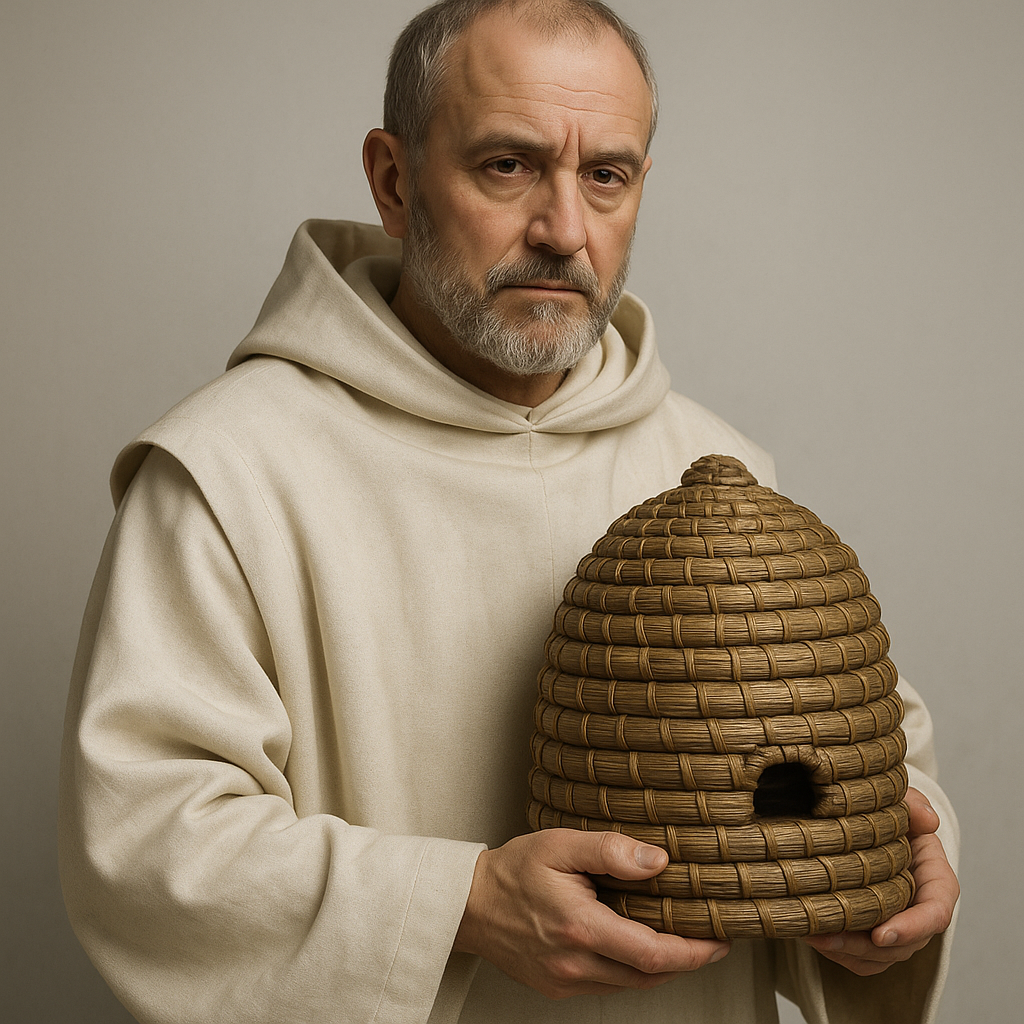
Step into the 12th century, a time of knights, cathedrals, and profound spiritual fervor, and you’ll encounter one of the most towering figures in Church history: St. Bernard of Clairvaux. Far from being a quiet monk confined to his cloister, Bernard was a spiritual dynamo, a mystic who advised popes, preached crusades, and shaped the very heart of medieval monasticism. He was a man of intense prayer and rigorous action, whose teachings on divine love and devotion to Mary continue to resonate powerfully today. This article will journey through his early life and the tumultuous world he inhabited, explore the key milestones that defined his vocation, delve into his enduring spiritual legacy, and discover how his wisdom can still guide us in our modern lives.
Quick Facts
| Category | Detail |
|---|---|
| Birth | 1090 or 1091, Fontaines-lès-Dijon, Burgundy (modern-day France) |
| Death | August 20, 1153, Clairvaux Abbey, Champagne, France |
| Feast Day | August 20 |
| Patronage | Cistercians, Bees and Beekeepers, Gibraltar, Speleologists (Cavers) |
| Canonized | January 18, 1174, by Pope Alexander III |
Historical Context & Early Life
The 12th century in Europe was a period of immense change and vibrant religious life, often called the “Golden Age of Monasticism.” The Holy Roman Empire vied for power with the papacy, chivalry was a defining social code, and intellectual curiosity was burgeoning, leading to the rise of universities. This era also saw the Crusades, attempts by Western European Christians to reclaim the Holy Land from Muslim rule, shaping both the political and spiritual landscape. Within the Church, there was a widespread desire for reform and a return to simpler, more austere forms of monastic life, moving away from the often wealthy and politically entangled Benedictine abbeys of Cluny.
It was into this dynamic world that Bernard was born around 1090 or 1091, in Fontaines-lès-Dijon, Burgundy, a region in what is now France. He hailed from a noble family with significant landholdings and influence. His father, Tescelin, was a knight in the service of the Duke of Burgundy, and his mother, Aleth, was known for her piety and charitable works. Bernard was one of seven children, six sons and one daughter. From a young age, he displayed exceptional intelligence and a sensitive, spiritual nature. He received a good education at the local school of Châtillon-sur-Seine, where he studied Latin grammar and rhetoric, preparing him for a potential career in the Church or as a scholar.
However, Bernard’s true inclination was towards a life dedicated wholly to God. He was particularly influenced by his devout mother, who instilled in him a deep love for prayer and a serious commitment to Christian virtues. Her death when Bernard was still young profoundly impacted him, intensifying his spiritual yearning. He witnessed the worldly ambitions and complexities of his family’s noble life, and while he was tempted by scholarly pursuits and the comforts of the world, he increasingly felt a powerful call to renounce these for a more radical form of Christian discipleship.
This call eventually led him away from the established wealth of Cluny and towards a newer, stricter monastic movement: the Cistercians. Founded in 1098 at Cîteaux, the Cistercian order sought to return to the literal observance of the Rule of St. Benedict, emphasizing manual labor, severe asceticism, contemplation, and a life of poverty, simplicity, and solitude in remote locations. It was this rigorous, back-to-basics approach that captured Bernard’s fervent heart, setting the stage for his extraordinary spiritual journey.
Calling & Key Milestones
Entering Cîteaux and Founding Clairvaux
In 1112, at the age of 22, Bernard made a decisive break with his former life. He presented himself at Cîteaux, but he did not come alone. His passionate conviction and persuasive eloquence had already converted 30 other young noblemen, including four of his brothers and his uncle. This influx of vocations was a miraculous boost to the fledgling Cistercian order, which was struggling for survival. Bernard’s arrival marked a turning point, infusing the community with new zeal and energy. He embraced the severe Cistercian life with absolute dedication, engaging in intense prayer, fasting, and manual labor.
His spiritual fervor and leadership qualities quickly became apparent. After only three years at Cîteaux, in 1115, the abbot, St. Stephen Harding, entrusted Bernard with the monumental task of establishing a new monastery in a desolate valley known as the “Valley of Wormwood.” Bernard renamed it “Clairvaux,” meaning “Valley of Light.” Under his inspired leadership, Clairvaux flourished, becoming the epicenter of the Cistercian reform. The sheer number of vocations that followed Bernard to Clairvaux was astounding; within a few years, he had founded dozens of daughter houses, and by the time of his death, there were 167 Cistercian monasteries throughout Europe, a testament to his charismatic influence and the compelling simplicity of the Cistercian ideal.
Theological Contributions and Marian Devotion
Beyond his administrative and spiritual leadership, Bernard was a prolific writer and theologian. He earned the title “Doctor of the Church” in 1830, centuries after his death, a rare honor bestowed upon saints whose writings are deemed to have exceptional theological significance. His works often focused on spiritual introspection, the love of God, and the humanity of Christ. He is particularly renowned for his sermons and treatises on the Song of Songs, interpreting its erotic poetry as an allegory for the soul’s loving union with God. He developed the concept of the “Four Degrees of Love,” progressing from self-love for one’s own sake to loving God for God’s sake, and ultimately loving oneself for God’s sake.
Bernard also had a profound and tender devotion to the Blessed Virgin Mary, often called the “Marian Doctor.” He saw Mary as the indispensable mediatrix of grace, the “aqueduct” through whom all graces flow from Christ to humanity. His sermons and writings on Mary are among the most beautiful and influential in Catholic tradition, portraying her not just as the exalted Queen of Heaven, but as a loving mother accessible to all. He popularized many Marian devotions and prayers, including the “Memorare,” though its precise authorship is debated, it perfectly encapsulates his Marian theology. His emphasis on Mary’s role fostered a personal and emotional connection to her among the faithful, deepening popular piety.
Church Reformer and Political Influence
Bernard’s reputation for holiness, wisdom, and uncompromising adherence to truth quickly spread beyond the monastery walls. He became an influential figure in the political and religious life of 12th-century Europe, despite his personal preference for solitude. He corresponded with kings, nobles, and popes, offering counsel, rebuke, and encouragement. Perhaps his most significant political intervention was his role in ending the papal schism of 1130, when two claimants vied for the papal throne. Bernard tirelessly championed Pope Innocent II, traveling across Europe, using his renowned eloquence to persuade rulers and clergy, ultimately securing Innocent’s universal recognition.
He was also a formidable defender of orthodox Catholic teaching, engaging in public debates against prominent theologians like Peter Abelard, whose rationalist approach to theology Bernard viewed as a threat to faith. Bernard emphasized that faith precedes understanding, arguing that intellectual pride could lead one astray. His interventions, while controversial at times, consistently aimed to preserve the purity of doctrine and the spiritual health of the Church.
Preaching the Second Crusade
One of the most complex and debated episodes of Bernard’s life was his role in preaching the Second Crusade. At the request of Pope Eugene III (a former monk of Clairvaux), Bernard traveled throughout France and Germany in 1146-1147, stirring immense enthusiasm for the crusade with his fiery sermons. He was a master orator, and his impassioned calls to arms inspired thousands to “take up the cross.” He promised spiritual rewards for those who participated, emphasizing it as a penitential act. Unfortunately, the Second Crusade was a catastrophic failure, leading to immense suffering and loss of life. Bernard was deeply grieved by the outcome and faced harsh criticism, reflecting on the mysterious ways of God and the fallibility of human endeavors even when undertaken with good intentions.
Final Years and Legacy
Bernard spent his final years at Clairvaux, physically worn out by his labors and austerities, but spiritually ever vibrant. He continued to write, advise, and guide his vast Cistercian network. He died on August 20, 1153, at the age of 63, surrounded by his monks. His last words were reportedly, “I have done nothing but evil in my life.” This profound humility, coming from a man who had accomplished so much for God and the Church, is a testament to his authentic holiness.
Spiritual Legacy & Theological Themes
St. Bernard’s spiritual legacy is vast and continues to shape Catholic spirituality. At its heart lies a profound emphasis on divine love and the contemplative pursuit of God. He is often called the “Doctor Mellifluus” (Honey-Sweet Doctor) because of the sweetness and eloquence of his teaching, particularly on the love of God. Bernard believed that God’s love is poured into our hearts, drawing us to Himself, and that our spiritual journey is a progressive ascent towards a more perfect love, culminating in mystical union. This is beautifully articulated in his “Four Degrees of Love”:
- Love of self for self’s sake: The most basic form of love, focused on personal survival and comfort.
- Love of God for self’s sake: Recognizing God as the source of our well-being and seeking Him for benefits.
- Love of God for God’s sake: A selfless love, where one delights in God for who He is, apart from personal gain.
- Love of self for God’s sake: The highest form, where one’s self-love is entirely transformed and directed towards God, desiring only God’s will.
Bernard championed humility as the foundational virtue, essential for all spiritual progress. He taught that true humility involves a profound self-knowledge, recognizing our complete dependence on God and our own sinfulness. He saw humility as the pathway to grace, leading to purity of heart and a deeper experience of God’s love.
His contributions to Marian devotion were unparalleled. He portrayed Mary as a loving, compassionate mother, accessible and intercessory, greatly influencing the popular understanding of her role in salvation history. His writings encouraged a tender, personal relationship with Mary, seeing her as the perfect model of faith and discipleship. The Cistercian emphasis on seeking God in the wilderness, through manual labor, silence, and liturgical prayer, also remains a significant part of his legacy. This balance of prayer and work (ora et labora) cultivates a robust, grounded spirituality.
Bernard’s influence extended to liturgy, encouraging a simple, austere form of worship that focused on the essence of the sacred mysteries, stripped of elaborate ornamentation. In art, he is often depicted with symbols reflecting his life: a pen or book (Doctor of the Church), a beehive (for his eloquent preaching), a lily (purity and devotion to Mary), and sometimes a chained dragon (representing his victory over heresy).
Devotion Today
St. Bernard of Clairvaux remains a profoundly revered saint in the Catholic Church and beyond. His feast day is celebrated annually on August 20th. While the original Abbey of Clairvaux suffered damage during the French Revolution and is now partly a prison, its spirit lives on in the hundreds of Cistercian and Trappist monasteries throughout the world (Trappists are a reformed branch of the Cistercians). These communities continue to live out the Benedictine Rule as interpreted by Bernard, emphasizing silence, solitude, manual labor, and contemplative prayer. Many of these abbeys offer guesthouses for retreats, allowing laypeople to experience a taste of Cistercian spirituality.
Devotion to St. Bernard is particularly strong among those seeking a deeper contemplative life, students of theology, and anyone drawn to Marian piety. Pilgrimages to sites associated with his life, though limited, often include visits to former Cistercian foundations across Europe. His writings, especially his sermons on the Song of Songs and his treatises on grace and free will, are still widely read and studied by religious and lay individuals seeking spiritual enrichment. Prayer groups and spiritual directors often recommend his works for their profound insights into the human soul’s relationship with God.
Reflections for Modern Readers
St. Bernard, though living centuries ago, offers timeless wisdom for our contemporary world. His life exemplifies virtues and practices that are profoundly relevant today:
- Embrace Humility in a Competitive World: Bernard’s insistence on humility, recognizing our dependence on God, is a powerful antidote to modern culture’s emphasis on self-reliance and achievement. In an era of social media and self-promotion, Bernard reminds us that true strength and peace come from acknowledging our limits and God’s boundless grace. Example: A young professional, instead of taking all the credit for a team success, humbly acknowledges the contributions of others and the blessings that enabled the outcome.
- Seek a Balance of Action and Contemplation: Bernard was a mystic who spent countless hours in prayer, yet he was also an active reformer, preacher, and advisor. His life demonstrates that deep prayer fuels effective action, and action, in turn, can deepen our prayer. We don’t have to choose between a life of service and a life of spiritual depth; they can and should enrich each other. Example: A busy parent dedicates 15 minutes each morning to quiet prayer or spiritual reading, finding that this time renews their energy and patience for the demands of their day.
- Cultivate a “Honey-Sweet” Devotion to Christ and Mary: Bernard’s “Doctor Mellifluus” title reminds us that faith can be both profound and profoundly beautiful. His tender devotion to Mary as a compassionate mother and his passionate love for Christ’s humanity offer a model for a heartfelt, rather than merely intellectual, faith. Example: Instead of seeing religious practices as obligations, a person intentionally focuses on the beauty of a prayer like the Rosary, reflecting on Mary’s journey with Christ, and finds it deeply comforting and joyful.
- Advocate for Truth with Charity and Conviction: Bernard was unafraid to speak truth to power, whether to popes or kings, or to challenge theological views he considered erroneous. He did so with a fiery conviction born of love for the Church, yet often tempered with pastoral concern. This inspires us to stand up for our faith and Christian values in a world often hostile to them, always striving to do so with both courage and compassion. Example: A group of friends discusses a challenging moral issue, and one individual, drawing on their faith, articulates a position rooted in Catholic teaching, doing so respectfully but firmly.
Symbols and Representations: In art, St. Bernard is commonly depicted with several meaningful symbols:
- Beehive or Bees: This is perhaps his most iconic symbol, reflecting his title “Doctor Mellifluus” (Honey-Sweet Doctor). It signifies his eloquent and persuasive preaching, his theological wisdom, and the sweetness of his spiritual teachings.
- Pen and Book (or Scroll): Represents his prolific writing and his status as a Doctor of the Church, highlighting his profound intellectual and spiritual contributions.
- Lily: A symbol of purity, often associated with his deep devotion to the Blessed Virgin Mary and his own personal chastity.
- Chained Dragon or Devil at his Feet: Symbolizes his triumph over heresy and spiritual evil, particularly his debates with figures like Abelard and his tireless work in defending orthodox doctrine.
- Monastic Habit: He is always shown in the simple white habit of the Cistercian order, emphasizing his identity as a monk and abbot.
- Tools of Labor (e.g., axe, spade): Less common, but sometimes present, recalling the Cistercian emphasis on manual labor and self-sufficiency.
Timeline Summary
- 1090/1091: Born in Fontaines-lès-Dijon, Burgundy, France.
- c. 1107: His mother, Aleth, dies, intensifying his spiritual aspirations.
- 1112: Enters the Cistercian monastery of Cîteaux with 30 companions.
- 1115: Sent by Abbot St. Stephen Harding to found a new monastery, Clairvaux, and becomes its first abbot.
- 1118-1120: Clairvaux grows rapidly, establishing its first daughter houses.
- 1130-1138: Plays a crucial role in ending the papal schism, advocating for Pope Innocent II.
- 1132: Writes “Apologia to William of St. Thierry,” defending Cistercian asceticism.
- 1135: Begins writing his influential “Sermons on the Song of Songs.”
- 1145: His former monk, Bernard of Pisa, is elected Pope Eugene III.
- 1146-1147: Preaches the Second Crusade across France and Germany.
- 1153: Dies at Clairvaux Abbey on August 20.
- 1174: Canonized as a saint by Pope Alexander III.
- 1830: Declared a Doctor of the Church (“Doctor Mellifluus”) by Pope Pius VIII.
Scripture for Reflection
St. Bernard’s life and teachings resonate deeply with several Scriptural themes, particularly those concerning humility, divine love, and Marian devotion.
Philippians 2:5-8 (Humility): “Let the same mind be in you that was in Christ Jesus, who, though he was in the form of God, did not regard equality with God as something to be exploited, but emptied himself, taking the form of a slave, being born in human likeness. And being found in human form, he humbled himself and became obedient to the point of death—even death on a cross.”
Bernard’s profound emphasis on humility as the foundation of spiritual life perfectly mirrors Christ’s self-emptying love. He taught that by humbling ourselves, like Christ, we open ourselves to God’s grace and true spiritual growth. His own famous last words, acknowledging his shortcomings, were a testament to this deep understanding of humility.
1 John 4:7-8 (Divine Love): “Beloved, let us love one another, because love is from God; everyone who loves is born of God and knows God. Whoever does not love does not know God, for God is love.”
Bernard, the “Doctor Mellifluus,” eloquently articulated the journey of the soul towards divine love. His “Four Degrees of Love” are a systematic exploration of how we move from self-centered love to a pure, selfless love of God, ultimately finding our true selves in loving Him. This passage underscores that love is the essence of God and the core of our relationship with Him, a truth Bernard passionately conveyed.
Luke 1:38 (Marian Devotion): “Then Mary said, ‘Here am I, the servant of the Lord; let it be with me according to your word.'”
St. Bernard’s tender devotion to the Blessed Virgin Mary was rooted in her perfect “fiat” – her humble acceptance of God’s will. He saw her as the supreme example of obedience and faith, and as the compassionate Mother who always leads us to Christ. Mary’s humble “yes” to God’s plan is the gateway through which salvation entered the world, making her, in Bernard’s words, the “aqueduct” of grace.
Prayers to St. Bernard of Clairvaux
Prayer for Humility and Love (adapted from St. Bernard’s writings):
O glorious St. Bernard, Doctor of divine love and mirror of humility, you who sought God with all your heart in the silence of Clairvaux, yet tirelessly served His Church with ardent zeal. Inspire us to follow your example in seeking true knowledge of ourselves and of God. Help us to shed the pride of the world and embrace the humility of Christ. Enlighten our minds to grasp the sweetness of God’s love, and inflame our hearts with an unquenchable desire for Him. Intercede for us, that we may progress through the degrees of love, loving God for His own sake, and finding our greatest joy in His holy will. Amen.
Prayer for Guidance:
St. Bernard, zealous servant of Christ and beloved Son of Mary, you were a light in your age, guiding many souls to holiness. We implore your intercession in our own lives. When we are faced with doubt or confusion, help us to discern God’s will with clarity and courage. When we are tempted by worldly distractions, strengthen our resolve to seek first the Kingdom of God. May your wisdom, which flowed like honey from your lips and pen, inspire us to live lives worthy of our Christian calling. Through your prayers, may we grow in faith, hope, and charity, and ultimately attain the eternal joy of heaven. Amen.