St. Brigid of Kildare, affectionately known as Mary of the Gaels, stands as one of Ireland’s most beloved and influential saints, a luminous figure whose life bridged the ancient Celtic world with the blossoming of Christianity. Born into a land steeped in myth and tradition, Brigid carved a path of profound compassion, radical generosity, and pioneering leadership that continues to inspire millions. This article will journey through her remarkable early life and the tumultuous historical backdrop of 5th-century Ireland, exploring the key milestones of her vocation, her enduring spiritual legacy, and the vibrant devotion she commands in the modern world. We will reflect on the timeless lessons her story offers us today and discover the rich tapestry of symbols associated with this extraordinary woman.
Quick Facts
| Attribute | Detail |
|---|---|
| Birth | c. 451 AD, Faughart, County Louth, Ireland |
| Death | c. 525 AD, Kildare, Ireland |
| Feast Day | February 1st |
| Patronage | Ireland, poets, dairy farmers, midwives, blacksmiths, healing, cattle, boatmen, fugitives, nuns, poultry farmers, travelers, and protection against fire. |
| Canonized | Pre-Congregation (Venerated since ancient times) |
Historical Context & Early Life
The Ireland into which Brigid was born around 451 AD was a land in fascinating transition. The Roman Empire, which had never conquered Ireland, had left its mark on neighboring Britain, but the Emerald Isle remained largely tribal, governed by powerful kings and chieftains, and deeply rooted in its ancient Celtic traditions. Druidism, with its reverence for nature, sacred wells, and mystical practices, was still a dominant spiritual force. However, Christianity was slowly but surely taking root, primarily through the tireless missionary efforts of figures like St. Patrick, who had arrived just a few decades before Brigid’s birth. This was a dynamic period where two distinct worldviews, paganism and Christianity, began to intertwine, creating a unique spiritual landscape that would shape Brigid’s life and legacy.
Brigid’s own family background perfectly illustrates this cultural blend. Tradition holds that her father, Dubhtach, was a pagan chieftain from Leinster, and her mother, Broicseach, was a Christian slave. It is said that Dubhtach’s wife grew jealous of Broicseach’s beauty and influence, leading him to sell Broicseach to a Druid in Faughart, where Brigid was born. This early experience of being born into a family with divided loyalties and societal challenges undoubtedly instilled in Brigid a deep empathy for the marginalized and a keen awareness of the complexities of her world. Raised initially in the household of her Druid master, Brigid learned much about the rhythms of nature and the land. However, her mother, a woman of deep faith, ensured that Brigid was introduced to Christian teachings from a young age. Even as a child, Brigid displayed an extraordinary generosity. Stories abound of her giving away her master’s butter and even her father’s prized possessions to the poor, often miraculously replenishing them shortly after. These formative experiences—her birth to a slave mother, her exposure to both pagan and Christian traditions, and her innate charitable spirit—laid the groundwork for the compassionate and powerful saint she would become.
Calling & Key Milestones
Early Miracles and Compassion
From a very young age, Brigid showed an unmistakable spiritual inclination and an overflowing heart of compassion for others. Her generosity was legendary, often pushing the boundaries of what was considered acceptable in her household. One famous story tells of Brigid, while still a young girl, giving away a large quantity of butter, a valuable commodity, to hungry beggars. When her master threatened to punish her, she prayed, and the butter miraculously reappeared in the churn, full and fresh. Another account describes her giving away her father’s jeweled sword to a leper, an act of such radical charity that it astonished even her pagan father. These early acts were not just random kindnesses; they were expressions of a profound faith that saw Christ in the face of every poor and suffering person. She instinctively understood the Gospel message of selfless love and acted upon it, demonstrating a deep trust in divine providence.
Vocation and Consecration
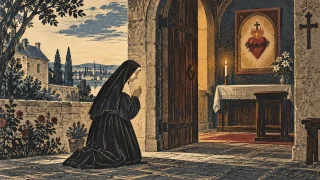
As Brigid grew, her desire for a life dedicated solely to God intensified. Despite her beauty and her father’s attempts to arrange a marriage, Brigid steadfastly refused, feeling a strong call to religious life. She sought to consecrate her virginity to God, a radical choice for a woman of her time and social standing. Around the age of eighteen, she traveled with a group of other young women to St. Mel, a bishop known for his holiness, to take her vows. During her consecration, a miraculous event is said to have occurred: when Bishop Mel laid his hands upon her head, it is believed that a pillar of fire rose from her, a sign of the Holy Spirit’s presence and her extraordinary spiritual power. This consecration marked a pivotal moment, formally dedicating her life to Christ and setting her on the path to becoming a foundational figure in Irish Christianity. She received the veil and, according to some traditions, was mistakenly ordained a bishop, though this is often understood as a symbolic recognition of her unique authority and leadership within the early Irish Church.
Founding Kildare and Her Unique Ministry
Brigid’s most significant achievement was the establishment of her monastic foundation at Kildare, which means “church of the oak.” The story goes that she asked the King of Leinster for land to build a monastery, but he was reluctant. Brigid, however, persisted, asking only for the land that her cloak could cover. Miraculously, her cloak spread out to cover many acres, a divine sign that convinced the king. Kildare became a unique and powerful double monastery, housing both men and women, led by Brigid as abbess. This was revolutionary for its time, as the abbess often held significant authority, not just over the nuns but also over the monks and even the local bishops. Kildare quickly grew into a vibrant center of learning, art, and spirituality, renowned throughout Ireland and beyond. It was a place of refuge for the poor, a school for scribes and artists (producing masterpieces like the Book of Kells, though after her time, it continued her legacy of scholarship), and a beacon of Christian faith in a still-developing landscape. Brigid’s leadership at Kildare exemplified her vision for a community founded on prayer, work, and service to others, making it a cornerstone of early Irish monasticism and a testament to her administrative and spiritual genius.
Miracles and Ministries
Beyond the founding of Kildare, Brigid’s life was characterized by numerous miracles that showcased her deep faith and compassionate heart. She was known for her healing touch, restoring sight to the blind and health to the sick. Her connection to the natural world was profound, echoing the Celtic reverence for creation. Stories tell of her calming raging storms, making barren cows give milk, and miraculously multiplying food to feed the hungry. One enduring legend speaks of her keeping a sacred flame perpetually burning at Kildare, a symbol of divine presence and enlightenment, which was maintained for centuries after her death. Her ministry extended beyond the monastic walls; she traveled throughout Ireland, preaching, baptizing, and establishing other small communities. Brigid was a spiritual mother to countless people, offering guidance, solace, and practical help. Her life was a living testament to the power of faith to transform lives and communities, blending the ancient reverence for the land with the radical love of the Gospel.
Spiritual Legacy & Theological Themes
St. Brigid’s spiritual legacy is vast and deeply rooted in core Christian virtues, resonating powerfully with scriptural themes. At the heart of her life was an extraordinary **compassion**, particularly for the poor, the sick, and the marginalized. This virtue aligns perfectly with Christ’s teaching in Matthew 25:35-40: “For I was hungry and you gave me food, I was thirsty and you gave me drink, a stranger and you welcomed me… Amen, I say to you, whatever you did for one of these least brothers of mine, you did for me.” Brigid lived this out daily through her radical generosity, giving away what little she had, always trusting that God would provide. Her miracles of multiplying food and healing were extensions of this Christ-like empathy, demonstrating God’s care for humanity through her hands.
Another defining theme in Brigid’s life was **hospitality**. Her monastery at Kildare became a renowned refuge for travelers, scholars, and those in need. This reflects the New Testament call to “welcome one another, then, as Christ welcomed you, for the glory of God” (Romans 15:7) and the injunction to “not neglect to show hospitality to strangers, for thereby some have entertained angels unawares” (Hebrews 13:2). Brigid’s hospitality extended beyond mere lodging; it was an embrace of the dignity of every person who came to her.
Furthermore, Brigid exemplified **courage and pioneering leadership**. In a patriarchal society, she founded a dual monastery for both men and women, assuming a role of spiritual and temporal authority that was groundbreaking. Her leadership demonstrated that spiritual authority is not limited by gender but by one’s commitment to Christ and service. This can be seen as an early echo of the dignity and equality of all persons in Christ, as expressed in Galatians 3:28: “There is neither Jew nor Greek, there is neither slave nor free person, there is not male and female; for you are all one in Christ Jesus.” She was a woman of strong will, vision, and unwavering faith, who used her gifts to build God’s kingdom.
Finally, Brigid’s deep connection to nature and her ability to work wonders with creation highlight a profound theme of **ecological stewardship and reverence for God’s creation**. While not a modern environmentalist, her life demonstrated a harmonious relationship with the natural world, seeing it as God’s gift to be cherished and used responsibly. This resonates with the biblical mandate in Genesis 2:15 for humanity to “cultivate and care for” the earth. Her lasting influence on liturgy, devotion, and art is undeniable. She is one of Ireland’s three patron saints, revered through the Brigid’s Cross, holy wells, and her sacred flame. Her story helped shape early Irish monasticism and contributed to a unique spiritual tradition that valued both contemplative prayer and active service in the world.
Devotion Today
Devotion to St. Brigid of Kildare remains vibrant and deeply cherished, particularly in Ireland but also among the Irish diaspora and Catholics worldwide. Her feast day, February 1st, known as Lá Fhéile Bríde in Irish, holds a special place in the liturgical calendar. It coincides with the ancient Celtic festival of Imbolc, a celebration of the awakening of spring and the return of light after winter. This blending of Christian reverence with ancient traditions further endears Brigid to many, symbolizing renewal, hope, and the promise of new life.
The primary center of devotion is Kildare, where her original monastery stood. While the original structures are long gone due to Viking raids and the dissolution of monasteries, the spirit of Brigid lives on. The Solas Bhríde Centre in Kildare, run by the Brigidine Sisters, is a modern pilgrimage site dedicated to promoting her legacy, offering hospitality, and fostering peace and justice. Here, visitors can pray at a perpetual flame, rekindled in 1993, symbolizing Brigid’s enduring light and wisdom. St. Brigid’s Cathedral in Kildare also stands on the site of her ancient foundation, continuing her spiritual presence in the town.
Throughout Ireland, numerous holy wells are dedicated to St. Brigid. These wells, often adorned with “clooties” (cloth strips tied to trees as prayers), are sites of pilgrimage where people come to pray for healing, guidance, and Brigid’s intercession. Annual pilgrimages to these wells and to Kildare itself are common, especially around her feast day, where people gather for prayer, reflection, and community. Many churches and schools across Ireland and beyond bear her name, testament to her enduring popularity and spiritual influence.
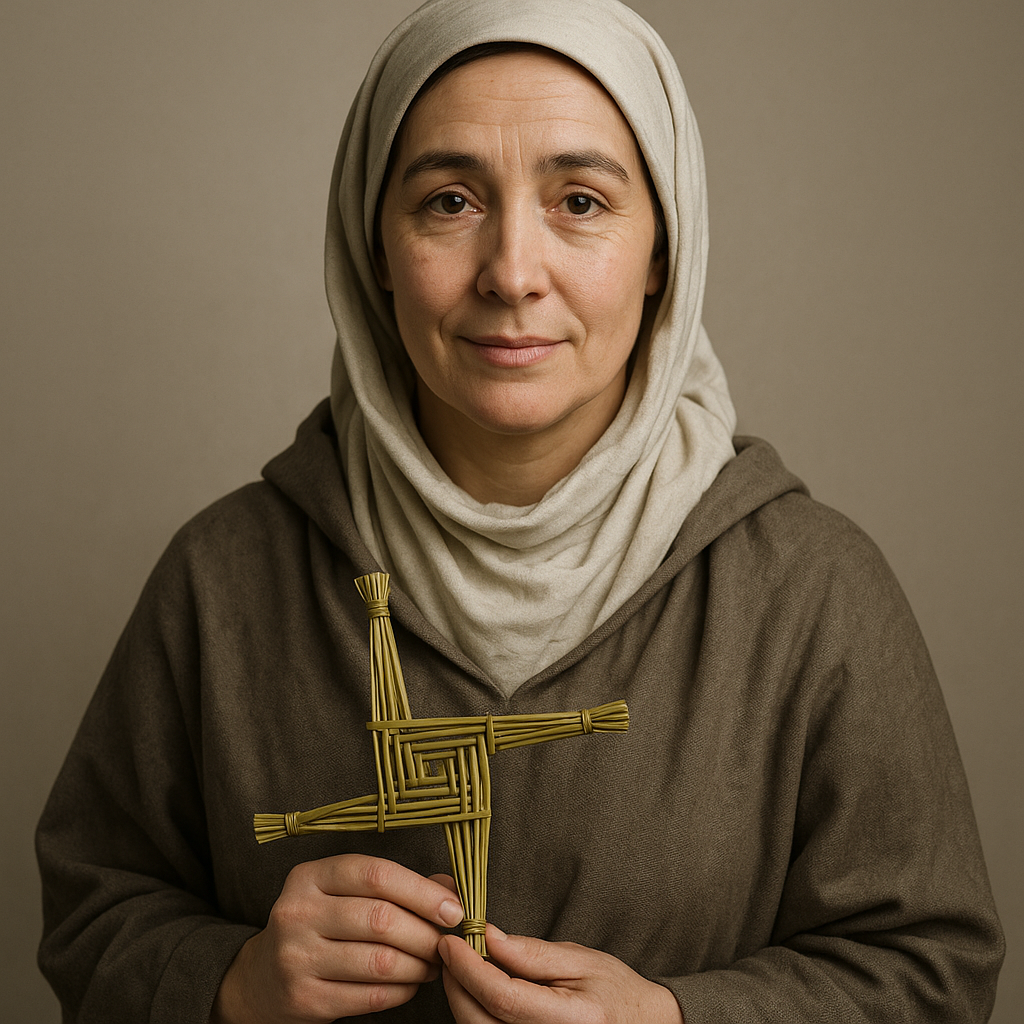
The creation of Brigid’s Crosses is perhaps the most widespread and recognizable form of devotion. Made from rushes, these simple yet meaningful crosses are traditionally woven on her feast day and hung in homes, barns, and businesses to invoke her protection from evil, fire, and hunger. The practice connects families to Brigid’s story and symbolizes the intertwining of faith with everyday life. For many, St. Brigid represents the deep spiritual roots of Ireland, a powerful female saint who embodies compassion, creativity, and connection to both humanity and the natural world, making her a relevant and beloved figure for today’s faithful.
Reflections for Modern Readers
St. Brigid’s life, though lived over 1,500 years ago, offers incredibly potent and actionable lessons for us in the 21st century. Her story is not just ancient history; it’s a vibrant blueprint for living a faith-filled and impactful life today.
1. Embrace Radical Generosity: Brigid’s willingness to give away everything, even her father’s prized possessions or her community’s food, stemmed from an unshakeable trust in God’s providence and a deep love for the poor. In our consumer-driven world, we are often encouraged to accumulate. Brigid calls us to examine our relationship with material possessions and to practice radical generosity. This could mean more than just donating to charity; it might involve sharing your time and skills with neighbors, intentionally simplifying your lifestyle to free up resources for others, or challenging yourself to give away something that feels truly sacrificial, trusting that God will provide for your true needs.
2. Cultivate a Spirit of Hospitality: Brigid’s monastery at Kildare was a haven for all, embodying an open-hearted welcome. In a world that often builds walls—social, economic, or ideological—Brigid invites us to extend genuine hospitality. This isn’t just about inviting someone to dinner. It means creating spaces, both physical and emotional, where others feel safe, seen, and valued. It could be as simple as making an effort to welcome newcomers at church, being a compassionate listener to a struggling friend, or advocating for inclusive policies in your community. Let your home, workplace, or even your social media presence be a place of welcome and understanding.
3. Lead with Compassion and Courage: Brigid was a pioneering female leader who founded a powerful monastery, demonstrating incredible administrative skill and spiritual authority in a challenging era. Her leadership was always rooted in compassion and service. Today, many of us are called to lead in various capacities—in our families, workplaces, volunteer organizations, or communities. Brigid inspires us to lead not with dominance or ego, but with empathy, integrity, and the courage to challenge the status quo when it perpetuates injustice. Consider how you can use your influence to uplift others, foster collaboration, and speak truth to power, always with a heart for the common good.
4. Reverence for Creation: Brigid’s deep connection to the earth and her miraculous interactions with animals and plants speak to a profound reverence for God’s creation. In an age of environmental crisis, Brigid reminds us of our sacred duty as stewards of the planet. This lesson encourages us to embrace more sustainable practices in our daily lives—reducing waste, conserving energy, supporting eco-friendly initiatives, and spending time in nature to rekindle our awe for creation. Her example calls us to see the divine presence in the natural world and to protect it as a precious gift.
Symbols and Representations of St. Brigid:
In art and jewelry, St. Brigid is often depicted with specific symbols that reflect her life and miracles:
- Brigid’s Cross: This distinctive cross, woven from rushes, is her most famous symbol. It signifies protection, especially from fire and evil, and is traditionally made on her feast day and hung in homes. Its circular center may also symbolize eternity and unity, reflecting the blend of Celtic and Christian traditions.
- A Lamp or Fire: This symbolizes the perpetual flame she kept burning at Kildare, representing divine wisdom, spiritual light, and the enduring presence of God. It also refers to her being a “pillar of fire” at her consecration.
- A Cow or Dairy Products (Butter, Milk): Brigid is the patroness of dairy farmers and is often associated with cows due to her numerous miracles involving milk and butter, symbolizing abundance, nourishment, and God’s provision.
- An Oak Tree: Kildare means “Church of the Oak,” and the oak tree represents strength, wisdom, and her founding of this significant spiritual center.
- A Crosier (Staff) and Book: These represent her role as an abbess, leader, and patroness of scholars and scribes, signifying her authority and the intellectual life of Kildare.
Timeline Summary
- c. 451 AD: Born in Faughart, County Louth, to Dubhtach and Broicseach.
- Childhood: Displays remarkable generosity, giving away goods to the poor, often leading to miraculous replenishment.
- Late 460s / Early 470s: Rejects marriage, feels a strong call to religious life.
- c. 480 AD: Consecrated by St. Mel, taking vows as a nun and becoming one of the first Irish women to do so.
- c. 480-490 AD: Establishes her monastic foundation at Kildare (“Church of the Oak”), a unique double monastery for both men and women, with Brigid as abbess.
- Throughout her life: Performs numerous miracles of healing, feeding the hungry, and interacting harmoniously with nature. Establishes other smaller monastic communities.
- c. 525 AD: Dies at Kildare, believed to be buried alongside St. Patrick and St. Columba in Downpatrick.
Scripture for Reflection
Matthew 25:35-40 (The Judgment of the Nations)
“For I was hungry and you gave me food, I was thirsty and you gave me drink, a stranger and you welcomed me, naked and you clothed me, ill and you cared for me, in prison and you visited me.’ Then the righteous will answer him and say, ‘Lord, when did we see you hungry and feed you, or thirsty and give you drink? When did we see you a stranger and welcome you, or naked and clothe you? When did we see you ill or in prison, and visit you?’ And the king will say to them in reply, ‘Amen, I say to you, whatever you did for one of these least brothers of mine, you did for me.’”
This passage perfectly encapsulates St. Brigid’s radical generosity and compassion. Her life was a living testament to seeing Christ in the “least of these” and responding with boundless love and practical care. She understood that true faith expresses itself in service to others, especially the vulnerable.
Luke 10:38-42 (Martha and Mary)
“As they continued their journey, he entered a village where a woman named Martha welcomed him to her home. She had a sister named Mary who sat beside the Lord at his feet listening to him speak. Martha, burdened with much serving, came to him and said, ‘Lord, do you not care that my sister has left me by myself to do the serving? Tell her to help me.’ The Lord said to her in reply, ‘Martha, Martha, you are anxious and worried about many things. There is need of only one thing. Mary has chosen the better part and it will not be taken from her.’”
While St. Brigid was known for her active service (Martha-like), her deep spiritual insights and the contemplative life fostered at Kildare also reflect Mary’s “better part”—listening to the Lord. Brigid balanced intense practical ministry with profound prayer, demonstrating that effective service flows from a rich interior life with God.
Prayers to St. Brigid
Prayer to St. Brigid
St. Brigid, you were a woman of peace.
You brought harmony where there was conflict.
You brought light to the darkness.
You brought hope to the downhearted.
May the mantle of your peace cover those who are troubled and anxious,
And may we who in our concern reach out to them
Experience your peace and the peace of Christ.
Amen.
Another Prayer to St. Brigid
Brigid, woman of Ireland,
Woman of courage and generosity,
Woman of fire and water,
Woman of peace and healing,
Woman of hospitality and creativity,
Woman of the heart and hearth.
May your spirit bless our homes.
May your flame light our way.
May your cross protect our dwellings.
May your spirit of generosity fill our hearts.
May your compassion extend through our hands.
May your mantle shelter our children.
May your care heal our sick.
May your wisdom guide our decisions.
May your love inspire our lives.
Through Christ our Lord.
Amen.