St. Anthony of Padua is one of the Catholic Church’s most beloved and widely recognized saints, a figure whose remarkable life, powerful preaching, and numerous miracles continue to inspire millions centuries after his death. Often invoked as the patron saint of lost things, Anthony’s story is far richer than this popular association suggests. Born into a noble family in Lisbon, Portugal, he embraced a life of poverty and devotion, becoming a brilliant scholar, a passionate preacher, and a compassionate shepherd of souls. This article will delve into his early life, his surprising call to the Franciscan order, his profound spiritual legacy, and the enduring devotion he receives in the modern world, offering reflections for contemporary readers and exploring the symbols that represent him.
Quick Facts
| Category | Detail |
|---|---|
| Birth | August 15, 1195, Lisbon, Portugal |
| Death | June 13, 1231, Arcella, near Padua, Italy |
| Feast Day | June 13 |
| Patronage | Lost items, barren women, Brazil, American Indians, animals, elderly people, harvests, horses, mariners, oppressed people, poor people, Portugal, shipwrecks, starving people, travellers, fish, sailors, against fevers, against sterility |
| Canonized | May 30, 1232, by Pope Gregory IX |
Historical Context & Early Life
Fernando Martins de Bulhões, who would later be known as Anthony, was born in Lisbon, Portugal, in the year 1195. This was a pivotal time in European history, the heart of the High Middle Ages. Europe was experiencing significant growth in population and urban centers, the Crusades were ongoing, and intellectual life was flourishing with the rise of universities and scholasticism. The Catholic Church itself was undergoing periods of reform and renewal, striving to address internal challenges and respond to burgeoning heresies.
Portugal, at the time of Anthony’s birth, was a young, independent kingdom, having recently asserted its autonomy from Muslim rule and from the Kingdom of León. Lisbon itself was a vibrant port city, a crossroads of cultures and ideas, though still very much a part of Catholic Christendom. The social structure was largely feudal, with a clear distinction between nobility, clergy, and commoners. Fernando’s family belonged to the nobility, providing him with a privileged upbringing and access to education, a rarity for many during this era.
From a young age, Fernando demonstrated a keen intellect and a deep piety. At the tender age of 15, he chose to forgo the path of worldly success expected of his social standing and entered the Augustinian Abbey of St. Vincent just outside Lisbon. This decision, though unusual for someone of his background, was not entirely unheard of; religious life offered a path for intellectual pursuit and spiritual devotion. He quickly became known for his studious nature, immersing himself in the study of Scripture, theology, and the writings of the Church Fathers. The Augustinians were renowned for their rigorous intellectual tradition, and Fernando thrived in this environment. He later moved to the more secluded Augustinian monastery of Santa Cruz in Coimbra, then the capital of Portugal, to further his studies and avoid distractions from his family.
Calling & Key Milestones
A Transformative Encounter with Franciscan Martyrs
While at Santa Cruz, a profound event stirred Fernando’s soul and redirected his spiritual journey. In 1220, the relics of five Franciscan friars, martyred in Morocco for their faith, were brought to Coimbra. These men, known as the Protomartyrs of the Franciscan Order, had gone to preach the Gospel in lands hostile to Christianity and had paid the ultimate price. Witnessing the veneration of these courageous friars deeply moved Fernando. He was struck by their radical commitment to Christ, their willingness to embrace poverty, and their zealous desire for martyrdom, ideals that contrasted sharply with the more settled, academic life of the Augustinians. He felt a powerful call to join the newly formed Order of Friars Minor, founded by St. Francis of Assisi, seeking a life of greater austerity and missionary zeal. With the permission of his superiors, he left the Augustinians and joined the Franciscans, taking the name Anthony, likely after St. Anthony the Great, the Desert Father.
The Journey to Morocco and Unexpected Detour
Inspired by the example of the martyrs, Anthony longed to preach the Gospel in Morocco himself. He set sail, eager to follow in their footsteps. However, God had a different plan. Soon after arriving, he became gravely ill with a severe fever and weakness, rendering him unable to continue his mission. Forced to abandon his dream of martyrdom, he embarked on a ship back to Portugal. Yet, another unforeseen twist of fate occurred: powerful storms blew his ship far off course, eventually landing him on the coast of Sicily, in southern Italy. This unexpected detour, a moment of apparent failure and dashed hopes, would prove to be a pivotal point in his life, placing him squarely in the heart of the nascent Franciscan movement.
The Hermitage of Monte Paolo and the Hidden Gift
Weakened by illness, Anthony made his way to Assisi for the great Pentecost Chapter of 1221, a significant gathering of Franciscan friars. It was here, among thousands of his brothers, that he likely saw St. Francis of Assisi in person, though they may not have spoken. After the Chapter, no one recognized Anthony’s scholarly abilities or his profound theological knowledge. He was assigned to the small, remote hermitage of Monte Paolo in Romagna, Italy, a place of quiet prayer and manual labor. For months, Anthony lived in obscurity, serving the community, cleaning, and praying, never revealing the depth of his learning. He embraced this hidden life, further cultivating humility and a deep interior union with God.
The Unexpected Preacher of Forlì
His hidden talent was revealed by accident. In 1222, Anthony attended an ordination ceremony in Forlì, where Franciscan and Dominican friars were present. Unexpectedly, the scheduled preacher fell ill, and no one else was prepared to speak. In a moment of desperation, the Provincial Superior asked Anthony, as the “least” of the friars, to give a short reflection, expecting something simple. To everyone’s astonishment, Anthony spoke with such eloquence, profound theological insight, and spiritual power that he captivated his audience. His words were clear, compelling, and deeply moving. From that moment, his life as an itinerant preacher began.
The Hammer of Heretics and the Voice of the People
St. Francis himself, upon hearing of Anthony’s gifts, formally commissioned him to preach. Recognizing Anthony’s extraordinary ability to articulate the faith, Francis also entrusted him with teaching theology to the friars, an unusual task given the order’s initial emphasis on simple humility. Anthony traveled extensively throughout northern Italy and southern France, regions deeply affected by the Cathar heresy (also known as Albigensianism), which denied the goodness of the material world and rejected many Catholic doctrines. Anthony became a tireless defender of the Catholic faith, earning the title “Hammer of Heretics.” He had a remarkable ability to explain complex theological truths in a way that ordinary people could understand, drawing them back to the Church with his captivating sermons, profound knowledge of Scripture, and fervent love for Christ.
Miracles and Wonders
Numerous miracles are attributed to St. Anthony during his lifetime, further enhancing his reputation and drawing crowds to hear him preach. Some of the most famous include:
- The Talking Fish: When people in Rimini refused to listen to his sermons, Anthony went to the seashore and preached to the fish. According to tradition, the fish gathered in the water, raising their heads above the surface as if listening attentively. This spectacle shamed the townspeople, leading many to repentance.
- The Mule and the Blessed Sacrament: To convert a skeptic who doubted the Real Presence of Christ in the Eucharist, Anthony challenged him to withhold food from his mule for three days. On the third day, Anthony presented the starving mule with the Blessed Sacrament, while the skeptic offered it oats. The mule, ignoring the food, knelt before the Eucharist, proving the presence of Christ.
- The Broken Foot Healed: A young man confessed to Anthony that he had kicked his mother. Anthony, in a moment of passionate rhetoric, exclaimed, “The foot that kicks father or mother deserves to be cut off!” Filled with remorse, the young man went home and cut off his foot. Anthony, hearing of this, rushed to the boy, prayed over him, and miraculously reattached the foot, leaving only a scar.
These stories, while perhaps embellished by popular piety, highlight Anthony’s deep faith, his commitment to spreading the Gospel, and God’s powerful working through him.
Teacher and Theologian
As mentioned, St. Francis appointed Anthony to teach theology to his friars, a role St. Francis initially hesitated to permit, fearing it would detract from the order’s commitment to humility and simplicity. However, Francis recognized the vital need for learned friars to preach effectively and combat heresy. He wrote to Anthony, stating, “I am pleased that you teach theology to the friars, provided that, as is written in the Rule, you do not extinguish the spirit of prayer and devotion.” Anthony excelled in this role, becoming one of the first and most significant teachers in the Franciscan order. His sermons and theological writings, such as his “Sermons for Feast Days” and “Sermons for Sundays,” demonstrate his vast knowledge of Scripture, patristics (writings of early Church Fathers), and scholastic theology, all presented with clarity and spiritual depth.
Last Days in Padua
Anthony spent his final years primarily in Padua, a city he deeply loved and where he had a profound impact. He continued to preach, hear confessions, and minister to the sick and the poor, exhausting himself in service to God and humanity. His health, which had always been delicate since his time in Morocco, began to decline rapidly. In 1231, at the age of 35, he died at Arcella, a small town near Padua. His last words were, “I see my Lord!” He was canonized less than a year later, in 1232, by Pope Gregory IX, a testament to his undeniable sanctity and the widespread devotion he inspired.
Spiritual Legacy & Theological Themes
St. Anthony of Padua’s spiritual legacy is rich and multifaceted. While famously known as the patron of lost things, his life exemplifies a far broader spectrum of virtues and theological themes:
Humility: Despite his extraordinary intellect and preaching gifts, Anthony consistently sought obscurity, first as an Augustinian, then living as a simple friar at Monte Paolo. His willingness to serve in menial tasks and his initial reluctance to preach demonstrate a profound humility, a virtue that truly allowed God’s grace to shine through him rather than his own ego. His life shows that true greatness in God’s eyes often begins with self-effacement.
Zeal for Souls and Evangelization: Anthony possessed an intense passion for bringing people to Christ and back to the Church. He tirelessly traveled, preaching conversion, repentance, and the joy of the Gospel. His direct engagement with heresies of his time, and his compassionate yet firm approach, serve as a model for evangelization today – speaking truth with love and clarity.
Profound Knowledge of Scripture: Anthony was truly a master of the Bible. He could quote vast passages from memory and weave them seamlessly into his sermons, illuminating complex doctrines with scriptural wisdom. He understood that Scripture is not just a book of stories, but the living Word of God that transforms hearts. His devotion inspires us to delve deeper into the Bible ourselves.
Love for the Eucharist: The miracle of the mule bowing before the Blessed Sacrament is a powerful testament to Anthony’s deep faith in the Real Presence of Christ in the Eucharist. For him, the Eucharist was the source and summit of Christian life, a constant reminder of God’s immense love and sacrifice. This devotion encourages us to approach the Eucharist with reverence and faith.
Compassion for the Poor and Marginalized: Following the example of St. Francis, Anthony embraced radical poverty and ministered tirelessly to the poor, the sick, and those on the fringes of society. He understood that faith without works is dead, and his actions consistently demonstrated a preferential option for the poor, advocating for justice and charity. This remains a core aspect of Catholic social teaching.
Synthesis of Study and Prayer: Anthony masterfully integrated intellectual rigor with deep spiritual prayer, a tension St. Francis himself acknowledged. He demonstrated that profound theological understanding, far from being a dry academic exercise, could fuel and enrich one’s spiritual life, making one a more effective instrument of God’s grace. He reminds us that faith and reason are not opposed but complementary.
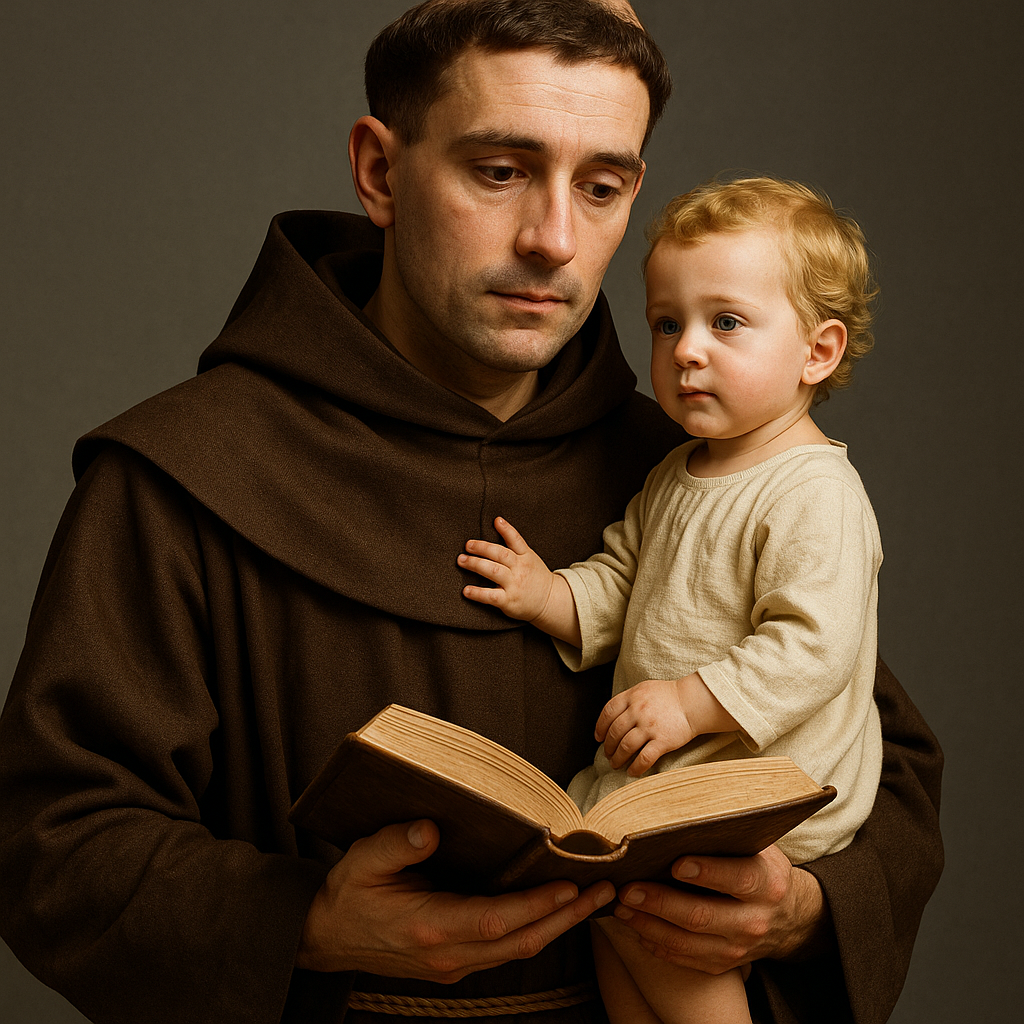
His lasting influence is significant. Though not formally declared a Doctor of the Church until 1946 (Pope Pius XII bestowed the title, recognizing his profound theological contributions), Anthony’s impact on Catholic doctrine, particularly through his sermons, is undeniable. His feast day is celebrated with great joy, and his image, often depicted with the Child Jesus, lilies, or a book, is ubiquitous in Catholic homes and churches, reminding us of his purity, wisdom, and mystical encounters with Christ.
Devotion Today
St. Anthony of Padua remains one of the most popular and beloved saints in the Catholic Church, his influence extending across continents and cultures. Devotion to him is vibrant and diverse:
Basilica of Saint Anthony in Padua: The most significant center of devotion to St. Anthony is the Pontifical Basilica of Saint Anthony of Padua in Italy. This magnificent basilica houses his tomb and relics, including his incorrupt tongue, which is remarkably preserved. Millions of pilgrims from around the world visit annually to pray at his tomb, seek his intercession, and honor his memory. It is a place of profound spiritual experience, drawing people from all walks of life.
Shrines and Churches Worldwide: Countless churches, chapels, and shrines around the globe are dedicated to St. Anthony. From grand cathedrals to small parish churches, his image and presence are found in nearly every Catholic community. These local shrines serve as centers for prayer, novenas, and community gatherings, especially on his feast day.
Annual Celebrations and Feasts: St. Anthony’s Feast Day, June 13th, is celebrated with great fervor, particularly in Italy, Portugal, and many Latin American countries. Festivities often include special Masses, street processions, blessing of lilies (a symbol of his purity), and communal meals. In Portugal, particularly Lisbon, it’s a major holiday with parades and traditional marches known as “Marchas Populares.”
“St. Anthony’s Bread”: A widespread tradition known as “St. Anthony’s Bread” involves donating money or food to the poor in thanksgiving for favors received through his intercession. This practice originated from the story of a woman who promised bread to the poor if her child, who had drowned, was restored to life. It beautifully connects the popular devotion for finding lost items with Anthony’s deep compassion for the poor, reminding us that acts of charity are a powerful way to honor him.
Patronage of Lost Items: The most common and enduring aspect of devotion to St. Anthony is his intercession for lost items. People pray to him for everything from misplaced keys to lost jobs or even a lost sense of faith. This tradition is so strong that the phrase “St. Anthony, St. Anthony, please come around, something is lost and cannot be found” is a well-known prayer. This seemingly simple devotion reflects a deeper truth: in moments of anxiety over lost possessions, people turn to a saint known for his miraculous intercession, demonstrating a fundamental trust in the communion of saints and God’s care for even the smallest details of our lives.
His universal appeal lies in his accessibility. He is seen not only as a powerful intercessor but also as a relatable figure who experienced struggles, learned from setbacks, and dedicated his life to selfless service. His story continues to offer hope and comfort to people facing difficulties today.
Reflections for Modern Readers
St. Anthony of Padua, though he lived eight centuries ago, offers timeless wisdom and actionable lessons for our modern lives:
1. Seeking What Truly Matters: While St. Anthony is the patron of lost items, his intercession isn’t just for car keys or cell phones. He teaches us to seek what is truly “lost” in our lives: lost faith, lost hope, lost peace, or a lost sense of purpose. When we feel adrift or disconnected, we can turn to St. Anthony to help us find our way back to Christ. Real-world example: A young adult grappling with anxiety and a feeling of emptiness might pray to St. Anthony not just for material possessions, but for the rediscovery of joy and meaning in their life, leading them to deeper prayer or service.
2. The Power of Your Voice (and Your Gifts): Anthony’s hidden brilliance was only discovered by accident. He reminds us that we all possess unique gifts and talents, which God intends for us to use for His glory and the good of others. Don’t be afraid to share your voice, your insights, or your skills, even if you feel unqualified or shy. You never know how God might use you. Real-world example: Someone who is a good listener might find themselves in a position to offer comfort and guidance to a struggling friend, using their gift of empathy to be a source of Christ’s love, much like Anthony used his gift of preaching.
3. Integrate Faith and Reason: Anthony was a brilliant scholar who never let his intellect overshadow his deep faith and prayer life. He shows us that intellectual pursuit and spiritual devotion are not opposing forces but complementary paths to understanding God and His creation. In our information-saturated world, he calls us to engage thoughtfully with our faith, seeking knowledge that deepens our love for God. Real-world example: A student studying science can see the intricate design of the universe as a testament to a Creator, integrating their scientific knowledge with their spiritual wonder, rather than seeing them as separate or conflicting.
4. Compassion in Action: Anthony’s life exemplified selfless service to the poor and marginalized. In a world often marked by inequality and suffering, his example challenges us to move beyond passive sympathy to active compassion. “St. Anthony’s Bread” reminds us that praying for others should lead to tangible acts of charity and justice. Real-world example: Instead of simply feeling bad about homelessness, a person might volunteer at a local shelter, donate to a food bank, or advocate for policies that help the vulnerable, embodying Anthony’s concern for those in need.
5. Embrace God’s Unexpected Plans: Anthony’s life was full of unexpected twists: illness in Morocco, being blown off course to Italy, and being unexpectedly asked to preach. Each “detour” was, in fact, God’s divine orchestration. He teaches us to be open to God’s plans, even when they disrupt our own, trusting that God can bring good out of apparent setbacks. Real-world example: Someone who loses their job might initially feel devastated, but by embracing the change and trusting in God’s providence, they might discover a new career path that is more fulfilling and aligned with their true calling.
Common Symbols and Representations:
- The Child Jesus: This is perhaps the most iconic image of St. Anthony. It represents a mystical vision Anthony had, where the Infant Jesus appeared to him. It symbolizes his profound closeness to Christ, his innocence, and the Incarnation. Often, the Child Jesus is depicted standing on a book in Anthony’s arms.
- The Lily: A white lily, often held by Anthony or the Child Jesus, is a symbol of purity, innocence, and integrity. It also represents his unwavering commitment to chastity and his opposition to heresy, which he saw as a corruption of faith.
- The Book: St. Anthony is frequently shown holding a book, symbolizing his profound knowledge of Scripture, his theological acumen, and his role as a great preacher and teacher. It signifies the Word of God that he so diligently studied and effectively proclaimed.
- Bread: While not always depicted directly, bread is a strong symbolic association due to the practice of “St. Anthony’s Bread.” It represents his charity, his concern for the poor, and the spiritual nourishment he offered through his preaching.
Timeline Summary
- 1195: Born Fernando Martins de Bulhões in Lisbon, Portugal.
- c. 1210: Enters the Augustinian Abbey of St. Vincent, Lisbon.
- c. 1212: Transfers to the Augustinian monastery of Santa Cruz in Coimbra for further study.
- 1220: Relics of Franciscan martyrs arrive in Coimbra, inspiring Fernando to join the Friars Minor, changing his name to Anthony.
- 1220: Sets sail for Morocco as a missionary but falls gravely ill.
- 1221: His ship is blown off course to Sicily, Italy. He attends the Pentecost Chapter of Assisi, likely seeing St. Francis.
- 1221: Assigned to the hermitage of Monte Paolo in Romagna, living in obscurity.
- 1222: Unexpectedly called to preach at an ordination in Forlì, revealing his oratorical and theological gifts.
- 1222-1227: Travels extensively as a preacher throughout Italy and France, combating heresy and teaching theology to the friars.
- c. 1227: Appointed Provincial Superior of Romagna, a position he reluctantly accepts for three years.
- 1230: Resigns as Provincial to dedicate himself fully to preaching and writing, settling primarily in Padua.
- 1231: Preaches his famous Lenten sermons in Padua.
- June 13, 1231: Dies at Arcella, near Padua, at the age of 35.
- May 30, 1232: Canonized by Pope Gregory IX, less than a year after his death.
- 1946: Declared a Doctor of the Church by Pope Pius XII, with the title “Evangelical Doctor.”
Scripture for Reflection
St. Anthony’s life profoundly reflected many scriptural truths. Here are a few passages that illuminate his key virtues and life’s work:
Proverbs 2:3-5 (NIV): “Indeed, if you call out for insight and cry aloud for understanding, and if you look for it as for silver and search for it as for hidden treasure, then you will understand the fear of the LORD and find the knowledge of God.”
This passage speaks to St. Anthony’s intense dedication to study and his pursuit of divine wisdom. His scholarly efforts were not merely academic but a deep quest for understanding God, which he then shared through his preaching.
Matthew 6:33 (NIV): “But seek first his kingdom and his righteousness, and all these things will be given to you as well.”
Anthony’s decision to leave a life of nobility for the austerity of religious life, and his constant focus on evangelization, perfectly embody this teaching. He sought God’s kingdom above all else, trusting that everything else would fall into place. This is especially relevant to his patronage of lost items – reminding us to prioritize spiritual “findings.”
James 1:27 (NIV): “Religion that God our Father accepts as pure and faultless is this: to look after orphans and widows in their distress and to keep oneself from being polluted by the world.”
This verse reflects Anthony’s deep compassion for the poor and marginalized, a hallmark of his Franciscan spirit. His preaching wasn’t just about doctrine; it called for concrete acts of charity and justice, aligning faith with practical love for one’s neighbor.
Prayers to St. Anthony
Here are popular prayers to St. Anthony, often recited for various intentions:
Prayer to St. Anthony for Lost Articles:
O glorious St. Anthony, you are known to possess miraculous powers and are invoked in all difficulties and distress, especially in the recovery of lost articles. I implore you to come to my aid. Restore to me what I have lost, (mention your lost item or intention), and show me your power and kindness, for which I will ever be grateful. Amen.
Novena Prayer to St. Anthony of Padua:
O Holy St. Anthony, gentlest of Saints, your love for God and charity for His creatures made you worthy, when on earth, to possess miraculous powers. Miracles waited on your word, which you were ever ready to speak for those in trouble or anxiety. Encouraged by this thought, I implmre you to obtain for me (mention your request). The answer to my prayer may require a miracle; if so, you are the Saint of miracles. O gentle and loving St. Anthony, whose heart was ever full of human sympathy, whisper my petition into the ears of the Infant Jesus, who loved to be folded in your arms, and the gratitude of my heart will ever be yours. Amen.
Say 3 Our Fathers, 3 Hail Marys, and 3 Glory Be’s.