In the vast tapestry of Catholic saints, few figures loom as large or as recently as Saint John Paul II. Born Karol Józef Wojtyła in a small Polish town, his life journey traversed the darkest chapters of the 20th century, from the shadows of Nazism and Communism to the dazzling light of the papacy. A poet, philosopher, actor, and ultimately the Vicar of Christ, John Paul II’s pontificate reshaped the Church and, indeed, the world. This article will explore his extraordinary early life, his courageous calling, the pivotal milestones of his papacy, his profound spiritual legacy, and the vibrant devotion that continues to honor him today, offering timeless reflections for a modern audience.
Quick Facts
| Attribute | Detail |
|---|---|
| Birth | May 18, 1920, Wadowice, Poland |
| Death | April 2, 2005, Vatican City |
| Feast Day | October 22 |
| Patronage | Families, young Catholics, World Youth Day, the Divine Mercy devotion, vocations, interreligious dialogue |
| Canonized | April 27, 2014, by Pope Francis |
Historical Context & Early Life
Karol Józef Wojtyła’s early life unfolded against a backdrop of immense political turmoil and personal tragedy in Poland, a nation with a deep Catholic identity but a history of occupation and suffering. Born in 1920 in Wadowice, a small town near Kraków, his childhood was marked by the end of World War I and the nascent independence of Poland. However, this fragile peace was soon shattered. In 1939, when Karol was nineteen, Nazi Germany invaded Poland, marking the beginning of World War II and a brutal occupation that would decimate his homeland and its people.
His family life was one of profound loss. His mother, Emilia, died when he was only nine years old. His older brother, Edmund, a doctor, died of scarlet fever three years later while caring for patients. His father, Karol Sr., an army officer, remained a pillar of strength and faith for his son until his death in 1941. These early experiences of bereavement, coupled with the daily horrors of the Nazi occupation – including the persecution of Jews and the suppression of Polish culture and religion – profoundly shaped the young Karol. He worked in a quarry and then in a chemical factory, often facing danger and hardship, all while secretly pursuing his intellectual and spiritual formation.
During the war, the Catholic Church in Poland became a crucial sanctuary and symbol of resistance. This period saw the underground seminary in Kraków, where Karol Wojtyła studied for the priesthood in secret, demonstrating immense courage and dedication. His personal suffering and his nation’s trials forged in him a deep empathy for humanity, a fierce commitment to human dignity, and an unshakeable faith that would define his future ministry.
Calling & Key Milestones
Karol Wojtyła’s life was a testament to a clear and unwavering calling, marked by significant events and groundbreaking achievements that would leave an indelible mark on the Catholic Church and the world.
Priesthood & Early Ministry
Despite the immense dangers of Nazi occupation, Karol Wojtyła completed his theological studies in the clandestine seminary and was ordained a priest on November 1, 1946. After further studies in Rome, he returned to Poland, where he served as a curate in various parishes, a university chaplain, and a professor of ethics at the Jagiellonian University of Kraków and the Catholic University of Lublin. His pastoral approach was marked by a deep intellectual rigor combined with a profound personal connection to young people, whom he often took on hiking and kayaking trips, engaging them in theological and philosophical discussions in informal settings.
Bishop & Cardinal
His intellectual and pastoral gifts quickly became evident, leading to his appointment as auxiliary bishop of Kraków in 1958 and archbishop in 1964. As a bishop, he participated actively in the Second Vatican Council (1962-1965), playing a significant role in drafting key documents, particularly those on religious freedom (Dignitatis Humanae) and the Church in the Modern World (Gaudium et Spes). His contributions highlighted his keen understanding of human dignity and the need for the Church to engage with contemporary challenges. In 1967, Pope Paul VI elevated him to the College of Cardinals.
Papacy & World Stage
On October 16, 1978, at the age of 58, Cardinal Wojtyła was elected Pope, becoming the first non-Italian Pope in 455 years and the first Polish Pope in history. Taking the name John Paul II, he immediately captivated the world with his vibrant personality, his intellectual depth, and his fervent spirituality. His pontificate, lasting over 26 years, was one of the longest and most impactful in Church history.
Global Travels & Role in the Fall of Communism
One of the hallmarks of his papacy was his unprecedented global travels. He visited 129 countries, becoming the most traveled Pope in history. These journeys were not mere diplomatic visits; they were pastoral pilgrimages where he preached tirelessly about human rights, justice, peace, and faith. His first pilgrimage to Poland in 1979 was a watershed moment, inspiring the Solidarity movement and fueling the democratic aspirations that ultimately contributed to the peaceful collapse of communism in Eastern Europe.
Major Teachings & Encyclicals
John Paul II was a prolific writer, issuing 14 encyclicals, numerous apostolic letters, and other documents. His teachings emphasized the inherent dignity of every human person, created in the image and likeness of God. Key themes included the “culture of life” in opposition to the “culture of death,” the importance of the family, divine mercy, and a “new evangelization” for a secularized world. His “Theology of the Body” series of catecheses offered a profound reflection on human sexuality and marriage as God’s original plan for humanity.
Attempted Assassination & Forgiveness
On May 13, 1981, John Paul II was shot and critically wounded in St. Peter’s Square by Mehmet Ali Ağca. Miraculously, he survived, attributing his life to the intercession of the Blessed Virgin Mary, whose feast day (Our Lady of Fatima) it was. His response to the attack was one of profound Christian forgiveness; he later visited Ağca in prison, offering him compassion and understanding. This act became a powerful witness to the world of Christ’s command to love one’s enemies.
Ecumenical & Interreligious Dialogue
John Paul II was a tireless champion of ecumenism (dialogue with other Christian denominations) and interreligious dialogue (dialogue with non-Christian religions). He made historic gestures, such as visiting a synagogue and a mosque, and hosting the World Day of Prayer for Peace in Assisi, bringing together leaders from diverse religious traditions to pray for peace.
World Youth Day
Recognizing the vital importance of young people for the future of the Church, John Paul II instituted World Youth Day in 1985. These international gatherings brought millions of young Catholics together from around the globe, fostering a sense of universal Church communion and inspiring countless vocations and deepened faith commitments.
Spiritual Legacy & Theological Themes
Saint John Paul II’s spiritual legacy is immense, characterized by a profound witness to Christ and a deep understanding of the human person. He exemplified numerous core virtues that resonate strongly with Scripture and Catholic teaching.
One primary virtue was his unwavering faith and trust in God, even amidst personal suffering and global crises. This echoed the trust called for in the Gospels, such as Jesus’ words in Matthew 6:25-34, urging us not to worry but to seek first the Kingdom of God. His life also powerfully demonstrated courage and conviction in defending human dignity and moral truth, confronting both totalitarian regimes and secular ideologies. This courage mirrored the apostles’ boldness in Acts, proclaiming the Good News despite persecution.
His profound devotion to the Blessed Virgin Mary was another cornerstone, encapsulated in his episcopal motto, Totus Tuus (Totally Yours). He believed that through Mary, one could draw closer to Christ. This devotion is deeply rooted in Catholic tradition, recognizing Mary’s unique role in salvation history as Mother of God and Mother of the Church.
The theme of Divine Mercy was central to his spiritual life and teaching. Having grown up in the homeland of Saint Faustina Kowalska, the apostle of Divine Mercy, John Paul II canonized her and established Divine Mercy Sunday as a universal feast day. This emphasized God’s boundless love and forgiveness, a message consistent with Scripture, particularly passages like Psalm 103:8, “The LORD is compassionate and gracious, slow to anger, abounding in love.”
His lasting influence on liturgy, devotion, art, and doctrine is multifaceted. He oversaw the publication of the Catechism of the Catholic Church, a comprehensive summary of Catholic doctrine. His “Theology of the Body” offered a groundbreaking articulation of human love, sexuality, and marriage, enriching Catholic anthropology. He fostered numerous new ecclesial movements and communities, promoting the participation of the laity. His emphasis on prayer, particularly the Rosary (adding the Luminous Mysteries), and Eucharistic adoration, revitalized devotional life for millions.
Devotion Today
Devotion to Saint John Paul II remains vibrant and widespread around the globe, a testament to his impactful life and enduring spiritual influence. Many shrines and places of pilgrimage honor his memory and legacy.
His birthplace, Wadowice, Poland, has become a significant pilgrimage site, featuring the Family Home of John Paul II Museum, which preserves his childhood home and tells the story of his early life. In Kraków, the Shrine of Divine Mercy in Łagiewniki, which John Paul II consecrated, stands as a central point for the Divine Mercy devotion he so deeply promoted. Near this shrine, the Saint John Paul II Center “Do Not Be Afraid” serves as a major pilgrimage site, housing a relic of his blood and offering exhibitions on his life and teachings.
Around the world, countless churches, schools, and hospitals are named in his honor. Statues and memorials grace public spaces and Catholic institutions on every continent. His feast day, October 22nd, is celebrated annually, often with special Masses, prayer services, and reflections on his teachings. Young people, in particular, continue to draw inspiration from him, especially through the ongoing legacy of World Youth Day, which he founded. The call to be “not afraid” and to open wide the doors to Christ continues to echo in the hearts of his devotees.
Reflections for Modern Readers
Saint John Paul II’s life offers profound wisdom and actionable takeaways that are incredibly relevant for navigating the complexities of the 21st century. His legacy encourages us to live with courage, compassion, and an unshakeable faith.
- Embrace Suffering with Faith: John Paul II experienced immense personal loss and physical suffering throughout his life, particularly in his later years. He consistently united his pain with Christ’s suffering, seeing it as a path to purification and redemption.
Real-world example: When facing personal hardship, illness, or professional setbacks, instead of despairing, we can ask for the grace to offer our difficulties to God, trusting that even in suffering, there can be growth and purpose. This doesn’t mean ignoring pain but integrating it into a larger spiritual perspective.
- Be Courageous in Defending Truth and Human Dignity: From challenging communism to championing the sanctity of life, John Paul II never shied away from speaking uncomfortable truths, always rooted in the inherent dignity of every human being.
Real-world example: In an age of relativism and rapid social change, we can draw inspiration to speak up for justice, for the marginalized, or for moral principles in our workplaces, communities, and online spaces, even when it is unpopular. This requires thoughtful engagement, not aggressive confrontation.
- Cultivate a Deep Prayer Life and Devotion to Mary: His papacy was marked by profound personal prayer and a well-known devotion to the Blessed Mother. He saw prayer not as an escape from the world, but as the source of strength to engage with it.
Real-world example: In our busy lives, we can commit to carving out intentional time for daily prayer, whether it’s a few minutes of silent reflection, reciting the Rosary, or attending daily Mass. This spiritual discipline can anchor us and provide clarity and peace amidst daily demands.
- Forgive Unconditionally: His act of forgiving his would-be assassin, Ali Ağca, was a powerful witness to the world of Christian love and mercy.
Real-world example: In a world often marked by resentment and division, we can strive to practice forgiveness in our personal relationships, letting go of grudges and seeking reconciliation. This isn’t always easy, but it’s a path to healing and freedom, both for ourselves and for others.
- Engage with the World, Bringing Christ’s Message: John Paul II’s global travels and engagement with diverse cultures exemplified his belief that the Church must go out to the world to share the Gospel, not retreat from it.
Real-world example: We can seek to be “salt and light” in our everyday environments. This might mean initiating conversations about faith respectfully, serving those in need in our local community, or using our talents and professions to contribute positively to society, animated by our Christian values.
Symbols and Representations
In art and jewelry, Saint John Paul II is commonly depicted with several recognizable symbols:
- Papal Vestments and Mitre: These symbolize his office as Pope and his authority as the leader of the Catholic Church. They represent the continuity of the Petrine ministry.
- Pastoral Staff (Crozier): He famously used a distinctive, modern-looking crozier with a crucifix at the top, representing his role as a shepherd guiding his flock.
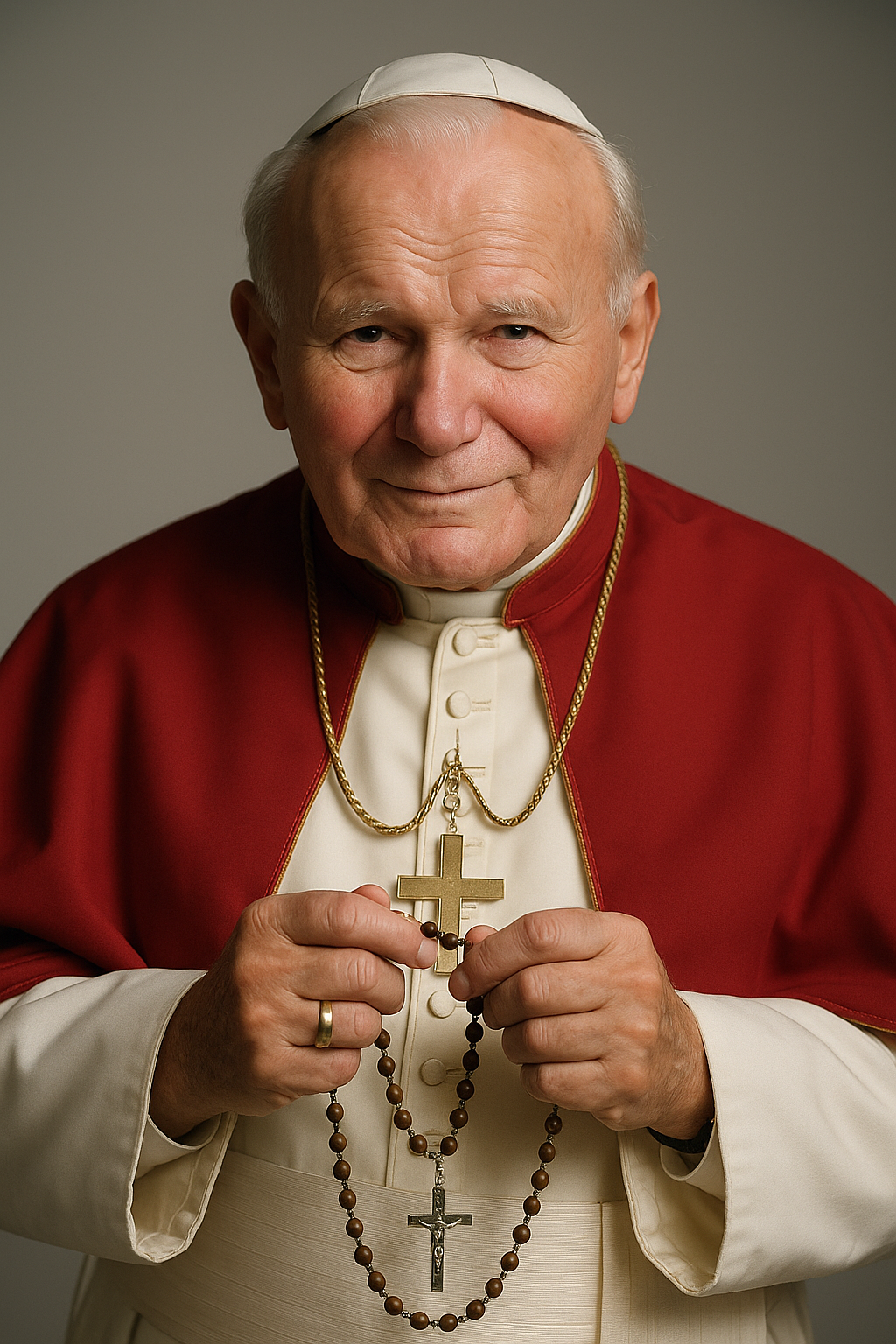
- Cross and Rosary: These highlight his deep personal piety and devotion, especially to the Rosary, which he encouraged all Catholics to pray, even adding the Luminous Mysteries.
- “Totus Tuus” Motto: His personal motto, meaning “Totally Yours,” referring to his consecration to the Blessed Virgin Mary, is often inscribed or referenced, symbolizing his profound Marian devotion.
- Image of Divine Mercy: Given his role in promoting the Divine Mercy devotion and canonizing Saint Faustina, he is sometimes shown in proximity to or reflecting on the image of Christ with rays of red and pale light emanating from his heart.
Timeline Summary
- May 18, 1920: Born Karol Józef Wojtyła in Wadowice, Poland.
- April 13, 1929: His mother, Emilia, dies.
- December 5, 1932: His elder brother, Edmund, dies.
- September 1939: Nazi Germany invades Poland, beginning World War II.
- February 18, 1941: His father, Karol Sr., dies.
- November 1, 1946: Ordained a priest in Kraków.
- July 4, 1958: Appointed Auxiliary Bishop of Kraków.
- 1962-1965: Participates in the Second Vatican Council.
- January 13, 1964: Appointed Archbishop of Kraków.
- June 26, 1967: Elevated to Cardinal by Pope Paul VI.
- October 16, 1978: Elected Pope, taking the name John Paul II.
- June 2-10, 1979: First pastoral visit to Poland, inspiring the Solidarity movement.
- May 13, 1981: Survives an assassination attempt in St. Peter’s Square.
- 1985: Institutes World Youth Day.
- October 27, 1986: Convenes the first World Day of Prayer for Peace in Assisi.
- December 25, 1989: Issues Encyclical Redemptoris Missio on the permanent validity of the Church’s missionary mandate.
- December 8, 1998: Begins the Great Jubilee Year 2000.
- April 30, 2000: Canonizes Saint Faustina Kowalska and establishes Divine Mercy Sunday.
- April 2, 2005: Dies in Vatican City.
- May 1, 2011: Beatified by Pope Benedict XVI.
- April 27, 2014: Canonized by Pope Francis.
Scripture for Reflection
Saint John Paul II’s life and teachings beautifully illuminate several passages from Scripture:
- John 13:34-35: “A new command I give you: Love one another. As I have loved you, so you must love one another. By this everyone will know that you are my disciples, if you love one another.”
This passage connects deeply with John Paul II’s tireless advocacy for human dignity, his calls for peace, and his groundbreaking ecumenical and interreligious dialogues. His entire papacy was a testament to the transformative power of Christian love, especially his embrace of his assassin.
- Matthew 10:28: “Do not be afraid of those who kill the body but cannot kill the soul. Rather, be afraid of the One who can destroy both soul and body in hell.”
The famous phrase “Be not afraid!” was a recurring theme in John Paul II’s pontificate, first uttered powerfully at his inaugural Mass. Having lived under totalitarian regimes, he understood the true nature of fear and courage, inspiring millions to stand firm in their faith and convictions, valuing spiritual integrity over worldly safety.
- Luke 1:38: ““I am the Lord’s servant,” Mary answered. “May your word to me be fulfilled.” Then the angel left her.”
Mary’s ‘fiat’ or ‘yes’ to God’s will profoundly shaped John Paul II’s spirituality. His motto Totus Tuus (Totally Yours), dedicated to Mary, reflected his deep trust in her intercession and his conviction that giving oneself completely to Mary leads one more perfectly to Christ. Her example of humble obedience and courageous faith was a guiding light for him.
Prayers to Saint John Paul II
A common prayer for the intercession of Saint John Paul II:
O Saint John Paul, from the window of heaven, grant us your blessing!
Bless the Church that you loved and served and guided, courageously leading her along the paths of the world in order to bring Jesus to everyone and everyone to Jesus.
Bless the young, who were your great passion. Help them to dream again, to set out again, to find new strength in Christ, so that they can build a future of hope.
Bless families, bless every family! You foresaw the devil’s assault against this vital and indispensable sanctuary, and you defended it with your prophetic witness. May your intercession strengthen and protect them.
Pray for us, that we may be instruments of justice, peace, and reconciliation in our world. Grant us the grace to respond generously to God’s call, to persevere in prayer, and to live lives worthy of the Gospel of Christ.
Amen.