Step into the vibrant world of St. John Bosco, affectionately known as Don Bosco, a saint whose heart beat for the young and the marginalized. Born into humble beginnings in 19th-century Italy, he dedicated his entire life to uplifting forgotten boys and girls, offering them not just education and skills, but also hope, love, and a pathway to God. His innovative approach to education, known as the “Preventive System,” transformed countless lives and continues to inspire educators and youth workers globally. This article will journey through Don Bosco’s remarkable life, explore his profound spiritual legacy, delve into his enduring influence on modern Catholic devotion, and offer reflections on how his wisdom remains strikingly relevant for us today.
Quick Facts
| Category | Detail |
|---|---|
| Birth | August 16, 1815, Becchi, Piedmont, Kingdom of Sardinia (modern Italy) |
| Death | January 31, 1888, Turin, Italy |
| Feast Day | January 31 |
| Patronage | Youth, educators, apprentices, editors, students, magicians, juvenile delinquents |
| Canonized | April 1, 1934, by Pope Pius XI |
Historical Context & Early Life
The early 19th century in Europe was a time of immense change and upheaval, and Italy was no exception. Born in 1815, St. John Bosco entered a world grappling with the aftermath of the Napoleonic Wars and the rise of industrialization. His home region of Piedmont, part of the Kingdom of Sardinia, was a patchwork of social and political tensions. The “Risorgimento,” the movement for Italian unification, was gaining momentum, often leading to friction between secular nationalist aspirations and the established Church.
For the common people, this era brought both promise and hardship. Industrial centers like Turin, where Don Bosco would later do much of his work, swelled with migrants seeking employment, often leading to overcrowded slums, rampant poverty, and a heartbreaking increase in abandoned and exploited children. These young people, many orphaned or left to fend for themselves, faced lives of illiteracy, crime, and despair. There were few social safety nets, and formal education was largely reserved for the wealthy. The Church, while a powerful presence, often struggled to meet the vast material and spiritual needs of such a rapidly changing society.
Giovanni Melchiorre Bosco’s own beginnings were humble. He was born into a peasant family in Becchi, a small hamlet near Castelnuovo d’Asti. His father, Francesco, died when Giovanni was just two years old, leaving his strong, devout mother, Margherita Occhiena, to raise him and his two older brothers during extremely difficult times. Mamma Margherita was a pivotal figure in Don Bosco’s life, instilling in him deep faith, compassion, and a practical approach to life’s challenges. She taught him the importance of prayer, hard work, and kindness, often saying, “Put your trust in God, and you will never lack anything.” Giovanni’s early experiences of poverty and the need for self-reliance would profoundly shape his future ministry, giving him a unique empathy for the struggling youth he would later serve.
Calling & Key Milestones
From a very young age, John Bosco felt a unique calling, a sense that God had a special plan for him, particularly involving children. This calling was dramatically foreshadowed in a dream he had at the age of nine, a dream that would guide his entire life’s work.
The Dream at Nine Years Old
In this vivid dream, young Giovanni found himself in a large field filled with a rowdy group of boys who were cursing and fighting. He tried to quiet them with his fists, but a majestic figure, appearing as a man in white, told him, “Not with blows, but with charity and kindness, you must win these friends of yours.” The man then revealed himself as Jesus. Soon after, a beautiful lady, whom he recognized as Mary, appeared and instructed him further, saying, “Make yourself humble, strong, and robust, and what you see happening to these wolves, you will do to my lambs.” The boys then transformed into wild animals and then back into lambs, symbolizing the transformation he was called to bring about in wayward youth.
Priesthood and the Oratory in Turin
Despite significant financial struggles and opposition from some family members, John Bosco pursued his vocation to the priesthood. He worked various jobs, studied diligently, and was finally ordained a priest in 1841. Settling in Turin, he was immediately confronted by the stark reality of the city’s poor and abandoned boys. Many were orphans, factory workers with no homes, or delinquents living on the streets. Don Bosco was deeply moved by their plight and began gathering them, initially in improvised spaces, to offer them catechism lessons, games, and a warm meal.
This informal gathering soon evolved into the “Oratory of St. Francis de Sales.” It was a movable feast in its early days, constantly searching for a stable home. Don Bosco’s gentle nature, infectious enthusiasm, and genuine love drew hundreds of boys. He provided not just religious instruction, but also practical skills, recreation, and a safe haven from the dangers of the street. Crucially, he listened to them, played with them, and showed them that they were loved and valued. This was the nascent stage of his groundbreaking educational philosophy.
Founding the Salesian Society (Salesians of Don Bosco)
As the Oratory grew, Don Bosco realized he couldn’t manage the ever-increasing number of boys alone. He needed collaborators who shared his vision and dedication. In 1859, he founded the Society of St. Francis de Sales, popularly known as the Salesians of Don Bosco. This religious congregation of priests and brothers was specifically dedicated to the education and evangelization of young people, especially the poor and abandoned. The Salesians were characterized by their active presence among the youth, their joyful spirit, and their commitment to Don Bosco’s unique educational method.
The Preventive System of Education
Central to Don Bosco’s work was his revolutionary educational approach, the “Preventive System.” In contrast to the punitive methods common at the time, which relied heavily on fear and punishment, Don Bosco’s system was built on three pillars: Reason, Religion, and Loving-Kindness (amorevolezza in Italian). It focused on preventing misbehavior through constant presence, genuine affection, and creating an environment where boys felt loved, understood, and encouraged to do good. Discipline came from respect and a desire to please, rather than fear. He believed that with enough love and guidance, every child could thrive and discover their full potential, both humanly and spiritually.
Founding the Daughters of Mary Help of Christians (Salesian Sisters)
Don Bosco’s vision extended to girls as well. Recognizing their distinct needs and the limited opportunities available to them, he co-founded the Daughters of Mary Help of Christians (also known as the Salesian Sisters) in 1872 with St. Mary Mazzarello. This congregation adopted the same Preventive System to educate and care for girls, providing them with academic instruction, vocational training, and spiritual formation. Today, both the Salesians and the Salesian Sisters are global organizations, serving millions of young people across every continent.
Missionary Zeal and Miracles
Don Bosco’s influence quickly spread beyond Italy. He sent his Salesians to missions around the world, beginning with Argentina in 1875, to serve indigenous populations and immigrant communities. Throughout his life, Don Bosco was also known for his extraordinary spiritual gifts, including prophecies, visions, and instances of miraculous provision and healing. Many witnessed his ability to multiply food, predict future events, and even appear in two places at once. These accounts, documented by his contemporaries, underscored his deep connection to God and bolstered the faith of those who followed him.
Spiritual Legacy & Theological Themes
St. John Bosco’s spiritual legacy is vast and deeply integrated with his practical ministry. At its heart lies a profound commitment to the salvation and holistic development of young people, rooted in a joyful and optimistic Catholicism.
Core Virtues and Their Alignment: Don Bosco exemplified numerous virtues, but perhaps the most prominent were charity, hope, and prudence. His boundless charity was evident in his unwavering love for the boys and girls he served, seeing in each of them the face of Christ. He poured himself out completely, often working himself to exhaustion, driven by an evangelical zeal to save souls, especially those most at risk. This aligns perfectly with Christ’s command to “love one another as I have loved you” (John 15:12) and the Church’s teaching on the preferential option for the poor.
His hope was unwavering, even in the face of incredible obstacles and criticisms. He firmly believed in the innate goodness of every young person and in God’s provident care. He taught his boys to trust in divine providence, reminding them that God never abandons those who seek Him. This hope is deeply scriptural, echoing passages like Jeremiah 29:11, “For I know the plans I have for you,” declares the Lord, “plans to prosper you and not to harm you, plans to give you hope and a future.”
Prudence guided his innovative educational methods. He didn’t just act on good intentions but carefully planned, adapted, and sought wise counsel. He understood the psychological needs of children and teenagers, developing a system that was both effective and deeply compassionate, a true integration of faith and reason.
Lasting Influence: Don Bosco’s theological themes center on a practical, incarnational spirituality. He taught that holiness is attainable in everyday life, even for young people, through small acts of virtue, joyful service, and fervent prayer. He famously encouraged his boys to “be good, study, and be joyful.”
His devotion to Mary Help of Christians (Maria Ausiliatrice) is another cornerstone of his legacy. He considered Mary the true foundress and protector of his work, attributing countless graces and miracles to her intercession. He actively promoted this Marian devotion, encouraging daily prayer of the Rosary and reliance on Mary’s maternal care. This Marian devotion is an integral part of Salesian spirituality worldwide.
He also championed a deep love for the Eucharist and frequent reception of Communion, alongside regular Confession. These sacraments were, for him, essential sources of spiritual strength and grace, particularly important for young people navigating a challenging world. His emphasis on the Sacraments and Marian devotion continues to shape Salesian liturgy, prayer life, and formation programs.
Devotion Today
St. John Bosco’s influence has only grown since his death, making him one of the most beloved and widely recognized modern saints. Devotion to Don Bosco is global, driven by the enduring work of the Salesian congregations and the countless lives he continues to inspire.
The epicenter of this devotion is the magnificent Basilica of Mary Help of Christians in Turin, Italy. This grand church, built by Don Bosco himself, houses his tomb and is a major pilgrimage site for Salesians, alumni, and admirers from around the world. Every year, especially around his feast day, pilgrims flock to Turin to pray at his tomb and seek his intercession. The entire Valdocco complex, where Don Bosco began his work, serves as a living museum and spiritual center, preserving his rooms, the first chapel (St. Francis de Sales), and the original Salesian printing press.
Annual celebrations of Don Bosco’s feast day on January 31st are observed with great solemnity and joy in Salesian schools, parishes, and communities worldwide. These celebrations often include special Masses, youth festivals, plays, and sporting events, reflecting Don Bosco’s spirit of joyful education and evangelization. Many schools hold “Don Bosco Week” with various activities emphasizing his educational principles.
Beyond Turin, thousands of Salesian educational institutions—schools, colleges, vocational training centers, youth centers, and orphanages—bear his name and operate on his principles in over 130 countries. These institutions serve as beacons of hope and development, continuing his mission to educate and form young people, especially the most needy. Many of these sites also have local shrines, statues, and chapels dedicated to St. John Bosco, fostering local devotion.
His writings, particularly his biographical sketches of his boys and his educational texts, are still widely read and studied. His impact extends beyond the Catholic Church, influencing secular education and youth work through his practical insights into adolescent psychology and effective mentoring.
Reflections for Modern Readers
St. John Bosco, though he lived in the 19th century, offers timeless wisdom that resonates powerfully with the challenges and opportunities of the 21st century. His life provides actionable lessons for anyone seeking to live a more purposeful and impactful life.
1. The Power of Positive Relationships: Don Bosco taught that true education and formation happen within a relationship built on trust, respect, and unconditional love. For us, this means prioritizing genuine connection with those around us, especially children and young people. In an age of digital screens, taking the time to truly listen, offer encouragement, and be a consistent, loving presence can be transformative. Think of a teacher who goes the extra mile to connect with a struggling student, or a parent who carves out quality time with their teenager amidst busy schedules.
2. Joy as a Spiritual Path: Don Bosco believed that holiness and happiness are not separate but intertwined. He fostered an atmosphere of joy, play, and celebration, even amidst poverty and hardship. In a world often marked by anxiety and cynicism, Don Bosco reminds us that joy is a gift from God and a powerful witness. We can practice this by finding gratitude in small things, embracing healthy recreation, and approaching our daily tasks with a spirit of cheerfulness, like someone who chooses to laugh and play with their family after a stressful day at work.
3. The Value of Mentorship and Accompaniment: Don Bosco didn’t just lecture his boys; he walked alongside them, sharing their lives, playing their games, and guiding them through their struggles. This emphasizes the importance of mentorship in all aspects of life. Whether as a formal mentor, a compassionate friend, or an involved family member, we can seek to accompany others, offering guidance, support, and a steady presence. Consider how a seasoned professional takes a younger colleague under their wing, helping them navigate career challenges with wisdom and support.
4. Holiness in the Ordinary: Don Bosco’s vision of holiness was not reserved for monks in monasteries but was accessible to everyone, especially young people living active, busy lives. He encouraged his boys to find God in their studies, work, and play, turning everyday actions into opportunities for spiritual growth. This teaches us that our daily responsibilities—our jobs, our family duties, our interactions—can be pathways to sanctity. It’s the parent who diligently cares for their children, the student who applies themselves to their studies, or the worker who performs their duties with integrity, all done with a loving heart towards God.
Common Symbols and Their Meanings:
- Boys and Girls: Often depicted surrounded by children, symbolizing his lifelong dedication to youth and his role as their father, teacher, and friend.
- Book or Scroll: Represents his commitment to education, his role as an author, and the importance of learning and catechism.
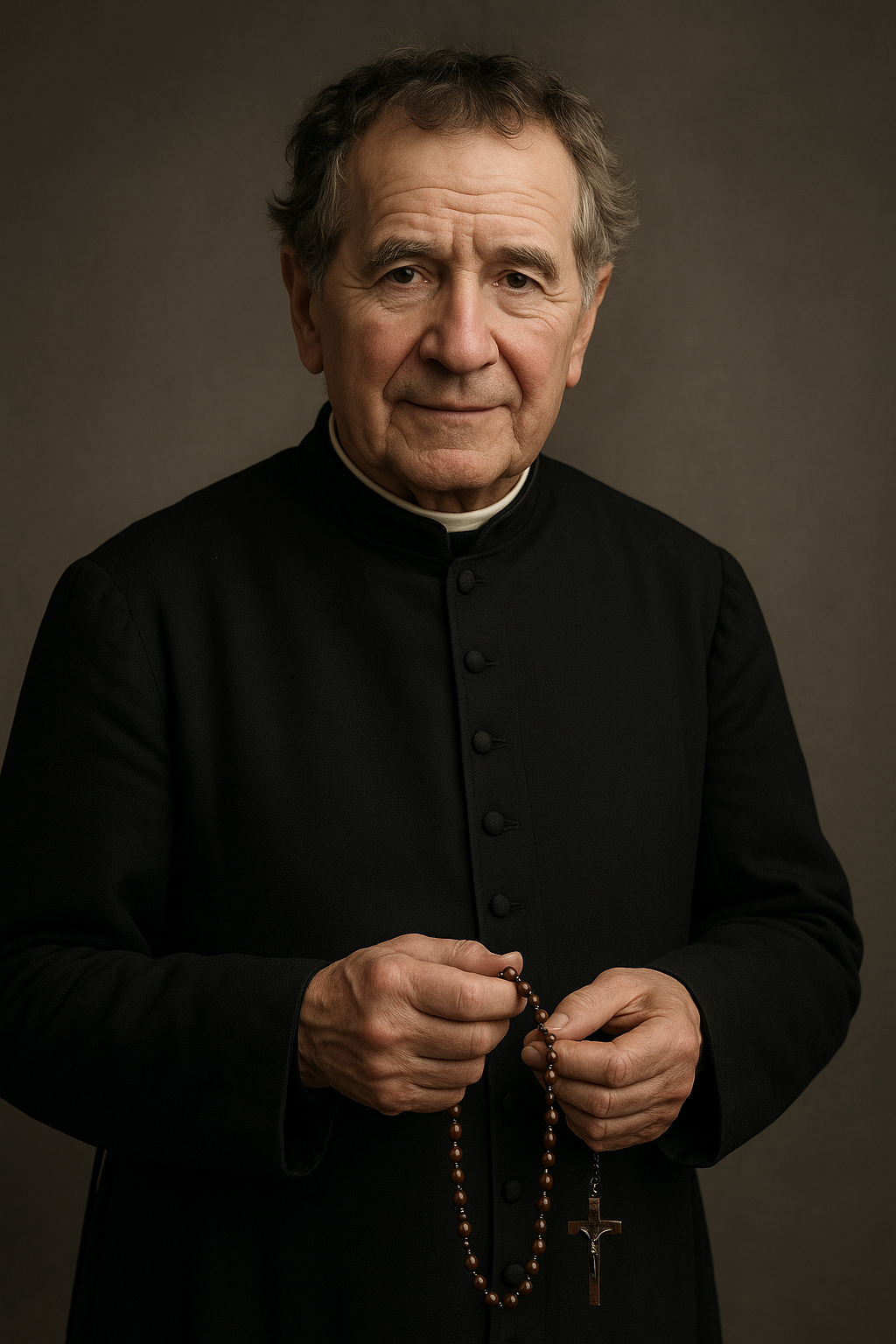
- Rosary or Cross: Signifies his deep faith, his devotion to Mary Help of Christians, and the central role of prayer in his life and educational system.
- Dog (Grigio): A large, mysterious dog named Grigio often appeared to protect Don Bosco from harm, especially during his early years. It symbolizes divine providence and protection in the face of danger.
- School Building or Workshop Tools: Represents the Salesian oratories and vocational schools he founded, emphasizing practical skills and a safe, productive environment for young people.
Timeline Summary
- 1815: Born Giovanni Melchiorre Bosco in Becchi, Piedmont.
- 1817: His father, Francesco Bosco, dies.
- 1835: Enters the seminary at Chieri.
- 1841: Ordained a priest in Turin; begins his apostolate among poor boys.
- 1844: Establishes the first stable Oratory of St. Francis de Sales in Valdocco, Turin.
- 1859: Founds the Society of St. Francis de Sales (Salesians of Don Bosco).
- 1863: Begins construction of the Basilica of Mary Help of Christians in Turin.
- 1872: Co-founds the Daughters of Mary Help of Christians (Salesian Sisters) with St. Mary Mazzarello.
- 1875: Sends the first Salesian missionaries to Argentina.
- 1888: Dies in Turin, Italy, on January 31st.
- 1929: Beatified by Pope Pius XI.
- 1934: Canonized a saint by Pope Pius XI on Easter Sunday.
Scripture for Reflection
St. John Bosco’s life beautifully echoes several scriptural themes, especially those concerning love for the marginalized and the call to nurture young souls.
Matthew 19:14: “But Jesus said, ‘Let the little children come to me and do not hinder them, for to such belongs the kingdom of heaven.'”
Connection: This passage perfectly encapsulates Don Bosco’s entire mission. His work was a living embodiment of Jesus’ invitation to children, creating a welcoming and safe environment where they could encounter God and grow in faith, free from the societal obstacles that often hindered them.
Proverbs 22:6: “Train up a child in the way he should go; even when he is old he will not depart from it.”
Connection: This proverb highlights the profound impact of early formation and education, a truth Don Bosco understood intimately. His Preventive System aimed to “train” children not just academically, but also morally and spiritually, laying a foundation that would guide them throughout their lives.
1 John 4:7-8: “Beloved, let us love one another, for love is from God, and whoever loves has been born of God and knows God. Anyone who does not love does not know God, because God is love.”
Connection: Don Bosco’s entire approach was steeped in loving-kindness (amorevolezza). He saw love not merely as a sentiment but as the most powerful educational tool, believing that it was through genuine love that boys and girls could come to know God and embrace goodness. His life was a testament to the transformative power of divine love made manifest through human care.
Prayers to St. John Bosco
Prayer to St. John Bosco for Youth and Educators
O Holy Saint John Bosco, Father and Teacher of Youth, you were so loving and patient with the children entrusted to your care. You dedicated your life to the poor and abandoned, showing them the face of Christ through your joyful spirit and tireless efforts. We ask you to intercede for all young people today, that they may be protected from evil, grow in wisdom and grace, and find their true calling in life. Inspire all educators, parents, and youth leaders to imitate your example of selfless dedication, understanding, and loving-kindness, that they may guide the young with prudence and charity. Through your intercession, may we all strive to build a world where every child feels loved, valued, and empowered to achieve their full potential, both humanly and spiritually. Amen.
Short Prayer to St. John Bosco
St. John Bosco, filled with compassion for the young and the needy, be our guide and protector. Teach us to love God with all our hearts and to serve our neighbor with unfailing generosity. Grant us your joy, your patience, and your zeal for souls. Amen.