In the vast tapestry of Catholic saints, some figures stand out as foundational pillars, shaping the very landscape of Christianity in Europe. Among these towering figures is St. Willibrord, an Anglo-Saxon monk whose missionary zeal transformed the pagan lands of Frisia and the Low Countries into a vibrant Christian heartland. His incredible journey, marked by unwavering faith, courageous evangelization, and dedicated service to the Church, offers profound lessons for believers today. This article will delve into his early life and historical context, trace his calling and key milestones, explore his enduring spiritual legacy, examine modern devotion, and provide actionable reflections for contemporary readers, culminating in a timeline and prayers dedicated to this remarkable Apostle of Frisia.
Quick Facts
| Attribute | Detail |
|---|---|
| Birth | c. 658, Northumbria (modern-day England) |
| Death | November 7, 739, Echternach (modern-day Luxembourg) |
| Feast Day | November 7 |
| Patronage | Benelux countries (Belgium, Netherlands, Luxembourg), Echternach, missionaries, architects, bricklayers, masons |
| Canonized | Pre-Congregation (Venerated since his death) |
Historical Context & Early Life
St. Willibrord was born into a world of profound change and spiritual ferment in 7th-century Europe. The Roman Empire had long since collapsed in the West, giving way to various Germanic kingdoms. In what is now England, the Anglo-Saxons, once pagan invaders, were steadily being converted to Christianity through the efforts of missionaries from both Rome (like St. Augustine of Canterbury) and Ireland (like St. Aidan). This period saw a blossoming of monasticism and learning in Anglo-Saxon England and Ireland, creating centers of scholarship and spiritual zeal.
The continent, however, presented a different picture. While the old Roman territories of Gaul (modern France) had largely adopted Christianity under the Franks, the regions to the north and east, particularly Frisia (roughly modern Netherlands and parts of Germany and Belgium), remained largely pagan. These Germanic tribes adhered to their ancestral gods, often resisting Christian overtures with fierce independence. The political landscape was dominated by the rising power of the Frankish kingdom, which saw the conversion of its neighbors as both a spiritual duty and a strategic advantage.
Willibrord himself was born into this vibrant Anglo-Saxon Christian culture around 658 AD in Northumbria, a powerful kingdom in northern England. His father, Wilgils, was a devout man who later became a hermit, demonstrating the spiritual earnestness of their family. From a young age, Willibrord’s path was marked by a deep commitment to God. At the age of seven, he was placed under the care of St. Wilfrid, the energetic Bishop of York, at the Benedictine monastery of Ripon. Here, Willibrord received an excellent education, steeped in Scripture, liturgy, and monastic discipline. He learned not only theology but also practical skills, which would prove invaluable in his later missionary endeavors.
Seeking an even deeper spiritual formation and intellectual rigor, Willibrord, at the age of twenty, traveled to Ireland, then a renowned center of Christian learning and monasticism, often called the “Island of Saints and Scholars.” For twelve years, he studied and lived at the monastery of Rathmelsigi (possibly modern Clonmelsh or Rathmelsigh) under the abbacy of St. Egbert. This extended period in Ireland, with its strict ascetical practices and fervent missionary spirit, solidified Willibrord’s character and prepared him for the monumental task that awaited him on the continent.
Calling & Key Milestones
Willibrord’s journey from a humble monastic student to a pioneering archbishop was a testament to his profound sense of calling and his unshakeable faith. It was in Ireland, amidst a community brimming with missionary zeal, that his heart was stirred by the plight of the pagan Frisians.
The Call to Mission in Frisia
While at Rathmelsigi, Willibrord and his companions heard persistent reports of the pagan peoples to the north of the Frankish kingdom. These Frisians, fiercely independent and devoted to their old gods, represented a vast spiritual wilderness. Inspired by the examples of earlier Anglo-Saxon and Irish missionaries, and driven by a fervent desire to spread the Gospel, Willibrord, at the age of 33, felt an undeniable call to evangelize these lands. He gathered a group of twelve like-minded monks, echoing the number of Christ’s apostles, and prepared for a mission into unknown and potentially hostile territory. This decision marked a pivotal turning point, not only for Willibrord but for the entire region.
Journey to Frisia and Frankish Support
Around 690 AD, Willibrord and his companions embarked on their arduous journey. They first landed at the mouth of the Rhine River, venturing into Frisian territory. However, their initial efforts were met with significant challenges. The Frisian king, Radbod, was a staunch pagan who actively resisted Christianization, often destroying churches and persecuting missionaries. Recognizing the need for political and spiritual backing, Willibrord quickly sought the support of Pepin II of Herstal, the powerful Mayor of the Palace of Austrasia (the eastern part of the Frankish kingdom). Pepin, who had recently conquered parts of Frisia, saw the Christianization of the region as beneficial for both religious and political reasons. He welcomed Willibrord and granted him protection and resources, understanding that the cross could pave the way for Frankish influence.
Consecration as Archbishop of Utrecht
To ensure the legitimacy and authority of his mission, and to firmly anchor the nascent Frisian Church within the broader Roman Catholic structure, Willibrord undertook a significant journey to Rome. In 695 AD, he traveled to the Eternal City and presented himself before Pope Sergius I. The Pope, recognizing Willibrord’s piety, knowledge, and missionary spirit, consecrated him as the Archbishop of the Frisians, giving him the pallium (a woolen band symbolizing archiepiscopal authority). The Pope also bestowed upon him the new name “Clement,” a gesture that signified his official endorsement and connection to the Roman See. This elevation provided Willibrord with the full ecclesiastical authority needed to organize the Church, establish dioceses, and ordain priests in the mission territories. Upon his return, he established his episcopal see in Utrecht, a strategic location within the newly Christianized areas, which became the ecclesiastical center for his expansive mission.
Founding Monasteries and Evangelization Efforts
With papal authority and Frankish support, Willibrord embarked on an ambitious program of evangelization and church building. He preached tirelessly, often traveling vast distances by foot or boat, baptizing converts, and ministering to new communities. He famously destroyed pagan idols and sacred trees, boldly challenging the old religious order. One of his most significant achievements was the founding of the Benedictine Abbey of Echternach in modern-day Luxembourg around 698 AD. This monastery became a vital center for learning, missionary training, and the copying of manuscripts, serving as a spiritual and cultural beacon for the entire region. Echternach also housed a scriptorium that produced beautifully illuminated manuscripts, spreading literacy and Christian culture. Willibrord also founded numerous churches and smaller monastic communities throughout his vast archdiocese, laying the groundwork for a lasting Christian presence.
Challenges and Perseverance
Willibrord’s mission was not without severe challenges. King Radbod, though initially pushed back by Pepin, continued to be a formidable adversary, especially in the unconquered western parts of Frisia. Willibrord faced danger, threats, and occasional setbacks. There were instances where his life was directly imperiled by pagan priests and warriors. Yet, he persevered, driven by an unyielding faith in God’s providence and the power of the Gospel. His steadfastness in the face of hostility became a powerful witness to the truth of his message.
Encounter with St. Boniface
Towards the later part of his life, Willibrord encountered another monumental figure in Anglo-Saxon missionary history: Wynfrith, who would later become St. Boniface, the Apostle of Germany. Boniface initially joined Willibrord’s mission in Frisia, learning from the seasoned archbishop. While Boniface eventually felt called to evangelize further east into German territories, Willibrord’s mentorship and example undoubtedly influenced the younger missionary. Willibrord lived long enough to see his mission bear abundant fruit, continuing his work until his peaceful death at Echternach on November 7, 739, at the venerable age of 81.
Spiritual Legacy & Theological Themes
St. Willibrord’s life was a vibrant embodiment of several core Christian virtues and theological principles. His spiritual legacy continues to resonate, providing a model for missionary activity and faithful living.
Missionary Zeal and the Great Commission
Willibrord’s most prominent virtue was his extraordinary missionary zeal. He perfectly exemplified Christ’s Great Commission: “Go, therefore, and make disciples of all nations, baptizing them in the name of the Father, and of the Son, and of the Holy Spirit” (Matthew 28:19). His willingness to leave his homeland, cross dangerous seas, and venture into pagan territories underscores a radical commitment to spreading the Gospel. He understood that faith was not meant to be kept enclosed but shared with all peoples, a fundamental truth of Catholic teaching.
Monastic Discipline and Prayer
His background in the rigorous Anglo-Saxon and Irish monastic traditions instilled in Willibrord a deep spiritual discipline. His life was rooted in prayer, study, and community. This monastic foundation provided the inner strength and resilience needed to face the immense challenges of his mission. It also shaped his approach to evangelization: not just converting individuals, but establishing stable monastic communities (like Echternach) that would serve as centers of prayer, learning, and cultural renewal, echoing the role monasteries played in the preservation of civilization during the Dark Ages.
Papal Obedience and Catholic Unity
Willibrord’s journey to Rome to seek papal approval and consecration as archbishop was not merely a formality. It demonstrated his deep understanding of and commitment to the unity of the Universal Church under the successor of St. Peter. By receiving his mission directly from the Pope, Willibrord ensured that the Frisian Church would be firmly integrated into the Roman Catholic tradition, avoiding potential fragmentation or deviation. This act of obedience highlights the Catholic teaching on the importance of the episcopate and the Pope’s role in guiding the Church.
Incarnational Ministry and Cultural Transformation
Willibrord’s evangelization was deeply incarnational. He didn’t just preach abstract doctrines; he built churches, established monasteries, taught practical skills, and introduced new ways of life that transformed pagan societies. He challenged existing cultural practices when they conflicted with Christian morality (like idol worship) but also worked to integrate new converts into a Christian culture. His focus on establishing lasting institutions shows a commitment to not just individual conversions but to the long-term spiritual and social flourishing of entire regions, reflecting the Church’s mission to permeate all aspects of human society with the Gospel.
Lasting Influence
St. Willibrord’s influence on the liturgy, devotion, and art of the Low Countries is immeasurable. He introduced the Roman Rite, standardized practices, and built the foundational structures of the Church in areas that are now the Netherlands, Belgium, and Luxembourg. His work paved the way for future missionaries, including his spiritual “successor” St. Boniface, to evangelize further into Germany. He is celebrated as the “Apostle of Frisia,” and his legacy continues to inspire those called to missionary work and those who seek to build up the Church in their own time and place.
Devotion Today
St. Willibrord continues to be a revered figure, particularly in the regions he evangelized. His most significant shrine and the enduring center of devotion is the Benedictine Abbey of Echternach in Luxembourg, which he founded. His tomb lies in the crypt of the Basilica of St. Willibrord within the abbey complex, a place of pilgrimage for centuries.
The most famous and unique annual celebration associated with St. Willibrord is the Echternach Dancing Procession (Sprangprëssessioun), which takes place every Whit Tuesday. This ancient procession, dating back to the Middle Ages, involves thousands of pilgrims, organized in rows, “dancing” or shuffling rhythmically forward through the streets of Echternach to the Basilica. It is a vibrant and deeply spiritual event, seeking the intercession of the saint for healing, particularly from nervous disorders, and celebrating the joy of faith. In 2010, the Echternach Dancing Procession was inscribed on the UNESCO Representative List of the Intangible Cultural Heritage of Humanity.
Beyond Echternach, numerous churches and chapels throughout the Benelux countries are dedicated to St. Willibrord. He is also honored through various festivals, processions, and educational programs that highlight his life and missionary efforts. Pilgrims visit places associated with his life and ministry, drawing inspiration from his courageous spirit.
Reflections for Modern Readers
St. Willibrord’s life, though lived over a thousand years ago, offers timeless wisdom and practical inspiration for believers navigating the complexities of the 21st century.
-
Courage in the Face of the Unknown: Willibrord left the relative comfort of his monastic life for dangerous, pagan lands. For us, this might not mean physically sailing to a new continent, but it can mean stepping out of our comfort zones to share our faith, advocate for justice, or serve those in need. When facing a daunting new job, a challenging ministry opportunity, or a difficult conversation about faith, we can draw strength from Willibrord’s example of trusting God’s call despite uncertainty. He reminds us that true courage isn’t the absence of fear, but acting despite it.
-
The Power of Perseverance: Willibrord faced setbacks, hostile rulers, and resistance, yet he never gave up. His mission was a marathon, not a sprint. In our fast-paced world, it’s easy to become discouraged when we don’t see immediate results. Willibrord teaches us the value of patience and sustained effort in our spiritual growth, our relationships, and our work for the Kingdom of God. Whether it’s nurturing a prayer life, patiently working on a difficult project, or consistently showing up for a cause, his life champions the long haul.
-
Building Lasting Foundations: Willibrord wasn’t content with just individual conversions; he established monasteries, built churches, and organized dioceses, creating structures that would nurture faith for generations. This inspires us to think beyond immediate gratification and invest in things that endure. This could mean dedicating time to catechizing our children, volunteering for Church committees that build community, supporting Catholic education, or contributing to charitable organizations that create sustainable change. He teaches us to be stewards of the future, laying spiritual and practical groundwork for those who come after us.
-
Cultural Engagement with Uncompromising Faith: Willibrord boldly challenged pagan practices while simultaneously seeking to integrate converts into a new Christian culture. This offers a model for navigating our own complex, often secular, modern culture. We are called to engage with the world, understand its nuances, and speak the truth of the Gospel without compromise, yet with charity and wisdom. He shows us how to be “in the world, but not of the world,” transforming culture by living out our faith authentically.
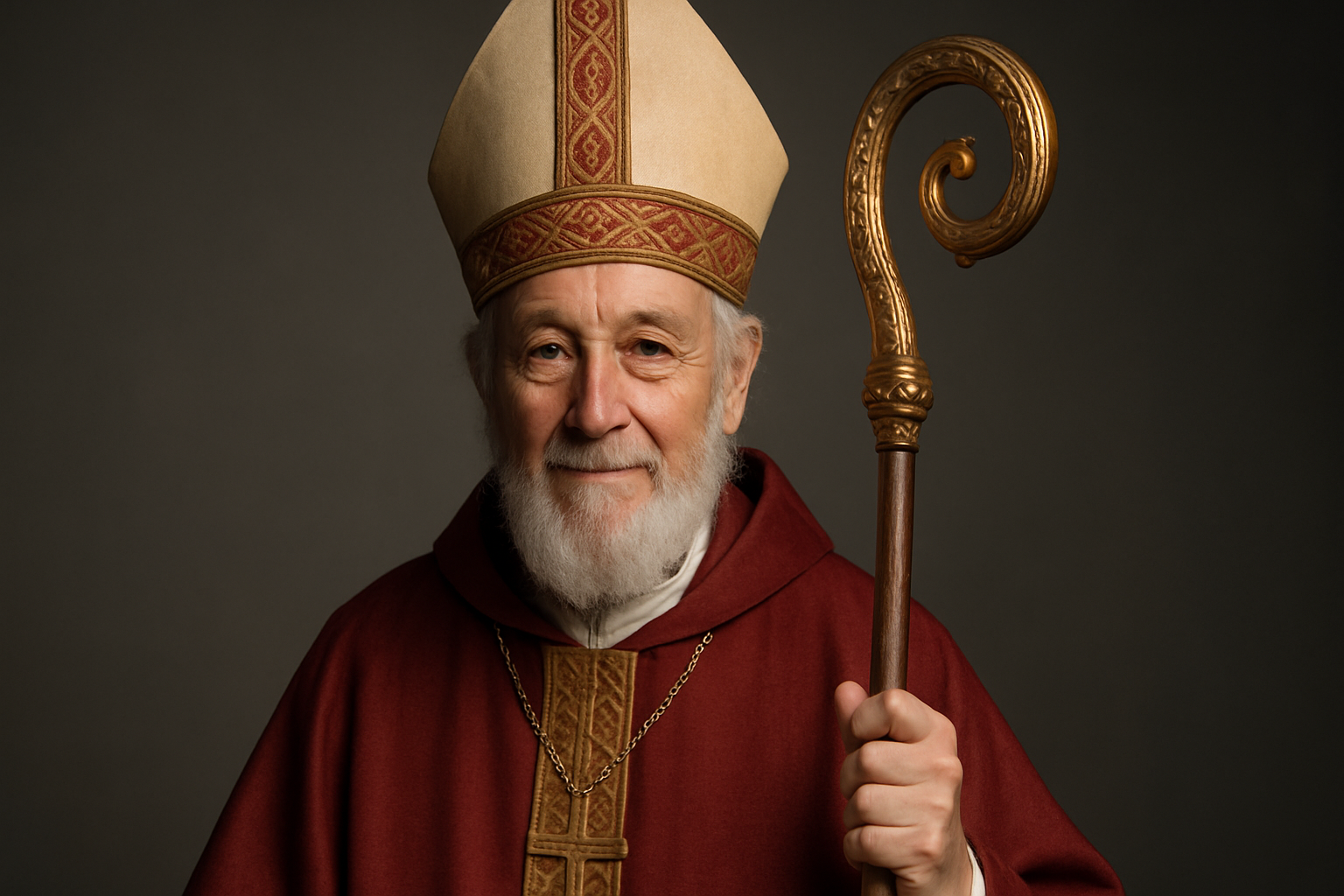
In art and jewelry, St. Willibrord is commonly depicted with several symbols that reflect his life and ministry. He is often shown in bishop’s vestments, wearing a mitre (the pointed hat) and holding a crozier (a shepherd’s staff), emphasizing his role as an archbishop and spiritual shepherd. Sometimes he carries a small church model in his hand, symbolizing the many churches and monasteries he founded. Another common symbol is a fountain or spring, which alludes to a legend where he miraculously caused a spring to flow from the ground. Less frequently, he might be depicted with a ship, representing his journeys across the sea to begin his mission in Frisia. These symbols serve as visual reminders of his courage, his episcopal authority, his foundational work for the Church, and his profound impact as a missionary.
Timeline Summary
- c. 658: Born in Northumbria, England.
- c. 665: Placed under the care of St. Wilfrid at Ripon Abbey.
- c. 678: Travels to Ireland to study at the monastery of Rathmelsigi under St. Egbert.
- c. 690: Leaves Ireland with twelve companions for a mission to Frisia.
- c. 690-692: Begins evangelization in Frisia, seeking support from Pepin II of Herstal.
- 695: Journeys to Rome, consecrated Archbishop of the Frisians by Pope Sergius I, receives the name “Clement.”
- 695: Establishes his episcopal see at Utrecht.
- c. 698: Founds the Benedictine Abbey of Echternach.
- Throughout his episcopacy: Continues widespread evangelization, founding churches and monasteries, despite opposition from pagan King Radbod.
- c. 716-719: Briefly works alongside Wynfrith (St. Boniface) in Frisia.
- November 7, 739: Dies peacefully at Echternach, aged 81.
Scripture for Reflection
St. Willibrord’s life beautifully illustrates several scriptural themes, particularly the call to evangelize and the strength found in Christ.
-
Matthew 28:19-20 (The Great Commission): “Go, therefore, and make disciples of all nations, baptizing them in the name of the Father, and of the Son, and of the Holy Spirit, teaching them to observe all that I have commanded you. And behold, I am with you always, until the end of the age.” This passage encapsulates Willibrord’s entire life’s work. He took Christ’s command literally and bravely, venturing into new lands to fulfill this divine mandate, trusting in Christ’s promise to be with him.
-
Philippians 4:13: “I can do all things in him who strengthens me.” Facing formidable challenges, hostile rulers, and the sheer scale of his mission, Willibrord’s perseverance was undoubtedly fueled by an unshakeable faith in God’s power. This verse reflects the interior strength and spiritual fortitude that allowed him to achieve so much in the name of Christ.
Prayers to St. Willibrord
Prayer to St. Willibrord
O glorious St. Willibrord, Apostle of Frisia and light of the Low Countries, you left your homeland and all that was familiar to bring the Good News of Jesus Christ to those living in darkness. With unwavering courage and tireless zeal, you faced danger, built churches, founded monasteries, and brought countless souls into the fold of Christ’s Church. We humbly implore your intercession, that we, too, may be filled with your missionary spirit. Grant us the courage to proclaim our faith boldly, the perseverance to overcome obstacles in our spiritual journey, and the wisdom to build up the Kingdom of God in our own time and place. Help us to be faithful disciples, always trusting in the Lord who strengthens us. Amen.
A Shorter Invocation
Saint Willibrord, pray for us.