St. Francis Xavier, a name synonymous with tireless evangelization and boundless zeal, stands as one of the Catholic Church’s most dynamic missionaries. Born into a noble family in the Basque region, his initial ambitions lay in academia, but a profound encounter with St. Ignatius of Loyola redirected his life towards a radical pursuit of God’s will. This article will delve into the extraordinary journey of St. Francis Xavier, exploring his early life and education, his pivotal role in founding the Society of Jesus, and his monumental missions across Asia. We will examine the spiritual legacy he left behind, the theological themes that defined his ministry, and how his inspiring example continues to resonate with believers and seekers in the modern world, offering practical lessons and enduring symbols of faith.
Quick Facts
| Fact | Detail |
|---|---|
| Birth | April 7, 1506, Xavier Castle, Navarre (modern-day Spain) |
| Death | December 3, 1552, Sancian Island, China |
| Feast Day | December 3 |
| Patronage | Foreign missions, missionaries, navigators, all of the missions in Asia, Goa, Australia, Borneo, China, East Indies, Japan, New Zealand |
| Canonized | March 12, 1622, by Pope Gregory XV |
Historical Context & Early Life
The 16th century was a period of immense upheaval and dramatic change across Europe and the wider world. The Protestant Reformation, ignited by Martin Luther, challenged the established religious order, leading to widespread theological debate and political conflict. Simultaneously, the Age of Exploration was in full swing, with European powers like Spain and Portugal extending their reach across oceans, establishing vast colonial empires, and opening up new trade routes. This era brought both opportunities for cultural exchange and complex ethical dilemmas related to conquest and evangelization.
It was into this vibrant and turbulent world that Francisco de Jasso y Azpilicueta, who would later be known as Francis Xavier, was born on April 7, 1506. His birthplace was the grand Xavier Castle in the Kingdom of Navarre, a region straddling the Pyrenees mountains between modern-day Spain and France. The Xavier family was part of the Basque nobility, deeply rooted in their land and Catholic faith. However, their political allegiances were complex; Navarre had recently been conquered by the Crown of Castile, a loss that profoundly impacted Francis’s family, leading to the destruction of parts of their castle and heavy fines. This early experience with loss and political subjugation may have subtly shaped his character, though his initial path was far removed from political affairs.
As the youngest son, Francis was destined for an academic career rather than military or land management. In 1525, at the age of 19, he embarked for Paris to study at the prestigious Collège Sainte-Barbe, part of the University of Paris. He excelled in his studies, particularly in philosophy and theology, and quickly gained recognition as a bright and ambitious scholar. He held a promising future as a university professor or a respected church official, enjoying the intellectual life and social prestige that came with it. It was during these formative years in Paris that his path would irrevocably intersect with a fellow student, a Basque nobleman named Íñigo López de Loyola, who would soon become St. Ignatius of Loyola. This encounter would prove to be the most decisive turning point in Francis Xavier’s life, pulling him away from worldly ambitions and towards a radical commitment to God.
Calling & Key Milestones
The Call to the Society of Jesus
While Francis Xavier was a brilliant and well-respected student at the University of Paris, he was also ambitious and worldly. His friend, Ignatius of Loyola, a much older and profoundly spiritual man, saw Francis’s potential and persistently challenged him with a simple yet piercing question: “What does it profit a man to gain the whole world and forfeit his soul?” This persistent inquiry, coupled with Ignatius’s personal example of deep prayer and spiritual discipline, slowly began to chip away at Francis’s worldly aspirations. Over several years, Francis resisted, debated, and struggled with Ignatius’s call to a more radical life of faith. Eventually, after a period of intense spiritual discernment, Francis underwent a profound conversion. He committed himself fully to Ignatius’s vision, participating in the Spiritual Exercises that transformed his understanding of God and his purpose. On August 15, 1534, in a small chapel on Montmartre, Paris, Francis Xavier, along with Ignatius and five other companions, took vows of poverty, chastity, and obedience, laying the groundwork for what would become the Society of Jesus, or the Jesuits. This moment marked his complete surrender to God’s will and the beginning of his true vocation.
Mission to the East
After their ordination as priests in Venice, the early Jesuits faced uncertainty about their mission. When Pope Paul III officially recognized the Society of Jesus in 1540, the fledgling order was ready for action. Coincidentally, King John III of Portugal requested missionaries for his expanding colonies in the East, particularly in India. Though initially another Jesuit, Bobadilla, was chosen, he fell ill. Ignatius, seeing God’s hand in the turn of events, immediately turned to Francis Xavier, asking him to go. Francis responded with his characteristic eagerness, simply saying, “Here I am, Lord.” He departed Lisbon on April 7, 1541, his 35th birthday, on a perilous 13-month sea voyage to Goa, India. This journey was incredibly arduous, marked by disease, storms, and the hardships of life on a cramped ship. Throughout the voyage, Francis ministered to the sick and dying, displaying the pastoral compassion that would define his entire missionary career. He arrived in Goa on May 6, 1542, beginning his monumental work in the East, a mission that would span a decade and cover thousands of miles.
Evangelizing India
Upon his arrival in Goa, then the bustling capital of Portuguese India, Francis Xavier found a city riddled with moral laxity among the European settlers and a vast, largely untouched indigenous population. He didn’t immediately set out to convert, but rather focused on revitalizing the faith of the existing Christians through preaching, teaching catechism to children, and tending to the sick and imprisoned. He recognized that true evangelization began with personal witness and charity. His ministry soon extended beyond Goa. He traveled extensively along the Pearl Fishery Coast, a region in southern India where Portuguese traders exploited the local Paravar people. Learning their language, he lived among them, celebrated Mass, taught simple prayers and doctrines, and baptized thousands. He later moved to Travancore (modern-day Kerala) and Ceylon (Sri Lanka), employing similar methods of cultural adaptation and direct engagement, often using local children as catechists. His approach was characterized by his willingness to immerse himself in local cultures, speak their languages (or have them translated), and address the spiritual and practical needs of the people.
Journey to Southeast Asia & Japan
Francis Xavier’s restless spirit and boundless zeal compelled him to continually seek new frontiers for the Gospel. After establishing a strong foundation in India, he traveled to Malacca (modern-day Malaysia) in 1545, a strategic trading port. From there, his journey took him to the Moluccas, or Spice Islands (modern-day Indonesia), where he again preached, baptized, and consoled those in need. It was in Malacca that he met a Japanese man named Anjiro, a samurai who had fled Japan after committing a murder. Anjiro became a key convert and Francis’s guide, inspiring him with accounts of Japan and its intelligent, honorable people. Recognizing the immense potential for the Church in Japan, Francis decided to embark on a mission there. He arrived in Japan in 1549, becoming the first Christian missionary to reach the archipelago. He spent over two years traveling through various regions, including Kagoshima, Hirado, and Miyako (Kyoto), encountering both curiosity and resistance. He learned Japanese customs, adapted his preaching style, and engaged in deep theological discussions with Buddhist monks and local daimyo (feudal lords). Though his initial success in Japan was limited in terms of mass conversions, he laid crucial groundwork for future missions, demonstrating profound cultural sensitivity and respect for the local population.
Dreams of China & Final Days
Despite the challenges in Japan, Francis Xavier’s vision stretched even further. He believed that if China, the powerful empire to the west, were to embrace Christianity, it would have an immeasurable impact on all of Asia. His fervent desire became to enter China, which at the time was closed to foreigners. In 1552, he set sail from Goa with the intent of reaching the mainland. His journey brought him to Sancian Island, a small, desolate island off the coast of Guangzhou, China, serving as a trading post for Portuguese merchants. He hoped to find a way to smuggle himself onto the mainland, but political obstacles and the treachery of local merchants thwarted his plans. Stranded and battling fever, likely malaria, Francis Xavier’s health rapidly deteriorated. On December 3, 1552, at the age of 46, he died on Sancian Island, with only a Chinese convert by his side, gazing towards the Chinese mainland, a mission unfulfilled in his lifetime but deeply ingrained in his heart. His body was eventually brought back to Goa, where it remains largely incorrupt in the Basilica of Bom Jesus, a testament to his extraordinary life and enduring sanctity.
Spiritual Legacy & Theological Themes
St. Francis Xavier’s life is a powerful testament to several core virtues that align deeply with Scripture and Catholic teaching. Foremost among these is his incredible zeal for souls. He embodied the Great Commission (Matthew 28:19-20) with a burning passion, driven by an unshakeable belief in the universal call to salvation. This zeal propelled him across continents, enduring immense hardships with joy and perseverance. His letters reveal a profound love for God and humanity, seeing Christ in every person he met, especially the poor and marginalized.
Another defining virtue was his profound self-sacrifice and detachment. He willingly renounced a comfortable academic life for one of constant travel, poverty, and danger. He had no permanent home, often sleeping on the bare ground, and embraced physical discomfort as a means of conforming himself to Christ’s sufferings. This detachment from worldly comforts mirrors Jesus’ call to “take up your cross and follow me” (Matthew 16:24) and the early Church’s emphasis on radical discipleship.
Francis Xavier also displayed remarkable adaptability and cultural sensitivity. While unwavering in his theological message, he was innovative in his methods. He learned local languages, composed simple catechisms in those tongues, and dressed in native attire when appropriate. In Japan, he engaged with local customs and religious leaders with respect, seeking common ground before presenting the Gospel. This approach reflected an understanding that the message of Christ must be presented in a way that is comprehensible and respectful to diverse cultures, without compromising its truth.
His lasting influence on the Church is immense. He set a powerful example for Jesuit missionary methodology, emphasizing intellectual rigor, personal poverty, and cultural adaptation. His life inspired countless missionaries who followed in his footsteps. His devotion to the Blessed Sacrament and the Rosary, which he promoted tirelessly, shaped popular piety. Furthermore, his efforts helped establish the Church in Asia, laying foundations for vibrant Christian communities in India, Southeast Asia, and Japan. He is revered as the patron saint of foreign missions, and his story continues to galvanize evangelization efforts worldwide, reminding the Church of its fundamental call to go forth and make disciples of all nations.
Devotion Today
Devotion to St. Francis Xavier remains vibrant and widespread, especially in the regions he evangelized and among those dedicated to missionary work. The most significant center of devotion is the Basilica of Bom Jesus in Goa, India, where his body lies in a silver casket. Although centuries have passed, parts of his body are remarkably preserved, drawing millions of pilgrims from around the globe. Every ten years, the relics are brought out for public veneration, a major event that attracts massive crowds and international attention, celebrating his enduring legacy in India and beyond. The next exposition is anticipated in 2024.
Numerous churches, schools, and institutions worldwide bear his name, particularly those with a focus on mission or Jesuit education. Many dioceses and religious orders hold annual novenas (nine days of prayer) leading up to his feast day on December 3rd. These novenas often focus on themes of missionary zeal, evangelization, and prayer for the spread of the Gospel. In communities across Asia, from Japan to the Philippines and Indonesia, his feast day is celebrated with special Masses, processions, and cultural events that honor his pioneering work.
Pilgrimages are also common to the places where he ministered, such as Sancian Island (where he died, though it’s less accessible) and his birthplace, Xavier Castle in Navarre, Spain, which now houses a museum and a basilica. These sites serve as powerful reminders of his journey and sacrifice, allowing modern pilgrims to connect with his spirit of adventure and dedication to Christ. His example continues to inspire individuals to volunteer for missionary service, support mission organizations, and pray for those who tirelessly spread the Catholic faith in challenging environments.
Reflections for Modern Readers
St. Francis Xavier’s life, though lived centuries ago, offers powerful and actionable takeaways for modern readers navigating the complexities of the 21st century:
1. Embrace Discomfort for a Greater Good: Francis Xavier willingly left behind comfort, family, and status for a life of grueling travel, disease, and uncertainty. He didn’t seek convenience but embraced hardship for the sake of the Gospel.
Modern Relevance: In an age of comfort and instant gratification, this challenges us to step outside our comfort zones for meaningful causes – whether it’s volunteering in our community, advocating for justice, or pursuing a challenging but fulfilling career path that serves others, even if it means personal sacrifice.
2. Adapt Your Approach Without Compromising Truth: He learned local languages, respected customs, and adapted his communication style to various cultures. Yet, he never watered down the core message of Christianity.
Modern Relevance: This teaches us the importance of effective communication and cultural intelligence. In a diverse world, we’re called to engage with others respectfully, understand their perspectives, and build bridges, while remaining firm in our own values and convictions, whether in interfaith dialogue, professional settings, or personal relationships.
3. Perseverance in the Face of Challenges: Francis faced countless setbacks – uncooperative officials, language barriers, illness, and the sheer vastness of his mission. Yet, he never gave up, driven by an unshakeable faith.
Modern Relevance: His example encourages us to cultivate resilience. When facing professional obstacles, personal struggles, or even widespread apathy, we can draw strength from his story to keep striving, innovating, and trusting that our efforts, however small, can contribute to something greater.
4. The Power of Personal Witness: More than his sermons, it was Francis’s tireless care for the sick, his humility, and his evident love for God that drew people to Christ. He lived what he preached.
Modern Relevance: This reminds us that actions often speak louder than words. Our integrity, kindness, and commitment to our beliefs in daily life – how we treat others, manage our resources, and respond to challenges – can be the most powerful form of evangelization or positive influence in a skeptical world.
5. Cultivate a Global Perspective: His vision extended across continents, seeing all humanity as worthy of hearing the Good News. He truly understood the interconnectedness of the world long before globalization.
Modern Relevance: In our interconnected global society, Francis’s life inspires us to look beyond our immediate surroundings. It challenges us to care about global issues, support international aid efforts, engage with people from different backgrounds, and understand our shared human family, fostering empathy and solidarity.
Symbols of St. Francis Xavier
In art and jewelry, St. Francis Xavier is commonly represented by several symbols, each carrying deep meaning:
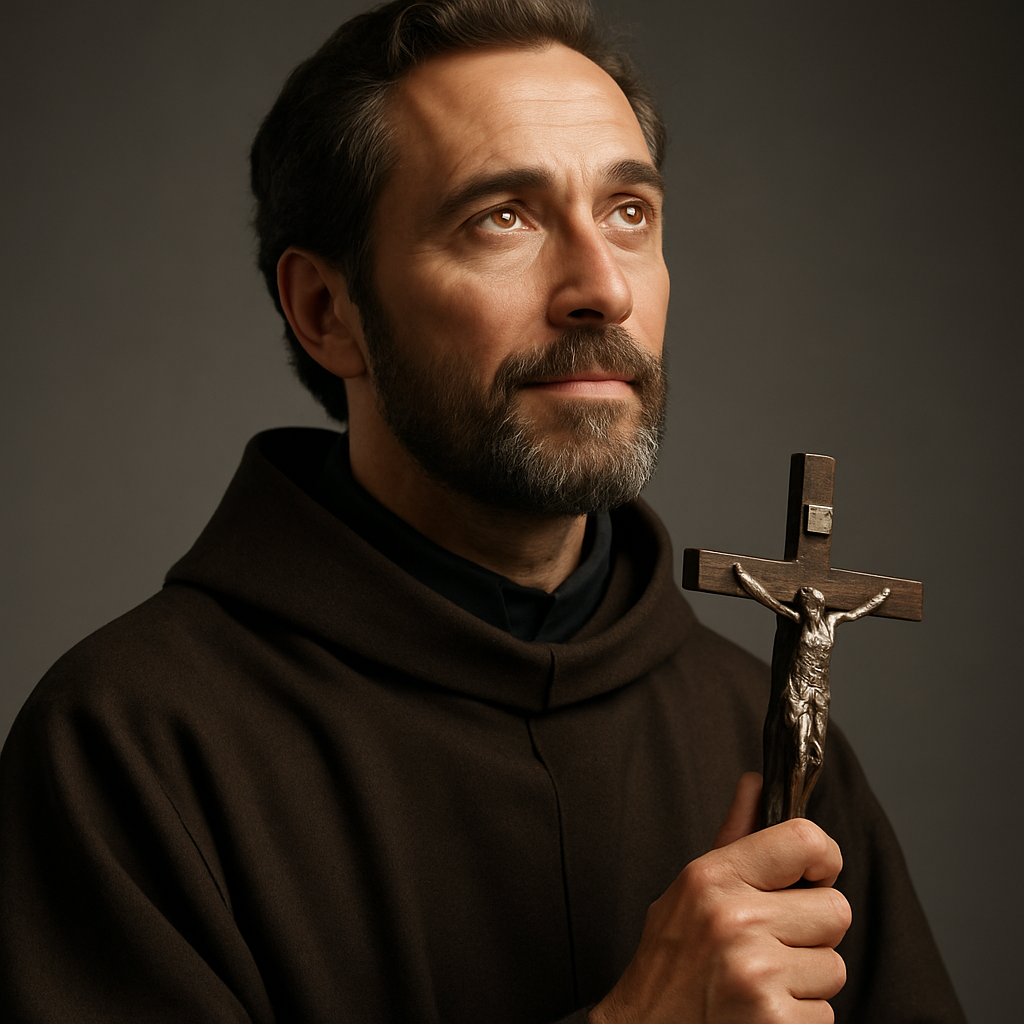
- The Crucifix: Often shown holding a large crucifix, symbolizing his unwavering focus on Christ’s sacrifice and his mission to spread the Gospel of the cross. It represents the center of his faith and preaching.
- A Missionary Staff or Walking Stick: This signifies his extensive travels and arduous journeys across Asia. It represents his role as a pilgrim and an evangelist constantly on the move for God’s kingdom.
- A Lily: Sometimes he holds a lily, a traditional symbol of purity and chastity, reflecting his priestly vows and virtuous life.
- A Scallop Shell: This is a symbol of baptism, referring to the countless individuals he baptized during his missions. It also broadly symbolizes pilgrimage, linking to his vast travels.
- A Globe or Map: Representing his patronage of foreign missions and his global vision for the spread of Christianity. It emphasizes his role as a missionary to the entire world.
- A Flaming Heart: This symbolizes his immense zeal and burning love for God and for souls, driving his tireless efforts.
- A Crab Holding a Crucifix: This alludes to a famous miracle story where, during a storm at sea, Francis lost his crucifix. The next day, a crab reportedly emerged from the ocean with the crucifix, returning it to him. This symbolizes divine providence and his close relationship with God’s miraculous power.
Timeline Summary
- April 7, 1506: Born Francisco de Jasso y Azpilicueta at Xavier Castle, Navarre.
- 1525: Begins studies at the University of Paris, Collège Sainte-Barbe.
- 1529: Meets Ignatius of Loyola.
- August 15, 1534: Takes vows of poverty, chastity, and obedience with Ignatius and companions on Montmartre, Paris, marking the foundation of the Society of Jesus.
- June 24, 1537: Ordained a priest in Venice.
- 1540: Society of Jesus formally approved by Pope Paul III.
- April 7, 1541: Departs Lisbon for India.
- May 6, 1542: Arrives in Goa, India, and begins his missionary work.
- 1543-1545: Evangelizes the Pearl Fishery Coast, Travancore, and Ceylon (Sri Lanka).
- 1545-1548: Journeys to Malacca and the Moluccas (Indonesia).
- August 1549: Arrives in Japan, becoming the first Christian missionary there.
- 1549-1551: Travels through Japan, engaging with local leaders and establishing initial Christian communities.
- 1552: Departs for China, arriving on Sancian Island.
- December 3, 1552: Dies on Sancian Island, desiring to enter mainland China.
- 1553: His body is brought to Goa, India.
- March 12, 1622: Canonized as a saint by Pope Gregory XV, along with Ignatius of Loyola, Teresa of Avila, Isidore the Farmer, and Philip Neri.
Scripture for Reflection
St. Francis Xavier’s life beautifully illustrates the urgent and expansive call of the Great Commission. Reflect on these passages that illuminate his missionary spirit and devotion:
Matthew 28:19-20 (The Great Commission): “Go, therefore, and make disciples of all nations, baptizing them in the name of the Father, and of the Son, and of the Holy Spirit, teaching them to observe all that I have commanded you. And behold, I am with you always, until the end of the age.”
This passage is the very heart of Francis Xavier’s mission. He literally “went to all nations,” traveling thousands of miles to Asia to baptize and teach, utterly convinced of Christ’s constant presence and support in his arduous endeavors. His life was a living embodiment of this divine command.
Mark 16:15: “Go into all the world and proclaim the good news to the whole creation.”
Similar to Matthew’s account, this verse captures Francis Xavier’s boundless zeal and his unwavering commitment to spreading the Gospel far and wide. He understood the “whole creation” not just geographically, but also culturally, adapting his message to diverse peoples and languages.
Prayers to St. Francis Xavier
Prayer to St. Francis Xavier for Missionary Zeal
O Saint Francis Xavier, chosen vessel of God, full of apostolic zeal, who, by your indefatigable labors and boundless charity, didst become the Apostle of the Indies and Japan, and didst lead countless souls to the knowledge and love of Jesus Christ; look down, we beseech thee, from heaven with an eye of pity upon the spiritual wants of our day.
Inflame our hearts with a fervent desire for the salvation of souls. Inspire us to follow thy example in our daily lives, embracing discomfort, adapting to new challenges, and persevering in our efforts to share the Good News. Grant that through thy powerful intercession, the number of those who dedicate themselves to spreading the Kingdom of Christ may increase, and that all nations may come to acknowledge and adore our Lord and Savior, Jesus Christ.
We ask this through the same Christ our Lord. Amen.
Novena Prayer to St. Francis Xavier (Day 1, Example)
O most lovable and most loving Saint Francis Xavier, in union with you I adore the Divine Majesty. The remembrance of the favors with which God blessed you during life, and of your glory after death, fills me with joy; and I unite with you in offering to Him my humble tribute of thanksgiving and praise. I implore you to secure for me, through your powerful intercession, above all things, the grace to live and die a holy death. Moreover, I ask you to obtain for me the particular favor I now implore (mention your intention here).
And if what I ask is not for the glory of God and the greater good of my soul, do you, I pray, obtain for me that which shall be most conducive to both. Amen.
V. Pray for us, Saint Francis Xavier.
R. That we may be made worthy of the promises of Christ.
Let us pray:
O God, Who by the preaching and miracles of Saint Francis Xavier didst gather unto Thy Church the peoples of the Indies and Japan, grant, we beseech Thee, that we who venerate his glorious merits may also imitate his virtues, through Jesus Christ our Lord. Amen.