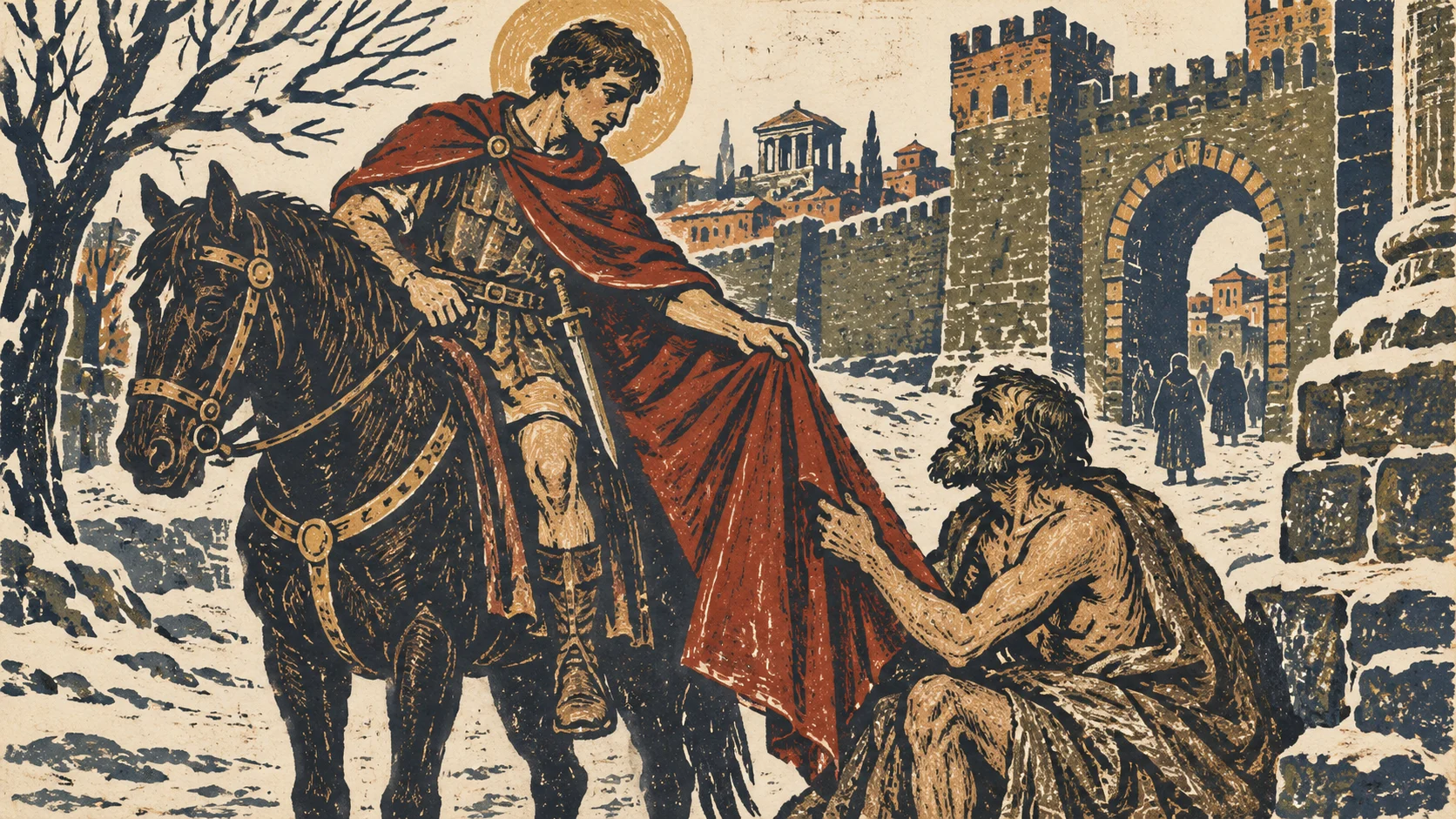
A soldier, a cold traveler, and a divided cloak: few saint stories are easier to remember than the one associated with Martin of Tours. Its staying power comes partly from its simplicity. A need is visible, and someone responds with what he has.
Martin beyond the famous cloak
Martin lived in the fourth century, served as a soldier, and later became a monk and bishop of Tours. He was connected with Hilary of Poitiers and helped establish monastic life in Gaul. He died in 397. The traditional cloak story tells how he shared his garment with a poor man and subsequently recognized Christ in the encounter. His feast is November 11. Vatican News presents the story and his later ministry.
Read the story as a call to notice
Religious art often freezes the moment of giving. In real life, there is a moment before that: deciding whether to see the person in front of us. We can become so absorbed in arriving somewhere that another person’s difficulty barely registers.
Practice noticing without assuming you know the solution. Someone struggling at a church entrance may need a door held, clearer directions, or space to move independently. Ask before helping. Attention is most useful when it includes respect for the person’s own judgment.
A coat collection that people can actually use
If Martin’s story inspires a parish clothing drive, contact the receiving organization before collecting. Ask about sizes, accepted items, storage limits, and delivery arrangements. Clean, usable clothing is a gift; damaged items can become work for someone else.
- Choose a partner organization and confirm its current needs.
- Publish a short, specific list and a clear deadline.
- Arrange a place to sort items and people to deliver them.
- Report the collection’s results without exposing recipients’ identities.
- Ask whether another need remains after the seasonal drive ends.
Speaking about strength with children
Invite children to describe what makes someone strong. They may mention speed, size, or winning. Add examples of strength that involve care: sharing something valuable, admitting a mistake, or standing beside someone being excluded.
A simple activity is to draw a cloak divided into two parts. On one side, write or draw something your family has. On the other, name a way it could be shared. Keep the action realistic: an hour, a useful item, a seat at the table.
One story, a longer life
The cloak makes Martin memorable, but his life continued into years of religious commitment and leadership. That longer view can help us move beyond a single generous moment. What practice could follow the first gift? Who will still need attention next week?
For a different setting in which resources became a responsibility, read about St. Hedwig of Silesia.