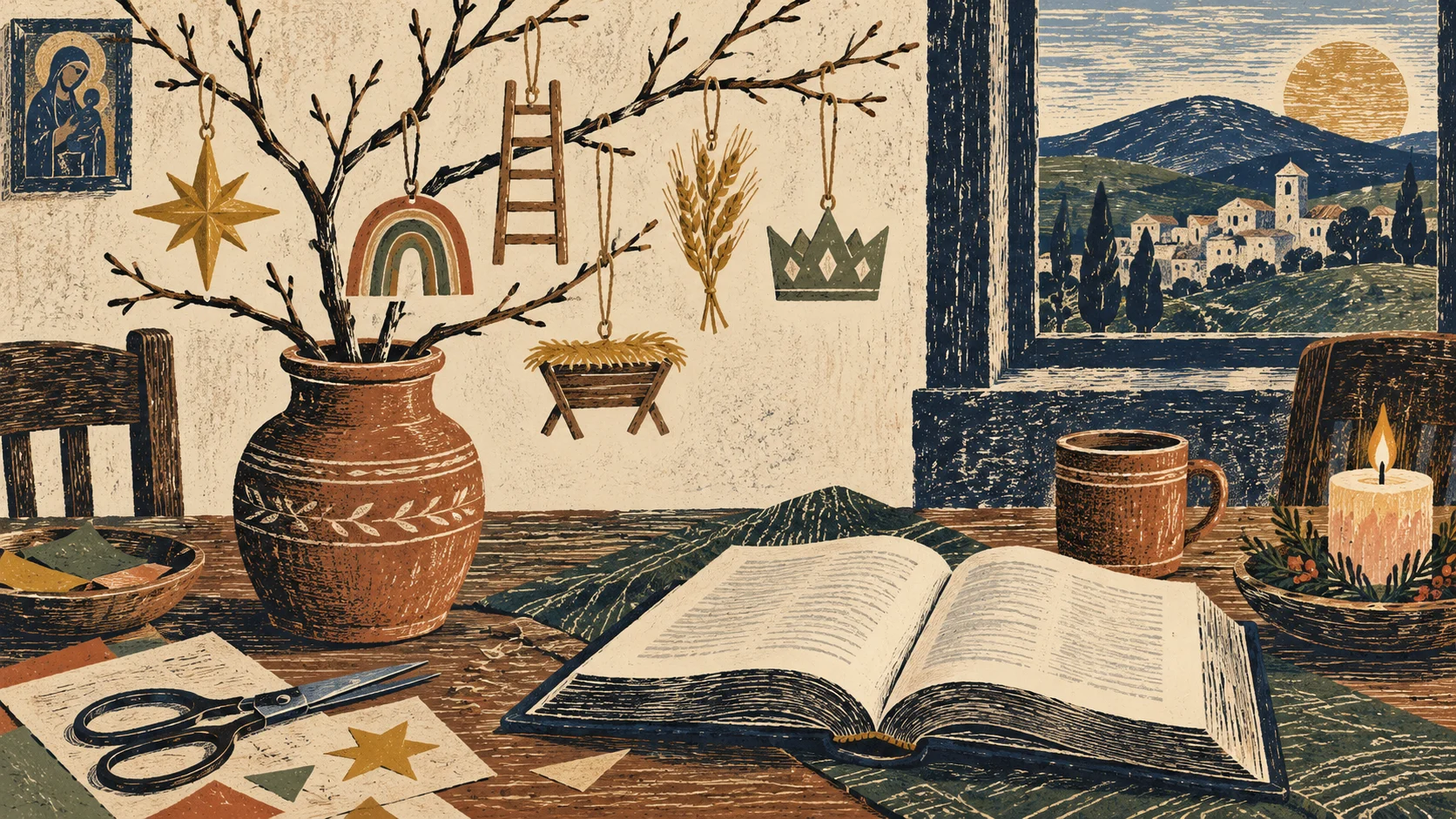
A Jesse Tree pairs short Bible readings with simple symbols to help a household follow the story leading toward Christmas. You can use a branch in a vase, a paper tree on a wall, or a string across a shelf. The reading is the heart of the practice; the ornament only helps people remember it.
Why it is called a Jesse Tree
The name recalls the image of new growth from Jesse’s family in Isaiah 11. Jesse was the father of King David. Christians read this imagery in relation to Jesus and the hope of God’s people. A Jesse Tree brings selected biblical stories into a visible sequence.
There is no single required Catholic list of twenty-five ornaments. The plan below is an original household selection for December 1–25, not the Church’s daily Mass lectionary or a claim that Advent always begins on December 1.
Twenty-five readings and easy symbols
Read from a Bible you already use. The references are intentionally short; adults can read the surrounding chapter when a child asks for more context.
| December | Reading | Paper symbol |
|---|---|---|
| 1 | Genesis 1:1–5 — creation’s beginning | Light and dark circle |
| 2 | Genesis 1:26–31 — humanity in God’s creation | Two human figures |
| 3 | Genesis 9:8–17 — God’s covenant with Noah | Rainbow |
| 4 | Genesis 12:1–9 — Abram’s call | Traveling tent |
| 5 | Genesis 15:1–6 — a promise under the stars | Stars |
| 6 | Genesis 28:10–17 — Jacob’s dream | Ladder |
| 7 | Genesis 45:1–8 — Joseph and his brothers | Grain sack |
| 8 | Exodus 3:1–12 — Moses is called | Burning bush |
| 9 | Exodus 14:21–31 — crossing the sea | Two waves |
| 10 | Exodus 20:1–17 — the commandments | Stone tablets |
| 11 | Ruth 1:15–18 — Ruth’s faithfulness | Traveling sandals |
| 12 | 1 Samuel 3:1–10 — Samuel listens | Small lamp |
| 13 | 1 Samuel 16:1–13 — David is chosen | Horn of oil |
| 14 | 2 Samuel 7:8–16 — the promise to David | Crown |
| 15 | 1 Kings 19:9–13 — Elijah at Horeb | Mountain |
| 16 | Isaiah 11:1–9 — hope from Jesse’s roots | Green shoot |
| 17 | Jeremiah 31:31–34 — the promised covenant | Heart |
| 18 | Micah 5:1–4 — a ruler from Bethlehem | Small town |
| 19 | Luke 1:5–17 — the announcement to Zechariah | Incense bowl |
| 20 | Luke 1:26–38 — the Annunciation | Lily |
| 21 | Luke 1:39–45 — Mary visits Elizabeth | Two doorways |
| 22 | Luke 1:46–55 — Mary’s song of praise | Musical note |
| 23 | Matthew 1:18–25 — Joseph’s response | Carpenter’s square |
| 24 | Luke 2:1–7 — the birth of Jesus | Manger |
| 25 | John 1:1–14 — the Word becomes flesh | Radiant candle |
A five-minute household routine
Let one person find the passage, another read, and another hang the symbol. Ask one question: “What did you notice?” Give room for an unexpected answer. Close with a brief prayer in your own words. You can find the biblical books through the USCCB Bible index.
Some passages contain difficult events or unfamiliar language. Read ahead, explain the context in age-appropriate terms, and avoid using a painful story as a quick moral lesson. A child’s question may deserve more time than that evening allows; write it down and return to it.
Keep the craft small
Cut circles from reused card and draw the symbols with a marker. Number the backs if that helps you stay organized. Young children can color a shape while older children find the reading. There is no need to create twenty-five elaborate handmade objects before December begins.
If daily reading is unrealistic, choose a few passages each week. If you miss several days, continue with the next reading rather than making the family sit through a long catch-up session. A simple practice that invites attention is more useful than a complete set that produces arguments.
Let the story continue after Christmas
The plan ends with Christmas Day, but the Gospels continue. Keep a Bible near the tree and choose another passage during the Christmas season. The ornaments can help children recall what they heard, while the reading itself keeps the practice connected to Scripture rather than decoration alone.