The story of Mary, the Mother of Jesus, is one of the most profound and influential narratives in human history. Far from being a distant figure, she remains a vibrant source of inspiration and intercession for millions around the globe. This article will journey through her remarkable life, from her humble beginnings in ancient Galilee to her pivotal role in salvation history, exploring her unwavering faith, the challenges she faced, and her enduring spiritual legacy. We will delve into the historical world she inhabited, trace the key moments of her calling, understand the virtues she embodied, and discover how her presence continues to shape Christian devotion and offer profound reflections for modern life.
Quick Facts
| Attribute | Detail |
|---|---|
| Birth | Traditionally September 8th, in Jerusalem (exact year unknown, likely 20-15 BC) |
| Death | Traditionally August 15th (date of her Assumption), likely sometime after Jesus’ Ascension |
| Feast Day | January 1 (Solemnity of Mary, Mother of God), August 15 (Assumption), December 8 (Immaculate Conception), and many others throughout the year |
| Patronage | All humanity, mothers, travelers, the Catholic Church, numerous countries and dioceses, those in need of intercession, purity, perpetual help |
| Canonized | Venerated as a saint and Mother of God since the earliest days of Christianity, long before formal canonization processes existed |
Historical Context & Early Life
Mary was born into a world marked by Roman occupation and deep Jewish religious tradition. The region of Judea, including Galilee where she lived, was under the heavy hand of Roman rule, yet Jewish life revolved intensely around the Law of Moses, the Temple in Jerusalem, and the local synagogues. Families were close-knit, and life was centered on agricultural rhythms, community bonds, and fervent religious observance. Messianic expectations were high; many Jews longed for a deliverer, a Messiah, who would free them from foreign oppression and restore the glory of David’s kingdom.
Mary’s parents, traditionally known as Joachim and Anne, are not mentioned in the Bible, but ancient Christian tradition holds them as devout and righteous individuals. They are believed to have raised Mary in Nazareth, a small, unassuming village in the hills of Galilee. Her upbringing would have been typical for a Jewish girl of that era: learning household duties, participating in family prayers, and being steeped in the Hebrew Scriptures. She would have known the stories of Abraham, Moses, David, and the prophets, and undoubtedly shared in the hopes for the Messiah’s coming. This environment fostered a deep personal faith, humility, and a readiness to say “yes” to God, qualities that would soon be tested in extraordinary ways.
Calling & Key Milestones
The Annunciation: A Divine Invitation
Mary’s life changed forever when she was a young woman, likely in her early teens, betrothed to a carpenter named Joseph. The angel Gabriel appeared to her, announcing that she would conceive a son by the power of the Holy Spirit, and this son would be the Son of God, named Jesus. This unexpected news shattered any conventional plans she might have had. Her response, “Behold, I am the handmaid of the Lord; let it be done to me according to your word” (Luke 1:38), demonstrates profound faith and obedience. This moment, known as the Annunciation, is a foundational event, marking her acceptance of her unique calling as the Mother of God.
The Visitation: Sharing Joy and Prophecy
Soon after the Annunciation, Mary traveled to visit her older cousin Elizabeth, who was also miraculously pregnant with John the Baptist. Upon Mary’s arrival, Elizabeth’s baby leapt in her womb, and Elizabeth, filled with the Holy Spirit, proclaimed Mary “blessed among women.” In response, Mary offered her beautiful prayer of praise, the Magnificat, which begins, “My soul magnifies the Lord, and my spirit rejoices in God my Savior” (Luke 1:46-47). This hymn reveals Mary’s deep understanding of God’s justice, mercy, and faithfulness to His promises, particularly to the poor and humble.
The Nativity: Birth in Bethlehem
As her pregnancy neared its end, Mary and Joseph were required to travel to Bethlehem, Joseph’s ancestral home, for a Roman census. There, in humble circumstances, likely in a stable, Mary gave birth to Jesus. This momentous event, the Nativity, fulfilled ancient prophecies and brought the Son of God into the world in profound humility. Mary laid her newborn son in a manger, and they received visits from shepherds, who had been alerted by angels, and later from wise men who had followed a star.
The Presentation in the Temple: A Sword Through the Soul
Forty days after Jesus’ birth, Mary and Joseph presented Him at the Temple in Jerusalem, according to Jewish law. There, an elderly prophet named Simeon recognized Jesus as the Messiah and foretold that He would be a “light for revelation to the Gentiles” but also that a “sword will pierce through your own soul also” (Luke 2:32-35). This prophecy hinted at the future suffering Mary would experience as her son fulfilled His mission.
The Flight into Egypt: Protecting the Savior
Warned in a dream about King Herod’s intention to kill the child, Joseph fled to Egypt with Mary and Jesus. This dangerous journey was an act of profound trust and protection, highlighting Mary’s readiness to endure hardship for her son’s safety. They remained in Egypt until Herod’s death, after which they returned and settled in Nazareth.
Finding Jesus in the Temple: A Mother’s Worry
When Jesus was twelve, Mary and Joseph took Him to Jerusalem for the Passover feast. On their way home, they realized Jesus was missing. After three days of anxious searching, they found Him in the Temple, engaged in profound discussion with the teachers. When Mary expressed her worry, Jesus responded, “Did you not know that I must be in my Father’s house?” (Luke 2:49). This event gives us a rare glimpse into Jesus’ childhood and Mary’s role as a mother grappling with her son’s unique divine identity.
The Wedding at Cana: First Public Miracle
Mary’s quiet influence is again seen at a wedding in Cana where the wine ran out. She simply told Jesus, “They have no wine.” Though Jesus initially seemed reluctant, He responded to His mother’s implicit request. She then instructed the servants, “Do whatever he tells you” (John 2:5). This act of faith led to Jesus’ first public miracle, turning water into wine, and marked the beginning of His public ministry. Mary’s words, “Do whatever he tells you,” resonate as a powerful spiritual directive for all believers.
Standing at the Foot of the Cross: Sharing His Suffering
Mary remained faithful to Jesus throughout His life, even to its most agonizing end. She stood at the foot of the cross, witnessing her son’s crucifixion. This moment fulfilled Simeon’s prophecy of a sword piercing her soul. Here, Jesus entrusted her to the care of His beloved disciple, John, saying, “Woman, behold your son!” and to John, “Behold, your mother!” (John 19:26-27). This act is often understood as Jesus entrusting His mother to all humanity, and all humanity to His mother’s care.
Pentecost: Mother of the Church
After Jesus’ resurrection and ascension, Mary was present with the apostles and other disciples in the Upper Room, praying before the coming of the Holy Spirit at Pentecost. Her presence symbolizes her continuing role as a mother figure to the nascent Church, a model of prayer and faith as the community of believers began its mission.
The Assumption: Glorified in Heaven
Catholic teaching holds that at the end of her earthly life, Mary was assumed body and soul into heaven. This unique privilege, known as the Assumption, is a dogma of the Church, meaning a divinely revealed truth that Catholics are bound to believe. It signifies her perfect union with her son and is seen as a prefigurement of the resurrection of all believers. While the Bible does not explicitly describe her Assumption, it reflects centuries of Christian tradition and belief in her unique purity and role.
Spiritual Legacy & Theological Themes
Mary’s spiritual legacy is immense and foundational to Catholicism. She is venerated as the Mother of God (Theotokos in Greek, meaning “God-bearer”), a title solemnly affirmed by the Council of Ephesus in 431 AD, confirming that her son is truly divine. She is also held to be Ever-Virgin, meaning she remained a virgin before, during, and after the birth of Jesus, a testament to her complete dedication to God.
The doctrine of the Immaculate Conception, defined in 1854, teaches that Mary, from the moment of her conception, was preserved free from all stain of original sin by a singular grace from God, in view of the merits of Jesus Christ. This unique grace prepared her to be a worthy dwelling place for the Son of God, not as a sign of her own accomplishment, but as a testament to God’s profound love and foresight.
Mary exemplifies numerous core virtues: her profound faith in accepting God’s will; her humble and complete obedience to His plan; her enduring purity of heart and body; her remarkable perseverance through joy and sorrow, particularly at the foot of the cross; and her unwavering hope in God’s promises. She is seen as the first and most perfect disciple, a model for all who seek to follow Christ. Her willingness to say “yes” to God, even when the path was uncertain, aligns perfectly with scriptural calls to trust and surrender.
Her lasting influence is evident in almost every aspect of Catholic life. She is honored in the liturgy through numerous feast days and prayers. Devotion to Mary is widespread, most famously through the Rosary, a prayer that meditates on the mysteries of Christ’s life through Mary’s eyes. Marian apparitions, such as those at Lourdes and Fatima, have inspired millions. Art, music, and poetry across centuries celebrate her beauty, grace, and maternal love. She is revered as a powerful intercessor, a spiritual mother who guides and protects the Church and its members, continually pointing them towards her son, Jesus.
Devotion Today
Devotion to Mary remains vibrant and global. Millions undertake pilgrimages to renowned Marian shrines, such as Our Lady of Lourdes in France, where miraculous healings are reported; Our Lady of Fatima in Portugal, site of apparitions to three children; Our Lady of Guadalupe in Mexico City, a powerful symbol of faith and national identity; and the House of the Virgin Mary in Ephesus, Turkey, traditionally believed to be where she spent her final years. These sites draw pilgrims seeking spiritual solace, healing, and deeper connection with Mary and her Son.
Annual celebrations and feast days dedicated to Mary punctuate the Church calendar. Key solemnities include the Solemnity of Mary, Mother of God on January 1, the Assumption of the Blessed Virgin Mary on August 15, and the Immaculate Conception on December 8. Numerous other feasts, such as Our Lady of Sorrows, Our Lady of the Rosary, and Our Lady of Mount Carmel, honor various aspects of her life and intercession. Throughout the months of May and October, Catholics often dedicate special prayers and devotions to Mary, frequently praying the Rosary in homes and parishes.
Reflections for Modern Readers
Mary’s life offers timeless lessons for believers in the 21st century:
- Saying “Yes” to God’s Plan: Mary’s “fiat” – “Let it be done to me according to your word” – is a powerful reminder that surrendering to God’s will, even when it’s challenging or unclear, opens the door to divine grace. In a world full of our own plans and ambitions, Mary teaches us to pause and ask what God is calling us to, even if it means stepping out of our comfort zone. Imagine a student choosing to volunteer for a cause they deeply believe in, sacrificing free time for a greater good, echoing Mary’s selfless response.
- Embracing Humility and Service: Despite her extraordinary role, Mary lived a humble life, always pointing to Jesus. She serves as a model of quiet service and putting others first. In an age of self-promotion, her humility is a refreshing counter-cultural virtue. Think of a CEO who quietly volunteers at a soup kitchen, demonstrating true leadership through service rather than status.
- Perseverance Through Suffering: Mary endured profound sorrow, from Simeon’s prophecy to standing at the foot of the Cross. Her steadfastness in the face of immense pain offers hope to those grappling with loss, illness, or heartbreak. She shows us that faith doesn’t remove suffering, but it allows us to bear it with grace and trust in God’s ultimate plan. A parent caring for a sick child day in and day out, drawing strength from their faith, reflects Mary’s enduring spirit.
- Intercession and Trust: At Cana, Mary simply presented a need to Jesus and trusted Him. This illustrates her role as an intercessor, a mother who brings our concerns to her son. It encourages us to bring our prayers, big and small, to her, confident in her loving attention and powerful advocacy. When facing a difficult decision, praying to Mary for guidance, trusting that she will bring our plea to Jesus, is a practical application of this lesson.
In art and jewelry, Mary is often depicted with specific symbols that carry deep meaning:
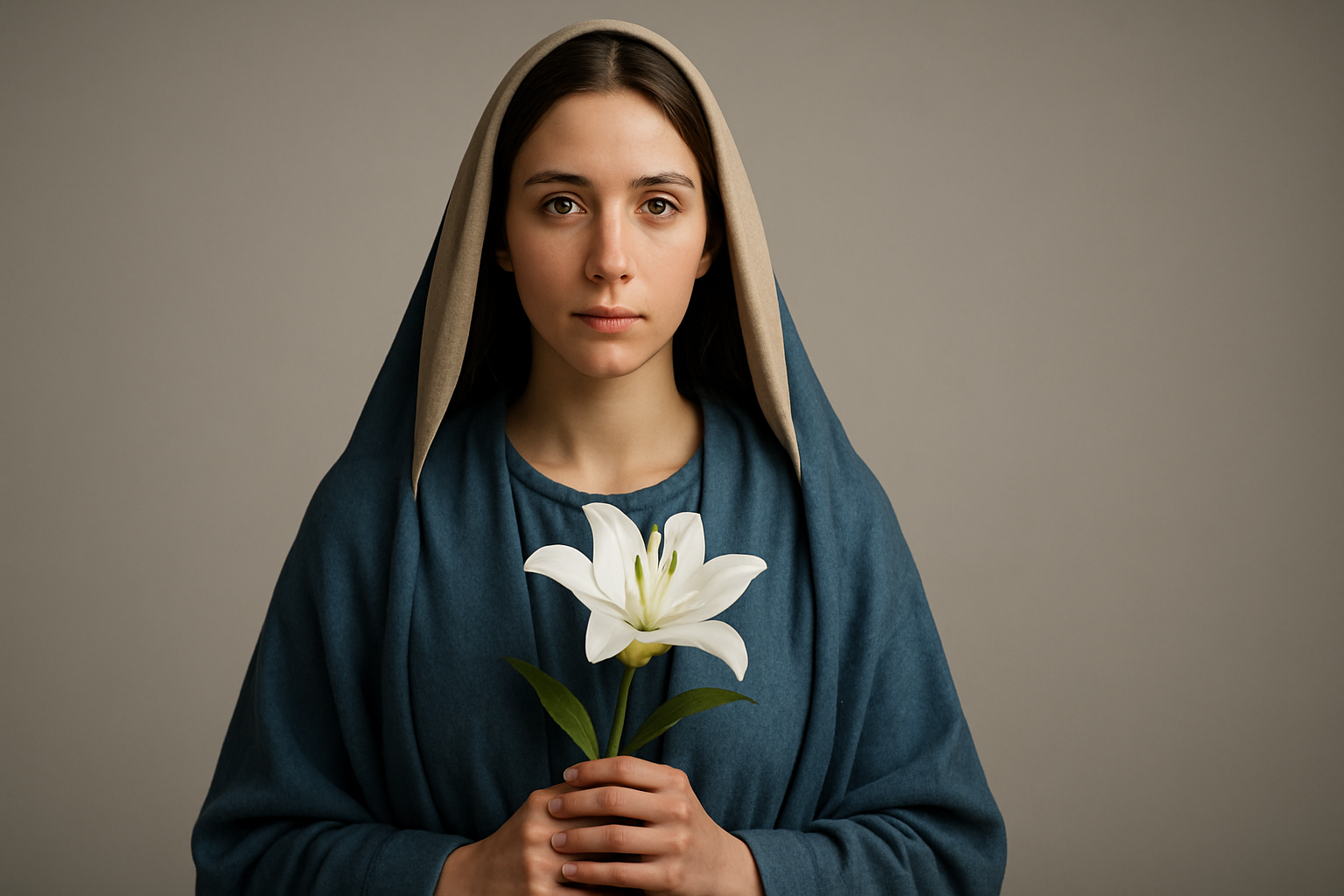
- Blue Cloak: Symbolizes royalty, truth, and heaven, representing her divine motherhood and grace. It also speaks to her purity and connection to the divine.
- White Lily: Represents purity, innocence, and virginity, referencing her Immaculate Conception and Ever-Virginity.
- Crown of Stars or Halo: Signifies her queenship of heaven and earth, as well as her holiness and glory.
- Crushing a Serpent: References Genesis 3:15 and her triumph over evil and sin through her son, Jesus.
- “M” Monogram: Often found on Miraculous Medals, symbolizing “Mary” and her maternal protection.
- Roses: Frequently associated with Mary, particularly in the Rosary, symbolizing her beauty and role as the “Mystical Rose.”
Timeline Summary
- c. 20-15 BC: Birth of Mary (traditional date).
- c. 6-5 BC: The Annunciation; Mary accepts her calling as Mother of God.
- c. 6-5 BC: The Visitation to Elizabeth and the Magnificat.
- c. 4 BC: Birth of Jesus in Bethlehem (The Nativity).
- c. 4 BC: Presentation of Jesus in the Temple and Simeon’s prophecy.
- c. 4-2 BC: Flight into Egypt to escape Herod.
- c. AD 8: Finding Jesus in the Temple at age 12.
- c. AD 30: Mary’s intercession at the Wedding at Cana, Jesus’ first public miracle.
- c. AD 33: Mary stands at the foot of the Cross during Jesus’ crucifixion.
- c. AD 33: Mary present with the Apostles at Pentecost.
- Date Unknown: Mary’s Dormition/Assumption into heaven (traditional).
Scripture for Reflection
The New Testament provides the primary accounts of Mary’s life and virtues. Here are a few passages that illuminate her faith and role:
Luke 1:26-38 (The Annunciation)
“In the sixth month the angel Gabriel was sent from God to a city of Galilee named Nazareth, to a virgin betrothed to a man whose name was Joseph, of the house of David. And the virgin’s name was Mary. And he came to her and said, ‘Greetings, O favored one, the Lord is with you!’ But she was greatly troubled at the saying and tried to discern what sort of greeting this might be. And the angel said to her, ‘Do not be afraid, Mary, for you have found favor with God. And behold, you will conceive in your womb and bear a son, and you shall call his name Jesus. He will be great and will be called the Son of the Most High. And the Lord God will give to him the throne of his father David, and he will reign over the house of Jacob forever, and of his kingdom there will be no end.’ And Mary said to the angel, ‘How will this be, since I am a virgin?’ And the angel answered her, ‘The Holy Spirit will come upon you, and the power of the Most High will overshadow you; therefore the child to be born will be called holy—the Son of God. And behold, your relative Elizabeth in her old age has also conceived a son, and this is the sixth month with her who was called barren. For nothing will be impossible with God.’ And Mary said, ‘Behold, I am the handmaid of the Lord; let it be to me according to your word.’ And the angel departed from her.”
This passage beautifully captures Mary’s humble acceptance of God’s extraordinary and challenging plan, demonstrating her profound faith and obedience.
Luke 1:46-55 (The Magnificat)
“And Mary said, ‘My soul magnifies the Lord, and my spirit rejoices in God my Savior, for he has looked on the humble estate of his handmaiden. For behold, from now on all generations will call me blessed; for he who is mighty has done great things for me, and holy is his name. And his mercy is for those who fear him from generation to generation. He has shown strength with his arm; he has scattered the proud in the thoughts of their hearts; he has cast down the mighty from their thrones and exalted those of humble estate; he has filled the hungry with good things, and the rich he has sent away empty. He has helped his servant Israel, in remembrance of his mercy, as he spoke to our fathers, to Abraham and to his offspring forever.'”
Mary’s prayer of praise reveals her deep theological understanding, her joy in God, and her prophetic insight into God’s work in history, especially in uplifting the humble.
John 2:1-5 (The Wedding at Cana)
“On the third day there was a wedding at Cana in Galilee, and the mother of Jesus was there. Jesus also was invited to the wedding with his disciples. When the wine ran out, the mother of Jesus said to him, ‘They have no wine.’ And Jesus said to her, ‘Woman, what does this have to do with me? My hour has not yet come.’ His mother said to the servants, ‘Do whatever he tells you.'”
This scene highlights Mary’s compassionate heart, her trust in Jesus, and her role as an intercessor, encouraging others to listen and obey her son.
Prayers to St. Mary
The Hail Mary
Hail Mary, full of grace, the Lord is with thee.
Blessed art thou amongst women,
and blessed is the fruit of thy womb, Jesus.
Holy Mary, Mother of God,
pray for us sinners,
now and at the hour of our death. Amen.
The Salve Regina (Hail, Holy Queen)
Hail, Holy Queen, Mother of Mercy, our life, our sweetness and our hope.
To thee do we cry, poor banished children of Eve.
To thee do we send up our sighs, mourning and weeping in this valley of tears.
Turn then, most gracious advocate, thine eyes of mercy toward us,
and after this, our exile, show unto us the blessed fruit of thy womb, Jesus.
O clement, O loving, O sweet Virgin Mary.V. Pray for us, O Holy Mother of God.
R. That we may be made worthy of the promises of Christ. Amen.