In the vast tapestry of Catholic history, certain figures stand out as pivotal, shaping not just the spiritual landscape but the very civilization around them. Saint Boniface, often hailed as the “Apostle of Germany,” is one such towering figure. Born Wynfrid in the heart of Anglo-Saxon England, his journey from a contemplative Benedictine monk to a fearless missionary and martyr transformed the spiritual face of Northern Europe. His story is one of unwavering faith, audacious courage, and profound dedication to bringing the light of Christ to lands still steeped in paganism. This article will delve into his early life, his pivotal missionary endeavors, his lasting spiritual legacy, and how his inspiring example continues to resonate with believers in the modern world.
Quick Facts
| Attribute | Detail |
|---|---|
| Birth | c. 675 AD, Crediton, Wessex, England |
| Death | June 5, 754 AD, Dokkum, Frisia (modern Netherlands) |
| Feast Day | June 5 |
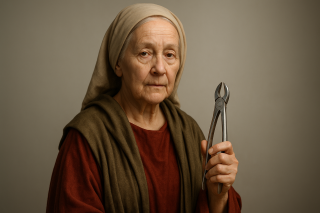
| Patronage | Germany, Archdiocese of Fulda, Archdiocese of Mainz, brewers, file-cutters, tailors |
| Canonized | Pre-Congregation (Veneration began immediately after his death) |
Historical Context & Early Life
The early 8th century was a time of immense change and flux in Europe. The Roman Empire had long since fallen in the West, replaced by a patchwork of burgeoning kingdoms and tribal lands. While Christianity had firmly established itself in the old Roman heartlands and in Britain and Ireland, vast swathes of continental Europe, particularly east of the Rhine, remained largely pagan. Germanic tribes, with their rich mythologies centered on gods like Thor and Woden, still practiced ancient rites, often involving sacred trees and groves.
The Frankish Empire, under the rising power of figures like Charles Martel, was beginning to assert its dominance, acting as a crucial bridge between the Christianized West and the pagan East. The Church itself was undergoing a period of expansion and consolidation, with the papacy in Rome increasingly seeking to extend its influence and establish a unified Christian identity across the continent. Monasticism, particularly the Benedictine tradition, was a powerful force for evangelization, education, and cultural preservation, producing many of the era’s great missionaries.
It was into this vibrant and challenging world that Wynfrid was born around 675 AD in Wessex, an Anglo-Saxon kingdom in what is now England. His family was likely of noble standing, meaning he was destined for a secular life, perhaps as a lord or warrior. However, from a young age, Wynfrid felt a powerful pull towards a spiritual life. Reportedly, the visits of traveling monks inspired him deeply. Despite his father’s initial resistance, Wynfrid’s determination prevailed. He entered the Benedictine monastery at Exeter as a young boy, seeking a life of prayer and study. Later, he moved to the monastery at Nursling, known for its rigorous scholarship and spiritual discipline.
At Nursling, Wynfrid excelled. He was not only deeply spiritual but also a brilliant scholar, mastering Latin, writing poetry, and developing a reputation as an eloquent preacher and a skilled teacher. He was ordained a priest around the age of 30. While a respected and beloved member of his monastic community, his heart yearned for something more. He felt an undeniable call to bring the Christian faith to those who had never heard it, specifically to the pagan peoples across the English Channel. This call would eventually lead him to forsake the comfort and security of his monastic home for a life of perilous mission.
Calling & Key Milestones
Initial Monastic Life & Call to Mission
From his early days as a monk at Exeter and then Nursling, Wynfrid proved himself to be a dedicated scholar and a pious servant of God. He became a highly regarded teacher and preacher, compiling a Latin grammar and a treatise on poetics. His intellectual gifts were evident, but it was his fervent spiritual desire that truly set him apart. He felt an unshakeable conviction that God was calling him to leave the relative safety of his monastery and venture into the pagan lands of continental Europe, particularly Frisia (modern-day Netherlands), where earlier missionary efforts had met with limited success.
This was a brave and radical decision. Leaving one’s established monastic community was not undertaken lightly, and the journey to convert pagan tribes was fraught with danger. Yet, Wynfrid’s zeal for souls outweighed any fear of the unknown. He was driven by a deep love for Christ and a profound belief in the transformative power of the Gospel.
First Mission Attempt & Papal Commission
In 716, Wynfrid made his first attempt to evangelize Frisia, joining the venerable missionary Saint Willibrord, who had already been working in the region for decades. However, the timing was unfortunate. The area was embroiled in war between the pagan Frisian king Radbod and the powerful Frankish leader Charles Martel. Political instability made missionary work nearly impossible, and Radbod was actively persecuting Christians and destroying churches. After a brief, unsuccessful period, Wynfrid realized the futility of his efforts under such conditions and returned to Nursling.
Despite this initial setback, Wynfrid’s resolve only deepened. He understood that for his mission to be truly effective and lasting, it needed broader ecclesiastical support. In 718, he embarked on a pilgrimage to Rome, seeking the blessing and authority of the Pope. This was a crucial strategic move. Pope Gregory II recognized Wynfrid’s extraordinary zeal and intellectual capabilities. In 719, the Pope formally commissioned Wynfrid to preach the Gospel in Germany, granting him papal letters of authorization. It was during this momentous meeting that Pope Gregory II gave him the new name “Boniface,” meaning “doer of good,” a prophetic title that would perfectly encapsulate his life’s work. This direct papal endorsement lent immense authority and legitimacy to Boniface’s mission, distinguishing it from earlier, more localized efforts.
The Felling of Thor’s Oak
One of the most dramatic and symbolic events in Boniface’s life occurred in 722. After successful initial missions in Hessia and Thuringia, where he baptized thousands and established Christian communities, Boniface confronted a major stronghold of paganism. Near Geismar, in Hessia, stood a massive, ancient oak tree, known as “Thor’s Oak,” or “Donar’s Oak.” This tree was considered sacred to the Germanic god Thor and was a central site for pagan worship and sacrifices. The local people believed that anyone who harmed the tree would incur the wrath of their gods.
Boniface, accompanied by a small group of followers and facing a large, hostile crowd of pagan worshipers, announced his intention to cut down the tree. He declared that it was an idol and that the true God was infinitely more powerful than their wooden deities. With an axe in hand, and perhaps with some help from his companions, Boniface began to chop down the massive oak. The pagans watched, expecting divine retribution to strike him down. But as the tree groaned and eventually crashed to the ground, splitting into four pieces, no lightning bolt or supernatural force intervened. Boniface used the timber to build a chapel dedicated to Saint Peter, right on the site of the former pagan shrine.
This bold act was a powerful demonstration. It shattered the illusion of Thor’s power and convinced many onlookers that the Christian God was indeed supreme. The felling of Thor’s Oak is remembered as a pivotal moment in the evangelization of Germany, marking a clear turning point from the old pagan ways to the new Christian faith for countless people.
Establishing the Church in Germany
With papal backing and a growing reputation, Boniface began the arduous task of organizing the Church in the vast and often wild lands of Germany. He didn’t just preach and baptize; he was a brilliant organizer and administrator. He founded numerous monasteries, which served as centers of evangelization, education, and culture. The most famous of these was Fulda Abbey, established in 744, which became a vital intellectual hub and a model of Benedictine monastic life. Boniface appointed abbots, consecrated bishops, and delineated dioceses, creating a structured ecclesiastical network where none had existed before.
His work cemented the Church’s presence, bringing order and discipline to what had often been an uncoordinated mission. He ensured that the clergy were well-trained and adhered to Roman liturgical practices, thereby strengthening the connection between the nascent German Church and the See of Peter in Rome. He insisted on high moral standards for his priests and monks, knowing that their example was crucial for the conversion of the local populace.
Reforming the Frankish Church
Boniface’s influence extended beyond the newly evangelized territories. The established Frankish Church, though Christian for centuries, suffered from significant problems: corruption among the clergy, bishops who were more warlords than pastors, and a lack of consistent adherence to canon law. Recognizing Boniface’s integrity and organizational genius, Pepin the Short and Carloman, the powerful Frankish rulers, invited him to help reform their Church.
From 742 to 747, Boniface presided over several significant synods (councils) in the Frankish kingdom. These councils addressed critical issues such as clerical discipline, the suppression of pagan practices that had crept into Christian worship, and the proper administration of dioceses. His reforms were instrumental in revitalizing the Frankish Church, strengthening its moral fiber, and bringing it into closer alignment with Roman standards. This collaboration between Boniface and the Frankish rulers laid important groundwork for the later Carolingian Renaissance.
Martyrdom
Despite his advanced age and his immense accomplishments, Boniface felt a renewed call to return to Frisia, the region where his missionary journey had first begun with an unsuccessful attempt. He felt compelled to complete the work he had started, to bring the Gospel to those who still resisted. In 754, in his late seventies, Boniface resigned as Archbishop of Mainz, placing his trusted disciple Lull in charge, and set out with a small group of priests, deacons, and monks. He traveled north, evangelizing among the Frisian tribes.
On June 5, 754, Boniface and his companions were gathered near Dokkum, in what is now the Netherlands, preparing to celebrate the sacrament of Confirmation. A band of armed pagan raiders, reportedly seeking plunder rather than religious confrontation, attacked their camp. Boniface forbade his companions from fighting back, reportedly saying, “Cease fighting, for we are told not to return evil for evil, but to render good for evil. I have long wished for this day, and the time of our departure is at hand. Be strong in the Lord.” As the pagans closed in, Boniface held up a Gospel book, perhaps attempting to preach or to offer it as protection. He and his entire party were slain, sealing his lifelong commitment to Christ with his blood.
His body was later retrieved and brought to Fulda, where it remains enshrined in Fulda Cathedral, a testament to his enduring legacy. His martyrdom solidified his status as a true apostle and a hero of the faith.
Spiritual Legacy & Theological Themes
Saint Boniface’s spiritual legacy is profound and multifaceted. He embodied numerous core virtues that resonate deeply with Catholic teaching and Scripture.
Courage and Fortitude: Boniface’s life was a testament to unparalleled courage. From defying his father’s wishes to enter monastic life, to confronting hostile pagan tribes and felling Thor’s Oak, to finally embracing martyrdom without resistance, he consistently demonstrated an unwavering resolve. This virtue aligns perfectly with scriptural calls to “be strong and courageous” (Joshua 1:9) and “do not be afraid” (Isaiah 41:10), trusting in God’s protection and providence.
Perseverance and Zeal for Souls: Despite initial setbacks in Frisia and facing constant dangers, Boniface never gave up on his mission. His zeal for bringing souls to Christ was relentless. This mirrors the New Testament’s emphasis on persistence in evangelization, as seen in Christ’s Great Commission (Matthew 28:19-20) and the tireless efforts of St. Paul. Boniface truly believed in the universal call to salvation.
Fidelity to the Papacy and the Church: A defining characteristic of Boniface’s mission was his deep loyalty to the See of Peter. He explicitly sought papal commission, ensuring his efforts were integrated into the broader structure of the universal Church. He understood the importance of unity and hierarchical order, a concept rooted in Christ’s promise to Peter (Matthew 16:18-19) and essential for the Church’s effective evangelization and administration. He brought Roman rites and disciplines to the nascent German Church, ensuring uniformity.
Organizational Genius and Vision: Beyond being a preacher, Boniface was a gifted administrator. He didn’t just convert individuals; he built the Church. He founded monasteries, established dioceses, and organized synods, laying the institutional framework for Christianity in Germany. This practical application of faith, creating structures to sustain and grow the spiritual life, reflects the wisdom found in passages about prudent stewardship and building on a solid foundation (Luke 14:28-30; 1 Corinthians 3:10-11).
Intellectual Rigor and Education: Boniface was a scholar who understood the importance of learning. He authored grammar books and poetry, and the monasteries he founded, particularly Fulda, became centers of learning. He knew that the faith needed to be understood, articulated, and transmitted through education. This commitment to truth and knowledge aligns with the Christian tradition’s value of wisdom and understanding, seeking to “discern what is best” (Philippians 1:10).
His lasting influence on liturgy, devotion, and art is undeniable. He standardized liturgical practices according to Roman custom, contributing to the uniformity of worship that strengthens Catholic identity. His memory is revered in countless churches and his image, often depicting him with an axe or a pierced Gospel book, inspires devotion to this day. More broadly, his work helped solidify the cultural and political integration of Germany into Christian Europe, setting the stage for future developments like the Holy Roman Empire and profoundly shaping Western civilization.
Devotion Today
Saint Boniface remains a deeply revered figure, especially in Germany, where his legacy is woven into the very fabric of the nation’s Christian identity. His tomb in Fulda Cathedral is a major pilgrimage site, attracting visitors from across the globe. The cathedral itself, a magnificent baroque edifice, stands as a testament to his enduring influence, built on the grounds of the monastery he founded.
Every year on his feast day, June 5th, special Masses and celebrations are held, particularly in the dioceses he established and reformed. In Fulda, a grand celebration known as the Bonifatiusfest draws pilgrims and local faithful to commemorate his life and martyrdom. The city also hosts the Bonifatiuswerk, a Catholic aid organization named in his honor, dedicated to supporting Catholics in diaspora and fostering vocations in Germany.
In Dokkum, the site of his martyrdom in the Netherlands, a memorial chapel and a statue honor his sacrifice. Pilgrims can trace his final journey, reflecting on his ultimate act of faith. Numerous churches, schools, and institutions across Europe and beyond bear his name, reflecting his status as a foundational saint and a model of missionary zeal. His story continues to inspire modern missionaries, educators, and those striving to build up the Church in their own communities.
Reflections for Modern Readers
Saint Boniface’s life, though lived over a millennium ago, offers powerful and actionable takeaways for Catholics and indeed anyone navigating the complexities of the 21st century. His example is a beacon for:
- Courage in Conviction: Boniface faced not only physical danger but also cultural resistance and skepticism. He wasn’t afraid to stand up for what he believed was true, even when it meant challenging long-held traditions or powerful figures. For us today, this means having the courage to live our Catholic faith authentically in a secular world, to speak up for justice, or to simply be true to our values, even when it’s unpopular. A modern example might be a young person choosing to defend Christian teaching on marriage in a social studies class or a professional refusing to compromise their ethics in a demanding workplace.
- Perseverance Through Setbacks: His first mission to Frisia failed due to political turmoil, yet Boniface did not give up. He regrouped, sought new strategies, and ultimately succeeded. This teaches us the importance of resilience. When we face failures in our personal goals, career paths, or spiritual journey, Boniface reminds us not to despair but to learn, adapt, and press forward with renewed faith. Think of a student who fails a major exam but redoubles their study efforts, or someone who struggles with a particular sin but keeps returning to the sacrament of Reconciliation.
- Evangelization in Daily Life: While Boniface traveled vast distances to preach, his core mission was to share the Good News. We are all called to be missionaries in our own spheres. This doesn’t necessarily mean moving to a foreign land, but rather living our faith so compellingly that it draws others to inquire. It could be as simple as being a good neighbor, showing compassion, or offering a kind word of encouragement rooted in faith. An example is a parent living out their faith joyfully at home, subtly inspiring their children, or a friend who genuinely listens and offers spiritual comfort to someone in distress.
- The Power of Order and Organization for Good: Boniface wasn’t just a fiery preacher; he was a meticulous organizer. He knew that lasting change required structure, education, and sustained effort. This lesson applies to building strong families, communities, or even businesses. Order, discipline, and clear vision, when infused with a spiritual purpose, can create environments where goodness and truth can flourish. Consider a parish volunteer who diligently organizes a food drive, ensuring it runs smoothly and serves those in need effectively, or a CEO who builds a company culture based on integrity and ethical practices.
In art and jewelry, Saint Boniface is most commonly represented by powerful symbols that encapsulate his life and martyrdom:
- The Oak Tree or Axe: This is a direct reference to his famous act of felling Thor’s Oak. It symbolizes the triumph of Christianity over paganism and the decisive breaking down of old idols to make way for the true God. When seen with an axe, it signifies his fearless confrontation of false beliefs.
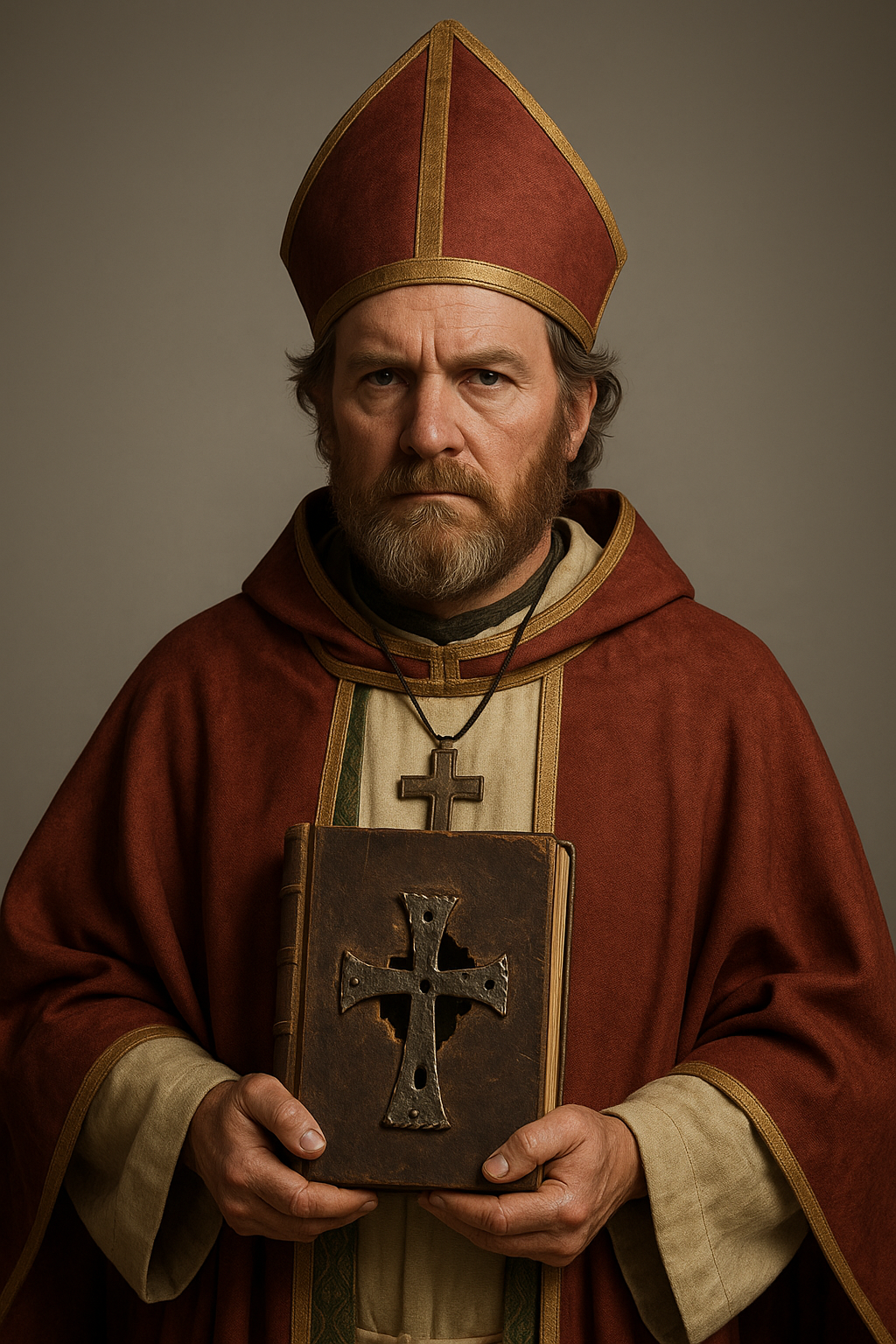
- A Book or Gospel Book, often pierced by a Sword: This dual imagery represents both his intellectual prowess and his martyrdom. The book signifies his scholarship, his role as a teacher, and his deep reverence for Scripture. The sword piercing the book vividly recalls his death, as he reportedly used a Gospel book to shield himself and his companions, dying while protecting the sacred Word of God. This symbol speaks to the power of the Gospel and the ultimate sacrifice made for it.
- A Mitre and Crosier: As an archbishop, Boniface is frequently depicted with these traditional episcopal insignia. The mitre (a bishop’s hat) and crosier (a bishop’s staff) signify his authority, his pastoral care for his flock, and his role in establishing the Church’s structure in Germany.
Timeline Summary
- c. 675 AD: Born Wynfrid in Crediton, Wessex, England.
- c. 685 AD: Entered Exeter monastery as a young boy.
- c. 700 AD: Became a monk and scholar at the monastery of Nursling.
- c. 705 AD: Ordained a priest.
- 716 AD: First, unsuccessful missionary journey to Frisia.
- 718 AD: Journeyed to Rome, seeking papal endorsement for his mission.
- 719 AD: Pope Gregory II commissioned him to preach in Germany and renamed him Boniface (“doer of good”).
- 722 AD: Felled Thor’s Oak near Geismar, a pivotal moment in the evangelization of Germany. Consecrated as a missionary bishop.
- 732 AD: Appointed Archbishop by Pope Gregory III, with authority to organize the Church in Germany.
- 737-738 AD: Undertook a third journey to Rome, after which he organized dioceses and appointed bishops throughout Bavaria, Thuringia, and Hessia.
- 744 AD: Founded Fulda Abbey, which became a vital center of learning and evangelization.
- 742-747 AD: Assisted the Frankish rulers Pepin the Short and Carloman in reforming the Frankish Church through several councils.
- 754 AD: Resigned as Archbishop of Mainz to return to Frisia for a final missionary endeavor.
- June 5, 754 AD: Martyred with his companions near Dokkum, Frisia (modern Netherlands). His relics were later brought to Fulda Abbey.
Scripture for Reflection
Saint Boniface’s life perfectly exemplifies several key biblical themes. Here are a few passages for reflection:
Matthew 28:19-20 (The Great Commission): “Go therefore and make disciples of all nations, baptizing them in the name of the Father and of the Son and of the Holy Spirit, teaching them to observe all that I have commanded you. And behold, I am with you always, to the end of the age.”
This passage directly illuminates Boniface’s life work. He embraced Christ’s command to “go forth” with profound conviction, dedicating his entire adult life to making disciples in lands far from his home. His mission was not merely about converting individuals but establishing the Church, teaching the faith, and ensuring its continuity, trusting in Christ’s promise to be with him always.
2 Timothy 4:7-8 (Paul’s reflection on his life and impending martyrdom): “I have fought the good fight, I have finished the race, I have kept the faith. Henceforth there is laid up for me the crown of righteousness, which the Lord, the righteous judge, will award to me on that Day, and not only to me but also to all who have loved his appearing.”
This verse beautifully captures Boniface’s unwavering perseverance and ultimate sacrifice. Like St. Paul, Boniface “fought the good fight” against paganism and indifference, “finished the race” of his missionary vocation with tireless zeal, and “kept the faith” to the very end, even shielding the Gospel with his own body. His martyrdom was the crown of his lifelong dedication.
Romans 1:16 (The Power of the Gospel): “For I am not ashamed of the gospel; it is the power of God for salvation to everyone who has faith, to the Jew first and also to the Greek.”
Boniface’s actions, particularly the felling of Thor’s Oak, were a bold, public declaration that he was “not ashamed of the Gospel.” He trusted completely in the “power of God for salvation” to overcome ancient superstitions and bring people to true faith. His life was a living testament to the transformative power of the Good News.
Prayers to St. Boniface
Here is a prayer often associated with Saint Boniface, invoking his intercession:
O God, who by the preaching and teaching of Saint Boniface, your Martyr and Bishop, brought the light of the Gospel to many nations, grant that we who honor his memory may follow his example in proclaiming your truth and defending your Church, through Christ our Lord. Amen.
Another prayer for guidance and missionary zeal:
Saint Boniface, zealous missionary and fearless martyr, you brought the saving light of Christ to the Germanic peoples, establishing the Church with courageous faith and tireless labor. Intercede for us, we pray, that we may be ever bold in proclaiming the Gospel in our own time and place. Inspire us with your unwavering fidelity to the See of Peter and your dedication to the truth. Help us to dismantle the idols of our age and build up the Kingdom of God in our hearts and in the world. Through your prayers, may we persevere in faith and charity until we are united with you in the heavenly kingdom. Amen.