Early Life and Background
Giovanni di Pietro di Bernardone was born in Assisi, Italy in 1181 or 1182 to a wealthy cloth merchant, Pietro Bernardone, and his French wife, Pica. Nicknamed “Francesco” (meaning “Frenchman”) by his father, young Francis lived a carefree, privileged life.
He was educated in basic Latin and was fond of troubadour music and chivalric romance. In 1202, Francis joined the war between Assisi and Perugia and was captured, spending a year as a prisoner. After his release and a serious illness, he began questioning his life of leisure.
In 1205, on the way to join another military campaign, Francis had a strange dream or vision that he interpreted as a call from God to turn back from worldly pursuits. He returned to Assisi, drawn increasingly to prayer and solitude, unaware that this was the first step of his journey toward sainthood.
Journey to Sainthood and Significant Contributions
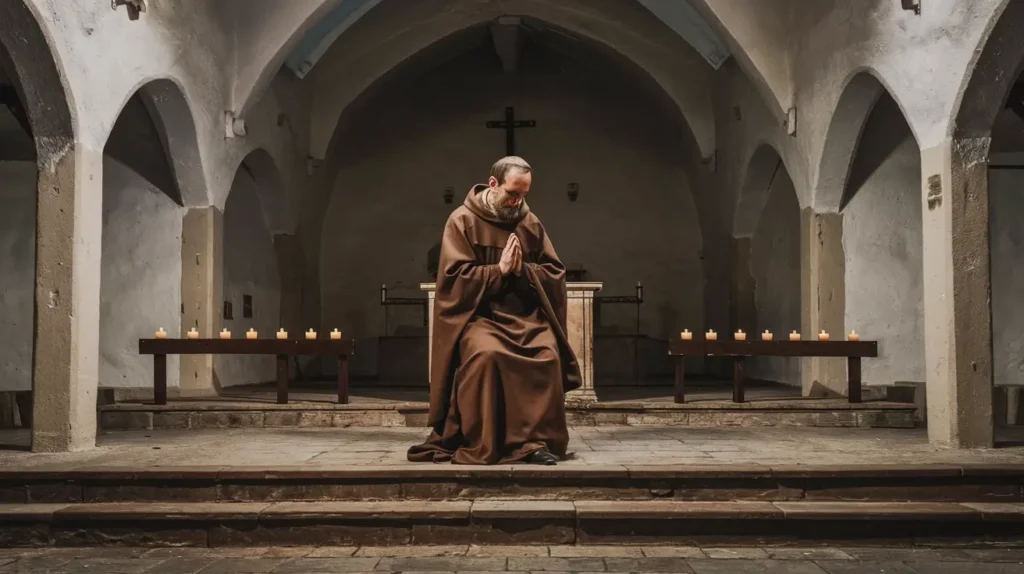
Back in Assisi, Francis dramatically changed his lifestyle. He started praying in deserted chapels and caring for lepers – acts of charity that caused his friends to ridicule him. One day, while praying in the dilapidated church of San Damiano, Francis heard Christ speak from the crucifix, saying, “Francis, go and repair My church which, as you see, is falling into ruins.”
Taking the command literally, he sold some of his father’s cloth to fund the church’s repair. This act angered his father, leading to a public confrontation. In early 1206, before the Bishop of Assisi, Francis renounced his inheritance completely, even stripping off his fine clothes to symbolize his rejection of his former life. From that point, he embraced total poverty, often wearing only a coarse tunic.
Now a penitent, Francis wandered the hills around Assisi rebuilding ruined chapels (including San Damiano and the Porziuncola) and tending to lepers. By 1208, his sincerity and joy attracted followers. He began preaching a simple message of repentance, brotherly love, and peace, even though as a layman he had no formal license to preach.
Francis formed a small brotherhood that lived in utter simplicity. In 1209 he composed a brief rule of life and led his 11 companions to Rome to seek approval from Pope Innocent III, who, after some hesitation, orally approved their way of life. This marked the informal founding of the Franciscan Order (Order of Friars Minor). Francis also inspired St. Clare of Assisi, a noblewoman, to embrace holy poverty; with his guidance Clare founded the “Poor Clares,” the Franciscan second order for women in 1212. For laypeople unable to leave their families, Francis later initiated a Third Order, allowing them to live Franciscan spirituality in the world.
In the years that followed, Francis traveled extensively, preaching the Gospel to all who would listen. He had an innate charisma and “evangelical zeal” that drew thousands to repentance. In 1219, during the Fifth Crusade, Francis courageously traveled to Egypt to seek peace, even meeting Sultan al-Kamil in a bold attempt to end the conflict.
Though he did not convert the Sultan, Francis’s respectful dialogue earned the Muslim leader’s admiration. Francis’s approach of witnessing through peace and example – rather than violence – was radical for his time. By 1220, the rapidly growing Franciscan movement needed organizational structure. Francis, preferring a humble life over administration, appointed another friar to lead the order, and he revised the rule to better organize the brotherhood.
Miracles and Key Events
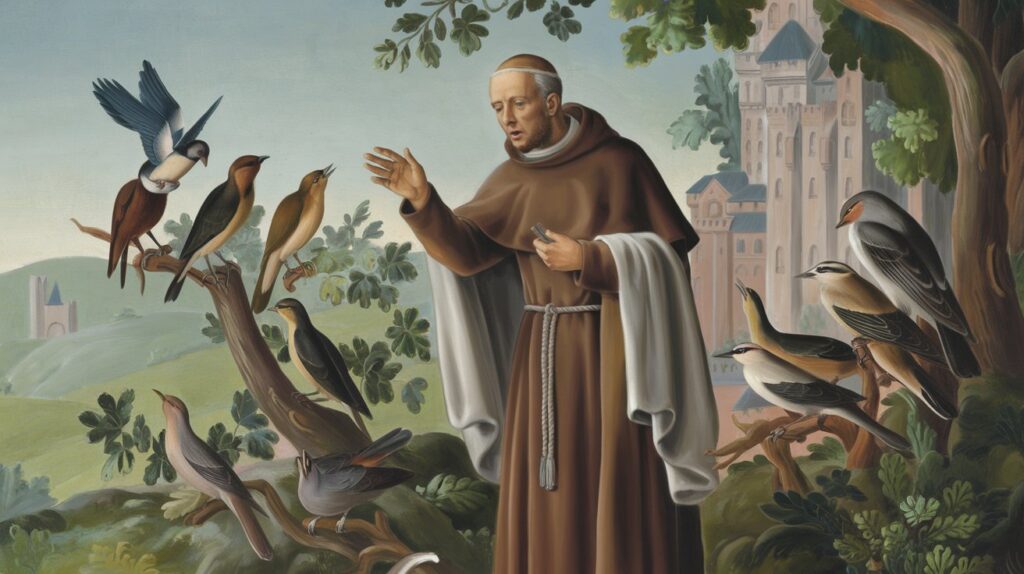
Many stories of miraculous events surround Francis’s life, contributing to his popular image as a saint close to God’s creation. He famously preached to the birds, gently persuading them to sing praises to the Creator, and tamed a wild wolf that had terrorized the town of Gubbio, turning the fierce wolf into a pet of the locals – legends that illustrate his extraordinary rapport with animals.
In Greccio on Christmas Eve 1223, Francis recreated the first live Nativity scene, complete with a manger, an ox, and a donkey, to help people contemplate the humility of Christ’s birth. This beloved tradition of the Christmas crèche spread throughout Christendom.
The most dramatic miracle associated with Francis occurred in 1224. While he was praying and fasting on Mount La Verna, Francis had a vision of a Seraphic angel crucified. When the vision faded, Francis discovered the stigmata – wounds corresponding to Christ’s crucifixion – in his own flesh.
He became the first documented saint to bear the stigmata, a sign of profound unity with Christ’s suffering. This event astonished even his contemporaries and was witnessed and recorded by his close companion Brother Leo. From then on, Francis bore these wounds hidden under his tunic, enduring them with patience and joy.
Numerous other miracles of healing and mercy are attributed to Francis. He reportedly cured the sick, multiplied food for his friars, and had insights beyond human knowledge. Perhaps his greatest “miracle,” however, was his joyful spirit and radical love for everyone – humans and animals alike – which transformed hearts. His life itself became a model of the beatitudes.
Interactions with Other Saints and Biblical Figures
Francis’s life intersected with several other saints. Most notably, he was the spiritual father to Saint Clare of Assisi, guiding her to establish the Poor Clares and supporting her vocation. He also met Saint Dominic de Guzmán (founder of the Dominicans) around 1215; according to tradition, the two founders developed a great mutual respect and pledged friendship between their orders. Francis’s influence on Clare and Dominic exemplifies the cross-pollination of holiness among the saints of his era.
Biblically, Francis sought to imitate Jesus as literally as possible. He often referred to himself as “the Herald of the Great King” (announcing the Gospel) and strove to live like the apostles described in Scripture – owning nothing and preaching everywhere.
His decision to embrace poverty was inspired by Christ’s instructions to the apostles in the Gospels. In fact, one pivotal moment in 1208 occurred when Francis heard the Gospel passage where Jesus sends out the disciples with no purse or sandals; he exclaimed, “This is what I wish; this is what I am seeking” and adopted that teaching as his lifestyle. Later, Francis’s reception of the stigmata solidified his mystical union with the Crucified Christ, again rooting his sanctity in a direct biblical parallel to Saint Paul’s words: “I bear on my body the marks of Jesus.”
Timeline of Saint Francis’s Life
- 1181/1182 – Birth of Francis in Assisi, Umbria, to Pietro and Pica Bernardone.
- 1202 – Fights in a war between Assisi and Perugia; taken prisoner and held for a year.
- 1203–1204 – Suffers a serious illness; has a vision in a dream that prompts him to abandon military ambitions and seek God’s will.
- 1205 – Gradual conversion begins: Francis gives money to the poor, even kissing a leper in an act of humble mercy. In the ruined chapel of San Damiano, he hears Christ say “Rebuild My church,” prompting him to repair churches literally.
- 1206 – Publicly renounces his wealth before the Bishop of Assisi by stripping off his garments; begins living as a penitent beggar reliant on God.
- 1208 – Embraces a life of preaching and penance. Gains his first followers and adopts a simple habit (coarse tunic with a rope belt). Francis starts the Franciscan movement of evangelical poverty.
- 1209 – Travels to Rome and receives Papal approval from Pope Innocent III for his group’s way of life. The Order of Friars Minor (Franciscans) is informally founded.
- 1212 – Welcomes St. Clare of Assisi as his follower; she founds the Poor Clares, the Second Order of Franciscans.
- 1219 – Journeys to Egypt during the Fifth Crusade; meets Sultan al-Kamil to advocate for peace and preach the Gospel.
- 1223 – Sets up the first Nativity scene in Greccio, Italy, creating the tradition of the Christmas crèche. Francis also finalizes the Rule of the Franciscan Order, which is approved by Pope Honorius III.
- 1224 – While on retreat at Mount La Verna, receives the stigmata (the five wounds of Christ) during a mystical vision of a six-winged seraph.
- 1226 – Seriously ill and nearly blind, Francis composes the “Canticle of Brother Sun,” praising God for creation. On October 3, 1226, he dies at the Porziuncola in Assisi, at about 44 years old.
- 1228 – Canonized as a saint by Pope Gregory IX, less than two years after his death. The Basilica of Saint Francis is built in Assisi to enshrine his tomb.
- 1979 – Pope John Paul II declares St. Francis the patron saint of ecology, in honor of his love for nature.
Legacy and Influence
Saint Francis of Assisi’s legacy is immensely impactful on the Church and the wider world. As “one of the most venerated religious figures in Roman Catholic history,” Francis’s example of holiness has universal appeal. He founded the Franciscan Orders – the Friars Minor, the Poor Clares (with St. Clare), and the Third Order for laity – which revitalized the Church by preaching renewal, poverty, and simplicity.
The Franciscan movement played a major role in the medieval revival of evangelical spirituality, focusing on Christ-like poverty and care for the poor. Francis’s personal charisma and love left a mark on thousands of followers in his lifetime, and that mark only grew after his death.
In art and literature, Francis is often portrayed preaching to birds or taming a wolf, symbols of his harmony with creation. His Canticle of Brother Sun is among the earliest Italian poetic texts and is considered a masterpiece of spirituality and literature, inspiring hymns like “All Creatures of Our God and King.”
Centuries later, Francis’s influence is evident in the Church’s emphasis on environmental stewardship; indeed, Pope Francis (elected in 2013) chose his papal name in honor of St. Francis, signaling a mission of humility, peace, and care for creation. St. Francis’s feast day (October 4) is celebrated worldwide, often with the blessing of pets and animals in remembrance of his patronage of animals and ecology.
Perhaps Francis’s greatest legacy is the witness that a life patterned directly on the Gospel is not only possible but also profoundly attractive. He showed that radical poverty – when embraced for love of Christ – can be a source of joy and freedom.
This “Poverello” (Poor Little Man) from Assisi inspired a spiritual revolution. Countless people, from peasants to popes, have sought to follow his footsteps of simplicity, seeing him as a “second Christ” in how closely he imitated Jesus. Through the Franciscan family of religious orders, the Church gained missionaries, scholars, and servants of the poor across the globe.
Nine centuries later, St. Francis of Assisi remains a touchstone of peace, charity, and reverence for all life – truly a saint whose life continues to “repair the Church” in every age.