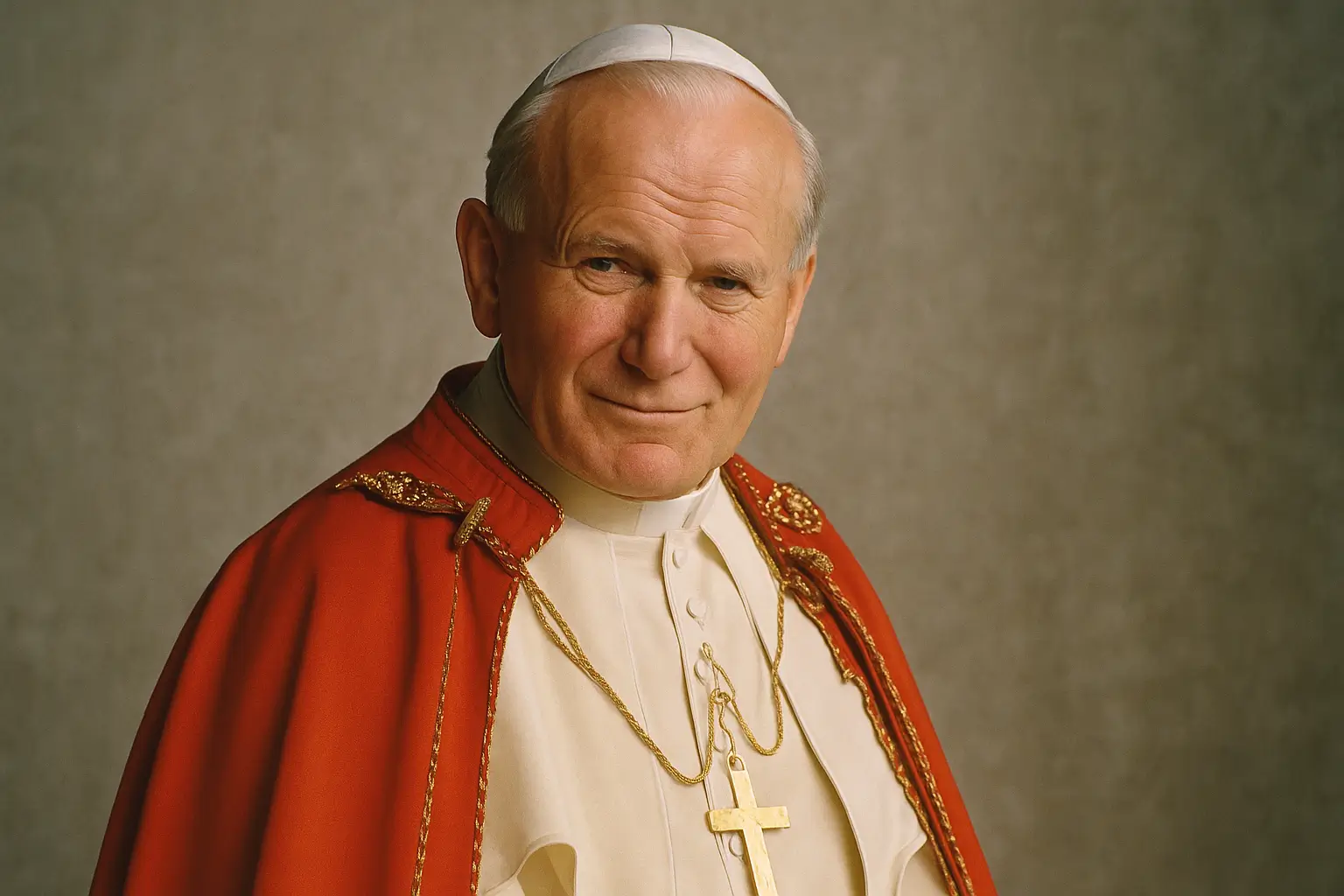
Discover the extraordinary life of Saint John Paul II, the Polish pope whose courage, travels, and teachings helped topple communism and inspire a new generation of faith.
Quick Facts
| Key | Detail |
| Birth | May 18, 1920, in Wadowice, Poland (as Karol Józef Wojtyła) |
| Death | April 2, 2005, in the Apostolic Palace, Vatican City |
| Feast Day | October 22 (the anniversary of his papal inauguration) |
| Patronage | World Youth Day, young Catholics, families, the Archdiocese of Kraków, and Poland |
| Canonized | April 27, 2014, by Pope Francis in Vatican City |
Historical Context & Early Life
To understand the titan of faith that was Saint John Paul II, we must first understand the world that forged him. Karol Józef Wojtyła was born in 1920 in Wadowice, a small Polish town. His homeland, Poland, was itself newly reborn, having regained its independence just two years earlier after more than a century of being partitioned by foreign powers. This national backdrop of resilience, culture, and deep-seated Catholic faith was the air he breathed.
Yet, his early life was marked by profound personal loss. His mother, Emilia, died from illness when he was just eight. His older brother, Edmund, a physician who became his hero, died tragically from scarlet fever contracted from a patient when Karol was twelve. By the age of twenty, his father, Karol Sr., a retired army officer and a man of deep piety, also passed away. This left the young Wojtyła utterly alone, an orphan who had experienced the depths of human suffering before even reaching adulthood.
These tragedies, however, did not break him; they deepened his reliance on God and his spiritual mother, Mary. He was a brilliant and vibrant young man—a gifted actor, a talented poet, and an avid athlete who loved hiking and skiing in the nearby Tatra Mountains. He enrolled at Kraków’s Jagiellonian University in 1938 to study Polish literature. But history intervened.
In 1939, Nazi Germany invaded Poland, plunging the nation into the darkness of World War II. The university was shut down, and to avoid deportation to a German labor camp, Wojtyła worked first in a limestone quarry and then in the Solvay chemical factory. This firsthand experience with the backbreaking reality of manual labor gave him a profound and lasting appreciation for the dignity of work and the worker—a theme that would echo throughout his papal teachings. During the occupation, he also participated in the “Rhapsodic Theatre,” an underground cultural resistance movement that used the power of the spoken word to keep Polish culture and hope alive.
It was in this crucible of war, occupation, and personal loss that his priestly vocation, once a quiet whisper, became a clear and compelling call.
Calling & Key Milestones
Karol Wojtyła’s journey to the papacy was as improbable as it was providential. Witnessing the systematic dehumanization of his people under two brutal, atheistic ideologies—Nazism and, later, Communism—convinced him that the only true answer to the world’s suffering was Christ.
In 1942, he began studying in a clandestine seminary secretly operated by the Archbishop of Kraków. He was ordained a priest on All Saints’ Day, November 1, 1946, as Poland was trading the tyranny of Nazism for the oppression of Soviet-backed Communism.
Bishop and Cardinal at Vatican II
After earning two doctorates in theology, Father Wojtyła’s intellectual and pastoral gifts were undeniable. In 1958, Pope Pius XII appointed him an auxiliary bishop of Kraków. At 38, he was Poland’s youngest bishop. He became a central figure at the Second Vatican Council (1962–1965), where his experience living under totalitarianism gave him a unique perspective. He made significant contributions to key documents, most notably Gaudium et Spes (“Joy and Hope”), the Pastoral Constitution on the Church in the Modern World, forcefully arguing for the Church’s role in defending religious freedom and human dignity. Pope Paul VI recognized his leadership, appointing him Archbishop of Kraków in 1964 and elevating him to Cardinal in 1967.
The Papacy: “Be Not Afraid!”
Following the sudden death of Pope John Paul I after only 33 days, the cardinals gathered in October 1978. In a stunning decision, they looked beyond Italy and elected the 58-year-old Polish Cardinal, Karol Wojtyła. He took the name John Paul II. Emerging on the balcony of St. Peter’s Basilica, his first words to the world became the watchwords of his pontificate: “Be not afraid! Open wide the doors for Christ!” It was a clarion call of hope to a world gripped by the Cold War, materialism, and fear.
The Pilgrim Pope and the Fall of Communism
John Paul II shattered the mold of a Vatican-bound pontiff. He was a missionary pope, undertaking 104 international apostolic journeys and visiting 129 countries. He utilized modern media to bring his message to billions.
His most consequential journey was his first trip back to Poland in June 1979. For nine days, millions of Poles poured into the streets to see and hear him. In Warsaw’s Victory Square, he preached a homily that changed history, crying out, “I, a son of Polish soil and I, the Pope, cry from the depths of this millennium: Let your Spirit descend! And renew the face of the earth. The face of this land!” The visit ignited a “revolution of the spirit” that gave birth to the Solidarity movement and, within a decade, led to the peaceful collapse of communism in Poland and across Eastern Europe.
World Youth Day and Divine Mercy
John Paul II had a special love for young people, whom he called the “hope of the Church.” In 1985, he established World Youth Day (WYD), a massive international gathering of faith. These events, held every few years in a different global city, have drawn millions and are responsible for countless vocations and conversions, revitalizing the faith of an entire generation.
He also championed the message of a humble Polish nun, Sister Faustina Kowalska, who had received visions of Jesus as the “King of Divine Mercy.” John Paul II shared her conviction that the world was in desperate need of God’s mercy. He canonized her in 2000 and established the Second Sunday of Easter as “Divine Mercy Sunday” for the universal Church.
The Assassination Attempt and Forgiveness
On May 13, 1981—the feast of Our Lady of Fatima—John Paul II was shot and critically wounded in St. Peter’s Square by an assassin. He hovered between life and death. He later attributed his survival to the direct intervention of the Virgin Mary, stating, “One hand pulled the trigger, and another hand guided the bullet.” In an act that stunned the world, he later visited his would-be assassin, Mehmet Ali Ağca, in prison and offered his personal forgiveness.
Spiritual Legacy & Theological Themes
John Paul II’s pontificate, the third-longest in history, left an indelible mark on the Church and the world. His legacy is built on several key pillars.
The Dignity of the Human Person: This was the bedrock of his thought. Forged in his opposition to ideologies that crush the individual, he taught that every single person, from conception to natural death, is created in the image of God and possesses an inviolable dignity. This principle animated his powerful defense of the unborn, the elderly, and the marginalized in encyclicals like Evangelium Vitae (“The Gospel of Life”).
Theology of the Body: In a series of 129 Wednesday audiences, John Paul II developed a profound and beautiful catechesis on human love in the divine plan. Known as the “Theology of the Body,” it explores who we are as embodied male and female persons, and how the Christian vision of love, sex, and marriage reveals deep truths about God himself. It was a revolutionary response to the sexual confusion of the modern age.
Faith and Reason: In his encyclical Fides et Ratio (“Faith and Reason”), he argued that faith and reason are not enemies but “two wings on which the human spirit rises to the contemplation of truth.” He championed a robust intellectual Catholicism that could confidently engage with science, philosophy, and modern culture.
Suffering as Redemptive: In his final years, John Paul II was afflicted with Parkinson’s disease and severe arthritis. He did not hide his frailty. Instead, he offered it to the world as a powerful witness. He showed how human suffering, when united with the Cross of Christ, can become a source of grace and a powerful prayer for the world, a concept he explored in his apostolic letter Salvifici Doloris (“On the Christian Meaning of Human Suffering”).
Devotion Today
Saint John Paul II is one of the most beloved saints of modern times. Millions of pilgrims flock to his tomb in the grottoes of St. Peter’s Basilica each year. Other major sites of devotion include the Saint John Paul II National Shrine in Washington, D.C., and the Divine Mercy Sanctuary in Kraków, Poland, which he consecrated.
The faithful invoke him as a powerful intercessor, especially as a patron for families, young people, and for the protection of human dignity. Many turn to him for courage in the face of fear, for strength in suffering, and for guidance in living out a bold and joyful faith in the modern world.
A popular prayer for his intercession is:
O, St. John Paul, from the window of heaven, grant us your blessing! Bless the Church that you loved and served and guided, courageously leading it along the paths of the world in order to bring Jesus to everyone and everyone to Jesus. Bless the young, who were your great passion. Help them dream again, help them look up high again to find the light that illuminates the paths of life on earth. Amen.
Reflections for Modern Readers
The life of Saint John Paul II is not just a historical account; it is a living lesson for us today. Here are a few takeaways:
- Embrace Courage: “Be Not Afraid!” We all face fears: fear of failure, fear of commitment, fear of what others think, fear of the future. John Paul II’s powerful exhortation reminds us to place our trust not in our own strength, but in Christ’s victory over sin and death. Open the doors of your heart, your family, and your work to Him without fear.
- See the Dignity in Everyone. In a world often marked by division and “cancel culture,” John Paul II’s radical insistence on the dignity of every person is a needed antidote. Challenge yourself to see the image of God in those you disagree with, in the poor, the immigrant, the elderly, and the unborn. Defend their dignity in your words and actions.
- Don’t Waste Your Suffering. Everyone suffers. The temptation is to see it as meaningless or to become bitter. John Paul II, especially in his public battle with illness, showed us a different way. By uniting our personal struggles—be they physical, emotional, or spiritual—to the Cross of Jesus, they can become a source of grace for ourselves and for the world.
- Authentic Love is a Gift of Self. In a culture that often reduces love to mere feeling or self-gratification, the Theology of the Body teaches that true love is about making a sincere gift of oneself to another. This is the path to true joy in our friendships, in marriage, and in our relationship with God.
Timeline Summary
- 1920: Karol Józef Wojtyła is born in Wadowice, Poland.
- 1942: Enters a clandestine seminary in Nazi-occupied Kraków.
- 1946: Ordained a Catholic priest.
- 1958: Appointed auxiliary bishop of Kraków.
- 1962-1965: Plays a significant role as a bishop at the Second Vatican Council.
- 1967: Elevated to the rank of Cardinal.
- 1978: Elected the 264th Pope, taking the name John Paul II.
- 1979: Makes his historic first papal visit to Poland, inspiring the Solidarity movement.
- 1981: Survives a near-fatal assassination attempt in St. Peter’s Square.
- 1985: Inaugurates the first World Youth Day.
- 1992: Promulgates the new Catechism of the Catholic Church.
- 2000: Canonizes St. Faustina Kowalska and establishes Divine Mercy Sunday.
- 2005: Dies at the age of 84 in Vatican City.
- 2011: Beatified by his successor, Pope Benedict XVI.
- 2014: Canonized a saint by Pope Francis.
Further Reading & References
- John Paul II. Crossing the Threshold of Hope. Alfred A. Knopf, 1994.
- John Paul II. Encyclical Letter Redemptor Hominis. 1979. Vatican.va.
- John Paul II. Encyclical Letter Evangelium Vitae. 1995. Vatican.va.
- Weigel, George. Witness to Hope: The Biography of Pope John Paul II. Harper Perennial, 2005.
- West, Christopher. Theology of the Body for Beginners: A Basic Introduction to Pope John Paul II’s Sexual Revolution. Revised ed., Ascension Press, 2009.
Reflection Quiz
1. What was the central theme of John Paul II’s first words as pope?
His first words were, “Be not afraid! Open wide the doors for Christ!” The central theme was courage and trust in Christ in the face of the world’s fears.
2. What two 20th-century totalitarian ideologies did Karol Wojtyła live under in Poland?
He lived under the occupation of Nazism during World War II and then under Soviet-backed Communism.
3. What major global event for young people did John Paul II establish?
He established World Youth Day (WYD) in 1985 to bring young Catholics from around the world together for a celebration of faith.
4. What is the “Theology of the Body”?
It is the name given to a series of 129 of his Wednesday audiences that explained the beauty of the human person, love, sexuality, and marriage as a reflection of God’s own inner life.
5. How did John Paul II respond to the man who tried to assassinate him?
He publicly forgave him and later visited him in his prison cell to offer his forgiveness in person.