In the vast tapestry of Catholic saints, each thread tells a unique story of faith, courage, and divine grace. Among these inspiring figures shines Saint Kateri Tekakwitha, affectionately known as the “Lily of the Mohawks.” Her life, lived in the 17th-century wilderness of what is now upstate New York, offers a profound testament to the power of conversion and perseverance in the face of profound cultural and personal challenges. This article will explore her humble beginnings, her unwavering commitment to Christ, her enduring spiritual legacy, and how her example continues to resonate with believers today, inviting us to embrace faith with a pure heart and steadfast spirit.
Quick Facts
| Category | Detail |
|---|---|
| Birth | 1656, Ossernenon (now Auriesville, New York, USA) |
| Death | April 17, 1680, Caughnawaga (now Kahnawake, Quebec, Canada) |
| Feast Day | July 14 (USA), April 17 (Canada) |
| Patronage | Environment, ecology, exiles, Native Americans, purity, orphaned children |
| Canonized | October 21, 2012, by Pope Benedict XVI |
Historical Context & Early Life
Kateri Tekakwitha was born in 1656 in the Mohawk village of Ossernenon, nestled in what is now Auriesville, New York. Her name, Tekakwitha, means “she who puts things in order” or “she who bumps into things.” Her father was a Mohawk chief, and her mother was an Algonquin Catholic, captured by the Mohawks and adopted into the tribe. This dual heritage placed Kateri at the crossroads of two distinct worlds.
The 17th century in North America was a time of immense change and conflict. European settlers, particularly the French and Dutch, were establishing colonies, bringing with them new technologies, diseases, and religious beliefs. Jesuit missionaries, known as “Blackrobes” by the Native Americans, were actively evangelizing among the indigenous peoples, often at great personal risk. This era saw devastating epidemics of smallpox and other European diseases sweep through Native American communities, for which they had no immunity.
When Kateri was just four years old, a smallpox epidemic ravaged her village. The disease tragically claimed the lives of her parents and her younger brother. Kateri herself contracted smallpox and survived, but it left her with weakened eyesight and a scarred face, which in her culture, often brought social stigma. Orphaned and partially disfigured, she was adopted by her two aunts and an uncle, who became her guardians. She was expected to conform to traditional Mohawk customs, which included marrying and raising a family.
Despite these early hardships, Kateri possessed an innate gentleness and a contemplative spirit that set her apart. She often found solace in nature, observing God’s creation, and developed a quiet strength that would become the hallmark of her extraordinary life. Her mother’s Catholic faith, though quietly practiced, had left an imprint, preparing Kateri’s heart for the seeds of Christianity.
Calling & Key Milestones
The Stirrings of Faith and a Vow of Purity
Even as a young girl, Kateri felt a deep longing for something more than the traditional life her community offered. Her encounters with Jesuit missionaries, who occasionally visited her village, further fanned the flames of a budding faith. She was particularly drawn to their teachings about Jesus Christ and the concept of a singular, loving God. At a time when marriage was a social and economic necessity, Kateri resisted all attempts to arrange a marriage for her. She made a private vow to remain a virgin, dedicating her life to God, a radical decision that caused misunderstanding and even persecution within her tribe.
Conversion and Baptism
In 1675, a Jesuit priest named Father Jacques de Lamberville visited Kateri’s village. He was impressed by her profound spiritual inclination and instructed her in the Catholic faith. On Easter Sunday, April 5, 1676, at the age of 20, Kateri received the sacrament of baptism, taking the name Kateri (Catherine) in honor of Saint Catherine of Siena. This act marked a profound turning point. Her conversion was met with hostility from some members of her village who viewed it as a rejection of their traditions. She faced ostracism, ridicule, and was even deprived of food on Sundays because she refused to work on the Sabbath.
Journey to Caughnawaga
Life in Ossernenon became increasingly difficult for Kateri. The harassment escalated, making it nearly impossible for her to practice her faith freely. Encouraged by her spiritual director, she decided to seek refuge in a Christian Native American settlement, a Jesuit mission village called Kahnawake (then known as Caughnawaga), located near Montreal, Quebec. In 1677, Kateri undertook a perilous journey of over 200 miles through dense forests, traveling secretly by night and hiding by day, to reach this community. This daring escape demonstrated her unwavering commitment to her faith and her incredible resilience.
A Life of Penance and Prayer
In Kahnawake, Kateri found the spiritual freedom she craved. She immersed herself in a life of intense prayer, penance, and devotion. She spent countless hours in meditation, often by the cross she erected in the woods, and developed a profound love for the Eucharist. She practiced severe mortifications, fasting rigorously and subjecting herself to physical austerities in imitation of Christ’s suffering and in reparation for sins. While her spiritual practices were intense, they were rooted in a deep love for God and a desire for holiness, carefully guided by her Jesuit confessors who often cautioned her against excess.
Mystical Experiences and Death
Kateri’s holiness deepened rapidly. She was known for her humility, charity, and radiant spiritual joy, despite her frail health. She often spoke of her experiences with Jesus and Mary, and her fellow villagers reported seeing a luminous glow about her. Her health, already weakened by smallpox and rigorous penance, began to decline. Kateri passed away peacefully on April 17, 1680, at the young age of 24. Witnesses reported that immediately after her death, the smallpox scars on her face miraculously vanished, and her face became beautiful and radiant. This phenomenon was seen as a sign of her sanctity and a foretaste of her heavenly glory.
Spiritual Legacy & Theological Themes
Saint Kateri Tekakwitha’s life is a powerful testament to several core virtues and theological themes that resonate deeply with Catholic teaching and Scripture. Foremost among these is her unwavering **purity of heart**. Despite societal pressures and physical hardships, she maintained a steadfast commitment to her vow of virginity, seeing it as a complete gift of herself to Christ. This purity extended beyond her physical state to her intentions and actions, exemplifying Matthew 5:8, “Blessed are the pure in heart, for they shall see God.”
Her story is also one of immense **courage and perseverance** in faith. Kateri chose Christ despite intense ostracization, ridicule, and even threats from her community. Her journey to Kahnawake was a dangerous act of faith, a testament to her conviction that a life with Christ was worth any sacrifice. She demonstrates how faith can flourish even in the most challenging environments, acting as a bridge between her Native American heritage and the Christian faith. Her life highlights the concept of **inculturation**, showing how the Gospel can be embraced and lived authentically within diverse cultures, without abandoning one’s roots but rather transforming them in Christ.
Kateri’s deep **love for the Eucharist** and her profound personal prayer life are central to her spiritual legacy. She understood the Real Presence of Christ in the Blessed Sacrament and sought Him with a hunger that fueled her entire being. Her intense spiritual practices, though perhaps daunting to modern sensibilities, underscore a passionate desire for union with God, mirroring the mystical traditions found throughout Christian history. Her life also speaks to the transformative power of grace, showing how a person can move from an inherited culture to a profound personal encounter with God that redefines their very existence.
Her lasting influence is seen not only in devotion but also in inspiring a greater appreciation for the sanctity of creation. As patron of the environment, she reminds us of the Native American reverence for the natural world, a spirituality that can be harmonized with Catholic teaching on stewardship of God’s creation.
Devotion Today
Devotion to Saint Kateri Tekakwitha has grown significantly, especially since her canonization in 2012. She is a beloved figure for Native American Catholics, serving as a powerful symbol of faith lived authentically within their cultural identity. Many see her as a bridge-builder, reconciling indigenous traditions with Christian beliefs.
Pilgrimages are made annually to her two primary shrines. The National Shrine of Saint Kateri Tekakwitha in Fonda, New York, is built on the site of her birthplace and ancestral village of Ossernenon. It draws thousands of visitors each year, who come to pray, learn about her life, and reflect on the deep spiritual roots of Christianity in North America. The other significant site of devotion is the Saint Kateri Tekakwitha Shrine in Kahnawake, Quebec, the location of the mission where she spent her final years and where she is buried. Both shrines offer a powerful sense of connection to Kateri’s journey and spirit.
Her feast day on July 14 (in the USA) and April 17 (in Canada) is celebrated with special Masses, cultural events, and prayer services, often incorporating elements of Native American spirituality and art. She is widely invoked as the patroness of ecology and the environment, urging Catholics to greater stewardship of creation. She is also a patron of purity, exiles, and orphaned children, offering comfort and intercession to those facing similar challenges.
Reflections for Modern Readers
Saint Kateri Tekakwitha’s life, though lived centuries ago, offers timeless lessons for us in the 21st century:
- Embrace Your Authentic Self in Christ: Kateri beautifully blended her Mohawk identity with her Catholic faith. She didn’t abandon her heritage but allowed Christ to purify and elevate it. For us, this means understanding that our unique cultural backgrounds, talents, and experiences are not obstacles to faith but can be pathways to encountering God and serving Him. Perhaps you come from a family with different beliefs; Kateri’s example encourages you to find your own path to Christ while respecting your roots.
- Courage in Conviction: Kateri faced immense pressure and suffering for her faith. She reminds us that following Christ sometimes requires standing firm against popular opinion, even from those we love. In a world where Christian values can be challenged, her steadfastness encourages us to articulate and live our beliefs with grace and courage, whether it’s defending a moral principle or simply living out your faith in daily actions, like refusing to participate in gossip or standing up for someone bullied.
- The Power of a Quiet, Deep Faith: Kateri was not a missionary or a great orator; her holiness shone through her humble, prayerful life. She teaches us that God uses ordinary people who offer extraordinary devotion. We don’t need grand gestures to be saints; consistent prayer, a heart for God, and small acts of charity in our daily lives can transform us and those around us. Think of her quiet perseverance in prayer, which transformed her soul and radiated hope to others.
- Stewardship of Creation: As patroness of the environment, Kateri connects us to the profound reverence for nature often found in indigenous cultures. Her life invites us to reconsider our relationship with the earth, seeing it not merely as a resource but as God’s precious handiwork, deserving of our care and respect. This could mean recycling, conserving water, or advocating for environmental protection, reflecting our Catholic call to care for creation.
- Intercultural Dialogue and Understanding: Kateri lived at a time of immense cultural clash. Her life serves as a model for finding common ground and understanding between different peoples. She shows that faith can transcend cultural barriers and unite people in Christ, urging us to be open to learning from and respecting those with different backgrounds and perspectives.
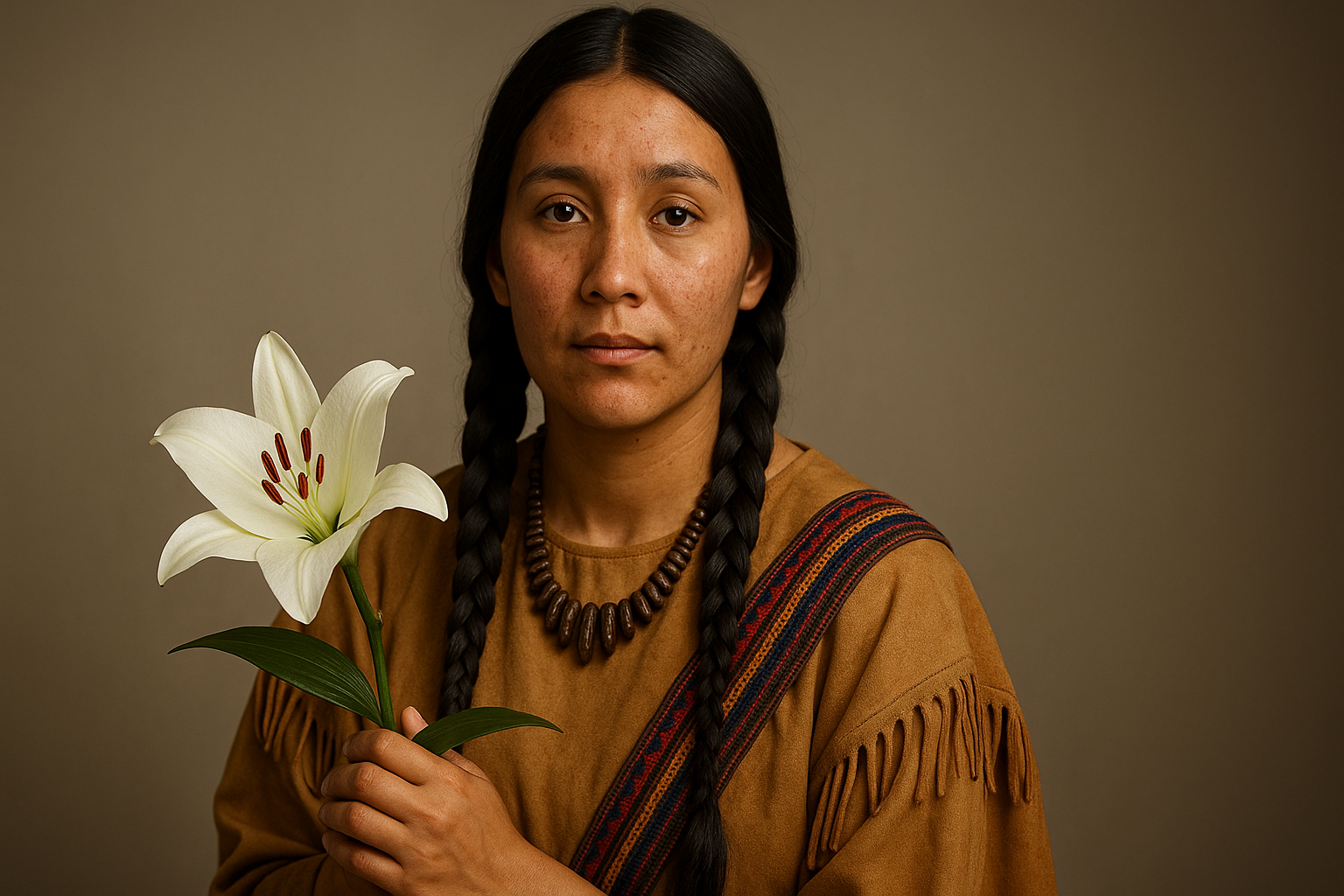
In art, Saint Kateri is often depicted with symbols that reflect her life and virtues. The most common is the **lily**, symbolizing her purity and her nickname, “Lily of the Mohawks.” She may also be shown holding a **cross** or a **rosary**, signifying her deep faith and devotion to Christ and Mary. Sometimes, she is seen with a **turtle**, which represents her membership in the Turtle Clan of the Mohawk Nation, honoring her cultural heritage. Other depictions might include **natural elements** like deer or forest scenes, emphasizing her connection to the environment and the wilderness where she lived and prayed. These symbols remind us of her dual identity, her unwavering faith, and her gentle, yet powerful, spirit.
Timeline Summary
- 1656: Born in Ossernenon (modern-day Auriesville, NY), daughter of a Mohawk chief and an Algonquin Catholic mother.
- 1660: Contracts smallpox during an epidemic, losing her parents and brother, and suffering from impaired eyesight and a scarred face. Adopted by her uncle.
- 1675: Meets Jesuit Father Jacques de Lamberville, who begins instructing her in the Catholic faith.
- April 5, 1676: Baptized on Easter Sunday at age 20, taking the name Kateri (Catherine).
- 1676-1677: Faces increasing ostracization and persecution for her faith within her village.
- 1677: Escapes her village and undertakes a dangerous 200-mile journey to the Christian mission village of Kahnawake (Caughnawaga) near Montreal.
- 1677-1680: Leads a life of intense prayer, penance, and devotion in Kahnawake, known for her humility and charity.
- March 25, 1679: Makes a private vow of perpetual virginity.
- April 17, 1680: Dies at the age of 24 in Kahnawake; witnesses report her face miraculously healing and becoming radiant after her death.
- 1884: First Plenary Council of Baltimore proposes her canonization.
- 1943: Declared Venerable by Pope Pius XII.
- 1980: Beatified by Pope John Paul II.
- October 21, 2012: Canonized as a saint by Pope Benedict XVI, becoming the first Native American saint.
Scripture for Reflection
Saint Kateri Tekakwitha’s life beautifully reflects several scriptural truths. Here are a few passages for reflection:
Matthew 5:8: “Blessed are the pure in heart, for they shall see God.”
Kateri’s unwavering commitment to purity, both of body and spirit, was a hallmark of her life. This beatitude speaks directly to her desire to dedicate herself entirely to God and the reward she now enjoys in heaven.
John 15:18-19: “If the world hates you, know that it has hated me before it hated you. If you were of the world, the world would love its own; but because you are not of the world, but I chose you out of the world, therefore the world hates you.”
Kateri experienced significant rejection and hostility from her community after her conversion. This passage reminds us that following Christ sometimes means standing apart from the world, and that such opposition is a sign of our belonging to Him.
Romans 12:2: “Do not be conformed to this world, but be transformed by the renewal of your mind, that you may prove what is the will of God, what is good and acceptable and perfect.”
Kateri’s radical conversion and her decision to live a life devoted to Christ, distinct from the societal norms of her time, perfectly illustrate the call to be transformed rather than conformed. She allowed God to renew her mind and direct her will.
Prayers to Saint Kateri Tekakwitha
Here is a beautiful prayer for intercession to Saint Kateri Tekakwitha:
Prayer to Saint Kateri Tekakwitha
O Saint Kateri, Lily of the Mohawks,
Your life was a testament to enduring faith and purity in the face of great adversity.
You walked a difficult path, leaving behind the comforts of your birthright to embrace Christ fully.
Through your intercession, we pray for the strength to live our faith courageously,
to remain pure of heart amidst the temptations of the world,
and to persevere in prayer and devotion, even when it is challenging.
Inspire us to love God’s creation as you did,
and to seek harmony and understanding among all peoples.
For all those who are marginalized,
for all Native American peoples,
and for those who struggle to find their place in the Church,
we ask for your gentle guidance and powerful prayers.
Help us, like you, to be transformed by God’s grace,
that we may one day share in the eternal vision of God in heaven.
Amen.