In the quiet cloisters of a French Carmelite monastery lived a young nun whose profound spiritual wisdom would echo through the ages, touching countless hearts and minds. Saint Thérèse of Lisieux, often called “The Little Flower of Jesus,” may have lived a short and outwardly unremarkable life, but her “Little Way” of spiritual childhood offers a powerful path to holiness for everyone, regardless of their circumstances. This article will journey through her fascinating life, from her loving family home to her entry into religious life, explore her influential teachings, and reveal why her message of radical trust and love remains so vital for us today.
Quick Facts
| Category | Detail |
|---|---|
| Birth | January 2, 1873, Alençon, France |
| Death | September 30, 1897, Lisieux, France |
| Feast Day | October 1 |
| Patronage | Missionaries, florists, aviators, Alaska, those suffering from tuberculosis, loss of parents, and the “little way.” |
| Canonized | May 17, 1925, by Pope Pius XI |
Historical Context & Early Life
Thérèse Martin was born in France during a period of significant change in Europe. The late 19th century was an era marked by rapid industrialization, scientific advancement, and political unrest, particularly in France, which had recently experienced the Franco-Prussian War and the tumultuous Paris Commune. Against this backdrop of societal upheaval, the Catholic Church in France was experiencing a period of renewed spiritual fervor, with a strong emphasis on devotion to the Sacred Heart of Jesus and the Blessed Virgin Mary. However, there was also growing secularism and anti-clerical sentiment, making the deep faith exemplified by families like the Martins particularly notable.
Thérèse’s parents, Louis Martin and Zélie Guérin, were extraordinary individuals who are now also recognized as saints by the Church. Louis was a watchmaker, and Zélie was a successful lacemaker. Their marriage was one of deep love, faith, and mutual respect, producing nine children, though only five daughters, including Thérèse, survived to adulthood. The Martin household was a vibrant domestic church, characterized by daily prayer, regular Mass attendance, charity, and a profound love for God. From an early age, Thérèse was immersed in an atmosphere where holiness was not just taught but lived.
Tragedy struck early in Thérèse’s life when her beloved mother, Zélie, died of breast cancer in 1877, when Thérèse was just four and a half years old. This loss profoundly affected the sensitive child. The family then moved to Lisieux to be closer to Zélie’s brother, Isidore Guérin. Her older sister Pauline, who had become a second mother figure, entered the Carmelite convent in Lisieux when Thérèse was nine, dealing another emotional blow. Soon after, Thérèse suffered from a mysterious illness, characterized by tremors and hallucinations, which lasted for several months. She attributed her miraculous recovery on Pentecost Sunday 1883 to the smile of the statue of the Blessed Mother in her room, an event she later called “Our Lady’s Smile.” This period of suffering and miraculous intervention deeply shaped her understanding of divine love and trust.
Calling & Key Milestones
From a very young age, Thérèse felt a powerful call to religious life, specifically to the Carmelite order, known for its contemplative and rigorous lifestyle. Her path was not without obstacles, but her unwavering determination and deep faith eventually prevailed.
Early Aspirations and Vocation
Even as a child, Thérèse harbored an intense desire for holiness and self-sacrifice. She recounted a pivotal moment around the age of 13, on Christmas Eve 1886, which she called her “complete conversion.” Prior to this, she was still quite sensitive and prone to tears. On this particular night, overhearing her father comment that she was too old to expect gifts in her shoes, instead of crying, she felt a profound inner strength and self-possession. This moment marked her freedom from self-pity and her newfound ability to forget herself for the sake of others. It was a crucial step towards her religious calling, enabling her to pursue it with greater resolve.
Her desire to enter the Carmelite convent was initially met with resistance due to her young age. Church law required a candidate to be at least 21 years old, and Thérèse was only 15. However, encouraged by her family, particularly her father, she sought special permission. This journey included a pilgrimage to Rome with her father and sister Céline in 1887, where she famously pleaded directly with Pope Leo XIII during an audience, asking him to grant her permission to enter Carmel. The Pope, impressed by her fervor, told her, “You will enter if it is God’s will.”
Entry into Carmel and the “Little Way”
Finally, on April 9, 1888, at the age of 15, Thérèse entered the Carmelite convent of Lisieux, joining two of her older sisters, Pauline (Sister Agnès of Jesus) and Marie (Sister Marie of the Sacred Heart). A third sister, Céline, would join later. Inside the cloister, Thérèse embraced the austere life of prayer, work, and communal living. She took the religious name Sister Thérèse of the Child Jesus and of the Holy Face.
It was within these seemingly ordinary circumstances that Thérèse developed her unique spiritual path, which she later called her “Little Way of Spiritual Childhood.” This path was characterized by profound humility, unwavering trust in God’s merciful love, and the performance of small, everyday duties with extraordinary love. Recognizing that she could not achieve great ascetic feats or grand acts of heroism, she resolved to offer God “little sacrifices” and to seek holiness not in extraordinary deeds, but in striving for perfection in the smallest actions, animated by a pure and selfless love. She saw herself as a small child in the arms of God, utterly dependent on His grace and mercy.
Spiritual Trials and Suffering
Thérèse’s spiritual journey was not without significant trials. For the last 18 months of her life, she endured a profound “night of faith,” experiencing intense spiritual darkness, doubt, and temptations against faith, particularly regarding the existence of heaven. Despite this inner suffering, she continued to live her Little Way, offering her struggles for the conversion of sinners and maintaining an outward demeanor of joy and fidelity to her rule. She saw this suffering as a participation in Christ’s Passion and an opportunity to trust God even more deeply in the absence of consolations.
Her Writings: “Story of a Soul”
At the command of her superiors, Thérèse began writing her autobiography, which would later be published posthumously as “L’Histoire d’une Âme” (The Story of a Soul). This collection of three manuscripts details her childhood, her entry into Carmel, her spiritual journey, and the exposition of her “Little Way.” It was through these writings, initially intended only for her sisters in the convent, that her spiritual genius and profound insights into the Gospel were revealed to the world. “Story of a Soul” became an instant success and has since been translated into countless languages, inspiring millions to follow her path of childlike trust and love.
Death and Legacy
Thérèse contracted tuberculosis, a common and often fatal disease of her era. She suffered greatly during her illness, enduring intense pain and physical debilitation with remarkable patience and cheerfulness. She died on September 30, 1897, at the age of 24, uttering her final words, “My God, I love You!” Her last desire was to “spend my heaven doing good on earth,” promising a shower of roses (meaning graces) from heaven. Her rapid canonization and designation as a Doctor of the Church attest to the extraordinary impact of her life and teachings.
Spiritual Legacy & Theological Themes
Saint Thérèse’s spiritual legacy is immense, despite her short life and limited direct interaction with the outside world. Her “Little Way” provides a unique and accessible path to holiness that resonates deeply with people from all walks of life.
The core virtues Thérèse exemplified are humility, trust, and love. She believed that true holiness wasn’t reserved for those capable of grand heroic acts, but was attainable by anyone who embraced their smallness and offered their entire being to God with perfect love. This aligns perfectly with scriptural teachings on humility (e.g., Matthew 18:3-4: “Truly, I say to you, unless you turn and become like children, you will never enter the kingdom of heaven. Whoever humbles himself like this child is the greatest in the kingdom of heaven.”), and the paramount importance of love (1 Corinthians 13).
Her “Little Way” can be understood as a practical application of the Gospel’s call to child-like faith. It involves:
- Accepting one’s littleness and imperfections: Rather than despairing over weaknesses, Thérèse embraced them as opportunities to rely more fully on God’s mercy. She understood that “God would never inspire me with a desire which I could not achieve, so I must be able to aspire to sanctity in spite of my littleness.”
- Performing ordinary actions with extraordinary love: Every mundane task, every small sacrifice, every kind word, when offered with pure love for God, became a powerful act of worship and a step towards holiness.
- Complete trust in God’s merciful love: Thérèse had an unshakeable confidence in God as a loving Father who delights in His children, regardless of their faults. She taught that even our sins could become a means to glorify God’s mercy.
- Spiritual childhood: This is the essence of her way – approaching God with the simple, confident trust of a child, knowing that He will pick us up when we fall and forgive our mistakes.
Thérèse’s lasting influence extends to several areas of Catholic life. She was declared a Doctor of the Church by Pope John Paul II in 1997, a rare honor bestowed upon saints whose writings and teachings have made a significant contribution to theology. This designation officially recognizes her profound spiritual wisdom and its enduring relevance. Her emphasis on the “little way” revolutionized approaches to spirituality, making holiness seem less daunting and more attainable for the ordinary faithful. She showed that the path to God is found not in external grandeur, but in the depths of an interior life lived with profound love.
Her writings have influenced countless priests, religious, and laity, promoting a deeper understanding of God’s mercy and the transformative power of love. She is also the patroness of missionaries, a remarkable designation for a cloistered nun, reflecting her intense desire to bring souls to Christ through her prayers and sacrifices. Her teachings continue to inspire new religious orders, spiritual movements, and individual devotion around the world.
Devotion Today
Devotion to Saint Thérèse of Lisieux remains incredibly vibrant and widespread across the globe. Her universal appeal stems from the accessibility of her “Little Way,” making her a relatable figure for ordinary people seeking holiness in their daily lives.
The most significant center of devotion is the Basilica of Saint Thérèse of Lisieux in France. Built after her canonization, it is one of the largest churches constructed in the 20th century and a major pilgrimage site. Millions of pilgrims visit annually to pray at her tomb, housed in the Carmelite chapel adjacent to the Basilica, and to reflect on her life in the town where she lived and died. The “Buissonnets,” her childhood home, is also preserved and open to visitors, offering a glimpse into the saint’s formative years.
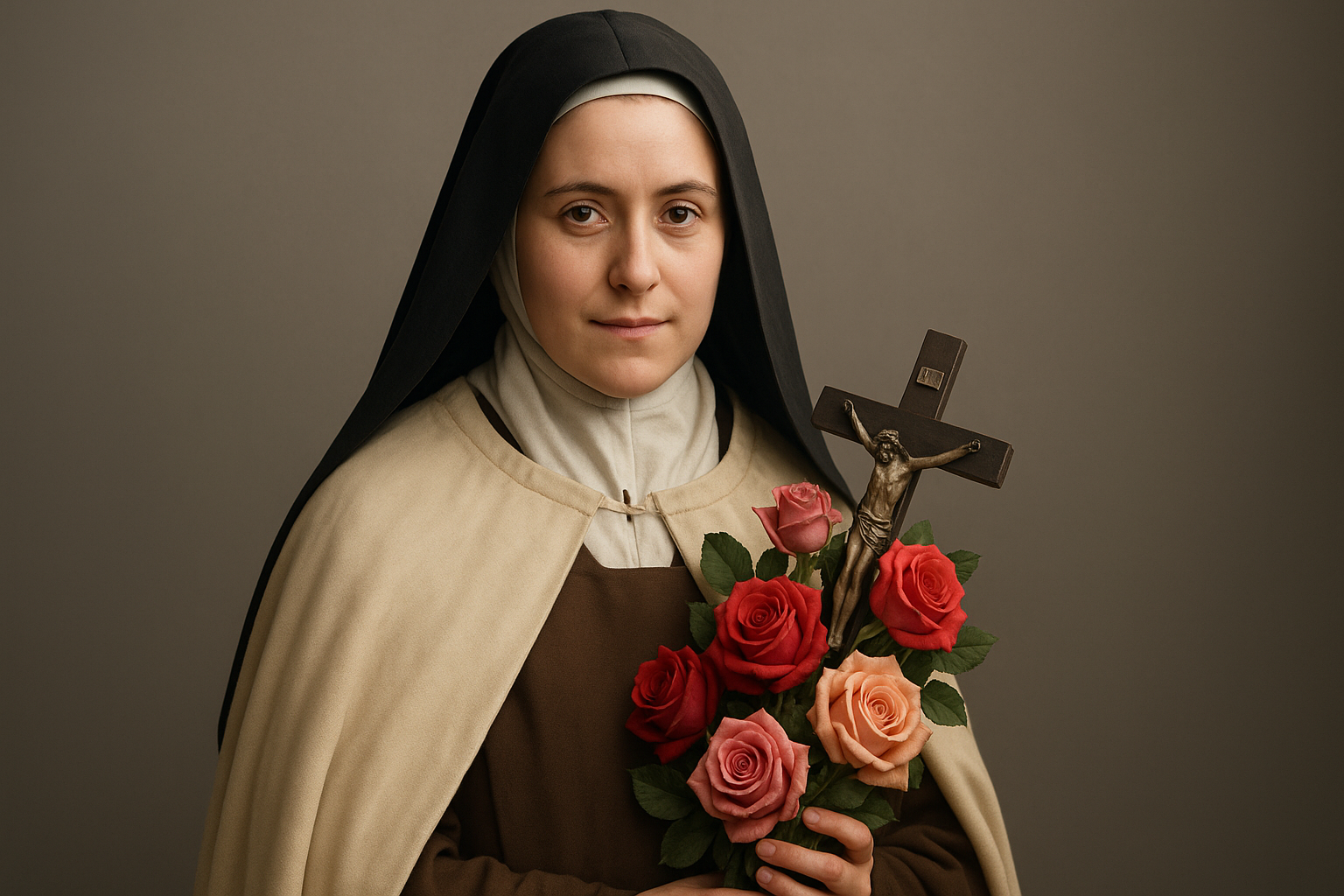
Beyond Lisieux, Thérèse is honored in numerous shrines and churches worldwide. Many parishes are named in her honor, and countless statues and stained-glass windows depict her, often holding a crucifix and roses, symbolizing her promise to send a “shower of roses” from heaven—graces and blessings—to those who pray to her. Annual celebrations on her Feast Day, October 1st, are observed with special Masses, novenas, and community events in Catholic communities globally.
Her book, “Story of a Soul,” continues to be a spiritual classic, read by millions seeking inspiration and guidance on their faith journey. It is a foundational text for many spiritual formation programs and personal reflection. Numerous novenas (nine-day prayers) to Saint Thérèse are popular, often invoked for specific intentions or to ask for her intercession for difficult situations. The “Rose Novena” is particularly well-known, where those who pray it often report receiving a rose, or the scent of roses, as a sign of Thérèse’s intercession.
Her message of profound trust in God’s love and the sanctification of ordinary life continues to resonate, making her a beloved patroness for missionaries (because of her desire to save souls), for florists (due to the “roses” imagery), and for those suffering from tuberculosis, the disease that claimed her life. Her enduring popularity underscores the timeless power of her simple yet profound spirituality.
Reflections for Modern Readers
Saint Thérèse of Lisieux, though she lived more than a century ago, offers powerful and actionable lessons for navigating the complexities of 21st-century life. Her “Little Way” isn’t about retreating from the world but about transforming it through love and intention.
- Embrace Your “Littleness”: In a world that often values grand achievements and outward success, Thérèse reminds us that God doesn’t expect us to be perfect or famous. He loves us in our imperfections and invites us to rely completely on His grace. When you feel overwhelmed by societal pressures or your own shortcomings, remember Thérèse. Instead of striving to be a “super-Catholic,” simply aim to be a faithful one in your everyday life, trusting God to work through your weaknesses. For example, if you’re struggling to pray for an hour, start with five minutes of heartfelt prayer, knowing that God values your sincere effort more than the duration.
- Sanctify the Ordinary: Thérèse teaches us that every mundane task can become a prayer when done with love for God. Washing dishes, commuting to work, attending to family responsibilities, or even sending an email can be infused with spiritual meaning. Instead of dreading routine tasks, try offering them up as a small sacrifice or a moment of love for God. Imagine a busy parent offering the tedious task of folding laundry for their children as an act of loving service to God, transforming a chore into a spiritual offering.
- Practice Radical Trust: In an age of anxiety and control, Thérèse’s unwavering trust in God’s merciful love is a balm. She encourages us to let go of excessive worry and place our complete confidence in God’s providence, knowing He works all things for our good, even when circumstances are difficult. When facing uncertainty in your job or health, instead of spiraling into fear, pause and actively place your trust in God’s plan, believing that He holds you in His loving care, just as Thérèse trusted Him even in her darkest night of faith.
- Love in Small Ways: The “Little Way” is fundamentally about love expressed in concrete, daily actions. It’s about small acts of kindness, patience, forgiveness, and understanding towards those around us. These seemingly insignificant gestures, when done consistently and from the heart, build up relationships and reflect God’s love to the world. A simple example is choosing patience instead of irritation with a difficult colleague, or offering a genuine compliment to a stranger—these small acts ripple outwards, mirroring Thérèse’s commitment to loving her community in the convent.
Common symbols associated with Saint Thérèse in art and jewelry include:
- Roses: This is her most iconic symbol, representing her promise to shower roses (graces) from heaven. In art, she is often depicted holding a bouquet or scattering roses, symbolizing the many blessings and intercessions she sends to those who pray to her.
- Crucifix: Thérèse’s deep devotion to Jesus, especially His Passion and His merciful love, is often shown through her holding a crucifix close to her heart. It signifies her desire to suffer with Christ and to find her joy in Him.
- Book (Story of a Soul): She is frequently shown holding or gazing at a book, representing her profound spiritual autobiography, “Story of a Soul,” which contains the essence of her “Little Way.”
- Carmelite Habit: As a Carmelite nun, she is always depicted in the brown and white habit of her order, symbolizing her commitment to contemplative life and her religious vocation.
Timeline Summary
- January 2, 1873: Thérèse Françoise Marie Martin is born in Alençon, France.
- August 28, 1877: Her mother, Zélie Martin, dies of breast cancer.
- November 16, 1877: The Martin family moves to Lisieux.
- May 10, 1883: Miraculous healing from a mysterious illness through “Our Lady’s Smile.”
- October 2, 1886: Her sister Pauline enters the Carmelite convent.
- December 25, 1886: Experiences her “complete conversion” or “Christmas grace.”
- November 20, 1887: Pleads with Pope Leo XIII for permission to enter Carmel.
- April 9, 1888: Enters the Carmelite convent of Lisieux, taking the name Sister Thérèse of the Child Jesus.
- September 8, 1890: Makes her solemn profession of vows, adding “of the Holy Face” to her name.
- 1895-1896: Begins writing her autobiography, “Story of a Soul,” under obedience.
- Easter 1896: Experiences the onset of tuberculosis and the beginning of her “night of faith.”
- September 30, 1897: Dies at the Carmelite convent in Lisieux at the age of 24.
- 1898: “Story of a Soul” is published posthumously.
- April 29, 1923: Beatified by Pope Pius XI.
- May 17, 1925: Canonized as Saint Thérèse of Lisieux by Pope Pius XI.
- October 19, 1997: Declared a Doctor of the Church by Pope John Paul II.
Scripture for Reflection
Saint Thérèse’s “Little Way” echoes many passages in Scripture, particularly those emphasizing humility, childlike faith, and the supremacy of love. Here are a few passages that illuminate her core virtues:
Matthew 18:3-4 (NABRE): “Amen, I say to you, unless you turn and become like children, you will not enter the kingdom of heaven. Whoever humbles himself like this child is the greatest in the kingdom of heaven.”
Connection: This passage directly embodies Thérèse’s spiritual childhood. She understood that humility and complete reliance on God, like a child relies on its parents, are the keys to holiness and entrance into God’s kingdom. She embraced her “littleness” and showed us how to approach God with the simple, trusting heart of a child.
1 Corinthians 13:4-7 (NABRE): “Love is patient, love is kind. It is not jealous, it is not pompous, it is not inflated, it is not rude, it does not seek its own interests, it is not quick-tempered, it does not brood over injury, it does not rejoice over wrongdoing but rejoices with the truth. It bears all things, believes all things, hopes all things, endures all things.”
Connection: Thérèse’s entire life was a testament to the power of love. She sought to perform even the smallest actions with extraordinary love, recognizing that love is what truly matters in God’s eyes. This passage describes the kind of pure, selfless love she strove for in her daily interactions within the convent and offered to God in every sacrifice.
Psalm 131:1-2 (NABRE): “O LORD, my heart is not proud, nor are my eyes haughty; I do not busy myself with great matters, with things too sublime for me. Rather, I have stilled and quieted my soul like a weaned child with its mother; my soul is like a weaned child.”
Connection: This psalm perfectly captures the essence of Thérèse’s spiritual journey: a humble, quiet soul resting in God’s presence. Like a contented child who no longer frets for milk but simply rests in its mother’s embrace, Thérèse found peace and sanctity in surrendering her own will and trusting entirely in God’s care, not seeking greatness but simple union with Him.
Prayers to Saint Thérèse of Lisieux
Here are some popular prayers invoking the intercession of Saint Thérèse of Lisieux:
Novena Prayer to Saint Thérèse (The “Little Flower” Novena)
O Little Thérèse of the Child Jesus, who during your short life on earth became a mirror of angelic purity, of heroic love, and of whole-hearted surrender to God, now that you enjoy the reward of your virtues, cast a glance of pity on me as I trustingly send up my prayer to you.
Obtain for me my request (mention your request here) and show me your “Little Way” of doing all things with love for Jesus, so that I may fulfill my mission on earth to do good and to bring souls to Christ. Guide me and bless me, and may I follow your example, loving God with all my heart and serving Him in every small action. Shower down on us your roses of grace and blessing, Little Flower, from the gardens of heaven.
Saint Thérèse of Lisieux, pray for us!
Prayer for the “Shower of Roses”
O glorious St. Thérèse, you who have promised to spend your heaven doing good on earth, send down your shower of roses on us who invoke you. Obtain for us from God the grace that we so earnestly implore (mention your request here). Show us your “Little Way” of confident trust and love for Jesus, so that we may grow in holiness and draw others to Him. Amen.
Short Daily Prayer to St. Thérèse
Little Flower of Jesus, ever-fresh, ever-new, send forth from heaven the showers of graces, so plentiful and so true. Fill my heart with trust and love for Jesus, and teach me your “Little Way” of humble faith. Saint Thérèse, pray for me. Amen.