Discover the remarkable story of Saint Thérèse of Lisieux, the young French Carmelite whose “Little Way” of spiritual childhood transformed Catholic spirituality.
Keywords: Saint Thérèse of Lisieux, Little Flower, Carmelite saint, Little Way spirituality, French Catholic saints, Doctor of the Church, Carmel convent, Story of a Soul, patron saint missionaries, spiritual childhood
Quick Facts
| Key | Detail |
|---|---|
| Birth | January 2, 1873, Alençon, France |
| Death | September 30, 1897, Lisieux, France |
| Feast Day | October 1 |
| Patronage | Missionaries, aviators, florists, France, Russia |
| Canonized | May 17, 1925, by Pope Pius XI |
| Doctor of the Church | October 19, 1997, by Pope John Paul II |
Historical Context & Early Life
The late 19th century was a time of profound change in France. The Third Republic had established itself after the Franco-Prussian War, and anticlericalism was rising. Yet within this turbulent period, Catholic families like the Martins maintained deep faith that would produce extraordinary saints.
Marie-Françoise-Thérèse Martin was born into a devoutly Catholic family in Alençon, a small town in Normandy. Her father, Louis Martin, was a watchmaker and jeweler, while her mother, Zélie Guérin Martin, ran a successful lace-making business. Both parents had initially considered religious life before marriage, and they raised their five surviving daughters with exceptional piety and devotion.
Tragedy struck early in Thérèse’s life when her beloved mother died of breast cancer in 1877, leaving four-year-old Thérèse devastated. The family moved to Lisieux to live with Zélie’s brother and his wife. This loss profoundly shaped young Thérèse, making her extraordinarily sensitive and clinging to her father and older sisters for security.
The Martin household was deeply religious, with daily Mass attendance, regular prayer, and works of charity. All five Martin daughters would eventually enter religious life, with four becoming Carmelite nuns. This remarkable family would later see Zélie and Louis canonized as saints themselves in 2015, making them the first married couple to be canonized together.
Calling & Key Milestones
Early Religious Awakening
Thérèse experienced what she called her “complete conversion” on Christmas Day 1886, when she was thirteen. She had struggled with extreme sensitivity and what she described as a childish need for attention. That Christmas night, she felt God’s grace transform her, giving her the strength to think of others rather than herself. This moment marked the beginning of her rapid spiritual maturation.
Entrance to Carmel
Despite her young age, Thérèse felt called to join her older sisters Pauline and Marie at the Carmelite convent in Lisieux. When the local bishop initially refused her request due to her age, she boldly appealed directly to Pope Leo XIII during a papal audience in Rome in 1887. Her persistence paid off, and she entered Carmel on April 9, 1888, at the unprecedented age of fifteen.
Development of the “Little Way”
Within the cloistered walls of Carmel, Thérèse developed her distinctive spiritual approach, which she called the “Little Way” or “way of spiritual childhood.” This path emphasized complete trust in God’s mercy, acceptance of one’s smallness, and offering every small act and suffering to God with love. Rather than seeking extraordinary penances or mystical experiences, she found holiness in ordinary duties performed with extraordinary love.
Literary Legacy
At the request of her prioress (her sister Pauline), Thérèse began writing her spiritual autobiography in 1895. “Story of a Soul” would become one of the most influential spiritual works of modern times, translated into dozens of languages and inspiring millions. Her simple yet profound insights into God’s merciful love challenged the rigorous spiritual approaches common in her era.
Spiritual Legacy & Theological Themes
Thérèse’s “Little Way” revolutionized Catholic spirituality by emphasizing God’s infinite mercy over human effort. She taught that spiritual perfection was not about heroic acts but about allowing God to lift us up in our weakness, much like a child who trusts completely in a loving parent. This theology of spiritual childhood resonated with Jesus’s own words: “Unless you become like little children, you will not enter the kingdom of heaven” (Matthew 18:3).
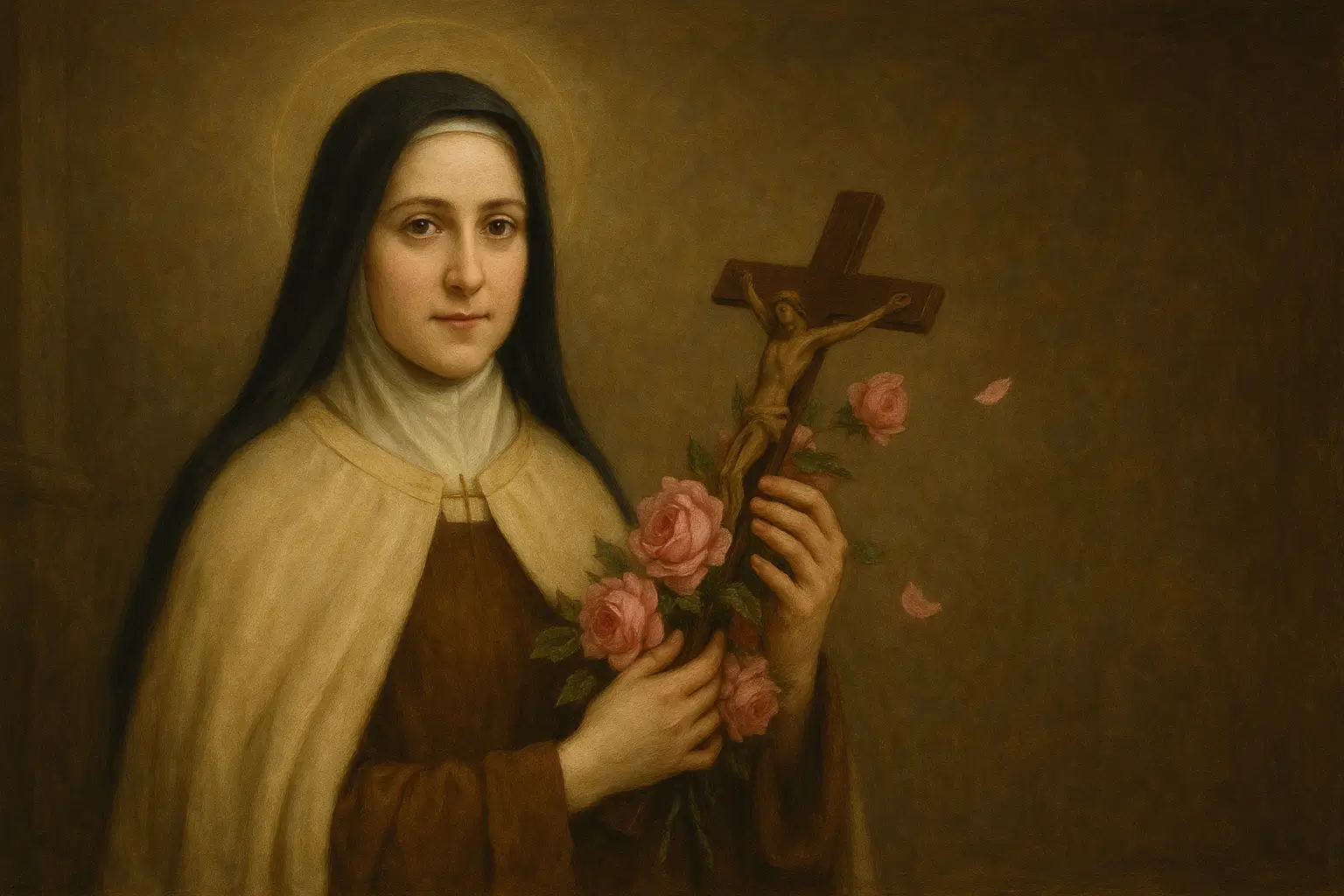
Her approach to suffering was equally transformative. Rather than seeking pain, she accepted unavoidable sufferings with love, offering them for the salvation of souls, particularly missionaries and sinners. Her famous promise to “spend my heaven doing good on earth” and to “let fall a shower of roses” has been validated by countless reported miracles and answered prayers.
Pope John Paul II declared Thérèse a Doctor of the Church in 1997, recognizing her profound theological contributions despite her youth and lack of formal theological training. She became only the third woman to receive this honor, joining Teresa of Avila and Catherine of Siena. The Pope praised her “science of love” that came not from books but from the Holy Spirit.
Her influence extended far beyond Catholic circles. Protestant theologians have found value in her emphasis on God’s grace over human works, while her simple trust appeals to believers seeking authentic spirituality in an increasingly complex world.
Devotion Today
The Basilica of Saint Thérèse in Lisieux remains one of France’s most visited pilgrimage sites, welcoming over two million visitors annually. Pilgrims come seeking healing, guidance, and spiritual renewal at the shrine where her relics are venerated. The original Carmelite convent where she lived has been preserved as a museum and place of prayer.
Devotion to Saint Thérèse flourishes worldwide through numerous shrines, churches, and religious communities dedicated to her memory. In the United States, the National Shrine of the Little Flower in Royal Oak, Michigan, draws thousands of pilgrims yearly. Similar shrines exist across Asia, Africa, and Latin America, testament to her universal appeal.
Popular devotions include the twenty-four-day novena to Saint Thérèse, often prayed by those seeking her intercession for healing, vocations, or family concerns. Many faithful follow her practice of offering small sacrifices and acts of love throughout the day, finding in her example a practical path to holiness accessible to everyone.
Her feast day, October 1, is celebrated globally with special Masses, rose petals blessed and distributed to the faithful (echoing her promise of roses), and renewed commitment to her Little Way. Catholic schools, hospitals, and parishes bearing her name continue her legacy of simple, trusting love.
Reflections for Modern Readers
Thérèse’s life offers profound lessons for contemporary believers navigating an often overwhelming world. First, her Little Way teaches that holiness is accessible to everyone, not just those called to extraordinary religious life. In our achievement-oriented culture, her emphasis on spiritual childhood reminds us that God’s love is freely given, not earned through performance.
Second, her approach to suffering provides hope for those facing trials. Rather than asking why suffering exists, she showed how to transform pain into love through patient acceptance and offering it for others. Modern examples include healthcare workers who follow her model of finding meaning in difficult circumstances, or parents caring for special-needs children who draw strength from her trust in God’s plan.
Third, her confidence in prayer demonstrates the power of persistent, trusting petition. Like a child who believes their parent will provide what’s needed, she approached God with complete confidence. This translates practically into trusting prayer for daily needs, family concerns, and global challenges.
Fourth, her focus on small acts of love challenges our culture’s obsession with grand gestures and public recognition. Her example encourages finding God in mundane tasks—changing diapers, caring for elderly parents, showing patience in traffic—performed with love and intentionality.
Finally, her promise to continue helping from heaven offers comfort to those who feel alone in their struggles. Many contemporary believers report experiencing her intercession through finding roses in unexpected places, receiving help in times of crisis, or feeling her gentle presence during prayer.
Timeline Summary
• 1873 – Born Marie-Françoise-Thérèse Martin in Alençon, France • 1877 – Mother Zélie dies; family moves to Lisieux • 1886 – Experiences “complete conversion” on Christmas Day • 1887 – Appeals to Pope Leo XIII for permission to enter Carmel • 1888 – Enters Carmelite convent at age 15 • 1889 – Takes religious habit; becomes Sister Thérèse of the Child Jesus • 1890 – Makes final vows • 1895 – Begins writing spiritual autobiography • 1896 – Suffers first hemorrhage from tuberculosis • 1897 – Dies September 30 at age 24 • 1925 – Canonized by Pope Pius XI • 1927 – Declared patron of missions alongside Saint Francis Xavier • 1997 – Declared Doctor of the Church by Pope John Paul II
Further Reading & References
Butler, Alban. Butler’s Lives of the Saints: New Full Edition. Collegeville: Liturgical Press, 1996.
Gaucher, Guy. The Story of a Life: St. Thérèse of Lisieux. San Francisco: Harper & Row, 1987.
John Paul II, Pope. Apostolic Letter Divini Amoris Scientia. Vatican City: Libreria Editrice Vaticana, 1997.
Martin, Thérèse of Lisieux. Story of a Soul: The Autobiography of Saint Thérèse of Lisieux. Translated by John Clarke. Washington, DC: ICS Publications, 1996.
O’Mahony, Christopher. St. Thérèse of Lisieux by Those Who Knew Her. Dublin: Veritas Publications, 1975.
Pius XI, Pope. Encyclical Rerum Omnium. Vatican City: Acta Apostolicae Sedis, 1923.
Reflection Questions
How does Saint Thérèse’s “Little Way” challenge modern assumptions about success and achievement?
Her Little Way emphasizes that spiritual greatness comes through accepting our smallness and trusting in God’s mercy rather than through personal accomplishments. This challenges our culture’s focus on self-improvement and performance-based worth, suggesting instead that true fulfillment comes from surrendering to divine love.
What practical steps can modern believers take to incorporate her approach to suffering?
Rather than avoiding all discomfort, we can accept unavoidable suffering with patience, offer our struggles for others’ benefit, and find meaning in hardship by uniting it with Christ’s sacrifice. This might include offering up illness for family members, accepting workplace difficulties with grace, or finding purpose in caregiving responsibilities.
How might her emphasis on small acts of love transform ordinary daily life?
By performing routine tasks—cooking, cleaning, working, parenting—with conscious love and attention to God, we transform mundane activities into prayer and service. This sanctifies ordinary life and makes holiness accessible regardless of our circumstances or calling.
What does her rapid canonization (28 years after death) suggest about the Church’s recognition of her message?
The quick canonization indicates the Church recognized her teachings as urgently needed for modern times. Her message of God’s merciful love and accessible holiness addressed the spiritual hunger of people overwhelmed by rigid religiosity or secular materialism.
How does declaring her a Doctor of the Church despite her youth and lack of formal education impact our understanding of wisdom?
This recognition shows that true spiritual wisdom comes from God’s grace and personal relationship with Christ rather than academic credentials or age. It validates the insights of ordinary believers and reminds us that the Holy Spirit teaches through unexpected vessels.