In the sweeping narrative of early Christianity in England, few figures shine as brightly and warmly as St. Aidan of Lindisfarne. This humble Irish monk, called from the contemplative silence of Iona to the bustling, often pagan, kingdom of Northumbria in the 7th century, became a beacon of faith, patience, and profound love for Christ and His people. His story is one of unwavering missionary zeal, a gentle approach that built bridges rather than walls, and a deep, practical compassion that transformed an entire region. This article will explore Aidan’s fascinating life, from his origins in Celtic monasticism to his foundational work on the “Holy Island” of Lindisfarne, examining his lasting spiritual legacy and how his virtues continue to inspire believers in the modern world.
Quick Facts
| Attribute | Detail |
|---|---|
| Birth | c. 590-600 AD, Ireland |
| Death | August 31, 651 AD, Bamburgh, Northumbria |
| Feast Day | August 31 (Western Christianity), May 20 (Eastern Christianity) |
| Patronage | Northumbria, firefighters, missionaries, Celtic Christians |
| Canonized | By popular acclamation and consistent veneration shortly after his death (pre-congregation) |
Historical Context & Early Life
The 7th century in what we now call Great Britain was a dynamic and often turbulent era. Roman legions had long departed, leaving behind a patchwork of Anglo-Saxon kingdoms, constantly vying for supremacy. While Christianity had taken root during the Roman occupation and flourished in places like Ireland, much of Anglo-Saxon England had reverted to paganism, especially after the arrival of Germanic tribes. However, pockets of Christian faith persisted, particularly in the Celtic traditions of Ireland and Scotland, which developed somewhat independently from the Roman style of Christianity.
The powerful kingdom of Northumbria, stretching from the Humber River to the Firth of Forth, was a key player in this landscape. It had briefly embraced Christianity under King Edwin, largely through the efforts of missionaries sent by Pope Gregory the Great from Canterbury. However, after Edwin’s death in battle, paganism made a strong resurgence, and the nascent Christian communities faced severe persecution. It was into this tumultuous setting that a young prince, Oswald, was forced into exile. During his time away, he found refuge in the monastery of Iona, an influential center of Celtic Christianity founded by St. Columba off the coast of Scotland. There, Oswald converted to Christianity and became deeply committed to his new faith.
St. Aidan himself hailed from Ireland, a land renowned for its flourishing monastic tradition and profound spiritual depth. He entered the monastic life on Iona, a place known for its rigorous asceticism, deep scholarship, and fervent missionary spirit. Aidan quickly distinguished himself among the monks for his deep humility, gentle demeanor, and remarkable wisdom. While the Celtic Church had different customs from the Roman Church regarding practices like the date of Easter and monastic tonsure, it shared a common core of Catholic faith and a passionate desire to spread the Gospel. Aidan’s early life on Iona instilled in him the spiritual disciplines, the love of God’s Word, and the missionary zeal that would define his future work.
Calling & Key Milestones
The Call to Northumbria
When Oswald finally reclaimed the throne of Northumbria in 634 AD, his first priority was to re-establish Christianity in his kingdom. Remembering the faith he had embraced in Iona, he sent a request to the monks there for a bishop to evangelize his people. The first monk sent was, unfortunately, ill-suited for the task; his stern approach and inability to connect with the pagan Anglo-Saxons led him to return to Iona in frustration. It was then that Aidan, renowned for his gentle and patient spirit, offered a different perspective, suggesting that the first missionary had been too harsh. The other monks, recognizing Aidan’s wisdom and compassion, urged him to take up the mission himself. And so, with a simple blessing, Aidan embarked on a journey that would change the spiritual landscape of England.
Founding Lindisfarne
Upon his arrival in Northumbria around 635 AD, King Oswald granted Aidan the small tidal island of Lindisfarne, just off the coast of his royal city of Bamburgh. This choice was deliberate: Lindisfarne, often referred to as the “Holy Island,” was reminiscent of Iona in its isolation and natural beauty. It was an ideal location for a monastery, offering both solitude for prayer and contemplation, and accessibility to the mainland when the tide was low. Here, Aidan established a monastery that would become a vibrant center of Celtic Christianity and a powerhouse of missionary activity. Lindisfarne became a hub for training local clergy, educating children, and launching evangelistic missions throughout Northumbria.
Missionary Zeal & Pastoral Care
Aidan’s approach to evangelization was profoundly relational and incarnational. He didn’t preach from grand pulpits in distant churches. Instead, he preferred to travel on foot, walking through villages and fields, meeting people where they were. King Oswald, fluent in both Irish Gaelic and Old English, often accompanied Aidan, acting as his interpreter. This unique partnership between king and bishop was crucial; it demonstrated a unified effort to spread the faith and allowed Aidan to truly listen to and understand the concerns of the local people before sharing the Gospel message. Aidan’s method involved patient instruction, explaining the basics of Christianity in simple, accessible terms. He focused on training local boys for the priesthood, establishing schools, and building small, humble churches made of wood rather than stone. His pastoral care extended to practical charity, advocating for the poor and even purchasing slaves to set them free, teaching them to read and then instructing them in the faith.
Miracles and Humility
Numerous stories from the Venerable Bede’s “Ecclesiastical History of the English People” attest to Aidan’s holiness, wisdom, and miraculous interventions. One famous account tells of how, when the pagan King Penda of Mercia attacked Bamburgh and tried to burn it down, Aidan’s fervent prayers reportedly caused the wind to shift, turning the flames back upon the attackers and saving the town. Another story recounts how Aidan refused the king’s gift of a fine horse, preferring to travel on foot, giving away the horse to a beggar. His profound humility was a defining characteristic; he always shared gifts with the poor and reprimanded the wealthy for their neglect of those in need. He exemplified Christian leadership not through power or grandiosity, but through selfless service and deep spiritual wisdom.
The Light of Northumbria
For sixteen years, until his death in 651 AD, Aidan served as the Bishop of Lindisfarne. His tireless efforts laid the groundwork for the widespread Christianization of Northumbria. He fostered a generation of local saints and leaders, including St. Cuthbert, who would continue his work. Under Aidan’s gentle guidance, Northumbria transformed from a land scarred by paganism into a vibrant center of Christian learning and spirituality, earning him the affectionate title, “Apostle of Northumbria.”
Spiritual Legacy & Theological Themes
St. Aidan’s spiritual legacy is rich and multifaceted, offering timeless insights into Christian living and evangelization. At its core, Aidan’s life exemplifies profound humility and gentleness, virtues he consistently demonstrated through his simple lifestyle and patient engagement with people. He believed deeply in the inherent dignity of every person, reflecting the Scriptural call to love our neighbor as ourselves (Mark 12:31) and to serve one another in humility (Philippians 2:3).
His approach to evangelization was revolutionary for its time. Rather than imposing faith, Aidan cultivated it through relationship, dialogue, and compassionate service. This aligns perfectly with the Catholic teaching on evangelization, which emphasizes witness and invitation over coercion. His missionary spirit, rooted in prayer and detachment from worldly comforts, demonstrated that the most effective way to share Christ is to live like Christ, embodying His love and mercy in every interaction. He showed that true pastoral care involves not just spiritual instruction but also practical concern for the well-being of the flock, mirroring Jesus’s own ministry to the poor and suffering.
Aidan also stands as a prime example of Celtic spirituality, which emphasized a deep connection to creation, a contemplative prayer life intertwined with active ministry, and a strong communal monastic tradition. This form of Christianity, while differing in some external practices from the Roman tradition, was deeply Catholic in its theology and devotion, fostering saints who were deeply rooted in Scripture and the sacraments. Aidan’s influence extended beyond Northumbria, shaping the development of monasticism in England and demonstrating the power of a monastic center to radiate Christian faith and culture throughout a region.
Devotion Today
St. Aidan’s memory remains vibrant today, particularly in the northeast of England and among those drawn to Celtic Christianity. The island of Lindisfarne, his spiritual home, continues to be a cherished pilgrimage destination. Visitors can explore the ruins of the medieval priory built on the site of Aidan’s original monastery, walk in contemplation along the causeway to the island, and visit St. Mary’s Church, which has existed in various forms since Aidan’s time. Lindisfarne offers a powerful sense of connection to the saint and the “Golden Age” of Northumbrian Christianity.
Many churches, schools, and religious communities bear St. Aidan’s name, especially in the United Kingdom, reflecting his enduring inspiration for pastoral care, education, and missionary work. His feast day on August 31st is celebrated with reverence, often with special services that honor his contributions to the Church. He is particularly revered as a patron saint for firefighters, due to the miraculous protection he afforded Bamburgh from fire, and for all who seek to spread the Gospel with gentleness and humility.
Reflections for Modern Readers
St. Aidan’s life, though lived in the 7th century, offers profound and actionable lessons for us today:
- Patience and Gentleness in Sharing Faith: Aidan’s initial missionary predecessor failed because of a harsh approach. Aidan succeeded through patience, understanding, and love. In a world often polarized by beliefs, Aidan reminds us that genuine dialogue and respectful listening are far more effective than condemnation. For example, when discussing faith with friends or family who hold different views, approach the conversation with a humble desire to understand and share, rather than to “win.”
- Servant Leadership: Aidan led not from a position of power, but through humble service, walking among his people and meeting them where they were. Modern leaders, whether in business, community, or family life, can learn from this. True leadership isn’t about control, but about empowering and uplifting others, much like a manager who rolls up their sleeves to help their team during a busy period, rather than just dictating tasks.
- Simplicity and Detachment: Aidan’s refusal of a royal horse and his consistent generosity to the poor highlight a life lived with detachment from worldly possessions. In our consumer-driven society, Aidan encourages us to consider how much “stuff” we truly need and how our resources could be better used to serve others, perhaps by donating to charity instead of always seeking the latest gadget.
- The Power of Partnership: The fruitful collaboration between Aidan and King Oswald demonstrates the immense good that can come from diverse individuals working together for a common goal. This applies to ecumenical efforts, community projects, or even within families, showing that when we combine our unique strengths and perspectives, we can achieve far more than we could alone.
- Listen Before You Speak: Oswald’s role as Aidan’s interpreter suggests Aidan was constantly listening and learning about the people and their culture before speaking. This teaches us the value of active listening in all relationships, professional and personal. Before offering advice or solutions, taking the time to truly hear and understand another person’s situation can prevent misunderstandings and build stronger connections.
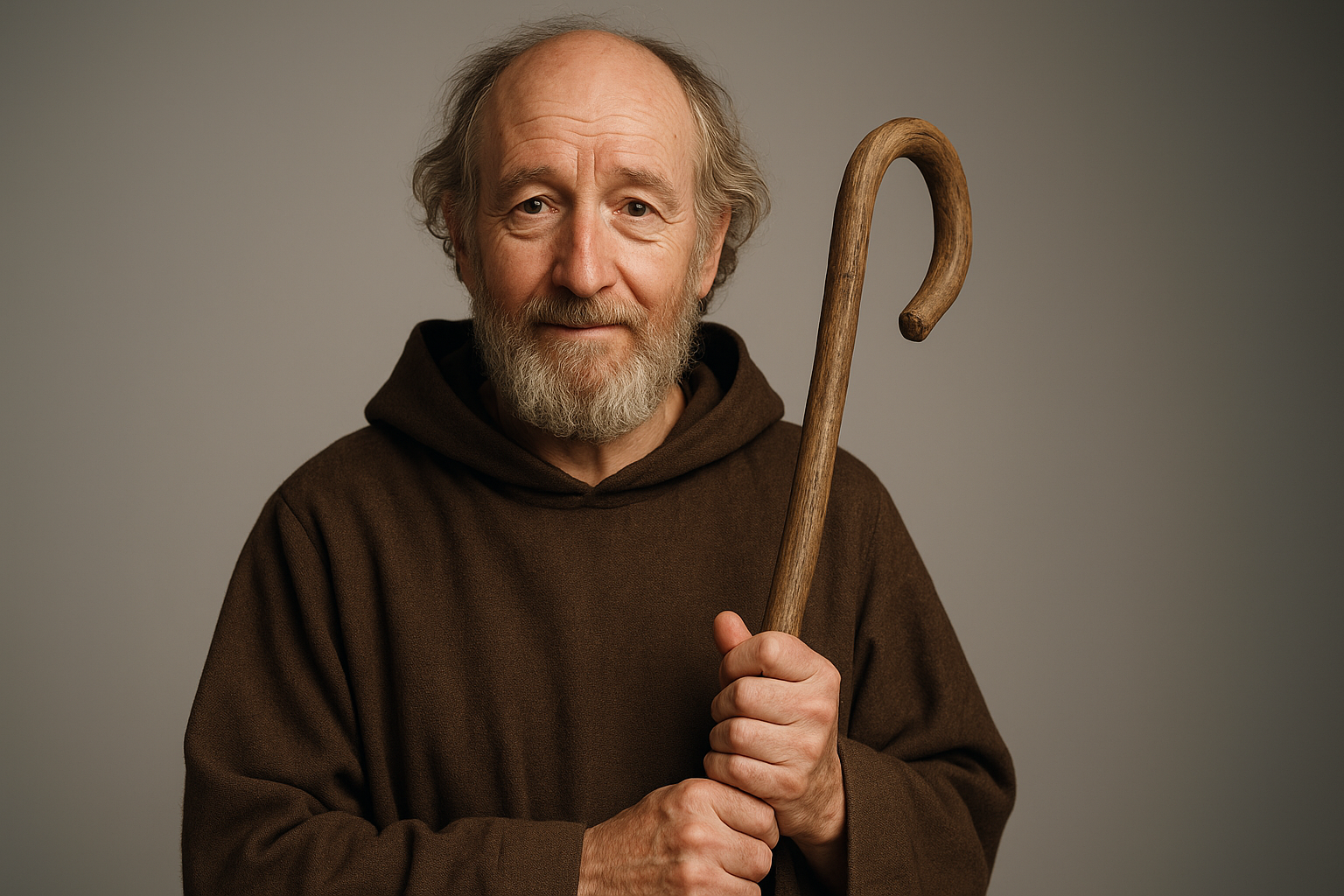
In art and jewelry, St. Aidan is often depicted as a Benedictine monk (even though he was Celtic, the visual tradition leans towards the more common monastic habit) holding a shepherd’s staff, symbolizing his role as a spiritual shepherd and bishop. Sometimes, a stag is shown nearby or accompanying him, representing his gentleness, his connection to nature (a hallmark of Celtic spirituality), and perhaps his solitude. A boat or the tidal island of Lindisfarne can also be seen, representing his missionary journeys and his spiritual home. Occasionally, a church or flames might be included, symbolizing his role in building the Church in Northumbria and the miracle of protecting Bamburgh from fire.
Timeline Summary
- c. 590-600 AD: Born in Ireland.
- Early 7th Century: Enters the monastery on Iona, eventually becoming a respected monk known for his humility and wisdom.
- 634 AD: King Oswald of Northumbria, having regained his throne, sends a request to Iona for a bishop to re-evangelize his kingdom.
- 635 AD: Aidan is sent from Iona to Northumbria after an initial missionary attempt fails. He establishes his monastic see on Lindisfarne.
- 635-651 AD: Aidan tirelessly travels throughout Northumbria, preaching, teaching, establishing churches, and training local clergy. King Oswald frequently acts as his interpreter.
- 642 AD: King Oswald dies in battle. Aidan continues his missionary work under Oswald’s successors.
- 651 AD: St. Aidan dies at Bamburgh, Northumbria, on August 31st, having brought about a profound spiritual transformation in the region. His body is eventually returned to Lindisfarne.
Scripture for Reflection
St. Aidan’s life profoundly echoes several Scriptural themes:
Matthew 10:16 (NIV): “I am sending you out like sheep among wolves. Therefore be as shrewd as snakes and as innocent as doves.”
Connection: This verse perfectly captures Aidan’s missionary spirit. He faced a challenging, often hostile, pagan environment (“wolves”), yet he approached his mission with profound gentleness and innocence (“doves”), combined with a strategic wisdom (“shrewd as snakes”) that led him to establish Lindisfarne and work closely with King Oswald to overcome linguistic and cultural barriers. He was not naive, but gentle.
Philippians 2:3-4 (NIV): “Do nothing out of selfish ambition or vain conceit. Rather, in humility value others above yourselves, not looking to your own interests but each of you to the interests of the others.”
Connection: This passage is a cornerstone of Aidan’s character. His profound humility was legendary; he refused royal gifts for personal comfort, always prioritizing the needs of the poor and his flock. He consistently put the interests of the Northumbrian people, their spiritual and material well-being, above his own comfort or prestige.
Luke 10:2 (NIV): “He told them, ‘The harvest is plentiful, but the laborers are few. Ask the Lord of the harvest, therefore, to send out laborers into his harvest.'”
Connection: As a missionary bishop, Aidan understood the vastness of the spiritual “harvest” in Northumbria and the urgent need for “laborers.” A significant part of his ministry was dedicated to establishing schools and training local clergy, effectively raising up new laborers for Christ’s harvest, ensuring the long-term growth of Christianity in the region.
Prayers to St. Aidan
O God, by the preaching of your servant Aidan, you caused the light of the Gospel to shine in the kingdom of Northumbria: Grant, we pray, that as he established your Church in that land, so we may ever walk as children of light, and be fervent in making known the riches of your grace; through Jesus Christ our Lord, who lives and reigns with you and the Holy Spirit, one God, for ever and ever. Amen.
Holy Saint Aidan, gentle shepherd of Northumbria, whose humility and love transformed a land, inspire us with your patience and missionary zeal. Help us to share the Gospel with kindness, to serve the poor with compassion, and to live lives of simple faith. Guide us to be a light in our own communities, building bridges of understanding and love. Through your intercession, may we grow in grace and bring many to Christ, who is our hope and our salvation. Amen.