In the vibrant tapestry of 15th-century Italy, amidst a time of profound change and spiritual searching, emerged a voice that resonated with the power of Christ’s love: St. Bernardine of Siena. A Franciscan friar known for his fiery sermons and unwavering devotion to the Holy Name of Jesus, Bernardine captivated vast crowds, leaving an indelible mark on both the Church and society. This article will journey through his fascinating life, exploring his humble beginnings, his innovative approach to evangelization, his enduring spiritual legacy, and how his message continues to inspire believers in the modern world.
Quick Facts
| Attribute | Details |
|---|---|
| Birth | September 8, 1380, Massa Marittima, Republic of Siena |
| Death | May 20, 1444, L’Aquila, Kingdom of Naples |
| Feast Day | May 20 |
| Patronage | Preachers, advertising, public relations, communications, compulsive gambling, Italy, Diocese of Siena |
| Canonized | May 24, 1450, by Pope Nicholas V |
Historical Context & Early Life
To understand St. Bernardine of Siena, we must first glimpse the world he inhabited. The late 14th and early 15th centuries in Italy were a period of dynamic transformation, often referred to as the cusp of the Renaissance. Politically, Italy was a patchwork of independent city-states, duchies, and republics, constantly vying for power, leading to both cultural flourishing and frequent conflict. Siena, Bernardine’s adopted home, was a powerful and wealthy republic, a center of art, commerce, and learning, but also prone to internal strife and rivalries with neighboring Florence.
The Church, too, was experiencing immense challenges. Bernardine was born during the tumultuous era of the Western Schism (1378-1417), when two, and at times three, rival claimants simultaneously asserted their right to be Pope, causing deep confusion and division among the faithful. This crisis of authority severely eroded trust in the Church’s leadership and contributed to a widespread decline in spiritual fervor and moral standards. The devastating Black Death, which had swept through Europe in the mid-14th century, leaving millions dead, also cast a long shadow, fostering both intense piety and a sense of fatalism and moral laxity.
It was into this complex world that Bernardine Albizeschi was born on September 8, 1380, in Massa Marittima, a town then controlled by the Republic of Siena. His family was noble and prominent; his father, Tollo, served as the governor of the town, and his mother, Nera, came from the distinguished Bichi family of Siena. Tragically, Bernardine was orphaned at a young age, losing his mother when he was just three and his father when he was six. He was then taken in and lovingly raised by his devout aunt, Diana, and later by his paternal aunt, Pia, both of whom instilled in him a deep love for God and a strong moral compass. His early education in Siena exposed him to the classics, philosophy, and rhetoric, preparing him for a life dedicated to learning and articulate expression. He studied civil and canon law at the University of Siena, skills that would later prove invaluable in his preaching.
A pivotal moment in his youth occurred around 1400, when Siena was struck by a severe plague. Defying the danger, the young Bernardine dedicated himself to caring for the sick in the city’s hospital of Santa Maria della Scala, organizing groups of young men to assist him. For four months, he selflessly ministered to the dying, a heroic act that nearly cost him his own life. This experience undoubtedly deepened his commitment to serving others and cemented his understanding of human suffering and the fragility of life.
Calling & Key Milestones
Bernardine’s selfless service during the plague solidified his spiritual resolve, leading him to discern a call to religious life. He had long been drawn to prayer and solitude, often withdrawing to a small chapel to meditate. In 1402, at the age of 22, he entered the Observant branch of the Franciscan Order, a reformed group within the larger Franciscan family that sought to return to the stricter observance of St. Francis of Assisi’s original rule, emphasizing poverty, penance, and evangelical preaching. His entry into this austere order marked the beginning of a life dedicated entirely to God and the evangelization of souls.
Preaching for Reform and Revival
After his ordination to the priesthood in 1404, Bernardine spent over a decade in relative obscurity, dedicating himself to study and prayer. However, his superiors soon recognized his extraordinary gifts for preaching. In 1417, he began his public ministry, and it quickly became clear that God had blessed him with a unique ability to move hearts. He embarked on extensive preaching tours throughout central and northern Italy, captivating audiences that often numbered in the tens of thousands, sometimes preaching for hours in vast outdoor squares when no church could contain the crowds. He was a master orator, known for his clear, direct, and engaging style, using vivid storytelling, humor, and relatable examples to convey complex theological truths in a way accessible to everyone, from scholars to farmers.
Bernardine’s sermons addressed the pressing moral and social issues of his day. He fearlessly denounced usury (charging excessive interest on loans), factionalism, gambling, and widespread immorality, urging people to repent and embrace Christian charity. He was a powerful force for peace, often mediating disputes between warring families and cities. His preaching was not just about moral correction; it was a call to spiritual renewal, emphasizing personal conversion and a return to fervent devotion. He effectively used his sermons as a platform for social reform, contributing significantly to a spiritual and moral revival across Italy.
The Holy Name of Jesus Devotion
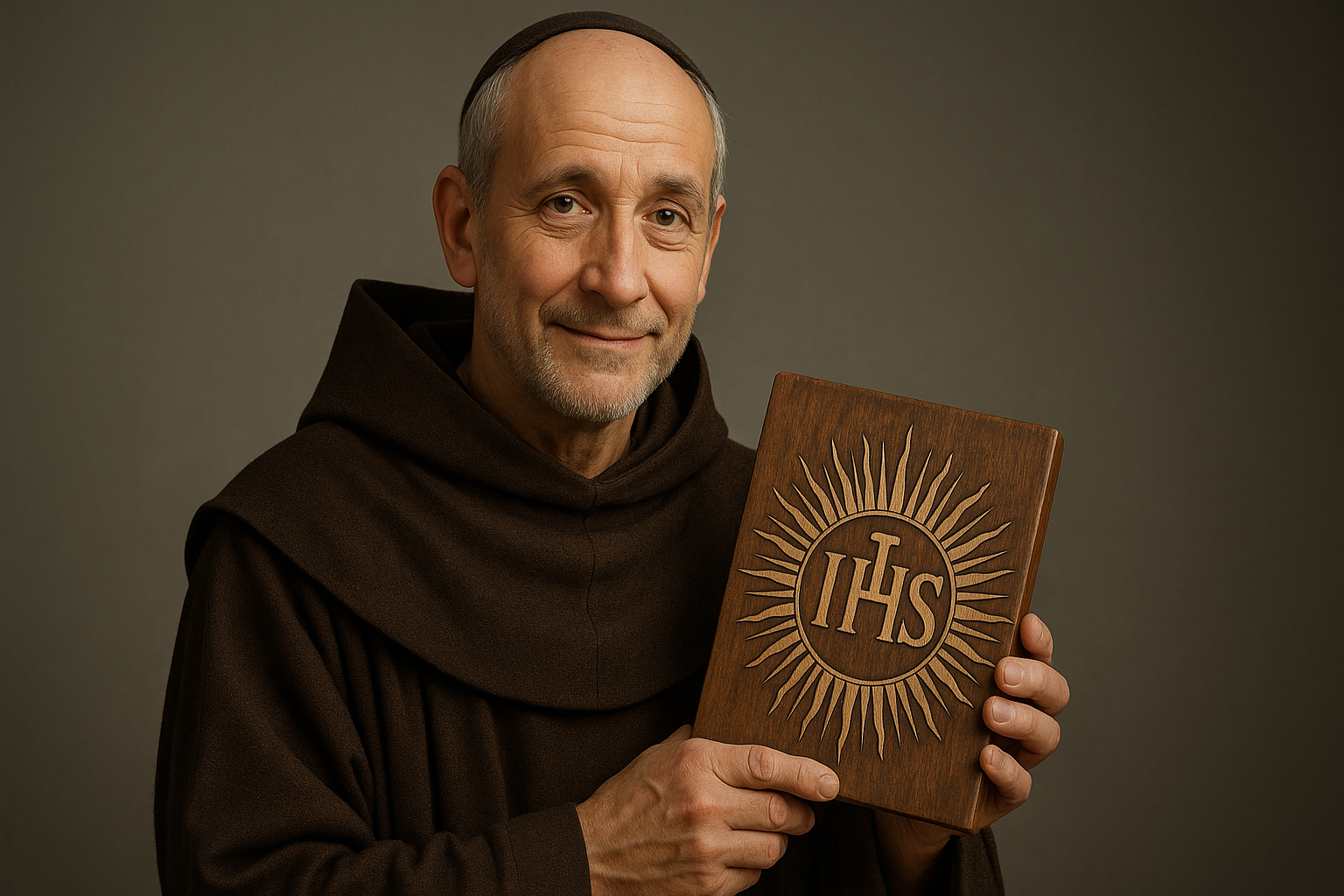
One of St. Bernardine’s most enduring and significant contributions was his passionate promotion of the devotion to the Holy Name of Jesus. While the devotion existed before him, Bernardine popularized it on an unprecedented scale. He would typically carry a wooden tablet displaying the monogram “IHS” – the first three letters of Jesus’ name in Greek (ΙΗΣΟΥΣ), often surrounded by a sunburst. At the conclusion of his sermons, he would display this tablet, encouraging people to venerate the Name of Jesus as a source of grace, protection, and healing. He taught that the Name of Jesus was a powerful invocation against evil, a source of comfort, and a reminder of God’s immense love for humanity. The sunburst, a symbol of divine light and radiating grace, further emphasized the power and glory inherent in the Name.
This simple visual aid became a powerful tool for evangelization. The monogram “IHS” soon appeared on churches, homes, and public buildings throughout Italy, becoming a widespread symbol of Christian faith and a rallying point for spiritual renewal. This devotion helped to unify Christians during the Schism, pointing them to the one Name above all names, Jesus, rather than earthly authorities. Bernardine saw the Name of Jesus as a focal point for all Christian virtues and the ultimate expression of God’s salvific plan.
Founding Monasteries and Reform Efforts
Beyond his preaching, Bernardine was also a dynamic reformer within his own Franciscan Order. He recognized the need for spiritual revitalization not only among the laity but also within religious communities. He was instrumental in expanding the Observant branch of the Franciscans, founding or reforming over two hundred monasteries across Italy. These new foundations adhered strictly to the original Franciscan rule, emphasizing poverty, prayer, and penance, providing exemplars of zealous religious life. Bernardine himself served as Vicar General of the Observants from 1438 to 1442, a period during which he successfully guided the order through significant growth and strengthened its commitment to its foundational charism. His leadership ensured that the Observant Franciscans remained a vibrant force for spiritual renewal in the Church.
Defender of the Faith and Controversies
Bernardine’s fervent preaching and innovative methods were not without their detractors. His popularization of the IHS monogram, in particular, drew suspicion from some who accused him of heresy, claiming he was introducing a new cult or even idolizing a symbol. He faced serious charges before the Papal Court on at least two occasions, first under Pope Martin V in 1427 and later under Pope Eugenius IV in 1431. Each time, Bernardine eloquently defended himself, explaining the theological soundness of the devotion to the Holy Name of Jesus, which he asserted was simply a veneration of Christ Himself through His sacred Name. His accusers were silenced, and he was fully vindicated. Pope Martin V even publicly praised Bernardine and encouraged him to continue his ministry, granting indulgences to those who venerated the Holy Name in the manner Bernardine promoted.
Bernardine’s humility was evident in his consistent refusal of high ecclesiastical honors. He was offered three bishoprics – those of Siena, Ferrara, and Urbino – but steadfastly declined each one, preferring to remain a simple Franciscan friar and dedicate himself entirely to his preaching ministry. He believed his true calling was to be on the road, speaking directly to the people, rather than managing a diocese.
Patron of Communication and Advertisers
Centuries after his death, St. Bernardine’s legacy found an unexpected modern resonance. His innovative methods of communication, his use of a simple, memorable visual (the IHS monogram), and his ability to “market” a spiritual message to vast audiences led to his unofficial, and later official, patronage of advertisers, public relations professionals, and those in communications. He understood the power of clear, compelling messaging and the importance of reaching people where they were. His ability to distill profound theological truths into accessible language and captivating imagery makes him a timeless example for anyone seeking to convey a message effectively.
Spiritual Legacy & Theological Themes
St. Bernardine of Siena’s spiritual legacy is profound and multifaceted. At its core lies his deep love for Christ and an unyielding zeal for souls. He exemplified a radical commitment to evangelical poverty, living out the Franciscan ideal with genuine joy and humility. His life was a testament to the transformative power of divine grace and the enduring relevance of Christ’s message.
The core virtues he exemplified include: Zeal for Souls, evident in his tireless preaching and refusal to rest; Humility, seen in his consistent rejection of episcopal honors and his self-identification as a simple friar; Devotion to the Holy Name of Jesus, which became the central theme of his spiritual teaching; Love for the Poor and Suffering, stemming from his early experiences during the plague; and Peace-making, as he frequently reconciled warring factions. These virtues align seamlessly with Scripture and Catholic teaching. His zeal echoes the Pauline call to evangelize (Romans 10:14-15), his humility mirrors Christ’s self-emptying (Philippians 2:5-8), and his emphasis on the Holy Name finds its foundation in Scripture’s affirmation of Jesus as Lord (Philippians 2:9-11; Acts 4:12).
His lasting influence on liturgy, devotion, and art is particularly notable through the omnipresence of the IHS monogram. This symbol, popularized by Bernardine, became a standard emblem in churches, on altars, and in religious art, a constant visual reminder of Christ’s central role in Catholic faith. His teachings also contributed to a renewed emphasis on Christ-centered spirituality, moving away from some of the more elaborate devotional practices that had emerged. Bernardine’s sermons, collected and published, served as models for subsequent generations of preachers, influencing figures like St. Philip Neri and St. Francis de Sales. His role in the Observant Franciscan reform also had a lasting impact, ensuring the vitality of the Franciscan charism and its commitment to poverty and evangelization for centuries to come.
Devotion Today
Even centuries after his death, St. Bernardine of Siena continues to be revered and invoked by the faithful. His feast day on May 20th is celebrated by Franciscans and throughout the universal Church. The city of Siena, where he spent much of his life and where his influence was deeply felt, remains a significant site of devotion. The Basilica of San Francesco in Siena houses a chapel dedicated to him, and his birthplace in Massa Marittima is also a place of veneration.
Numerous churches, schools, and hospitals around the world are named in his honor, particularly in Italy and in areas with historical Franciscan influence. Franciscan communities, especially the Observant friars, continue to uphold his spiritual legacy, living out the stricter observance of the Rule of St. Francis that Bernardine championed. Devotion to the Holy Name of Jesus, while perhaps less overtly displayed in public squares today, remains a vital part of Catholic spirituality, often incorporated into personal prayer, litanies, and various forms of adoration.
Pilgrims to Siena can still encounter the “IHS” monogram prominently displayed, often on ancient buildings, reminding them of the powerful spiritual revival he sparked. His message of repentance, peace, and fervent love for Christ continues to resonate, drawing believers to seek his intercession for personal conversion, for effective evangelization, and for reconciliation in a divided world.
Reflections for Modern Readers
St. Bernardine of Siena, though living in a vastly different time, offers profound and actionable lessons for readers today. His life provides a blueprint for impactful faith and service in the 21st century.
- Communicate Your Faith Clearly and Courageously: Bernardine was a master communicator. In our age of constant information and noise, he teaches us the importance of articulating our beliefs in a way that is both clear and compelling, without diluting the truth. Whether through social media, personal conversations, or community engagement, we are called to share the good news of Christ with passion and clarity.
- Focus on the Essentials: In a world overwhelmed by distractions, Bernardine’s singular focus on the Holy Name of Jesus reminds us to prioritize the core truths of our faith. What is truly essential? For him, it was Christ. For us, it means identifying the fundamental tenets of our beliefs and allowing them to guide our lives, rather than getting lost in superficialities.
- Be an Agent of Peace and Reconciliation: Bernardine frequently intervened in civic and personal feuds, urging reconciliation. In an era often marked by polarization and division, his example calls us to be peacemakers in our families, communities, and even online interactions. We can seek understanding, bridge divides, and promote dialogue, rather than fueling conflict.
- Live with Integrity and Stand for Truth: Despite facing accusations and opposition, Bernardine stood firm in his convictions, defending the devotion to the Holy Name with humility and truth. This encourages us to live with integrity, to courageously uphold what we know to be right, and to defend Gospel values even when it’s unpopular or challenging.
- Embrace Humility and Service: His repeated refusal of prestigious bishoprics illustrates a profound lesson in humility. True impact often comes not from seeking power or recognition, but from selflessly serving God and others in the role we are truly called to. This can manifest in quiet acts of charity, volunteering, or simply being present for those in need.
In art and jewelry, St. Bernardine is most commonly represented by the IHS monogram, often within a flaming sunburst. This symbol directly references his primary contribution to Catholic devotion and signifies the power and glory of the Holy Name of Jesus. Another common symbol is the presence of three miters (bishop’s hats) at his feet or nearby, which represents the three bishoprics he famously refused (Siena, Ferrara, and Urbino) out of humility and his desire to remain a traveling preacher. He is also often depicted holding an open book or scroll, symbolizing his profound preaching and teaching ministry. These symbols not only identify the saint but also communicate the core virtues and messages he embodied: the centrality of Christ, humility, and the powerful propagation of the Gospel message.
Timeline Summary
- September 8, 1380: Born in Massa Marittima, Republic of Siena.
- c. 1383: His mother, Nera, dies.
- c. 1386: His father, Tollo, dies, leaving him an orphan.
- 1400: Selflessly nurses plague victims in Siena.
- 1402: Enters the Observant Franciscan Order.
- 1404: Ordained a priest.
- 1417: Begins his public preaching ministry, captivating vast audiences.
- 1427: Accused of heresy before Pope Martin V regarding the Holy Name devotion; successfully defends himself and is vindicated.
- 1431: Refuses the Bishopric of Siena; later offered and refuses Ferrara and Urbino.
- 1431: Faces a second inquiry into the Holy Name devotion, again vindicated by Pope Eugenius IV.
- 1438-1442: Serves as Vicar General of the Observant Franciscans, significantly expanding and strengthening the order.
- May 20, 1444: Dies in L’Aquila, Italy, while on a preaching tour.
- May 24, 1450: Canonized a saint by Pope Nicholas V, just six years after his death.
Scripture for Reflection
St. Bernardine’s life and ministry beautifully echo several scriptural themes:
Luke 19:40: “He replied, ‘I tell you, if these were silent, the very stones would cry out.'” This verse captures the irrepressible zeal of Bernardine. So fervent was his desire to proclaim Christ that one could imagine him believing that if he remained silent, creation itself would take up the task. His preaching tours were driven by an unstoppable passion to bring souls to God.
Romans 10:14-15: “But how are they to call on one in whom they have not believed? And how are they to believe in one of whom they have not heard? And how are they to hear without someone to proclaim him? And how are they to proclaim him unless they are sent? As it is written, ‘How beautiful are the feet of those who bring good news!'” This passage perfectly encapsulates Bernardine’s vocation. He was a sent preacher, whose “beautiful feet” traveled throughout Italy, bringing the good news of salvation through Jesus Christ to countless thousands who otherwise would not have heard it with such clarity and conviction.
Philippians 2:9-11: “Therefore God also highly exalted him and gave him the name that is above every name, so that at the name of Jesus every knee should bend, in heaven and on earth and under the earth, and every tongue should confess that Jesus Christ is Lord, to the glory of God the Father.” This foundational text directly underpins St. Bernardine’s devotion to the Holy Name of Jesus. He understood the profound power and dignity inherent in the Name of Jesus, tirelessly promoting its veneration as a means of honoring Christ’s supreme Lordship and drawing closer to God.
Prayers to St. Bernardine of Siena
Prayer to St. Bernardine of Siena for Effective Communication
O glorious St. Bernardine, filled with zeal for God’s glory and the salvation of souls, you proclaimed the Holy Name of Jesus with fervent love and eloquent speech, moving countless hearts to conversion. You, who are a patron of advertisers and communicators, inspire us to use our voices and talents for the greater good. Help us to communicate the truths of our faith with clarity, warmth, and persuasive power. Grant us the wisdom to speak words that build up, heal, and bring light into the world. May our messages, like yours, point always to Jesus, the Name above all names, and draw others closer to His divine love. Amen.
Short Invocation to St. Bernardine
Saint Bernardine of Siena, zealous preacher of the Holy Name, pray for us that we may always honor Jesus in our words and deeds. Amen.