In the bustling, often turbulent world of 14th-century Europe, a voice emerged from Sweden that would shake popes, kings, and commoners alike. St. Bridget of Sweden, known in her time as Birgitta Birgersdotter, was a remarkable figure whose life journey took her from the comforts of nobility and family life to the challenging role of a mystic, prophetess, and founder of a religious order. Her story is one of unwavering faith, profound mystical experiences, and a courageous commitment to Church reform, offering timeless lessons on living a devout life amidst worldly duties and responding to God’s call with bold determination. This article will explore her early life and historical backdrop, trace her extraordinary calling and key milestones, delve into her enduring spiritual legacy, and examine how her powerful witness continues to inspire devotion in the modern world.
Quick Facts
| Attribute | Detail |
|---|---|
| Birth | Around 1303, Finsta, Uppland, Sweden |
| Death | July 23, 1373, Rome, Papal States (modern Italy) |
| Feast Day | July 23 |
| Patronage | Sweden, Europe, widows, pilgrims, publishers, difficult marriages |
| Canonized | October 7, 1391, by Pope Boniface IX |
Historical Context & Early Life
The 14th century in Europe was a period of immense upheaval and transformation, a dramatic backdrop against which St. Bridget’s prophetic voice would resonate. Politically, the continent was embroiled in conflicts like the Hundred Years’ War. Spiritually, the Catholic Church faced one of its greatest crises: the Avignon Papacy, where the Pope resided in France rather than Rome, leading to a loss of prestige and widespread calls for reform. The devastating Black Death swept through Europe mid-century, killing millions and leaving a profound impact on society, art, and religious thought. It was an era ripe with spiritual hunger, fear, and a yearning for moral leadership.
Into this tumultuous world, Birgitta Birgersdotter was born around 1303 in Finsta, Uppland, Sweden, into one of the most powerful and influential noble families in the country. Her father, Birger Persson, was the provincial governor of Uppland and a knight, while her mother, Ingeborg Bengtsdotter, was a relative of the Swedish royal family. From a very young age, Bridget exhibited extraordinary piety and sensitivity to spiritual realities. She reportedly had her first mystical vision at the tender age of seven, witnessing the Blessed Virgin Mary crowning her, and another profound vision of Christ’s Passion when she was ten, which left an indelible mark on her soul and ignited a lifelong devotion to the suffering of Jesus.
In accordance with the customs of her time, at the age of thirteen, Bridget was arranged to marry Ulf Gudmarsson, a devout nobleman and lord of Ulvåsa. Far from being a mere political alliance, their marriage blossomed into a deeply loving and spiritually fruitful partnership that lasted for 28 years. Together, they had eight children, four sons and four daughters, including St. Catherine of Sweden, who would later follow in her mother’s footsteps. Bridget managed her large household with competence and compassion, combining her noble duties with a rigorous spiritual discipline. She instilled deep faith in her children, educated them well, and cared for the poor and sick in her community. Ulf and Bridget were known for their hospitality and generosity, welcoming guests and performing acts of charity. They even became Oblates of the Third Order of St. Francis, embracing a life of prayer, penance, and service while still living in the world. Their home became a model of Christian family life, demonstrating that true holiness was attainable not just in monasteries but within the everyday realities of marriage and societal responsibilities.
Calling & Key Milestones
Early Mystical Experiences and Divine Call
Even before her marriage, Bridget’s spiritual life was marked by vivid visions and deep contemplation. The vision of Christ’s suffering at age ten profoundly shaped her understanding of redemption and fueled her desire to live a life of penance and compassion. These early experiences were not fleeting but became a consistent feature of her spiritual journey. After her husband, Ulf, became ill, the couple embarked on a pilgrimage to Santiago de Compostela in Spain, a journey that further deepened their shared faith. It was during this period that Bridget’s divine encounters became more frequent and intense.
Widowhood and the Call to Prophecy
A pivotal moment in Bridget’s life occurred in 1344 when Ulf, shortly after their return from pilgrimage, passed away. His death marked a profound shift, freeing Bridget from her marital duties and paving the way for a more direct and public calling. Christ Himself, in one of her visions, called her His “bride and channel,” tasking her with conveying His messages to the world. She left her family estate at Ulvåsa and retired to the Cistercian monastery at Alvastra, though she did not become a nun. Here, under the guidance of her spiritual director, she intensified her life of prayer and penance, and her “Revelations” began in earnest. These were detailed spiritual communications she received from Christ, the Blessed Virgin Mary, and other saints, dictating instructions for kings, popes, bishops, and even ordinary people, often urging repentance and reform.
Founding the Order of the Most Holy Savior (Bridgettines)
One of the most significant divine commands Bridget received was to establish a new religious order. Around 1346, she began to outline the unique Rule for the Order of the Most Holy Savior, known as the Bridgettines. This order was revolutionary for its time, featuring a “double monastery” with separate enclosures for nuns and monks, but under the spiritual authority of an abbess. The primary mission of the Bridgettine Order was to honor the Blessed Virgin Mary, devote themselves to the Passion of Christ, and promote spiritual growth through contemplation, study, and manual labor. The first monastery was established in Vadstena, Sweden, in 1346, though it would not be fully recognized until after Bridget’s death. The Bridgettine Rule emphasized poverty, chastity, obedience, and intense prayer, with a strong focus on liturgical worship and daily recitation of the Divine Office. Its unique structure symbolized the unity of the Church and the spiritual equality of men and women in their shared pursuit of holiness.
Move to Rome and Efforts for Papal Return
In 1349, motivated by both a divine command and a desire to see the Holy Year of Jubilee, Bridget traveled to Rome. What began as a pilgrimage became a permanent residence for the last 24 years of her life. Rome at the time was in a state of disrepair and spiritual neglect, with the Pope still residing in Avignon, France. Bridget saw this as a clear sign of the Church’s spiritual malaise. Her main mission in Rome became to implore the Pope to return to his rightful see and to restore the city’s spiritual vibrancy. She also tirelessly worked to obtain papal approval for her new religious order. Living in humble circumstances, often facing skepticism and opposition, she continued to receive her Revelations, fearlessly delivering messages to cardinals, nobles, and even the absent popes (first Clement VI, then Innocent VI, Urban V, and Gregory XI), urging them to forsake worldly ambitions and return to their pastoral duties. Her persistence, combined with the efforts of other saints like Catherine of Siena, eventually bore fruit with Pope Urban V’s brief return to Rome in 1367 and later Pope Gregory XI’s definitive return in 1377.
Pilgrimage to the Holy Land
Late in her life, Bridget embarked on a final, arduous pilgrimage to the Holy Land in 1371. Accompanied by her children, including Catherine, she visited the sacred sites of Christ’s life, death, and resurrection. This journey was deeply spiritual for her, offering new insights and confirming her devotion to the Passion of Christ. It was during this pilgrimage that she reportedly received some of her most poignant revelations concerning the details of Christ’s birth and suffering, which would later influence Christian art and devotion, particularly the depiction of the Nativity scene. Exhausted from her travels, she returned to Rome in 1372, her health failing. She died peacefully in Rome on July 23, 1373, at the age of 70, leaving behind a remarkable legacy of prophetic witness and spiritual reform.
Spiritual Legacy & Theological Themes
St. Bridget of Sweden’s spiritual legacy is vast, encompassing a profound commitment to personal holiness, an unyielding call for Church reform, and a unique mystical theology. At her core, Bridget exemplified several key virtues that align deeply with Scripture and Catholic teaching.
Her life demonstrates profound obedience to God’s will, even when it led her to challenge powerful figures. Just as the prophets of old spoke truth to kings, Bridget, a laywoman, fearlessly delivered divine messages, embodying the call found in Jeremiah 1:7-8: “Do not say, ‘I am only a youth,’ for to all to whom I send you, you shall go, and whatever I command you, you shall speak. Do not be afraid of them, for I am with you to deliver you, declares the Lord.”
Another central theme was her intense devotion to the Passion of Christ and the sorrows of the Blessed Mother. Her visions often focused on the details of Jesus’ suffering, inspiring a deeper empathy and penitential spirit in herself and others. This devotion is rooted in the biblical understanding of Christ’s sacrifice, as articulated in Philippians 2:8: “And being found in human form, he humbled himself by becoming obedient to the point of death, even death on a cross.” Her spirituality encouraged contemplation of this ultimate act of love as a path to personal conversion and a remedy for the world’s sins.
Bridget also championed the importance of penance and conversion, urging both clergy and laity to live lives of greater spiritual purity. Her messages were often calls for individuals and institutions to turn away from sin and embrace righteousness. This echoes the consistent biblical call to repentance, such as John the Baptist’s message in Matthew 3:2: “Repent, for the kingdom of heaven is at hand.”
Her lasting influence is evident in several areas. The Bridgettine Order, though slow to gain official approval, became a significant force for contemplative life and liturgical prayer, particularly in Northern Europe. Its unique structure, where an abbess governs both nuns and monks, highlighted the dignity and spiritual authority of women within the Church, a revolutionary concept for its time. Bridget’s “Revelations,” meticulously recorded by her confessors and widely circulated, became a cornerstone of mystical literature. While some of their prophecies pertained to specific historical events, their theological insights into Christ’s Passion, the nature of sin, and the importance of virtue have been carefully examined and affirmed by the Church as private revelation, not part of public Revelation (like Scripture), but still spiritually enriching.
Her detailed descriptions of the Nativity, particularly the image of Mary kneeling in adoration before the Christ Child, became highly influential in Christian art. This humble and intimate depiction replaced earlier, more formal Nativity scenes and is still prevalent today. She also left a significant mark on the theological understanding of Church reform, demonstrating that prophetic witness and an ardent desire for holiness could come from any member of the faithful, not just the hierarchy. Her persistent advocacy for the return of the papacy to Rome was a critical factor in resolving the Avignon crisis, solidifying her place as a true reformer and patron of Europe.
Devotion Today
St. Bridget of Sweden continues to inspire fervent devotion around the world, reflecting her enduring legacy as a powerful intercessor and spiritual guide. Her influence is most strongly felt through the continuing presence of the Bridgettine Order, which, after periods of decline following the Reformation, experienced a remarkable revival in the 20th century. Today, there are distinct branches of the Bridgettine family: the medieval Order of the Most Holy Savior, which includes both nuns and monks, and several modern congregations, primarily of sisters, founded in the 19th and 20th centuries (e.g., the Bridgettine Sisters of the Most Holy Savior, founded by St. Mary Elisabeth Hesselblad). These communities maintain houses across Europe, Asia, and the Americas, continuing Bridget’s mission of prayer, hospitality, and service.
Pilgrimages to sites associated with St. Bridget are a cherished tradition. The most significant is the Vadstena Abbey in Sweden, the motherhouse of the Bridgettine Order, which she founded. Although the original monastery was largely suppressed during the Reformation, its ruins and the remaining convent church are powerful reminders of her vision. Vadstena is a popular destination for pilgrims seeking to connect with Bridget’s spirituality and learn about her life. In Rome, the Bridgettine House on Piazza Farnese, where St. Bridget lived for many years and where she died, now serves as a vibrant guesthouse and spiritual center run by the modern Bridgettine Sisters. Pilgrims can visit her preserved rooms and a chapel dedicated to her.
St. Bridget’s significant role in European history and her efforts for unity and reform led Pope John Paul II to declare her, alongside St. Catherine of Siena and St. Teresa Benedicta of the Cross (Edith Stein), a Co-Patroness of Europe in 1999. This honor highlights her relevance to the continent’s spiritual and cultural heritage, making her an important intercessor for European unity and Christian values. Her feast day on July 23rd is celebrated with special Masses and devotions in Bridgettine monasteries and parishes globally. Many Catholics also observe the 15 Prayers of St. Bridget, a set of prayers and meditations on the Passion of Christ that she reputedly received in visions, accompanied by promises of grace for those who recite them faithfully for a year. While the Church does not officially endorse the promises, the prayers themselves are a beautiful and reverent devotion to Christ’s suffering, consistent with Catholic spirituality.
Reflections for Modern Readers
St. Bridget’s life, though lived centuries ago, offers profound and actionable lessons for contemporary Catholics striving for holiness in the 21st century:
- Sanctity in All States of Life: Bridget lived for many years as a wife and mother, demonstrating that holiness is not reserved for priests or religious. She raised eight children, managed a noble household, and actively served her community, all while pursuing a deep spiritual life. This reminds us that our daily vocations – whether as spouses, parents, professionals, or students – are fertile ground for encountering God and growing in virtue. For example, a modern parent balancing work and family can find inspiration in Bridget’s commitment to both, seeking God’s presence in every diaper change, homework session, or shared family meal.
- Courage to Speak Truth to Power: Bridget fearlessly delivered God’s messages, even when they challenged powerful leaders like popes and kings. She spoke out against corruption and injustice with charity but also with conviction. This calls us to cultivate moral courage in our own lives, to speak truth when necessary, and to advocate for justice within our families, workplaces, and wider society, always guided by love and prayer. A young person today might find Bridget’s example inspiring to speak up against bullying or injustice in their school or online community, even when it’s uncomfortable.
- The Power of Prayer and Discernment: Bridget’s entire mission flowed from her intimate prayer life and her profound mystical experiences. She constantly sought God’s will through prayer and penance. This emphasizes the vital importance of daily prayer, spiritual direction, and quiet discernment in navigating life’s complexities. In a noisy, distracting world, taking time for silence and prayer, even just 15 minutes a day, helps us hear God’s voice and make choices aligned with His plan.
- Active Role of Laypeople and Women in the Church: As a laywoman and later a widow, Bridget played a significant role in Church reform and founded a new religious order. Her life challenges any notion that active participation and spiritual leadership are exclusively for the clergy or men. She reminds us that every baptized person, regardless of gender or state in life, is called to contribute their unique gifts to the building up of the Church and the world. A Catholic woman today, discerning how to best serve her parish or community, can look to Bridget as a powerful example of active, inspired leadership.
In art and jewelry, St. Bridget is often depicted with several symbolic elements:
- A Book or Quill: This symbolizes her role as a writer and recipient of her “Revelations,” which were meticulously recorded and widely influential. It also signifies her wisdom and her contributions to theological thought.
- A Pilgrim Staff: This highlights her numerous pilgrimages, particularly to Santiago de Compostela and the Holy Land, emphasizing her journey of faith and her identity as a pilgrim on earth.
- A Heart with a Cross: Sometimes shown on her habit or in her hand, this represents her profound devotion to the Passion of Christ and her call to selfless love.
- A Crown: Occasionally she is shown with a crown, signifying her royal lineage and noble status before she dedicated her life fully to God. It can also hint at the “crown of thorns” given her devotion to Christ’s suffering.
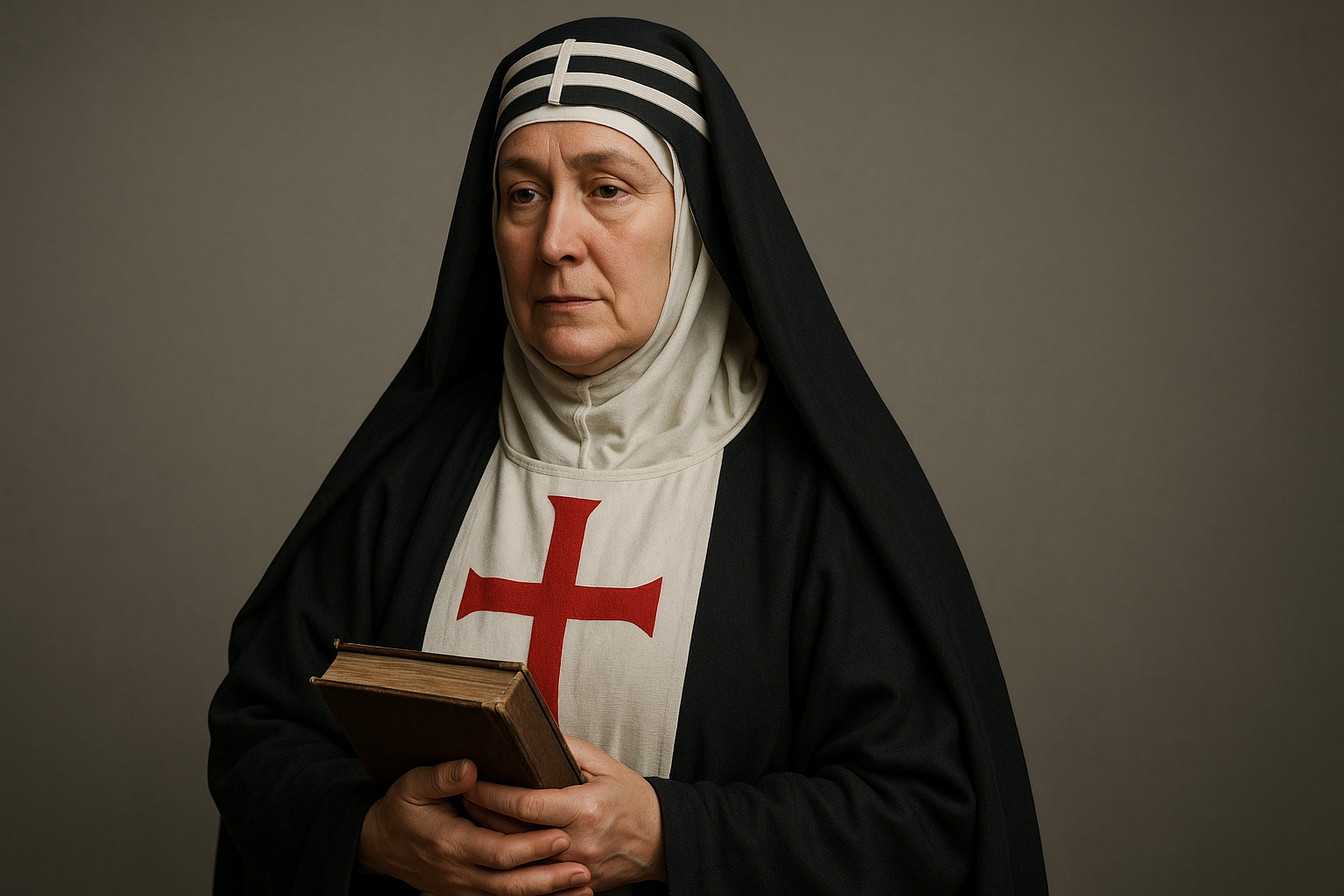
- The Habit of the Bridgettine Order: This white habit with a red cross on a white or grey veil (often with five red dots representing the five wounds of Christ) clearly identifies her as the founder of her order.
Timeline Summary
- c. 1303: Born Birgitta Birgersdotter in Finsta, Uppland, Sweden.
- c. 1310: Experiences her profound vision of Christ’s Passion.
- c. 1316: Marries Ulf Gudmarsson at age 13.
- 1316-1344: Raises eight children, manages her household, and lives a devout life. Becomes an Oblate of the Third Order of St. Francis.
- 1341-1342: Undertakes a pilgrimage with Ulf to Santiago de Compostela.
- 1344: Ulf Gudmarsson dies; Bridget retires to Alvastra monastery and receives her explicit divine call to be a “channel” for God’s messages. Her “Revelations” begin.
- 1346: Receives the Rule for her new Order of the Most Holy Savior (Bridgettines) and begins establishing the monastery at Vadstena.
- 1349: Travels to Rome for the Holy Year of Jubilee, intending to secure papal approval for her Order and urge the Pope’s return to Rome.
- 1349-1373: Lives in Rome, continuing her prophetic ministry and advocating for Church reform and papal return.
- 1367: Pope Urban V briefly returns to Rome, partly due to Bridget’s persistent pleas.
- 1371-1372: Makes a final pilgrimage to the Holy Land.
- July 23, 1373: Dies in Rome.
- 1377: Pope Gregory XI definitively returns the papacy to Rome.
- 1384: The Bridgettine Order receives final papal approval.
- October 7, 1391: Canonized by Pope Boniface IX.
- 1999: Declared a Co-Patroness of Europe by Pope John Paul II.
Scripture for Reflection
St. Bridget’s life beautifully illuminates several biblical themes, particularly those concerning prophetic witness, the suffering Christ, and the call to holiness within all states of life.
Jeremiah 1:7-8: “But the Lord said to me, ‘Do not say, ‘I am only a youth,’ for to all to whom I send you, you shall go, and whatever I command you, you shall speak. Do not be afraid of them, for I am with you to deliver you, declares the Lord.'”
This passage directly speaks to Bridget’s prophetic role. Despite being a laywoman and later a widow, a “youth” in terms of ecclesiastical power, she was sent by God to speak to the most powerful figures of her time. Her fearlessness in delivering challenging messages, even to popes and kings, perfectly mirrors God’s reassurance to Jeremiah. It reminds us that God calls unexpected people to do His work, empowering them with His presence.
Philippians 2:8: “And being found in human form, he humbled himself by becoming obedient to the point of death, even death on a cross.”
Bridget’s entire spiritual life was deeply centered on the Passion of Christ. Her visions often brought her into intimate communion with Jesus’ suffering and His ultimate obedience unto death. This verse encapsulates the humility and sacrificial love that Bridget meditated upon and sought to imitate. It teaches us that true love and redemption are found in self-emptying and obedience to God’s will, even when it involves suffering.
Proverbs 31:26, 28-29: “She opens her mouth with wisdom, and the teaching of kindness is on her tongue… Her children rise up and call her blessed; her husband also, and he praises her: ‘Many women have done excellently, but you surpass them all.'”
Before her prophetic ministry, Bridget was a devoted wife and mother. This passage from the Book of Proverbs beautifully describes the virtuous woman, a description that fit Bridget perfectly in her domestic life. She managed her household with wisdom, instilled faith in her children, and was deeply loved and respected by her husband. It connects her early life to the scriptural ideal of a woman of faith, demonstrating that the seeds of holiness are often planted and nurtured in the context of family and daily responsibilities.
Prayers to St. Bridget of Sweden
Here is a common prayer invoking St. Bridget:
Prayer to St. Bridget of Sweden
O Saint Bridget, you saw in your visions the Body of our Lord Jesus Christ, torn and covered with wounds, enduring the most cruel torments for our salvation. You felt a deep compassion for His suffering and for the sorrow of His Blessed Mother. You yearned for the return of the Popes to Rome and the reform of the Church. You tirelessly worked for the salvation of souls, dedicating your life to prayer, penance, and good works.
We implore you, O holy mother, intercede for us before the throne of God. Obtain for us a profound understanding of the Passion of Christ, that we may truly repent of our sins and seek His mercy. Inspire us to love our neighbor and to work for justice and peace in the world. Help us to be faithful to our vocations, whether in marriage, in consecrated life, or as single persons, always striving for holiness.
Through your powerful intercession, may we grow in faith, hope, and charity, and one day attain the eternal joys of heaven, where we may praise God with you forever. Amen.
Another shorter prayer:
Saint Bridget, Patroness of Europe, you who united Christian faith with human concern, inspire us to work for the unity of all peoples and to cherish our spiritual heritage. Pray for us, that we may always follow Christ with courage and compassion, bringing His light to a world in need. Amen.