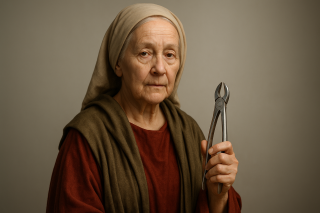
In the vast tapestry of Christian history, some figures shine with a brilliance that transcends centuries, inspiring courage, wisdom, and unwavering faith. One such luminary is St. Catherine of Alexandria, a saint whose story, though shrouded in the mists of antiquity, continues to captivate and challenge believers today. Celebrated for her intellect, her steadfast devotion, and her fearless defense of the Christian faith against a powerful Roman emperor, Catherine’s legacy offers profound lessons for modern life. This article will delve into her historical context, explore the pivotal moments of her life, unpack her enduring spiritual legacy, and examine how her story continues to resonate in contemporary devotion, offering timeless reflections for all who seek wisdom and fortitude.
Quick Facts
| Category | Detail |
|---|---|
| Birth | Late 3rd century AD (c. 287 AD) |
| Death | Early 4th century AD (c. 305 AD) |
| Feast Day | November 25 |
| Patronage | Philosophers, scholars, students, librarians, teachers, apologists, virgins, wheelwrights, millers, craftspeople working with wheels, women. |
| Canonized | Pre-Congregation (Venerated as a saint from ancient times) |
Historical Context & Early Life
To understand the remarkable life of St. Catherine of Alexandria, we must first transport ourselves to the vibrant yet volatile world of the late Roman Empire. The setting is Alexandria, Egypt, a magnificent city renowned as a center of learning, culture, and trade. Founded by Alexander the Great, Alexandria boasted the famous Library and was a melting pot of Greek, Roman, Egyptian, and Jewish influences. It was also a critical hub for early Christianity, home to a significant Christian community that flourished despite periods of intense persecution.
The Roman Empire at this time, during the late 3rd and early 4th centuries AD, was undergoing profound transformations. Emperors like Diocletian and, later, Maxentius, sought to consolidate imperial power and restore traditional Roman paganism. This often led to severe persecutions of Christians, who refused to worship the Roman gods or the emperor, a stance seen as disloyal and subversive to the state. Christians were often scapegoated for societal problems, subjected to torture, public humiliation, and execution unless they recanted their faith.
It was into this intellectually rich and politically charged environment that Catherine was born, likely around 287 AD. While specific details of her early life are drawn from tradition and later hagiographies, it is generally believed that she was of noble or even royal lineage. This privileged background afforded her an exceptional education, a rarity for women of her time. She was said to be not only beautiful but also remarkably intelligent, excelling in philosophy, rhetoric, poetry, and the sciences. Alexandria’s diverse intellectual climate provided ample opportunities for a keen mind like hers to flourish, allowing her to master the classical pagan literature and philosophical arguments of her era. This deep intellectual training would prove crucial in her later confrontations, as she was uniquely equipped to articulate her Christian faith with both eloquence and logic.
Calling & Key Milestones
The Vision and Conversion
Tradition tells us that despite her immersion in pagan philosophy, Catherine felt a deep spiritual yearning that the prevalent polytheistic beliefs could not satisfy. The pivotal moment in her life came through a mystical experience, a vision that profoundly altered her trajectory. According to legend, Catherine was visited by the Blessed Virgin Mary and the Christ Child. In this heavenly encounter, the Christ Child placed a ring on her finger, symbolizing a mystical marriage between Catherine and Christ. This “mystical marriage” is a powerful theological metaphor, representing a soul’s complete dedication and union with Christ, often associated with saints known for their purity and deep personal devotion.
This vision served as Catherine’s decisive call to faith. It transformed her intellectual curiosity into a fervent conviction. She embraced Christianity wholeheartedly, understanding it not merely as a philosophy but as the ultimate truth revealed by God. Her conversion was not a quiet, private affair but an empowering moment that prepared her for the extraordinary challenges she would soon face, giving her the courage and conviction to proclaim her new faith openly.
Confronting Maxentius and the Philosophers
The stage for Catherine’s public witness was set during a period of fierce persecution under Emperor Maxentius, who visited Alexandria and ordered Christians to sacrifice to pagan idols. Appalled by the sight of Christians being forced to renounce their faith and suffer martyrdom, the young Catherine, barely 18 years old, felt compelled to act. With astonishing boldness, she confronted the emperor directly. She did not merely protest; she engaged him in a theological and philosophical debate, challenging his authority and the very foundations of pagan worship with her superior intellect and unwavering faith.
Maxentius, accustomed to absolute power, was reportedly enraged and impressed by her audacity and eloquence. Unable to defeat her arguments himself, he summoned fifty of the empire’s most learned pagan philosophers and rhetoricians, instructing them to refute Catherine’s Christian arguments and persuade her to abandon her faith. This was a classic intellectual showdown, a contest of minds that placed a young Christian woman against the intellectual might of the pagan world. Yet, remarkably, Catherine, empowered by her faith and knowledge, systematically dismantled their arguments, demonstrating the truth and rationality of Christianity. So profound was her persuasive power that, according to tradition, many of these philosophers were themselves converted to Christianity on the spot, preferring to embrace Christ rather than the emperor’s wrath. Maxentius, infuriated by this unexpected turn of events, ordered the immediate execution of his own scholars, who chose martyrdom rather than deny their newfound faith.
The Torture and the Breaking Wheel
Having failed to sway Catherine with reasoned debate or intimidation, Maxentius resorted to brutal torture. He ordered her imprisoned and subjected to various torments, including starvation. During her imprisonment, heavenly light and angelic visitors sustained her, and she continued to evangelize, converting high-ranking officials and the empress herself, who visited her out of curiosity. This period of suffering only strengthened her resolve and demonstrated the supernatural power working through her.
The emperor’s final, infamous attempt to break her spirit involved a gruesome device known as the “breaking wheel” or “Catherine Wheel.” This instrument of torture consisted of four wheels studded with sharp spikes, designed to tear the victim’s body to pieces. As Catherine was bound to this horrific contraption, she offered a prayer to God. Miraculously, at that very moment, the wheels shattered into pieces, an event widely interpreted as divine intervention, preventing her martyrdom by this means. This dramatic miracle further solidified her reputation as a saint favored by God, inspiring greater awe and conviction among onlookers.
Martyrdom
Despite the miraculous destruction of the breaking wheel, Maxentius remained unyielding in his determination to extinguish Catherine’s life and faith. Frustrated by her unwavering resolve and the string of conversions inspired by her witness, he ultimately ordered her beheading. Catherine faced her death with serene courage, accepting her fate as a final act of devotion to Christ. Her martyrdom cemented her place as one of Christianity’s most revered virgin martyrs.
Legend holds that after her death, angels transported her body to Mount Sinai, where it was later discovered by monks centuries later. This extraordinary detail further adds to the mystique and sanctity surrounding her life, portraying her as a figure not only divinely protected in life but also honored in death.
Spiritual Legacy & Theological Themes
St. Catherine of Alexandria’s life embodies several profound spiritual virtues and theological themes that continue to inspire Catholics worldwide. At the heart of her legacy are wisdom, fortitude, purity, and unwavering faith.
Her wisdom was not merely intellectual brilliance but a divine gift, enabling her to discern truth and articulate it with clarity and conviction. This wisdom, as described in the Book of Proverbs, is “more precious than rubies” (Proverbs 3:15) and enables one to “understand justice and judgment and equity, every good path” (Proverbs 2:9). Catherine exemplified the Catholic tradition’s high regard for intellect when used in service of God, demonstrating that faith and reason are not adversaries but complementary paths to truth. Her ability to debate and convert pagan philosophers highlights the Church’s historical engagement with intellectual inquiry and apologetics, the reasoned defense of Christian beliefs.
Fortitude, or courage, was another hallmark of her character. Facing an emperor and the threat of brutal torture, she stood firm, embodying the scriptural call to “be strong and courageous” (Joshua 1:9). Her refusal to deny Christ, even unto death, aligns perfectly with Jesus’ words: “Whoever finds his life will lose it, and whoever loses his life for my sake will find it” (Matthew 10:39). Her story is a powerful testament to the virtue of martyrdom, seen in the Catholic Church as the ultimate act of loving witness to Christ.
Her purity, symbolized by her mystical marriage to Christ, underscores the Christian call to holiness and dedication. As a virgin martyr, she represents the profound commitment to God that transcends worldly attachments, echoing the sentiments of St. Paul in 1 Corinthians 7:34, where he speaks of the unmarried woman “anxious about the things of the Lord, how to be holy in body and spirit.”
St. Catherine’s lasting influence on Catholic liturgy, devotion, and art is significant. She became one of the Fourteen Holy Helpers, a group of saints venerated together in the Middle Ages, especially in Germany, invoked particularly against various diseases and for specific needs. Her story fueled countless plays, poems, and artistic renditions, often depicting her with her symbolic wheel, sword, or book. Her feast day on November 25th (though briefly removed from the General Roman Calendar in 1969 due to historical uncertainties, she was reinstated in 2002 as an optional memorial, reflecting her persistent veneration) remains a day of special remembrance, particularly among academics and students. She is a revered patroness for those who seek knowledge, wisdom, and the courage to defend their faith, serving as a powerful role model for Catholic education and intellectual pursuits.
Devotion Today
Even centuries after her martyrdom, devotion to St. Catherine of Alexandria remains vibrant in many parts of the world. Her status as a celebrated saint endures, thanks to her compelling story and the universal virtues she represents.
Perhaps the most significant and ancient site of devotion to St. Catherine is the Monastery of Saint Catherine on Mount Sinai in Egypt. This UNESCO World Heritage site is one of the oldest continually operating Christian monasteries in the world. According to tradition, it is built on the very spot where angels deposited Catherine’s body. Monks at the monastery claim to possess her relics, and pilgrims have journeyed there for centuries to venerate her and seek her intercession. The monastery’s library houses an unparalleled collection of ancient manuscripts, making it a living monument to the intellectual pursuits Catherine championed.
Throughout Europe, especially in France, Italy, and Spain, countless churches, chapels, and altars are dedicated to St. Catherine. Her feast day on November 25th is celebrated with particular solemnity in these regions. In France, young unmarried women traditionally observe “Ste. Catherine’s Day” or “Catherinettes,” invoking her patronage for marriage and a good husband. While this custom has evolved, it still highlights her historical role as a patroness of young women.
In contemporary Catholicism, St. Catherine continues to be a popular intercessor for students, teachers, librarians, and anyone engaged in intellectual work. Her story is frequently taught in Catholic schools as an example of faith, reason, and courage. Many modern Catholics find inspiration in her ability to stand firm against overwhelming opposition and to articulate her beliefs with clarity and conviction in a world that often challenges faith. Her story offers a powerful message of perseverance in the face of adversity and the importance of intellectual engagement with one’s faith.
Reflections for Modern Readers
St. Catherine of Alexandria, a figure from a distant past, offers surprisingly relevant lessons for navigating the complexities of the 21st century. Her life, though marked by extreme circumstances, provides enduring wisdom for modern believers.
1. Cultivate Wisdom and Critical Thinking: Catherine’s deep learning allowed her to effectively defend her faith. In an age of information overload and competing narratives, she reminds us of the importance of intellectual formation. Just as she studied pagan philosophies to understand and challenge them, modern Catholics are called to understand contemporary ideologies and engage them thoughtfully, not just dismissively. For example, a student facing skepticism about faith in a college philosophy class can draw courage from Catherine, seeking to understand diverse viewpoints while also being able to articulate their own beliefs with reasoned arguments and charity.
2. Stand Firm in Your Convictions: Catherine refused to compromise her faith, even when facing torture and death. While few of us will face such extreme persecution, we frequently encounter social pressures, professional challenges, or cultural trends that subtly push us to dilute or abandon our Christian values. A professional in a highly competitive industry might be tempted to cut corners or compromise ethical principles to get ahead. Catherine’s unwavering fortitude encourages us to remain steadfast, to prioritize integrity and faith over worldly gain or approval.
3. Speak Truth to Power (with Charity): Catherine bravely confronted Emperor Maxentius. This doesn’t mean we should be confrontational for confrontation’s sake, but it does mean having the courage to speak up against injustice, falsehood, or ungodliness, even when it’s unpopular or risky. This could manifest as advocating for the unborn, defending religious freedom, or simply speaking a truthful word in a difficult family or workplace discussion, always striving to do so with love and respect, as Catherine debated, rather than simply accused.
4. Embrace Your Unique Gifts for God’s Glory: Catherine used her exceptional intellect and education for the glory of God. Each of us is endowed with unique talents, be they intellectual, artistic, practical, or relational. Catherine inspires us to identify these gifts and intentionally use them to build up the Kingdom of God, rather than solely for personal gain or fleeting pleasures. A talented writer might use their skill to craft hopeful stories, or a skilled organizer might use their abilities to coordinate charitable works, all in imitation of Catherine’s dedication.
In art and jewelry, St. Catherine is frequently depicted with several powerful symbols:
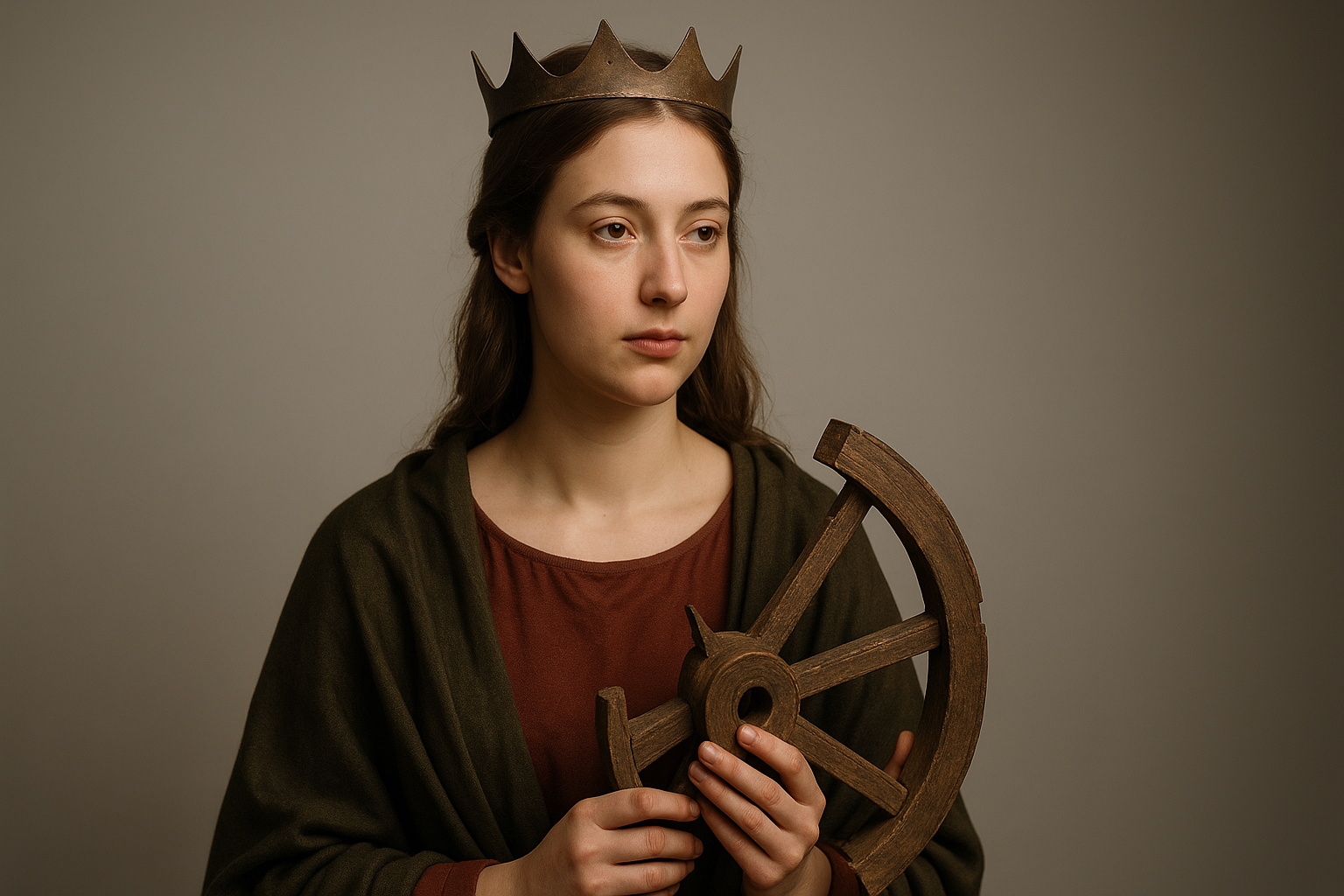
- The Breaking Wheel (or Catherine Wheel): This is her most iconic symbol, representing the miraculous intervention that saved her from this instrument of torture. It signifies divine protection, resilience, and fortitude in the face of suffering.
- A Sword: This symbolizes her martyrdom by decapitation. It also represents the “sword of truth” (Ephesians 6:17), signifying her intellectual prowess and her unwavering defense of the Christian faith.
- A Crown: Often worn on her head, this signifies her royal lineage (in tradition) and her status as a victorious martyr, having won the crown of eternal life. It also can represent her purity and chastity, a “crown of virginity.”
- A Book or Scroll: This symbol highlights her immense learning, wisdom, and patronage of scholars and students. It signifies the importance of sacred knowledge and intellectual pursuit within the Christian life.
Timeline Summary
- c. 287 AD: Born in Alexandria, Egypt, into a noble family.
- Late 3rd/Early 4th Century: Receives an exceptional education, excelling in philosophy and rhetoric.
- Early 4th Century: Experiences a mystical vision, leading to her profound conversion to Christianity and a “mystical marriage” to Christ.
- c. 305 AD: Emperor Maxentius visits Alexandria, initiating severe persecution of Christians.
- c. 305 AD: Catherine, around 18 years old, bravely confronts Emperor Maxentius, challenging his pagan beliefs.
- c. 305 AD: Debates 50 pagan philosophers summoned by Maxentius, converting many of them to Christianity through her superior arguments.
- c. 305 AD: Imprisoned and tortured; continues to evangelize, converting the empress and high-ranking officials.
- c. 305 AD: Sentenced to death on the breaking wheel; the wheel miraculously shatters.
- c. 305 AD: Martyred by beheading.
- Post-Martyrdom: According to tradition, angels transport her body to Mount Sinai.
- 9th Century: Relics reportedly discovered by monks at Mount Sinai, leading to the construction of the Monastery of St. Catherine.
- Middle Ages Onward: Becomes widely venerated, especially as one of the Fourteen Holy Helpers, and a patroness of scholars.
- November 25th: Her traditional feast day, observed by many Catholics globally.
Scripture for Reflection
St. Catherine’s life powerfully echoes several scriptural themes, offering rich passages for reflection:
1. Proverbs 4:7-9 (on Wisdom): “The beginning of wisdom is this: Get wisdom, and whatever you get, get insight. Prize her highly, and she will exalt you; she will honor you if you embrace her. She will place on your head a graceful garland; she will bestow on you a beautiful crown.”
Connection: This passage perfectly captures Catherine’s intellectual and spiritual journey. Her commitment to wisdom, both worldly and divine, ultimately led to her spiritual exaltation and the “beautiful crown” of martyrdom and sainthood.
2. Matthew 10:28 (on Fortitude and Fearlessness): “And do not fear those who kill the body but cannot kill the soul. Rather fear him who can destroy both soul and body in hell.”
Connection: Catherine embodied this teaching with profound courage. She refused to fear the emperor or the instruments of torture, recognizing that her eternal soul was beyond Maxentius’s power. Her ultimate fear was to displease God, a fear that empowered her to stand firm.
3. Romans 8:38-39 (on Unwavering Faith): “For I am sure that neither death nor life, nor angels nor rulers, nor things present nor things to come, nor powers, nor height nor depth, nor anything else in all creation, will be able to separate us from the love of God in Christ Jesus our Lord.”
Connection: St. Catherine’s unwavering faith, even in the face of excruciating trials, demonstrates this profound truth. No torment, no threat, and no earthly power could separate her from her love for Christ, a testament to the enduring power of God’s love in the hearts of His saints.
Prayers to St. Catherine of Alexandria
Here are prayers commonly associated with St. Catherine of Alexandria, invoking her intercession:
Prayer to St. Catherine for Wisdom and Fortitude
O glorious St. Catherine, virgin and martyr, you were endowed with a brilliant mind and a fearless heart, which you dedicated entirely to Christ. You confounded the pagan philosophers and stood firm against the tyranny of the emperor, preferring death to denial of your beloved Bridegroom, Jesus. Intercede for us, we pray, that we may be granted your wisdom to discern the truth, your fortitude to defend our faith, and your purity of heart to remain ever faithful to Christ. Enlighten our minds, strengthen our wills, and inspire us to use our talents for God’s greater glory and the salvation of souls. Amen.
Short Prayer to St. Catherine
St. Catherine of Alexandria, patroness of scholars and students, you were renowned for your learning and your courageous faith. Guide us in our studies and efforts to seek truth. Inspire us to defend our Catholic faith with wisdom and conviction. Help us to remain steadfast in trials and pure in heart, that we may always follow Christ our Lord. Amen.