Born into a wealthy noble family in 13th-century Assisi, St. Clare might have lived a life of comfort and social standing, but her heart yearned for something far deeper. Inspired by the radical example of her friend and mentor, St. Francis, Clare chose a path of profound poverty, unwavering faith, and sisterhood that would forever change the face of religious life for women. This article will explore her early life, her courageous decision to embrace Christ as her spouse, the founding of the Order of Poor Ladies (now known as the Poor Clares), her spiritual legacy, and how her radical commitment to simplicity and trust in God continues to inspire believers in the modern world.
Quick Facts
| Attribute | Detail |
|---|---|
| Birth | July 16, 1194 (Assisi, Umbria, Italy) |
| Death | August 11, 1253 (Assisi, Umbria, Italy) |
| Feast Day | August 11 |
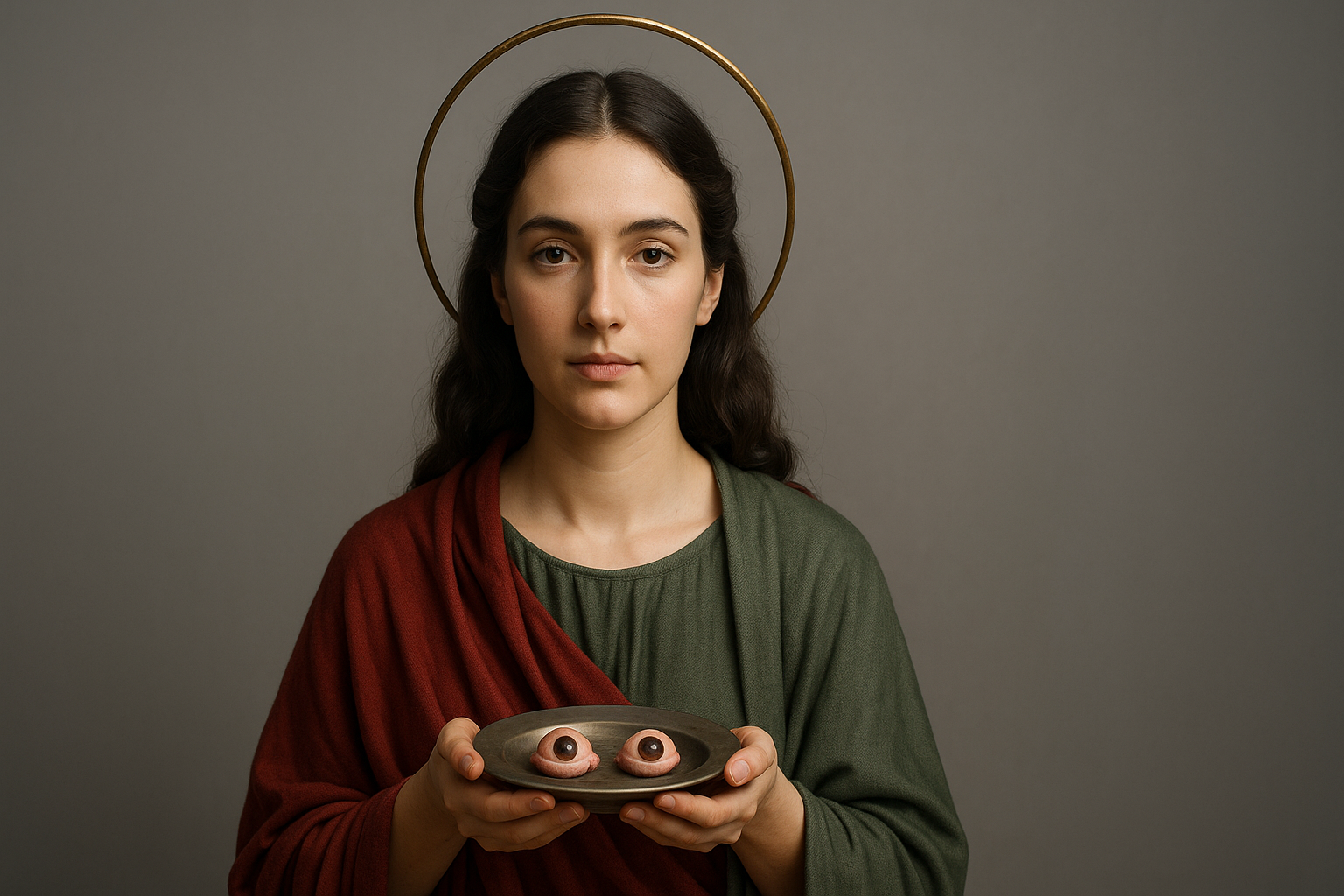
| Patronage | Television, telecommunications, eye diseases, gilders, embroiderers, Santa Clara (California), coppersmiths, laundry, Good Weather |
| Canonized | September 26, 1255 (by Pope Alexander IV) |
Historical Context & Early Life
The 13th century in Italy was a vibrant and tumultuous period, marked by significant changes in both society and the Church. Cities like Assisi, nestled in the Umbrian hills, were bustling centers of trade and political power, often caught between the Holy Roman Empire and the Papal States. Feudalism was giving way to an emerging merchant class, leading to shifts in social structures and an increasing gap between the very rich and the very poor. Within the Church, there was a growing desire for spiritual renewal and a return to the Gospel’s simplicity, challenging the perceived wealth and power of some ecclesiastical institutions. It was against this backdrop that two towering figures, Francis and Clare, would emerge from Assisi, each profoundly influencing the other and the course of Christian history.
Clare Favarone di Offreduccio was born on July 16, 1194, into one of Assisi’s most prominent and wealthy noble families. Her father, Favarone di Offreduccio, was a knight and a powerful landowner, and her mother, Ortolana, was a pious and charitable woman who had made pilgrimages to Rome and the Holy Land. Clare was the eldest of three daughters, with Agnes and Beatrice following her. Her upbringing was typical for a noble girl of her time: she was educated in the manners and expectations of high society, likely instructed in household management, embroidery, and prayer. However, even from a young age, Clare displayed a deep spiritual inclination that set her apart. She was known for her compassion for the poor, often secretly giving away food and clothing, and for her quiet devotion to prayer and penance, choosing simplicity even amidst her family’s opulence.
Her family expected her to make a prestigious marriage, further solidifying their social standing. However, Clare harbored a secret desire for a different kind of life, one dedicated entirely to God. Stories from her early life suggest a strong will and an independent spirit, coupled with profound piety. These formative years, though lived within the confines of aristocratic expectations, laid the groundwork for the radical choice she would soon make, a choice that would defy societal norms and pave the way for a new form of consecrated life for women.
Calling & Key Milestones
Meeting St. Francis and the Call to Poverty
The turning point in Clare’s life came with the arrival of Francis Bernardone, a charismatic young man from Assisi who, after a dramatic conversion, had renounced his family’s wealth and embarked on a radical life of poverty and preaching. Francis’s message resonated deeply with Clare, who had heard him preach in the streets and churches of Assisi. She was captivated by his passionate commitment to living the Gospel literally, embracing poverty, and serving the poor. Through her aunt Bianca, Clare began to arrange secret meetings with Francis, seeking his spiritual guidance. In these conversations, Francis confirmed Clare’s deep longing for a life dedicated to Christ and encouraged her to abandon the world for God.
The Escape and Vow of Poverty
Clare’s decision was not easy. It meant defying her family and societal expectations. On Palm Sunday night, March 18, 1212, at the age of 18, Clare made her courageous escape. Instead of attending the elaborate Palm Sunday liturgy with her family, she slipped away from her home, accompanied by a companion. She met Francis and his friars at the small chapel of St. Mary of the Angels (the Porziuncola), a place sacred to Franciscans. There, in a symbolic ceremony, Francis cut her hair – a sign of renouncing the world – and gave her a simple tunic and veil, marking her embrace of consecrated life. This dramatic act was a public declaration of her intention to live a life of poverty and chastity, committing herself entirely to God. Her family, upon discovering her absence, pursued her fiercely, attempting to drag her back home, but Clare clung to the altar and famously declared, “I will have no other husband but Jesus Christ!”
San Damiano and the Founding of the Poor Ladies
Francis initially placed Clare with Benedictine nuns, as he had no suitable place for women committed to such a radical form of life. However, her sister Agnes soon joined her, followed by other women, including her mother, Ortolana, and their other sister, Beatrice. Francis eventually provided them with the small, dilapidated church of San Damiano, which he himself had rebuilt. This became the birthplace of the Order of Poor Ladies, later known as the Poor Clares. Clare became their abbess (spiritual leader), guiding her sisters in a life of extreme poverty, prayer, and manual labor. They lived simply, subsisting on alms, embracing what Clare called the “Privilege of Poverty”—owning no property, either individually or as a community. This was revolutionary, as most women’s religious orders at the time relied on endowments and stable incomes.
The Miracle of the Eucharist
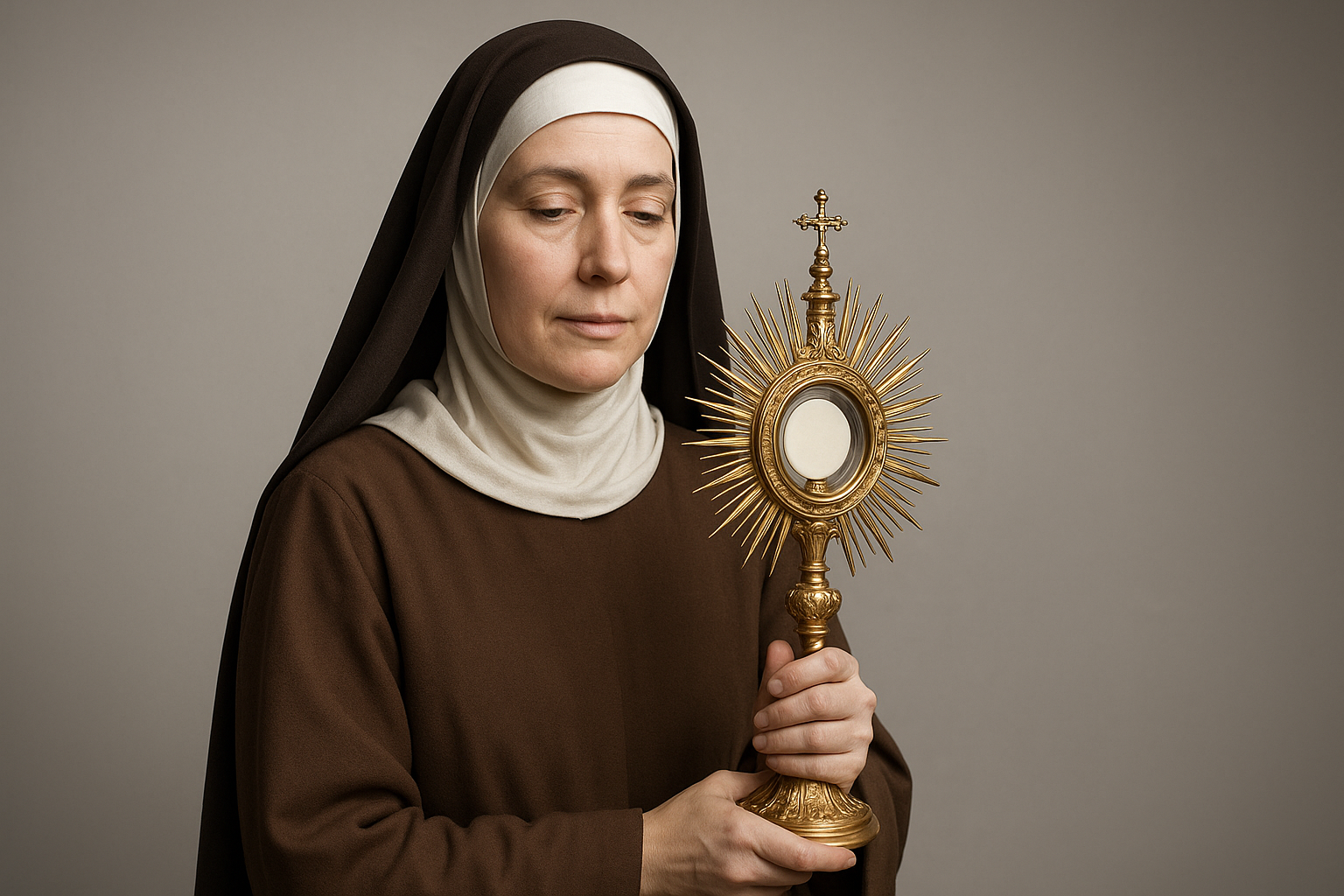
One of the most famous stories of St. Clare involves her steadfast faith in the face of danger. In 1240, Saracen mercenaries, part of the army of Emperor Frederick II, were attacking Assisi. They attempted to invade the monastery of San Damiano. Weak and ill, Clare asked to be carried to the gate of the monastery, where she placed a monstrance (a vessel used to display the Blessed Sacrament) containing the Eucharist before the invaders. She prayed, “Does it please you, my Lord, to deliver into the hands of these dogs the defenseless sisters whom I have nourished with your love? Protect your servants, since I cannot protect them.” According to tradition, a voice answered, “I will always protect you.” A sudden terror seized the attackers, and they fled, leaving the monastery unharmed. This event solidified her reputation for holiness and profound trust in God’s providence.
The Privilege of Poverty and the Rule of Life
Throughout her life, Clare fiercely defended her order’s unique commitment to absolute poverty. Church authorities, accustomed to established monastic models, were often hesitant to grant this “privilege of poverty” to a community of women, fearing for their material security. They encouraged her to accept endowments, but Clare steadfastly refused, believing that complete dependence on God’s providence was essential to their charism. She spent years writing her own Rule of Life for her sisters, based on Francis’s Rule for the Friars Minor, emphasizing Gospel poverty, communal life, and contemplative prayer. It was a groundbreaking document, making her the first woman in Church history to write a Rule of Life for a religious order. Just two days before her death, in 1253, Pope Innocent IV officially approved her Rule, a testament to her perseverance and divine inspiration. This ensured the survival and distinct identity of the Poor Clares.
Spiritual Legacy & Theological Themes
St. Clare’s spiritual legacy is profound and enduring, particularly for women in the Church and for anyone seeking a more radical way of living the Gospel. Her life exemplified several core virtues that continue to resonate with Catholic teaching and Scripture.
Radical Poverty and Dependence on God: At the heart of Clare’s spirituality was her unwavering commitment to poverty. Unlike previous monastic traditions that allowed communities to own property, Clare insisted on absolute poverty, both individually and communally. This was not a negation of worldly goods for its own sake, but an act of profound trust in divine providence. She believed that by owning nothing, her sisters could be entirely free to embrace Christ, who himself “had nowhere to lay his head” (Matthew 8:20). This aligns perfectly with scriptural teachings on detachment from worldly possessions and seeking first the Kingdom of God (Matthew 6:19-34). For Clare, poverty was a liberating force, allowing for deeper intimacy with God and solidarity with the poor.
Contemplative Prayer and the “Mirror of Christ”: While the Poor Clares lived active lives of manual labor and service within their enclosure, their primary focus was contemplative prayer. Clare encouraged her sisters to gaze upon Christ as a “mirror,” reflecting on His humility, poverty, and love. This practice of contemplation transformed them from within, conforming them more closely to Christ. Her writings, particularly her letters to St. Agnes of Prague, are rich with imagery of this spiritual mirror, inviting her sisters to see themselves in Christ and to reflect His virtues back to the world. This deep contemplative life is rooted in Christ’s own example of retreating to pray (Luke 5:16) and the call to “be holy, because I am holy” (1 Peter 1:16).
Sisterhood and Community: Clare fostered a strong sense of sisterhood and mutual support within her community at San Damiano. Despite strict enclosure, the sisters shared a common life of prayer, work, and recreation, bound by love and a shared commitment to their Rule. Clare’s leadership was marked by humility and service, always prioritizing the well-being and spiritual growth of her sisters. She understood that communal life, lived in charity, was a powerful witness to the Gospel. This echoes the early Christian communities described in the Acts of the Apostles, where believers “were of one heart and mind” (Acts 4:32).
Feminine Leadership and Empowerment: In an era when women had limited roles in public life and often in the Church, Clare’s leadership as an abbess who wrote her own Rule of Life was revolutionary. She demonstrated that women could lead, innovate, and contribute profoundly to the Church’s spiritual life, not just within established structures but by forging new paths. Her persistence in defending the Privilege of Poverty against papal pressure showcases remarkable spiritual strength and autonomy, empowering women to define their own consecrated lives.
Clare’s lasting influence is immense. The Order of Poor Clares continues to thrive worldwide, embodying her charism of contemplative prayer and radical poverty. Her Rule of Life inspired countless other women’s religious orders, especially those with an emphasis on enclosure and contemplation. She stands as a powerful symbol of spiritual courage, a model of total trust in God, and a testament to the transformative power of poverty embraced for Christ’s sake. Her life reminds us that true riches are found not in material possessions but in a heart wholly given to God.
Devotion Today
St. Clare of Assisi remains a beloved and influential saint, and devotion to her continues to flourish around the world. Assisi, the very town where she lived and died, is naturally a major center of pilgrimage and devotion. The Basilica of St. Clare in Assisi houses her remains in a beautiful crypt, and visitors can also see the crucifix that spoke to St. Francis and the original San Damiano Cross, which was moved from her monastery. The Monastery of San Damiano itself, located just outside the walls of Assisi, is preserved as a sacred place where pilgrims can experience the simplicity and peace of the early Poor Clares’ life. It’s a powerful experience to walk the grounds where Clare lived, prayed, and led her sisters.
Beyond Assisi, the Order of Poor Clares, founded by St. Clare, is a thriving contemplative order with monasteries scattered across every continent. These communities continue to live out Clare’s Rule, dedicating their lives to prayer, penance, and absolute poverty, offering a powerful spiritual witness in a materialistic world. Many people visit these monasteries for spiritual retreats, to participate in their liturgies, or to simply seek prayer and guidance from the sisters.
St. Clare’s feast day on August 11th is celebrated with special Masses, prayers, and festivities in Catholic communities globally. In some places, particularly in Italy and regions with strong Franciscan traditions, there are processions and special devotions. Due to her miraculous protection of Assisi with the Eucharist, she is often invoked for protection and for strong faith. Her patronage of television and telecommunications stems from a tradition that when she was too ill to attend Mass, she was able to miraculously see and hear the Mass being celebrated in her cell, much like we view broadcasts today.
Many individuals and families also maintain personal devotions to St. Clare, praying to her for intercession, particularly for clarity of vision (physical or spiritual), for strength in adversity, and for a deeper commitment to simplicity in their own lives. Her life serves as a constant reminder that true wealth lies not in what we possess, but in how fully we embrace God’s will and depend on His loving care.
Reflections for Modern Readers
St. Clare of Assisi, living eight centuries ago, might seem distant from our fast-paced, digital world. Yet, the core lessons from her life are profoundly relevant and actionable for anyone seeking a more meaningful existence today.
- Embrace Simplicity and Detachment: In a consumer-driven society that constantly urges us to acquire more, Clare’s radical poverty offers a powerful counter-cultural message. Her life teaches us that true freedom comes not from accumulating possessions but from detaching ourselves from them.
- Real-world example: Instead of constantly upgrading electronics or buying the latest fashion, consider decluttering your home, donating what you don’t need, or making conscious choices to buy less. This frees up resources, time, and mental energy for what truly matters, echoing Clare’s focus on spiritual wealth over material wealth.
- Cultivate a Contemplative Spirit: Clare’s life was centered on deep prayer and gazing upon Christ as a mirror. In a world full of noise and distractions, the practice of contemplative prayer—simply being present to God—is more vital than ever.
- Real-world example: Set aside even 5-10 minutes each day for quiet reflection, meditation, or prayer. This isn’t about solving problems but about being still and listening. It could be journaling, a quiet walk, or simply sitting in silence with God, allowing His presence to ground you amidst daily chaos.
- Trust in Divine Providence: Clare faced immense challenges, from family opposition to threats of invasion and papal pressure. Yet, her trust in God never wavered, culminating in miracles and the ultimate approval of her Rule. Her life is a testament to unwavering faith in God’s care.
- Real-world example: When facing uncertainty—a job loss, health scare, or relationship struggle—instead of succumbing to anxiety, make a conscious effort to surrender your worries to God. Take action where you can, but also pray, “God, I trust you to provide.” This doesn’t mean inaction, but a peaceful assurance that God is ultimately in control.
- Live Courageously for Your Convictions: Clare defied societal expectations and her family’s wishes to follow her calling. She steadfastly defended her order’s unique charism against powerful Church figures. Her story inspires us to have the courage to stand firm in our values.
- Real-world example: If you believe strongly in an ethical cause, speak up, even if it’s unpopular. If your spiritual path calls you to make choices that differ from your peers (e.g., prioritizing family time over career advancement, or living more sustainably), embrace those choices with confidence and grace, just as Clare lived her radical Gospel life.
Common Symbols and Representations of St. Clare
- Monstrance / Eucharist: This is arguably her most famous symbol, directly linked to the miracle where she repelled invaders from San Damiano by holding up the Blessed Sacrament. It signifies her profound faith in the Real Presence of Christ in the Eucharist and her powerful intercession. In art, she is often depicted holding a monstrance or a ciborium (a vessel for consecrated hosts).
- Lily: The lily is a classic symbol of purity and virginity, often associated with saints who lived lives of chastity. For St. Clare, it represents her consecrated virginity and the spiritual purity she sought through her life of prayer and poverty.
- Lamp / Oil Lamp: This symbol relates to her name, “Clare,” which comes from the Latin “clara,” meaning “clear” or “bright.” It represents the light of Christ that shone through her and her role in illuminating the path of consecrated life for women. It also subtly connects to the parable of the wise and foolish virgins (Matthew 25:1-13), symbolizing readiness and spiritual vigilance.
- Poor Clares Habit: She is typically shown wearing the simple habit of the Poor Clares: a plain tunic, cincture (rope belt), and veil, often in a natural, undyed wool color (gray or brown). This symbolizes her embrace of radical poverty and humility.
Timeline Summary
- 1194 (July 16): Clare Favarone di Offreduccio is born in Assisi, Italy, into a wealthy noble family.
- ~1210-1211: Clare hears St. Francis preach and begins to seek his spiritual counsel in secret.
- 1212 (Palm Sunday, March 18): Clare dramatically leaves her family home, meets St. Francis at the Porziuncola, and receives her religious habit, taking vows of poverty, chastity, and obedience.
- 1212: Francis places Clare and her first followers, including her sister Agnes, at the church of San Damiano, establishing the Order of Poor Ladies (later Poor Clares).
- 1212: Clare is appointed abbess of the community at San Damiano by St. Francis.
- 1216: Pope Innocent III grants Clare the “Privilege of Poverty,” allowing her community to own no property.
- 1228: Pope Gregory IX issues a new bull confirming the Privilege of Poverty, but offering a Rule that Clare found too lenient.
- 1240: Saracen mercenaries attack Assisi; Clare, ill, repels them from San Damiano with the Blessed Sacrament.
- 1244: Pope Innocent IV stays at San Damiano for a period, developing a great respect for Clare.
- ~1247-1253: Clare works diligently on her own Rule of Life for the Poor Ladies, advocating for absolute poverty.
- 1253 (August 9): Pope Innocent IV formally approves Clare’s Rule of Life, making her the first woman to write a Rule for a religious order.
- 1253 (August 11): St. Clare dies at San Damiano, surrounded by her sisters and visited by Pope Innocent IV.
- 1255 (September 26): Pope Alexander IV canonizes Clare in Anagni, just two years after her death.
Scripture for Reflection
St. Clare’s life beautifully illustrates several key scriptural principles, particularly those related to detachment, trust, and seeking God’s Kingdom above all else.
- Matthew 6:19-21: “Do not store up for yourselves treasures on earth, where moths and vermin destroy, and where thieves break in and steal. But store up for yourselves treasures in heaven, where moths and vermin do not destroy, and where thieves do not break in and steal. For where your treasure is, there your heart will be also.”
This passage perfectly encapsulates Clare’s radical choice for poverty. She recognized that earthly wealth is fleeting and ultimately unsatisfying. Her decision to renounce her inheritance and live a life of complete dependence on God was a profound act of storing up “treasures in heaven,” demonstrating where her true heart lay.
- Matthew 6:25-26, 33: “Therefore I tell you, do not worry about your life, what you will eat or drink; or about your body, what you will wear. Is not life more than food, and the body more than clothes? Look at the birds of the air; they do not sow or reap or store away in barns, and yet your heavenly Father feeds them. Are you not much more valuable than they? … But seek first his kingdom and his righteousness, and all these these things will be given to you as well.”
Clare’s unwavering trust in divine providence, especially in her insistence on the “Privilege of Poverty,” directly reflects this teaching of Christ. She believed that if her sisters truly sought God’s Kingdom above all else, He would provide for their every need, just as He cares for the birds of the air. Her life was a living testament to not worrying about material needs, but focusing solely on spiritual ones.
- Psalm 27:4: “One thing I ask from the Lord, this only do I seek: that I may dwell in the house of the Lord all the days of my life, to gaze on the beauty of the Lord and to seek him in his temple.”
This verse beautifully captures the contemplative heart of St. Clare. Her life at San Damiano, centered on prayer and communal life, was dedicated to “gazing on the beauty of the Lord.” She understood that true joy and fulfillment come from an intimate relationship with God, actively seeking His presence and reflecting on His love, just as she encouraged her sisters to gaze upon Christ as a mirror.
Prayers to St. Clare
Prayer to St. Clare
O glorious St. Clare,
who chose to live a life of poverty and simplicity,
that you might possess the Lord Himself as your treasure.
Help us to understand the vanity of worldly things
and to seek only the eternal riches of God’s grace.
You who were privileged to found the Order of Poor Ladies,
and to be a spiritual mother to countless souls,
intercede for us that we may always follow the path of Christ
with sincere hearts and unwavering faith.
By your powerful intercession,
protect us from all harm and grant us clarity of vision
to see God’s will in our lives.
We ask this through Christ our Lord. Amen.
Short Invocation to St. Clare
St. Clare, full of grace,
Pray for us, that we may embrace
True poverty of spirit,
And know God’s love without limit. Amen.
From a Novena to St. Clare
Glorious St. Clare,
shining mirror of holiness,
your life was a testament to total trust in God.
Though weak in body, you possessed a spiritual strength
that drove away enemies and brought comfort to your sisters.
We pray for your intercession in our needs,
especially for a clear understanding of God’s will (mention your intention).
Help us to simplify our lives,
to seek God above all things,
and to follow Christ with generous and joyful hearts.
Through your prayers, may we grow in faith, hope, and charity,
and one day join you in the eternal joy of heaven. Amen.