In the vibrant, sometimes turbulent, landscape of the early 5th century Church, a figure of immense theological intellect and unyielding conviction emerged: St. Cyril of Alexandria. Born into a world grappling with profound questions about the nature of Christ, Cyril rose to become a powerful bishop, a fierce defender of orthodox faith, and a pivotal player in one of Christianity’s most defining councils. His legacy, though complex and at times controversial, indelibly shaped our understanding of Jesus Christ and Mary’s unique role. This article will explore his early life and the bustling city he led, delve into the critical moments of his ministry, unpack his profound spiritual and theological contributions, and offer reflections on his enduring relevance for believers today, providing a comprehensive guide to this towering Church Father.
Quick Facts
| Category | Detail |
|---|---|
| Birth | c. 376 AD, Theodosius, Egypt |
| Death | June 27, 444 AD, Alexandria, Egypt |
| Feast Day | February 8 (Roman Catholic Church); June 27 (Eastern Orthodox, Coptic Churches) |
| Patronage | Alexandria, theologians, orthodoxy |
| Canonized | Acclaimed as a saint shortly after his death; declared a Doctor of the Church by Pope Leo XIII in 1882 |
Historical Context & Early Life
To understand St. Cyril, we must first glimpse the world he inhabited. The late 4th and early 5th centuries AD were a period of dramatic transformation for the Roman Empire and the burgeoning Christian Church. The empire was gradually fragmenting, with the Western half facing increasing barbarian incursions, while the Eastern Roman (Byzantine) Empire began to solidify its own identity. Christianity, having been legalized in 313 AD, was now the dominant religion, but its internal cohesion was constantly tested by intense theological debates.
Alexandria, the city where Cyril would serve as patriarch, was not just any city. It was a glittering jewel of the ancient world, a bustling metropolis on the Mediterranean coast of Egypt, second only to Rome and later Constantinople in importance. Famed for its legendary library, its lighthouse, and its vibrant intellectual life, Alexandria was a melting pot of cultures, philosophies, and religions. It was a center of both pagan and Jewish scholarship, and crucially, a hotbed of Christian theological innovation and dispute. The Alexandrian School of theology was known for its allegorical interpretation of Scripture and its strong emphasis on the divinity of Christ. This intellectual ferment meant that theological arguments were not merely academic exercises; they often spilled into the streets, inciting passionate public demonstrations and even violence.
Born around 376 AD in Theodosius, Egypt, Cyril came from a family deeply embedded in the Alexandrian ecclesiastical hierarchy. His uncle, Theophilus, was the powerful and politically astute Patriarch of Alexandria. This familial connection placed Cyril on a clear path toward Church leadership, though it also meant inheriting a legacy of strong-willed, sometimes confrontational, leadership. Cyril received a comprehensive education, likely combining classical rhetoric and philosophy with rigorous theological training. Early accounts suggest he spent time living among monks in the desert, an experience common for aspiring Church leaders of that era, which would have instilled in him a deep ascetic discipline and a profound commitment to the faith. Serving as a priest under his uncle, Cyril was a firsthand witness to Theophilus’s energetic, and at times controversial, governance, including the infamous “Synod of the Oak” in 403 AD where John Chrysostom was deposed. These formative years honed Cyril’s own intellectual prowess and prepared him for the intense theological battles that would define his episcopacy.
Calling & Key Milestones
St. Cyril’s life was a testament to his unwavering commitment to what he believed was the true faith, often played out amidst political intrigue and passionate theological arguments. His journey from an educated priest to a pivotal figure in Church history is marked by several significant milestones.
Ascension to the Patriarchate
Upon the death of his uncle Theophilus in 412 AD, Cyril was chosen as his successor, becoming the Patriarch of Alexandria. This was not a smooth transition; his election was heavily contested, underscoring the fierce rivalries and political power struggles characteristic of the Alexandrian Church. His early years as patriarch were marked by decisive, and often controversial, actions. He swiftly moved to consolidate his authority, closing Novatian churches (a schismatic Christian group) and expelling the Jewish community from Alexandria after a series of riots. He also clashed with Orestes, the Roman Prefect of Egypt, over civil authority. These events, though viewed critically by some historians, illustrate Cyril’s strong conviction and his determination to assert the Church’s authority and maintain order according to his vision of orthodoxy in the complex multi-religious and multi-ethnic society of Alexandria. They reveal a leader who was not afraid to use his considerable influence to shape the social and religious landscape of his city.
The Nestorian Controversy
The defining moment of Cyril’s patriarchate, and indeed his lasting legacy, was his central role in the Nestorian Controversy. This theological dispute erupted when Nestorius, who became Patriarch of Constantinople in 428 AD, began to preach that Mary should not be called “Theotokos” (Greek for “God-bearer” or “Mother of God”). Instead, Nestorius preferred “Christotokos” (“Christ-bearer” or “Mother of Christ”). While seemingly a subtle distinction, Cyril immediately recognized the profound theological implications of Nestorius’s teaching. For Cyril, denying Mary the title “Theotokos” undermined the fundamental truth of Christ’s nature: that Jesus, born of Mary, was truly God Incarnate, a single person with two complete natures, divine and human, united without confusion, change, division, or separation. Nestorius’s arguments, Cyril believed, effectively separated the divine and human natures of Christ into two distinct persons, thereby implying that Mary only bore the human person of Christ, not the divine. This threatened the very core of Christian belief in the Incarnation and salvation.
The Council of Ephesus (431 AD)
Cyril became the primary theological opponent of Nestorius, engaging in a fervent literary and epistolary debate. He wrote extensively, explaining and defending the unity of Christ’s person and the appropriateness of the title “Theotokos.” The escalating controversy eventually led Emperor Theodosius II to convene an Ecumenical Council in Ephesus in 431 AD. Cyril presided over this monumental assembly. Acting with characteristic assertiveness and theological precision, Cyril led the condemnation of Nestorius and his teachings. The Council officially affirmed Mary as “Theotokos,” thus upholding the unity of Christ’s divine and human natures in one person. Although the Council itself was fraught with political maneuvering, delays, and accusations of unfair procedure, its theological outcome was a monumental victory for Cyril and the Alexandrian understanding of Christology. Cyril’s “Twelve Anathemas” against Nestorius became a cornerstone of orthodox Christological doctrine, articulating the concept that would later be known as the “hypostatic union” – the personal union of the divine and human natures in the one person of Jesus Christ.
Major Writings and Theological Contributions
Beyond his active role in Church politics and councils, St. Cyril was a prolific writer and profound theologian. His works include numerous commentaries on books of the Old and New Testaments, dogmatic treatises, apologetic writings, and letters. His most significant contributions are found in his Christological works, such as *On the Incarnation of the Only-Begotten*, *Against Nestorius*, and his various letters to Nestorius, Pope Celestine I, and other bishops. Through these writings, Cyril meticulously explained the biblical and traditional basis for the unity of Christ’s person, emphasizing that God the Word truly became flesh and suffered as a man for our salvation. His theological precision and clarity, particularly concerning the Incarnation, laid essential groundwork for later Ecumenical Councils, most notably the Council of Chalcedon in 451 AD, which further refined the doctrine of Christ’s two natures in one person, drawing heavily from Cyril’s formulations. He is recognized as one of the great Doctors of the Church, whose intellectual output profoundly shaped Christian doctrine.
Spiritual Legacy & Theological Themes
St. Cyril of Alexandria’s spiritual legacy is primarily rooted in his unwavering commitment to the truth of the Incarnation and his courageous defense of orthodoxy. The core virtues he exemplified, though sometimes expressed with intense zeal, were profound faith, intellectual rigor, and an ardent desire to safeguard the purity of Christian doctrine. He was a champion of the belief that Jesus Christ is truly God and truly man, united in one divine Person. This belief is central to Catholic teaching and is beautifully articulated in Scripture.
His defense of the title “Theotokos” for Mary directly aligns with the biblical truth found in Luke 1:43, where Elizabeth, filled with the Holy Spirit, exclaims to Mary, “And why is this granted me, that the mother of my Lord should come to me?” Here, “Lord” unequivocally refers to God, indicating that Mary is indeed the Mother of God. Cyril’s work underscored that honoring Mary as God-bearer is not merely about Mary herself, but about affirming the full divinity of her Son. Similarly, his emphasis on Christ’s unity of person resonates with passages like John 1:1, “In the beginning was the Word, and the Word was with God, and the Word was God,” and John 1:14, “And the Word became flesh and dwelt among us.” St. Paul also speaks of Christ’s divine nature in Philippians 2:6-7: “Though he was in the form of God, did not regard equality with God as something to be exploited, but emptied himself, taking the form of a slave, being born in human likeness.” These scriptures illuminate Cyril’s theological insistence that the divine Word truly united Himself to human nature, forming one inseparable Christ.
Cyril’s lasting influence on liturgy, devotion, and doctrine is immense. His Christological formulations became the bedrock of orthodox Christianity, guiding subsequent theological discussions and solidifying the Church’s understanding of Jesus. The affirmation of Mary as Theotokos at Ephesus profoundly impacted Marian devotion, fostering a deeper veneration for the Mother of God as one who brought forth the Incarnate Word. His writings continue to be studied by theologians, particularly in Eastern Christianity where his authority is highly revered. The precise language he employed to describe the hypostatic union — the union of Christ’s two natures in one divine person — echoes through the Church’s creeds and theological statements to this day, ensuring that the mystery of the Incarnation remains clearly articulated and faithfully preserved.
Devotion Today
While St. Cyril of Alexandria may not be as widely known for specific Marian shrines or major pilgrimage sites in the Western Church as some other saints, his devotion today is nonetheless significant, particularly in the realm of theological study and in Eastern Christianity. He is widely venerated in the Eastern Orthodox and Oriental Orthodox Churches, where his feast day on June 27 is observed with great solemnity. In these traditions, he is regarded as a pivotal Church Father and a staunch defender of true faith, often simply referred to as “Cyril the Great.”
In the Roman Catholic Church, St. Cyril is honored as a Doctor of the Church, a title bestowed upon saints whose writings and preaching have made a lasting and significant contribution to Christian doctrine. This recognition, granted by Pope Leo XIII in 1882, underscores his theological importance. Catholics commemorate his feast day on February 8. His legacy is celebrated through academic study of his voluminous works, particularly in seminaries and universities where students delve into early Church history and Christology. While there may not be dedicated Cyril-specific pilgrimages, many churches dedicated to “Our Lady, Mother of God” or “St. Mary Theotokos” implicitly honor his legacy, as his defense secured this foundational title for the Virgin Mary.
Annual celebrations typically involve liturgical commemorations on his feast days, with readings and prayers reflecting on his life and theological contributions. For those who study theology, Cyril remains a constant point of reference, a guide through the complex early debates about the identity of Christ. His example encourages all believers to seek a deeper understanding of their faith and to defend its essential truths with intellectual rigor and courage.
Reflections for Modern Readers
St. Cyril of Alexandria, though living in a distant era, offers profound lessons for believers navigating the complexities of the 21st century. His life demonstrates that faith is not merely a private sentiment but a conviction worth understanding, defending, and living out with integrity.
1. Defending Core Truths with Conviction: Cyril’s unwavering stand against Nestorianism, even in the face of political opposition and personal attacks, highlights the importance of discerning and defending fundamental truths. In an age of relativism and conflicting narratives, Cyril encourages us to thoughtfully understand our faith and articulate it clearly and courageously, whether in defending the sanctity of life, the dignity of the human person, or the truths of the Gospel, always seeking charitable engagement while remaining firm in conviction. For example, when faced with misinformation about Church teaching online, we can emulate Cyril by seeking accurate knowledge and respectfully sharing it, rather than remaining silent or contributing to confusion.
2. The Centrality of Christ’s Identity: Cyril’s entire ministry revolved around the question, “Who do you say that I am?” (Matthew 16:15). His insistence on Christ’s full divinity and humanity, united in one Person, reminds us that our understanding of Jesus profoundly shapes our faith, worship, and moral life. For modern readers, this means making Christ the center of our lives, reflecting on His dual nature in prayer – recognizing Him as both the relatable human who experienced our joys and sorrows, and the divine Son of God who offers salvation. This helps us avoid reducing Jesus to merely a historical figure or an abstract concept, ensuring our faith is deeply rooted in the Incarnate Word.
3. Engaging Faith with Intellect: Cyril was a brilliant scholar who used his intellect to delve into the deepest mysteries of faith. His life challenges the false dichotomy between faith and reason. He teaches us that intellectual pursuit and theological study are vital aspects of a mature faith. In our highly educated world, Cyril inspires us to engage with the Catechism, read theological works, participate in Bible studies, and ask tough questions, seeking deeper understanding rather than settling for superficial answers. This intellectual engagement strengthens our personal faith and enables us to better share it with others.
4. Learning from Complex Leaders: Cyril was a complex figure, a saint whose zealous personality sometimes led to controversial actions. His story reminds us that even holy people are human, with flaws and limitations, and that the Church’s journey is often messy and challenging. This offers a realistic perspective on leadership within the Church and in society, encouraging us to appreciate the contributions of leaders while acknowledging their humanity, and to discern the wisdom in their actions without idealizing them to an impossible degree. It fosters humility and understanding when we encounter imperfections in our own leaders or in historical figures.
Common Symbols and Representations:
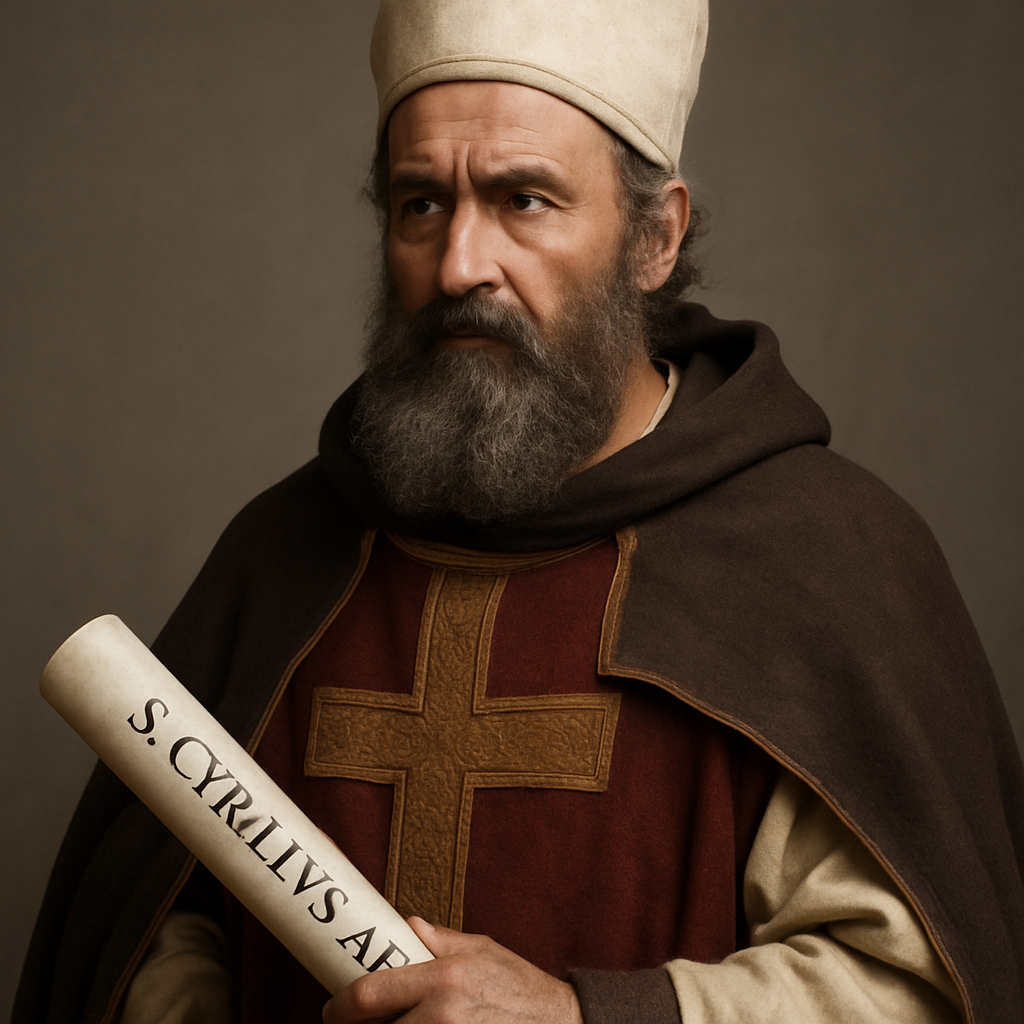
- Bishop’s Mitre and Staff: These symbols clearly identify St. Cyril as a bishop and a patriarch, signifying his ecclesiastical authority and his role as a spiritual shepherd. The mitre represents the authority and wisdom of a bishop, while the staff (crozier) symbolizes his role as a shepherd guiding his flock.
- Books or Scrolls: Often depicted holding or seated beside books or scrolls, these represent his profound theological scholarship, his extensive writings, and his role as a Doctor of the Church. They symbolize his intellectual contributions and his efforts to interpret and explain Scripture and doctrine.
- The Virgin Mary (Theotokos): St. Cyril is frequently shown gesturing toward, or in the presence of, an icon or image of the Virgin Mary, sometimes with the Christ Child. This is a direct reference to his passionate and successful defense of Mary’s title as “Theotokos” (God-bearer), a central tenet of his Christology. It signifies his victory in upholding the truth of the Incarnation.
- The Cross or a Christological Icon: Given his primary focus on the nature of Christ, he may also be depicted alongside a cross or an icon of Christ, emphasizing his role as a defender of Christ’s divinity and unity of person.
Timeline Summary
- c. 376 AD: Born in Theodosius, Egypt.
- c. late 300s – early 400s: Receives extensive classical and theological education; possibly spends time in a monastic setting.
- 403 AD: Accompanies his uncle, Theophilus, Patriarch of Alexandria, to the controversial “Synod of the Oak.”
- 412 AD: Elected Patriarch of Alexandria, succeeding his uncle, amidst a contested election.
- 412-428 AD: Consolidates power, engages in conflicts with Novatians, the Jewish community, and the Roman Prefect Orestes.
- 428 AD: Nestorius becomes Patriarch of Constantinople and begins preaching controversial Christological views.
- 429 AD onwards: St. Cyril begins his vigorous theological opposition to Nestorius, writing letters and treatises defending the title “Theotokos” and the unity of Christ’s person.
- 431 AD: Presides over the First Council of Ephesus, which condemns Nestorius and affirms Mary as “Theotokos.”
- 433 AD: Enters into the “Formula of Reunion” with John of Antioch, a document reconciling differences after the Council.
- June 27, 444 AD: Dies in Alexandria, having served as Patriarch for 32 years.
- 1882 AD: Declared a Doctor of the Church by Pope Leo XIII.
Scripture for Reflection
St. Cyril of Alexandria’s life and theological work are deeply rooted in understanding the true identity of Jesus Christ and Mary’s unique role as His Mother. These Scripture passages illuminate the core virtues and the central tenets he defended:
John 1:1, 14 (NRSVCE): “In the beginning was the Word, and the Word was with God, and the Word was God… And the Word became flesh and lived among us, and we have seen his glory, the glory as of a father’s only son, full of grace and truth.”
This passage from John’s Gospel powerfully articulates the divinity of Christ (the Word was God) and the reality of the Incarnation (the Word became flesh). St. Cyril’s entire theological output was a defense of this truth: that the divine Son of God truly became human without ceasing to be God. He fought to ensure that Christ was understood as one unified person, truly God and truly man, because only such a Christ could offer true salvation.
Luke 1:43 (NRSVCE): “And why has this happened to me, that the mother of my Lord comes to me?”
These are the words of Elizabeth to Mary, spoken when both women were pregnant. Elizabeth, filled with the Holy Spirit, calls Mary “the mother of my Lord.” St. Cyril famously championed the title “Theotokos” (God-bearer) for Mary. This passage is a strong scriptural foundation for that title, as “Lord” in this context refers to God. Cyril argued that if Jesus is truly God, and Mary is His Mother, then she must be the Mother of God, not just the mother of a human being who was later united with God.
Philippians 2:6-7 (NRSVCE): “who, though he was in the form of God, did not regard equality with God as something to be exploited, but emptied himself, taking the form of a slave, being born in human likeness.”
This hymn speaks to Christ’s divine nature (“in the form of God”) and His humbling Incarnation (“taking the form of a slave, being born in human likeness”). It captures the mystery of God becoming man, a truth central to Cyril’s Christology. He emphasized that Christ’s divine nature was not separated or diminished by His human nature, but rather that these two complete natures were united in one divine Person.
Prayers to St. Cyril of Alexandria
O Holy Bishop Cyril, faithful defender of Christ’s truth,
You stood firm against error, proclaiming with wisdom and courage
that our Savior Jesus Christ is truly God and truly man,
one divine Person, born of the Virgin Mary, Theotokos.
We honor your profound intellect and your unwavering zeal for orthodoxy.
Grant us, we pray, through your intercession, a deeper understanding of our faith,
the grace to embrace the mysteries of Christ’s Incarnation,
and the courage to defend the truths of the Gospel in our own time.
Help us to love Christ with undivided hearts,
and to venerate His Most Holy Mother, as you taught us to do.
May your example inspire us to intellectual rigor and spiritual devotion.
Through Christ our Lord. Amen.