In the vast tapestry of Christian history, some figures shine with a particular brilliance, not just for their holiness but for their profound wisdom and artistic expression. Among these luminous souls is St. Ephrem the Syrian, often hailed as the “Harp of the Holy Spirit.” A deacon, theologian, and poet from the 4th century, St. Ephrem’s life unfolded amidst tumultuous times, yet his words soared with a divine melody, shaping the spiritual landscape of the early Church. This article will delve into his early life and the historical context that forged his spirit, explore the key milestones of his calling, uncover his enduring spiritual legacy, and show how his wisdom continues to resonate with believers today, offering reflections and prayers for modern readers.
Quick Facts
| Attribute | Detail |
|---|---|
| Birth | c. 306 AD in Nisibis, Roman Mesopotamia (modern-day Turkey) |
| Death | June 9, 373 AD in Edessa, Mesopotamia (modern-day Turkey) |
| Feast Day | June 9 (Western Church); January 28 (Eastern Churches) |
| Patronage | Poets, spiritual directors, theologians, Syriac Christians |
| Canonized | Recognized as a saint throughout Christian history; declared a Doctor of the Church by Pope Benedict XV in 1920 |
Historical Context & Early Life
St. Ephrem’s life unfolded in a region constantly caught between the mighty Roman and Persian Empires, a volatile borderland known as Mesopotamia. Nisibis, his birthplace, was a crucial Roman stronghold, frequently under siege by the Sasanian Persian Empire. This geopolitical tension meant that life for the inhabitants was often marked by conflict, displacement, and the ever-present threat of war. Amidst this turmoil, Christianity was taking root and flourishing, especially in the East, though it faced both external persecution and internal theological debates.
The early 4th century was a pivotal time for the Church. The Edict of Milan (313 AD) had recently granted Christians freedom of worship, allowing the faith to spread more openly. However, this newfound freedom also brought challenges, including the rise of heresies – teachings that contradicted the core beliefs of the Church. One significant challenge was Arianism, which questioned the divinity of Jesus Christ, leading to the Council of Nicaea in 325 AD. St. Ephrem grew up in a vibrant Syriac Christian community, which had its own distinct theological traditions, language, and cultural expressions of faith, often seen as a bridge between the Greek-speaking West and the Persian East.
Ephrem was born around 306 AD, most likely into a Christian family in Nisibis. While some ancient accounts suggest his parents were pagan and he converted later, the more widely accepted tradition is that he was raised in the faith. From a young age, he showed remarkable intelligence and a deep spiritual inclination. He became a disciple of St. James, the Bishop of Nisibis, who recognized Ephrem’s gifts and mentored him deeply. Under St. James’s guidance, Ephrem received an excellent education, immersing himself in Scripture, theology, and the vibrant poetic traditions of the Syriac language. This formative period, marked by both intellectual rigor and spiritual devotion, laid the groundwork for his future as a profound theologian and prolific hymnographer.
Calling & Key Milestones
St. Ephrem’s spiritual journey was deeply intertwined with the fate of his hometown and the broader Christian community. His calling wasn’t a single dramatic event but a lifelong unfolding of dedication to God through scholarship, teaching, and artistic expression.
Early Ministry in Nisibis and Defense of the Faith
As a young man and later a deacon, Ephrem served the Church in Nisibis with unwavering devotion. He became a respected teacher, instructing catechumens (those preparing for baptism) and the faithful in Scripture and Christian doctrine. It was during this time that he began to compose the hymns and poems that would earn him the title “Harp of the Holy Spirit.” These works were not merely beautiful verses; they were powerful tools for teaching theology, refuting heresies, and uplifting the spirits of a community under constant threat. Nisibis endured three major sieges by the Persians during Ephrem’s lifetime (in 338, 346, and 350 AD), and his presence, prayers, and hymns were a source of immense encouragement to the defenders and the besieged citizens.
The Fall of Nisibis and Exile to Edessa
The defining turning point in Ephrem’s life came in 363 AD. After a Roman military defeat, Emperor Jovian was forced to sign a humiliating peace treaty with Persia, ceding Nisibis and several other territories to the Sasanian Empire. For the Christian inhabitants, this meant living under non-Christian rule, often accompanied by persecution. Faced with this grim reality, Ephrem, along with many other Christians, chose to leave his beloved hometown and migrate to the Roman city of Edessa (modern-day Sanliurfa, Turkey). This experience of exile and displacement was profoundly painful, yet it deepened his reliance on God and informed much of his later spiritual writing, imbuing it with themes of resilience, longing for the heavenly homeland, and finding solace in divine mercy.
Flourishing Ministry in Edessa
Edessa, a major center of Syriac learning and culture, became the stage for the most prolific period of Ephrem’s life. He established a school, which would later be known as the famous School of Edessa, attracting numerous students eager to learn from his wisdom. As a deacon, he dedicated himself to an ascetic life of voluntary poverty, prayer, and study, never seeking the priesthood, though his wisdom was clearly priestly in nature. It was here that he poured out his heart and mind in a vast literary output: commentaries on nearly every book of the Bible, theological treatises, and thousands of hymns (called madrashe) and prose poems (memre). He actively engaged in theological debates, using his eloquent poetry to defend orthodox Christian doctrine against various Gnostic and Manichaean heresies that were prevalent in the region, such as those of Mani, Marcion, and Bardaisan. His method was often to present truth beautifully and winsomely, rather than with harsh condemnation.
Encounter with St. Basil the Great (Reputed)
While the historical accuracy is debated, a famous tradition holds that Ephrem, late in his life, traveled to Caesarea in Cappadocia to visit St. Basil the Great, another towering figure of the early Church. This encounter, whether literal or symbolic, represents a powerful bridge between the Syriac and Greek-speaking Christian worlds. It highlights Ephrem’s widespread reputation and the universal appeal of his spiritual depth. The story often depicts Basil being so impressed by Ephrem’s humility and wisdom that he urged him to be ordained a priest, which Ephrem is said to have humbly declined.
Spiritual Legacy & Theological Themes
St. Ephrem’s spiritual legacy is immense, cementing his place as one of the most significant figures in Syriac Christianity and a Doctor of the Universal Church. His writings are characterized by a profound poetic sensibility, a deep love for Scripture, and a unique way of expressing complex theological truths through vivid imagery and metaphor.
The core virtues Ephrem exemplified include profound humility, earnest penance, unwavering prayerfulness, and a commitment to asceticism (a life of self-discipline and detachment for spiritual growth). He lived a life of voluntary poverty, seeing it as a path to greater freedom and closeness to God. His works consistently radiate hope and a joyful trust in God’s mercy, even amidst suffering and worldly challenges.
His theology, deeply rooted in Scripture, emphasized several key themes that align perfectly with Catholic teaching:
- The Incarnation: Ephrem had a particularly profound understanding and reverence for the Incarnation – the belief that God became man in Jesus Christ. He marveled at the paradox of the infinite God becoming a tiny infant, seeing it as the ultimate act of humility and love. He often used tender, maternal imagery to describe Mary’s role in the Incarnation.
- The Virgin Mary: He was one of the earliest and most eloquent proponents of Marian devotion. His hymns frequently praise Mary as the immaculate vessel chosen by God, highlighting her purity and her unique role in salvation history. He saw her as the “Second Eve,” through whom life and grace entered the world.
- The Holy Spirit: The source of his poetic inspiration, the Holy Spirit, is a constant theme in his works. He believed the Spirit illumined the Scriptures and empowered believers to live holy lives. His title, “Harp of the Holy Spirit,” reflects his conviction that his words were divinely inspired.
- The Sacraments: Ephrem held a deep reverence for the Sacraments, particularly Baptism and the Eucharist. He saw them not just as symbols but as tangible encounters with God’s grace, where Christ’s presence is truly experienced. His Eucharistic hymns are especially powerful, emphasizing the Real Presence of Christ in the consecrated bread and wine.
- The Paradox of God: Ephrem frequently explored the paradoxical nature of God – His immense power yet profound humility, His transcendence yet immanence (His being beyond and within creation). This approach helped readers grasp the mystery of faith in a way that resonated deeply.
His lasting influence on liturgy, devotion, and doctrine is significant. Many of his hymns are still sung in Syriac Christian liturgies today, preserving his poetic and theological insights for new generations. He essentially shaped the liturgical poetry and musical traditions of the Syriac Churches. His allegorical and typological interpretations of Scripture (seeing Old Testament events and figures as “types” foreshadowing Christ and the New Testament) influenced later biblical commentators. As a Doctor of the Church, his writings provide an invaluable window into the theological thought and spiritual fervor of the early Christian East, continuing to inspire theologians and spiritual writers globally.
Devotion Today
Though St. Ephrem the Syrian may not be as widely known in the Western Church as some Latin Fathers, his devotion remains incredibly strong, particularly within the Eastern Christian traditions, including the Syriac Orthodox, Syriac Catholic, Maronite, and Chaldean Churches. In these communities, he is revered as a national saint and a foundational pillar of their theological and literary heritage.
Throughout the Middle East, churches and monasteries bear his name, serving as centers of worship and learning. While there isn’t a single “pilgrimage site” in the Western sense that draws millions, faithful from Syriac traditions often visit sites associated with his life, such as Edessa (modern-day Sanliurfa, Turkey) or Nisibis, as a way to connect with his spiritual roots. His feast day, June 9th in the Roman Catholic Church and January 28th in many Eastern Churches, is celebrated with special liturgies, hymns, and spiritual readings of his works.
In modern times, his writings are increasingly being translated into English and other languages, making his profound spiritual insights accessible to a broader audience. Scholars and spiritual seekers are discovering his unique blend of poetic beauty and theological depth, finding him to be a relevant guide for contemporary spiritual life. He is particularly cherished by those who appreciate the rich liturgical and theological traditions of the Christian East, and his hymns continue to be a source of profound inspiration and prayer for Christians across the globe.
Reflections for Modern Readers
St. Ephrem the Syrian, despite living over 1,600 years ago, offers timeless wisdom that can deeply enrich our lives in the 21st century. His life and writings provide powerful lessons for navigating faith in a complex world.
-
Embrace the Power of Art in Faith: St. Ephrem used poetry, hymns, and beautiful language to teach, inspire, and defend the faith. He reminds us that faith isn’t just about abstract ideas; it’s about beauty, emotion, and creative expression. How can you use your own creative gifts – whether writing, music, painting, or even simply appreciating beauty – to deepen your faith or share it with others? For example, instead of just reading a prayer, try writing a personal prayer in the form of a poem, or find a piece of sacred music that helps you connect with God’s presence during times of stress.
-
Find God in Suffering and Exile: Ephrem endured the trauma of losing his homeland and living in exile. Yet, it was during this time that he produced some of his most profound works, finding solace and strength in God. This teaches us that even in our darkest moments – whether facing personal loss, a difficult move, or a health crisis – we can choose to turn to God. Our challenges can become opportunities for deeper faith, resilience, and spiritual growth, reminding us that our ultimate home is with God.
-
Defend Truth with Charity and Wisdom: Ephrem confronted numerous heresies of his time, not through harsh polemics, but through compelling, beautiful, and theologically rich poetry that drew people to the truth. In a world often polarized by strong opinions, his example encourages us to engage in dialogue about faith and moral issues with kindness, understanding, and wisdom. We can seek to explain our beliefs clearly and winsomely, trusting that truth presented with love is more powerful than any argument.
-
Practice Asceticism and Simplicity: St. Ephrem chose a life of voluntary poverty and detachment from worldly comforts, recognizing that true wealth lies in spiritual riches. While most of us aren’t called to monastic life, we can integrate aspects of his asceticism into our own lives. This might mean simplifying our possessions, practicing mindful consumption, donating to charity, or fasting from certain luxuries during Lent or other times. This detachment can free us from materialism and open our hearts more fully to God and others.
-
Cherish the Eucharist and Sacraments: His writings are filled with deep reverence for the Eucharist, seeing it as a true encounter with Christ’s Body and Blood. In an age where faith can sometimes feel distant, St. Ephrem calls us to draw closer to the real presence of Christ in the Sacraments. Attending Mass regularly, spending time in Eucharistic adoration, and reflecting on the profound mystery of the Eucharist can transform our spiritual lives, making God’s presence tangible and real.
Symbols and Representations of St. Ephrem
In art and jewelry, St. Ephrem is often depicted with specific symbols that reflect his life and spiritual gifts:
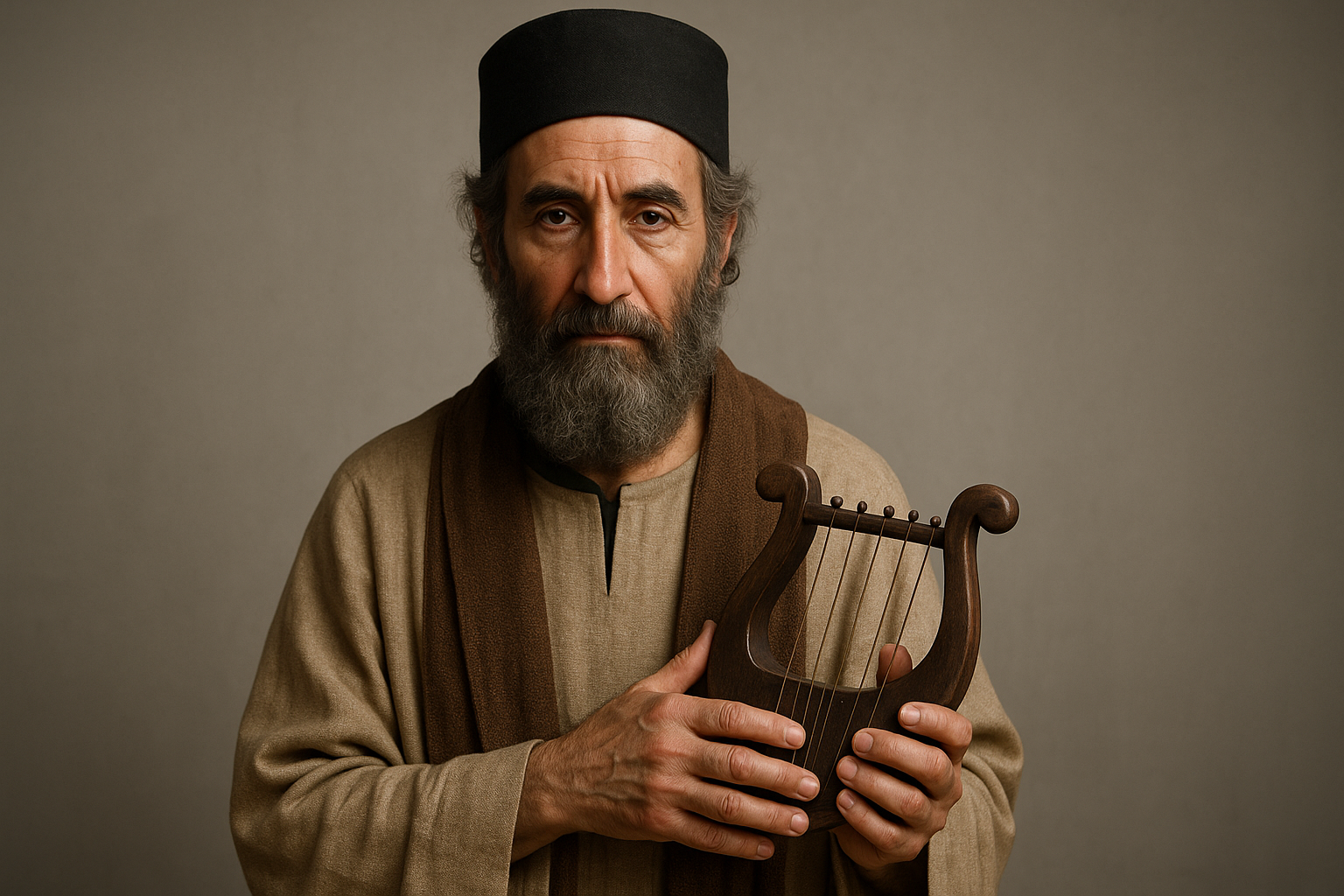
- The Harp: This is his most famous and iconic symbol. It represents his extraordinary gift for poetry and hymns, earning him the title “Harp of the Holy Spirit.” When you see a harp with St. Ephrem, it signifies his role as a musician and poet who used his art to praise God and teach the faith.
- A Scroll, Book, or Pen: These symbols highlight his prolific literary output and his status as a renowned writer, theologian, and Doctor of the Church. They represent his intellectual prowess and his enduring written legacy.
- A Dove: Sometimes, a dove is depicted near St. Ephrem, symbolizing the Holy Spirit who inspired his eloquent writings and profound theological insights. It signifies divine inspiration and wisdom.
- Deacon’s Vestments: He is almost always shown wearing the vestments of a deacon, specifically a stole worn over the left shoulder. This reminds us of his humility in remaining a deacon throughout his life, faithfully serving the Church without seeking higher ecclesiastical office.
Timeline Summary
- c. 306 AD: Born in Nisibis, Roman Mesopotamia.
- c. 320s AD: Baptized and became a disciple of St. James, Bishop of Nisibis.
- 338, 346, 350 AD: Participated in the defense of Nisibis against Persian sieges, inspiring the city with his hymns.
- 363 AD: Nisibis ceded to the Persian Empire; Ephrem and many Christians relocate to Edessa.
- 363-373 AD: Lived and taught in Edessa, establishing a school and producing the majority of his vast literary works (hymns, commentaries, treatises).
- c. 370 AD: Reputed meeting with St. Basil the Great in Caesarea.
- 373 AD: Died in Edessa during a plague, ministering to the sick and poor until his final days.
- 1920: Declared a Doctor of the Church by Pope Benedict XV, recognizing his universal theological importance.
Scripture for Reflection
St. Ephrem’s life and work beautifully echo many passages of Scripture. Here are a few that resonate with his virtues and mission:
Psalm 33:2-3 (NRSVCE): “Praise the Lord with the harp; make melody to him with the lute of ten strings! Sing to him a new song; play skillfully on the strings, with loud shouts.”
This passage perfectly captures St. Ephrem’s spirit as the “Harp of the Holy Spirit.” He used his poetic and musical gifts to compose thousands of hymns, offering joyful praise and teaching profound truths to God’s people. His entire life was a symphony dedicated to the Lord.
1 Peter 2:11-12 (NRSVCE): “Beloved, I urge you as sojourners and exiles to abstain from the passions of the flesh that wage war against your soul. Conduct yourselves honorably among the Gentiles, so that when they speak against you as evildoers, they may observe your honorable deeds and glorify God on the day of visitation.”
This verse directly speaks to Ephrem’s experience as an “exile” from Nisibis and his steadfast Christian witness in Edessa, a diverse city. He lived a life of asceticism, abstaining from worldly passions, and his honorable conduct and powerful teachings undoubtedly caused many to glorify God, even amidst those who might have opposed the faith.
James 1:2-4 (NRSVCE): “My brothers and sisters, whenever you face trials of many kinds, consider it nothing but joy, because you know that the testing of your faith produces endurance; and let endurance have its full effect, so that you may be mature and complete, lacking in nothing.”
St. Ephrem faced numerous trials: the sieges of Nisibis, the loss of his home, theological battles, and a plague. Yet, his writings reveal a profound joy and resilience rooted in faith. His endurance led to a maturity and completeness that made him a wise spiritual guide, demonstrating how challenges can refine and strengthen our faith.
Prayers to St. Ephrem the Syrian
While there isn’t one single “official” prayer to St. Ephrem as widely known as some other saints, we can invoke his intercession with a prayer that reflects his spiritual gifts and patronage. Here is a prayer that honors him as a Doctor of the Church and “Harp of the Holy Spirit”:
O God, Light of the faithful and Shepherd of souls, who raised up Saint Ephrem the Syrian to feed Your flock with his eloquent word and nourish them with his sacred hymns, grant, we pray, that through his intercession, we may be ever more deeply enriched by the truths of faith and express our devotion with sincere and beautiful praise.
Harp of the Holy Spirit, Saint Ephrem, whose heart burned with love for Christ and His Blessed Mother, intercede for us, that we may ponder the Sacred Scriptures with your wisdom and humility. Help us to endure trials with courageous faith, to teach truth with charity, and to find profound joy in the Sacraments of the Church, especially the Holy Eucharist. Inspire all poets, writers, and spiritual directors to use their gifts for the glory of God and the edification of His people. Amen.