In the vibrant, often dangerous, world of the early Church, a figure named Ignatius emerged as a beacon of faith, a fierce defender of truth, and a passionate lover of Christ. As the third Bishop of Antioch, a crucial center for early Christianity, St. Ignatius stood at a pivotal moment in history, bridging the gap between the Apostles themselves and the nascent Church. His incredible journey, captured in a series of powerful letters penned while under Roman guard, offers us a unique window into the heart and mind of a saint willing to embrace martyrdom for his Lord. This article will explore his quick facts, delve into the historical backdrop of his life, trace his calling and key milestones, uncover his enduring spiritual legacy, examine modern devotion, and offer reflections for today’s faithful, all while honoring a man whose witness continues to inspire.
Quick Facts
| Category | Detail |
|---|---|
| Birth | Circa 35-50 AD, Syria (Antioch region) |
| Death | Circa 107 AD, Rome (martyred) |
| Feast Day | October 17 (Latin Rite), December 20 (Eastern Rites) |
| Patronage | Church unity, bishops, persecuted Christians, Diocese of Antioch |
| Canonized | Pre-Congregation (Venerated as a saint from ancient times) |
Historical Context & Early Life
To truly understand St. Ignatius of Antioch, we must first step back into the first century of the Roman Empire, a time of immense challenge and growth for the fledgling Christian movement. The city of Antioch, where Ignatius served as bishop, was a bustling metropolis in what is now modern-day Turkey. It was a city of immense cultural diversity, a crossroads of Greek, Roman, and Syrian influences, and remarkably, one of the earliest and most significant centers of Christianity outside of Jerusalem. It was here, in fact, that followers of Jesus were first called “Christians” (Acts 11:26).
The Roman Empire, while providing a network of roads and relative peace that aided the spread of the Gospel, also viewed this new religion with suspicion, and often, outright hostility. Christians refused to worship the Roman gods or the emperor, a stance seen as disloyalty and a threat to public order. This led to intermittent but often brutal persecutions, where confessing Christ could mean imprisonment, torture, or death.
Ignatius’s early life is not extensively documented, but tradition holds that he was likely born in Syria around the middle of the first century. Some early accounts even suggest he was a disciple of St. John the Apostle, or even St. Peter, who was believed to have founded the Church in Antioch. This direct connection to the Apostles themselves is incredibly significant, placing Ignatius firmly within the “Apostolic Fathers,” a group of early Christian writers whose lives often overlapped with the Apostles and whose teachings reflect authentic Apostolic tradition. He would have grown up immersed in a vibrant Christian community, learning the faith directly from those who had walked with Jesus or His immediate followers. This firsthand connection undoubtedly shaped his profound understanding of Christ’s teachings and his unwavering commitment to the Church’s unity.
Calling & Key Milestones
Ignatius’s life as a Christian leader was defined by his unwavering commitment to Christ and His Church, culminating in a powerful witness of martyrdom. His journey to Rome, under heavy guard, served as a crucial period where he penned some of the most significant writings of the early Church.
Bishop of Antioch
Ignatius succeeded Evodius as the third Bishop of Antioch, a role of immense responsibility and spiritual authority in such a foundational Christian community. As bishop, he was a shepherd to his flock, guiding them through the challenges of living out their faith in a pagan world. He would have overseen worship, administered the sacraments, taught doctrine, and defended the community against both external persecution and internal theological disagreements, particularly the emerging heresies of the time.
Arrest and Journey to Martyrdom
Around 107 AD, during the reign of Emperor Trajan, a wave of persecution swept through the Roman Empire. Ignatius, as a prominent Christian leader, was arrested. According to tradition, he was brought before Emperor Trajan himself, who was passing through Antioch. Refusing to recant his faith, Ignatius was condemned to death in Rome, to be thrown to wild beasts in the Colosseum as a public spectacle. This sentence set in motion his final, fateful journey across Asia Minor and Greece, a journey that would become one of the most spiritually fruitful periods of his life.
The Epistles of Ignatius: A Testament of Faith
While being transported to Rome in chains, Ignatius was granted a remarkable opportunity by his guards – he was allowed to meet with representatives from various Christian communities and even write letters to them. These seven letters – to the Ephesians, Magnesians, Trallians, Romans, Philadelphians, Smyrnaeans, and to Polycarp (Bishop of Smyrna) – are treasures of early Christian literature. They are not merely historical documents; they are passionate theological treatises and deeply personal reflections that reveal the heart of a saint on the precipice of eternity.
Letter to the Ephesians
In this letter, Ignatius emphasizes the importance of Christian unity and love, urging the Ephesians to obey their bishop and priests as they would Christ. He speaks eloquently of the Eucharist as “the medicine of immortality,” highlighting the real presence of Christ in the sacrament and its power to grant eternal life. He also warns against false teachers who would try to sow discord.
Letter to the Magnesians
Ignatius continues his theme of unity, emphasizing the necessity of following the bishop, presbyters (priests), and deacons. He specifically warns against Judaism, not as a religion, but as a practice that some Christians were trying to impose, causing division from the newness of Christ’s covenant. He highlights Christ as the bridge between the old and new covenants.
Letter to the Trallians
Here, Ignatius again stresses submission to the episcopal authority, arguing that such order is essential for true Christian fellowship and protection against heresy. He powerfully connects the bishop’s role to God’s own authority, seeing the Church’s structure as divinely ordained.
Letter to the Romans
This is arguably the most famous and personal of his letters. In it, Ignatius expresses his fervent desire for martyrdom, pleading with the Roman Christians not to intervene or try to save him. He sees his impending death as a perfect imitation of Christ’s sacrifice, a true union with his Lord. He famously declares, “Let me be food for the wild beasts, for through them I can reach God.” This letter reveals a man consumed by divine love, eager to give his life as the ultimate act of worship.
Letter to the Philadelphians
Ignatius discusses a past division within the Philadelphian community and offers a powerful plea for unity, particularly around the Eucharist. He encourages them to rally around their bishop, emphasizing that the Eucharist should only be celebrated in union with the bishop to preserve the Church’s true teaching.
Letter to the Smyrnaeans
In this letter, Ignatius strongly refutes Docetism, a heresy that claimed Jesus only “seemed” to have a human body and did not truly suffer or die. Ignatius vehemently affirms the real humanity of Christ, His birth, suffering, death, and resurrection, as central to Christian faith. He also uses the term “Catholic Church” for the first recorded time, signifying the universal nature and unity of the Church.
Letter to Polycarp
This letter is a personal admonition to his fellow bishop, St. Polycarp of Smyrna, a younger man who would himself become a martyr. Ignatius offers advice on leadership, urging Polycarp to be steadfast, to care for his flock, and to be patient and loving. It’s a beautiful example of mentorship within the early Church.
Martyrdom in Rome
Upon his arrival in Rome, Ignatius was led to the Colosseum. There, as he had so eagerly desired, he was thrown to wild beasts, fulfilling his longing to be “ground by the teeth of the wild beasts to become pure bread for Christ.” His martyrdom was a powerful witness to the enduring strength of Christian faith in the face of brutal persecution, solidifying his place as one of the Church’s most revered martyrs.
Spiritual Legacy & Theological Themes
St. Ignatius of Antioch’s influence on the Church is profound, particularly given the early date of his writings. His letters provide invaluable insights into the beliefs, practices, and organizational structure of the nascent Christian community just decades after the Apostles.
Martyrdom as the Ultimate Witness
Ignatius’s most striking virtue is his intense desire for martyrdom. He saw it not as an end, but as a direct path to union with Christ, a perfect imitation of Christ’s own sacrifice. He understood that through his suffering, he would truly become a disciple. This perspective transformed suffering from a terrifying ordeal into a joyful anticipation of communion with God, setting a powerful example for countless future martyrs.
The Eucharist as the “Medicine of Immortality”
Ignatius articulated a robust understanding of the Eucharist, emphasizing the Real Presence of Christ. He explicitly calls it “the flesh of our Savior Jesus Christ, the flesh which suffered for our sins and which the Father, in His goodness, raised up again.” For Ignatius, the Eucharist was not merely a symbol but the actual body and blood of Christ, essential for spiritual life and a guarantee of resurrection. This teaching profoundly shaped the Catholic understanding of the sacrament.
Episcopal Structure and Church Unity
A central theme in Ignatius’s letters is the absolute necessity of unity, especially around the bishop. He saw the bishop, along with the presbyters (priests) and deacons, as a visible sign of unity and a safeguard against false teachings. He urged Christians to do nothing without the bishop, likening the bishop to Christ and the presbyters to the Apostles. This strong emphasis on episcopal authority laid crucial groundwork for the hierarchical structure of the Catholic Church.
First Use of “Catholic Church”
In his Letter to the Smyrnaeans, Ignatius famously writes, “Wherever the bishop appears, there let the people be; as wherever Jesus Christ is, there is the Catholic Church.” This is the first recorded instance of the term “Catholic Church” (meaning “universal” or “according to the whole”) in Christian literature. It underscored his belief in the Church’s universal nature and its unified identity under Christ, emphasizing that despite local variations, all particular churches form one Body of Christ.
Defense Against Heresy
Ignatius was a fervent defender of orthodox Christian doctrine. He vigorously combatted early heresies, particularly Docetism, which denied the true humanity of Christ. His insistence on Christ’s real flesh, suffering, and resurrection was crucial in preserving the truth of the Incarnation against those who would spiritualize away the physical reality of Jesus’ life.
Devotion Today
While St. Ignatius of Antioch might not be as widely known as some later saints, his impact on Christian theology and Church structure is immense, particularly among scholars and those devoted to the early Church Fathers. His feast day is celebrated on October 17th in the Latin Rite and December 20th in Eastern Rites, especially in the Eastern Orthodox and Eastern Catholic Churches, where he is highly venerated as a holy martyr and confessor of the faith.
There are no major international pilgrimage sites specifically dedicated to St. Ignatius in the way there might be for a Marian apparition, but his relics are honored in various places. The most prominent traditions state that his relics, or at least a portion of them, were eventually brought back to Antioch after his martyrdom, and later transferred to Rome. Churches dedicated to him exist around the world, particularly in areas with a strong historical connection to the early Church or Eastern Christianity. His letters continue to be studied in seminaries and universities worldwide, serving as a foundational text for understanding Christian origins, ecclesiology (the study of the Church), and Eucharistic theology.
Devotion to St. Ignatius today often focuses on his role as a patron of Church unity and persecuted Christians. He is frequently invoked in prayers for Christian unity, for bishops and priests in their ministry, and for those who face persecution for their faith around the globe. His powerful witness to martyrdom encourages modern believers to stand firm in their convictions, even in the face of adversity.
Reflections for Modern Readers
St. Ignatius of Antioch, though living nearly two millennia ago, offers timeless lessons for believers navigating the complexities of the 21st century. His life and writings are a beacon for genuine faith.
- Embrace Courage in Faith: Ignatius faced the ultimate test of faith – martyrdom. His joyful acceptance of death for Christ challenges us to examine the depths of our own commitment. In our modern world, we may not face literal lions, but we often face social pressure, ridicule, or career setbacks for living out our Catholic values. Ignatius teaches us to stand firm, to speak truth with charity, and to prioritize our relationship with Christ above all else, knowing that true freedom comes from surrendering to God’s will.
- Cherish Church Unity: In a world often polarized and divided, Ignatius’s insistent call for unity around the bishop, presbyters, and deacons is profoundly relevant. He reminds us that the Church, despite its human imperfections, is a divine institution, and unity within it is essential for our spiritual well-being and for the effective proclamation of the Gospel. This means actively participating in our parish communities, supporting our spiritual leaders, and striving to overcome divisions through charity and understanding.
- Deepen Your Eucharistic Life: Ignatius’s vivid language about the Eucharist as “the medicine of immortality” is a powerful reminder of its central importance. In an age where attendance at Mass might sometimes be seen as optional, Ignatius calls us back to the profound mystery and life-giving power of this sacrament. Reflecting on his words can help us approach each Mass with renewed reverence, receiving Christ’s Body and Blood as true spiritual nourishment for our journey.
- Live Your Faith Authentically: Ignatius’s letters are intensely personal, revealing a man utterly devoted to Christ. He lived his faith authentically, not just in word, but in his very being. For us, this means living a consistent Christian life – letting our faith influence our choices at work, in our families, and in our social interactions. It means being known as a person of integrity and love, reflecting the light of Christ in all circumstances.
In art and jewelry, St. Ignatius of Antioch is commonly depicted with several powerful symbols that speak to his life and legacy:
- Lions or Wild Beasts: This is perhaps his most common and recognizable symbol, directly referencing his martyrdom in the Roman arena. It signifies his courage, his desire to be “food for the wild beasts,” and his ultimate sacrifice for Christ.
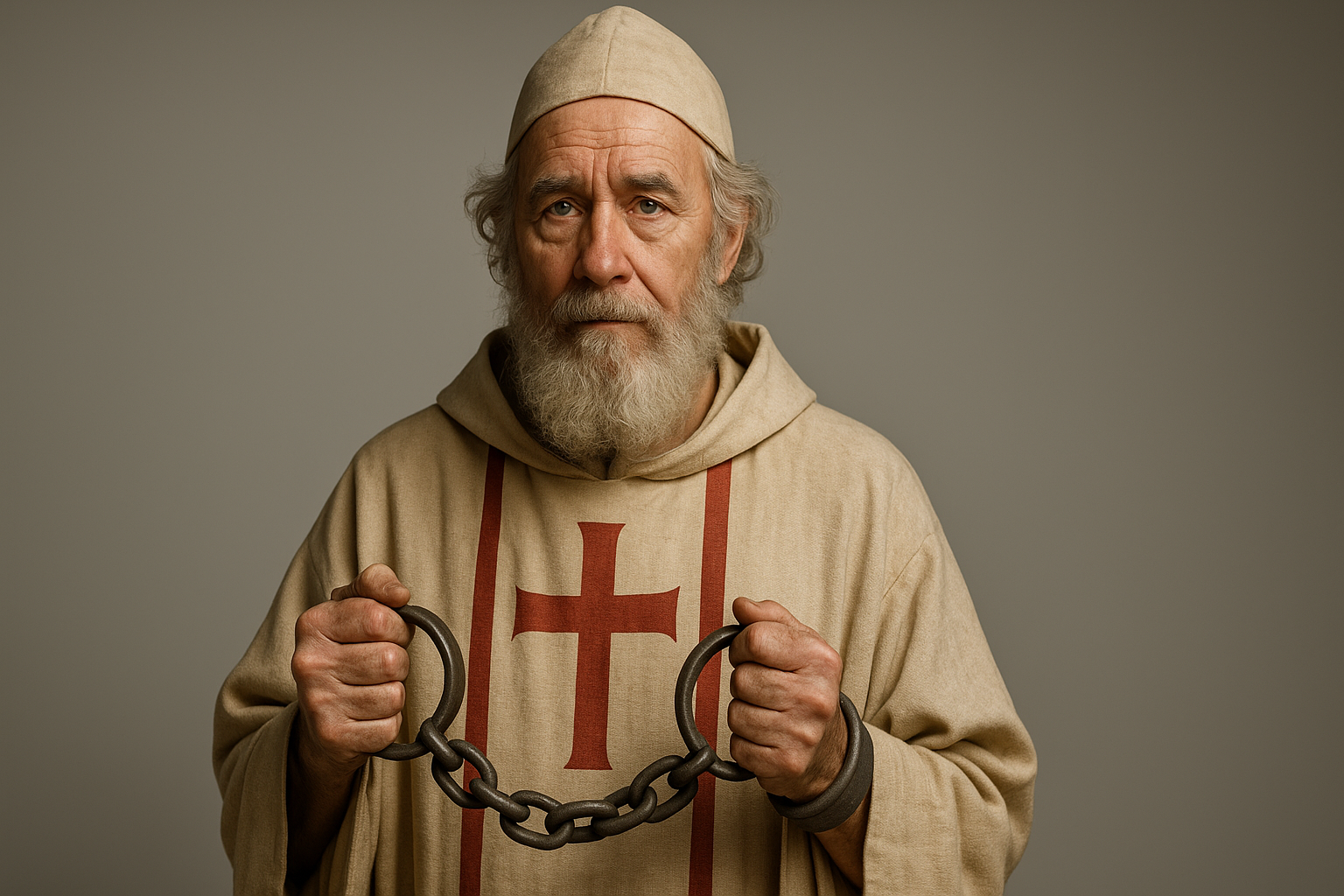
- Chains or Shackles: Often shown wearing or holding chains, these symbolize his imprisonment and the journey to Rome where he penned his famous letters. They represent his suffering and his steadfastness in captivity.
- Book, Scroll, or Pen: These symbols highlight his role as one of the Apostolic Fathers and the author of the pivotal Epistles. They represent his theological contributions, his teachings on unity and the Eucharist, and his lasting literary legacy.
- Bishop’s Mitre or Crozier: As a bishop, he is sometimes depicted with the traditional symbols of his office, signifying his authority and pastoral care over the Church in Antioch.
- Heart Aflame: Less common but sometimes seen, a burning heart can symbolize his fervent love for Christ and his burning desire for martyrdom, reflecting the passion evident in his writings.
Timeline Summary
- Circa 35-50 AD: Born in Syria (likely Antioch region).
- Late 1st Century: Becomes the third Bishop of Antioch, succeeding Evodius.
- Circa 107 AD: Arrested during Emperor Trajan’s persecution of Christians.
- Circa 107 AD: Condemned to be thrown to wild beasts in Rome.
- Circa 107 AD: Begins his journey to Rome, escorted by ten Roman soldiers.
- Circa 107 AD: Writes his seven Epistles (to the Ephesians, Magnesians, Trallians, Romans, Philadelphians, Smyrnaeans, and to Polycarp) during his journey.
- Circa 107 AD: Arrives in Rome and is martyred in the Colosseum, likely devoured by lions.
- October 17: Feast Day in the Latin Rite, commemorating his martyrdom.
Scripture for Reflection
St. Ignatius’s life and teachings resonate deeply with several key scriptural themes:
Philippians 1:21-23: “For to me, to live is Christ, and to die is gain. If I am to live in the flesh, that means fruitful labor for me. Yet which I shall choose I cannot tell. I am hard pressed between the two. My desire is to depart and be with Christ, for that is far better.”
Ignatius’s fervent desire for martyrdom, as expressed in his Letter to the Romans, perfectly mirrors St. Paul’s yearning. Both saints saw death, not as an end, but as a direct and more profound union with Christ, a “gain” that surpassed all earthly life. This passage beautifully captures Ignatius’s spiritual state as he faced his imminent death.
John 17:20-21: “I do not ask for these only, but also for those who will believe in me through their word, that they may all be one, just as you, Father, are in me, and I in you, that they also may be in us, so that the world may believe that you have sent me.”
Christ’s prayer for unity is a foundational theme in Ignatius’s Epistles. His constant exhortation for Christians to be united under their bishop, in the Eucharist, and in love, directly reflects Jesus’s desire for His followers to be one. Ignatius understood that the Church’s unity was not merely an organizational convenience, but a profound theological reality that bore witness to the truth of Christ to the world.
John 6:54-56: “Whoever feeds on my flesh and drinks my blood has eternal life, and I will raise him up on the last day. For my flesh is true food, and my blood is true drink. Whoever feeds on my flesh and drinks my blood abides in me, and I in him.”
Ignatius’s passionate teaching on the Eucharist as “the medicine of immortality” and the true flesh and blood of Christ is a direct echo of Jesus’s own words. This passage underpins Ignatius’s understanding of the Real Presence and the life-giving power of the sacrament, showing how deeply rooted his Eucharistic theology was in apostolic teaching.
Prayers to St. Ignatius of Antioch
Here is a traditional prayer to St. Ignatius of Antioch, often recited for his intercession:
O glorious St. Ignatius, Bishop of Antioch, who by your zeal and courage did strengthen the early Church, and by your fervent desire for martyrdom did offer your life as a perfect sacrifice to Christ. You who taught us the profound truth of the Eucharist as the “medicine of immortality” and championed the unity of the Church under its bishops, we humbly implore your intercession.
Pray for us, that like you, we may be strong in faith, unwavering in our commitment to Christ, and devoted to the unity of His Holy Church. Inspire us to love the Eucharist with ever-increasing fervor and to embrace suffering for the sake of Christ, knowing that through it we draw closer to Him.
Protect all bishops and priests, and strengthen all persecuted Christians throughout the world, that they may persevere in faith and hope, just as you did. May your example lead us to desire nothing more than to be found truly in Christ, our Lord and our God.
Amen.