In the vast tapestry of Catholic saints, few figures loom as large and intellectually luminous as St. John Henry Newman. An extraordinary mind of the 19th century, Newman embarked on a profound spiritual journey that captivated and challenged the religious landscape of his time. From his influential beginnings as an Anglican priest and leader of the Oxford Movement to his eventual conversion to Catholicism and elevation as a Cardinal, his life was a relentless pursuit of truth. This article will explore his early life and historical context, trace the key milestones of his remarkable vocation, delve into his enduring spiritual legacy and theological contributions, discuss how he is honored today, and offer reflections pertinent to modern readers, concluding with a timeline and prayers for his intercession.
Quick Facts
| Category | Detail |
|---|---|
| Birth | February 21, 1801, London, England |
| Death | August 11, 1890, Birmingham, England |
| Feast Day | October 9 |
| Patronage | Convert, Theologians, Catholic university students, Newman Centers, Educators |
| Canonized | October 13, 2019, by Pope Francis |
Historical Context & Early Life
John Henry Newman was born into a world undergoing tremendous change, both in England and across Europe. The early 19th century in Britain was a period of industrial revolution, social upheaval, and intellectual ferment. The Church of England, the established state church, was grappling with various internal factions – the evangelicals, the broad church liberals, and the high church conservatives. Against this backdrop, there was also a growing awareness of Catholicism, which had long been suppressed in England. The Catholic Emancipation Act of 1829, which granted full civil rights to Catholics, marked a significant shift, though anti-Catholic sentiment remained strong.
Newman’s family background was one of intellectual curiosity and moderate Anglicanism. His father, John Newman, was a banker, and his mother, Jemima Fourdrinier, came from a Huguenot family known for its intellectual rigor. John Henry was the eldest of six children. From an early age, he showed exceptional intellectual gifts and a deep sensitivity to religious matters. His childhood was marked by a strong education and a voracious appetite for reading. He excelled in classical studies and developed a keen analytical mind.
At the tender age of fifteen, a pivotal moment occurred during what he described as his “first conversion.” He experienced a profound conviction of the truth of God and the reality of a spiritual world, feeling a call to a life of holiness. This experience shaped his entire future, setting him on a path of dedicated religious inquiry and commitment. He matriculated at Trinity College, Oxford, in 1817, and later became a Fellow of Oriel College, one of the most prestigious colleges at Oxford. It was here, within the hallowed halls of academia, that his intellectual and spiritual journey began to unfold in earnest, leading him to become one of the most respected and influential thinkers of his generation.
Calling & Key Milestones
John Henry Newman’s life was a testament to a relentless, often agonizing, search for truth, which ultimately led him from the Anglican Church to the Catholic Church. His journey was marked by several critical periods and intellectual breakthroughs.
Anglican Ordination and Early Ministry
After graduating from Oxford, Newman was ordained an Anglican priest in 1824. He quickly established himself as a brilliant preacher and scholar. His early ministry was characterized by a deep devotion to the Church of England, which he believed to be a branch of the one true Church. He served as the vicar of St. Mary’s, the university church at Oxford, where his sermons drew large crowds of students and faculty. His powerful, subtle, and deeply personal preaching style had a profound impact on his listeners, calling them to a deeper faith and understanding of Christian principles.
The Oxford Movement and the Tracts for the Times
The 1830s saw Newman emerge as a leading figure in the Oxford Movement, also known as Tractarianism. This movement was a group of High Church Anglicans who sought to revive forgotten elements of Catholic teaching and practice within the Church of England. They emphasized the apostolic succession of Anglican bishops, the importance of the sacraments, and the liturgical traditions of the early Church. Newman, along with colleagues like John Keble and Edward Bouverie Pusey, published a series of influential pamphlets called “Tracts for the Times.” These tracts argued for the Catholic nature of the Church of England and challenged what they saw as the growing liberalism and state interference in religious matters.
Newman’s own contribution, especially Tract 90, published in 1841, created a huge controversy. In it, he argued that the Thirty-Nine Articles, the foundational doctrinal statements of the Church of England, could be interpreted in a way consistent with Catholic teaching. This was met with widespread outrage and suspicion from many Anglican bishops and leaders, who saw it as a betrayal and a move towards Rome. The controversy surrounding Tract 90 effectively brought the Oxford Movement to an end as a unified force.
The Journey to Rome: Conversion
The aftermath of Tract 90 plunged Newman into a period of intense spiritual struggle and intellectual re-evaluation. He had always believed the Anglican Church possessed a true Catholic identity, but the backlash convinced him that the institution itself rejected this identity. He withdrew from his Anglican ministry, moved to Littlemore, a village near Oxford, and spent years in deep study, prayer, and reflection. It was during this time that he wrote his monumental work, “An Essay on the Development of Christian Doctrine,” which explored how Christian truth unfolds over time while remaining consistent with its original revelation. This work helped him resolve many of his intellectual difficulties regarding the differences between Anglicanism and Catholicism.
Finally, on October 9, 1845, after years of agonizing deliberation, John Henry Newman was received into the Catholic Church by Blessed Dominic Barberi, an Italian Passionist priest. His conversion sent shockwaves through England, impacting countless individuals and shaking the foundations of the Anglican establishment. Many followed his example, while others condemned him as a traitor. For Newman, it was the culmination of a lifelong search for the fullness of truth.
The Oratory and Catholic Ministry
Shortly after his conversion, Newman traveled to Rome, where he was ordained a Catholic priest in 1846. He joined the Congregation of the Oratory, a religious order founded by St. Philip Neri, known for its intellectual rigor, spiritual warmth, and commitment to urban ministry. Upon returning to England, he established the first English Oratory in Maryvale, and later in Birmingham. The Oratory became a vibrant center of Catholic life, learning, and prayer. Newman’s sermons and writings continued to draw attention, and he became a leading voice for the burgeoning Catholic community in England.
Among his significant contributions as a Catholic priest was his role as the first Rector of the Catholic University of Ireland (now University College Dublin). Here, he delivered a series of lectures, later published as “The Idea of a University,” which remains a foundational text on Catholic education and the nature of liberal arts. He argued for the importance of knowledge for its own sake, the integration of faith and reason, and the development of the whole person.
Cardinalate and Final Years
Despite facing various misunderstandings and even criticisms within the Catholic hierarchy at times, Newman remained steadfast in his faith and commitment to the Church. His intellectual honesty, spiritual depth, and humility eventually gained wider recognition. In 1879, Pope Leo XIII, recognizing Newman’s immense contributions to theology and his defense of the Church, elevated him to the College of Cardinals, though Newman opted not to be consecrated a bishop, preferring to remain a simple priest of the Oratory. His cardinalatial motto, “Cor ad cor loquitur” (Heart speaks to heart), perfectly encapsulated his approach to faith and evangelization.
He spent his final years at the Birmingham Oratory, continuing to write and offer spiritual guidance until his death in 1890 at the age of 89. His funeral was a massive public event, attended by people of all faiths, a testament to the profound respect and affection he had earned.
Spiritual Legacy & Theological Themes
St. John Henry Newman’s spiritual legacy is vast and deeply resonant, making him one of the most influential Catholic thinkers of the past two centuries. He exemplified virtues such as intellectual honesty, the relentless pursuit of truth, integrity, humility, and unwavering faith, all of which align profoundly with Scripture and Catholic teaching.
The Primacy of Conscience
One of Newman’s most profound and enduring contributions is his articulation of the primacy of conscience. He taught that conscience is “the aboriginal Vicar of Christ,” a voice within us that speaks to us of God’s law. This is not simply a subjective feeling, but a rational judgment of what is right and wrong, guided by God’s truth. This emphasis on listening to one’s conscience, even when it means standing against popular opinion, echoes biblical calls to integrity and moral uprightness (Romans 2:14-15).
The Development of Doctrine
Newman’s “Essay on the Development of Christian Doctrine” is arguably his most significant theological work. It provides a framework for understanding how the Church’s understanding of revealed truth grows and deepens over time, without changing the essence of the original deposit of faith. He used organic analogies, comparing doctrine to a seed that grows into a tree, maintaining its identity while maturing. This concept proved vital in defending the historical continuity of the Catholic Church and explaining apparent historical discrepancies. It also laid groundwork for understanding how the Church engages with new questions and challenges while remaining faithful to tradition.
Faith and Reason
A central theme in Newman’s thought was the harmonious relationship between faith and reason. He rejected the idea that faith was irrational or opposed to intellectual inquiry. Instead, he argued that faith perfects reason, leading it to higher truths. His work “An Essay in Aid of a Grammar of Assent” explored how individuals come to believe with certainty, distinguishing between logical inference and the deeper, personal act of assent. He championed the idea of a university where all branches of knowledge, including theology, are pursued together, contributing to a comprehensive understanding of truth.
The Role of the Laity
Ahead of his time, Newman also emphasized the crucial role of the laity in the Church. He famously stated, “The Church would look foolish without them.” He believed that laypeople, through their baptismal call, were active participants in the mission of the Church, not merely passive recipients of clergy instruction. This insight profoundly influenced the Second Vatican Council’s teachings on the universal call to holiness and the importance of the laity.
Lasting Influence
Newman’s influence extends across many fields. His writings continue to shape theological discussion, particularly in areas of fundamental theology, ecclesiology, and moral theology. His literary style and profound spirituality have made his autobiographical “Apologia Pro Vita Sua” a classic of spiritual literature. His hymns, such as “Lead, Kindly Light,” remain beloved prayers. Newman’s vision for education is enshrined in the very concept of Catholic universities and the “Newman Centers” found on secular university campuses worldwide, which provide spiritual and intellectual homes for Catholic students.
Devotion Today
St. John Henry Newman continues to be a vibrant source of inspiration and devotion for Catholics and many others around the world. His intellectual legacy and personal journey resonate deeply in the modern age, where questions of faith, reason, conscience, and truth remain paramount.
The primary center of devotion to St. John Henry Newman is the Birmingham Oratory in England, where he lived for over 40 years and is buried. Pilgrims from all over the world visit his shrine there, seeking his intercession and drawing inspiration from his life. The Oratory houses many of his personal effects, manuscripts, and a museum dedicated to his life and work. His tomb is a place of quiet reflection and prayer, a reminder of his journey from Oxford don to Catholic cardinal.
Annually, his feast day on October 9th is celebrated with special Masses and events, particularly in academic institutions and Oratorian communities. These celebrations often highlight his intellectual contributions and his example of following conscience.
One of the most widespread forms of devotion to Newman is through Newman Centers. These centers, found on college and university campuses, bear his name and embody his vision for integrating faith and reason within higher education. They provide spiritual formation, community, and intellectual resources for Catholic students and faculty, striving to foster a holistic understanding of truth, just as Newman advocated in “The Idea of a University.”
His writings continue to be widely read and studied, fostering a deeper understanding of Catholic theology and spirituality. Many study groups and academic societies are dedicated to exploring his works. His hymns, especially “Lead, Kindly Light,” are sung in churches worldwide, testifying to his enduring spiritual artistry.
Reflections for Modern Readers
St. John Henry Newman’s life offers profound lessons that are remarkably relevant for navigating the complexities of the 21st century. His journey was not easy, but his commitment to truth provides a powerful example for us all.
- Embrace the Lifelong Pursuit of Truth: Newman’s entire life was a relentless search for truth, a journey that led him through intellectual struggle and personal sacrifice. For us, this means being open to questioning, learning, and growing in our understanding, rather than settling for comfortable answers. In a world saturated with information and misinformation, Newman encourages us to critically examine our beliefs and be willing to change our minds when presented with compelling evidence or spiritual insight. For example, when faced with conflicting viewpoints on social media, we can apply Newman’s rigorous intellectual honesty to discern truth rather than merely accepting what aligns with our current bias.
- Listen to Your Conscience: Newman famously called conscience “the aboriginal Vicar of Christ.” He teaches us that our inner moral compass, when properly formed, is a divine guide. In an age of relativism and conflicting moral messages, cultivating a well-formed conscience and having the courage to follow it is paramount. This could mean speaking up against injustice at work, making an unpopular but ethically sound decision, or choosing integrity in personal relationships, even when it’s difficult.
- Integrate Faith and Reason: Newman showed that faith and reason are not opposed but are two wings upon which the human spirit ascends to contemplate truth. He encourages us to engage our intellect fully in our faith, to ask hard questions, and to seek understanding. For students and professionals today, this means not compartmentalizing faith from academic or professional life, but allowing faith to inform and enrich intellectual inquiry, and allowing reason to deepen our understanding of faith. For instance, a scientist of faith can see the wonders of creation through both a scientific and a theological lens.
- Cultivate Personal Relationship with God: Despite his immense intellectual prowess, Newman’s spirituality was deeply personal and centered on prayer. His call, “Heart speaks to heart,” reminds us that faith is ultimately a relationship with God. In a busy, distracting world, we can emulate Newman by carving out time for silent prayer, spiritual reading, and personal reflection, fostering that intimate connection with the Divine that grounds all other pursuits.
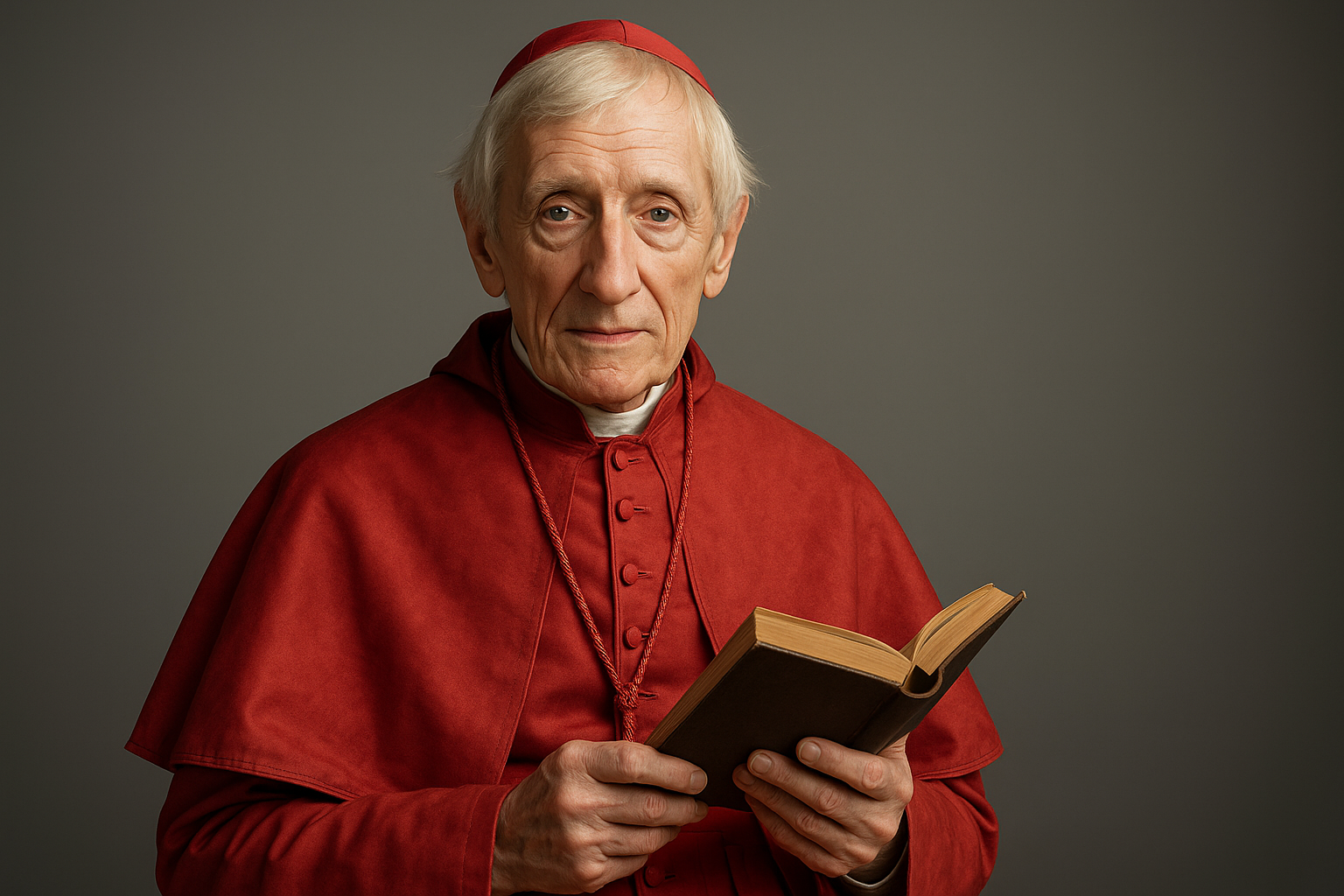
In art and jewelry, St. John Henry Newman is often represented with symbols that reflect his life and intellectual contributions. He is frequently depicted wearing a Cardinal’s hat (galero), signifying his late-life elevation within the Church and his immense contributions to Catholic thought. He is also often shown with a pen or a book, symbolizing his prolific writing and his dedication to scholarship and education. Sometimes, a lamp or a candle is depicted with him, an allusion to his most famous hymn, “Lead, Kindly Light,” which became a prayer for divine guidance during his profound spiritual discernment.
Timeline Summary
- 1801: Born in London, England.
- 1816: Experiences his “first conversion” at age 15, fostering a lifelong commitment to religious life.
- 1817: Enters Trinity College, Oxford.
- 1822: Becomes a Fellow of Oriel College, Oxford.
- 1824: Ordained an Anglican priest.
- 1828: Becomes Vicar of St. Mary’s, the University Church at Oxford.
- 1833: Publishes “Tracts for the Times,” marking the beginning of the Oxford Movement.
- 1841: Publishes Tract 90, generating widespread controversy and signaling the decline of the Oxford Movement.
- 1843: Resigns as Vicar of St. Mary’s and retreats to Littlemore for intense study and prayer.
- 1845: Writes “An Essay on the Development of Christian Doctrine” and is received into the Catholic Church on October 9.
- 1846: Travels to Rome, is ordained a Catholic priest, and joins the Oratorians.
- 1847: Founds the first English Oratory in Birmingham.
- 1852: Delivers his “Discourses on the Scope and Nature of University Education,” later published as “The Idea of a University,” while serving as Rector of the Catholic University of Ireland.
- 1864: Publishes “Apologia Pro Vita Sua,” a powerful spiritual autobiography defending his conversion.
- 1870: Publishes “An Essay in Aid of a Grammar of Assent,” exploring the nature of religious belief.
- 1879: Elevated to the College of Cardinals by Pope Leo XIII.
- 1890: Dies at the Birmingham Oratory on August 11.
- 2010: Beatified by Pope Benedict XVI in Birmingham, England.
- 2019: Canonized as a saint by Pope Francis on October 13.
Scripture for Reflection
St. John Henry Newman’s life and teachings resonate with several scriptural passages, particularly those emphasizing the pursuit of truth, the guidance of God, and the importance of conscience.
-
Psalm 119:105: “Your word is a lamp for my feet, a light on my path.”
This verse beautifully encapsulates the spirit of Newman’s most famous hymn, “Lead, Kindly Light.” Throughout his life, Newman sought God’s guidance through intellectual inquiry and prayer, trusting that divine truth would illuminate his path through periods of doubt and uncertainty. He believed that God’s revelation, contained in Scripture and tradition, serves as the ultimate guide for human reason and conscience. -
Proverbs 2:3-5: “If you call out for insight and cry aloud for understanding, and if you look for it as for silver and search for it as for hidden treasure, then you will understand the fear of the Lord and find the knowledge of God.”
This passage speaks directly to Newman’s lifelong intellectual quest. He approached truth with the intensity of someone digging for hidden treasure, never content with superficial answers. His rigorous scholarship and spiritual discernment were driven by a profound desire to find the knowledge of God, believing that true wisdom comes from this earnest and persistent search. -
Romans 2:14-15: “Indeed, when Gentiles, who do not have the law, do by nature things required by the law, they are a law for themselves, even though they do not have the law. They show that the requirements of the law are written on their hearts, their consciences also bearing witness, and their thoughts sometimes accusing them and at other times even defending them.”
This New Testament teaching directly supports Newman’s profound understanding of conscience. He saw conscience not as a mere human invention but as God’s law “written on their hearts,” an internal voice reflecting divine truth. This passage underscores the universal nature of moral law and the intrinsic human capacity to discern right from wrong, echoing Newman’s view of conscience as a sacred guide.
Prayers to St. John Henry Newman
Here is a popular prayer for the intercession of St. John Henry Newman:
O God, our Father, You bestowed on Saint John Henry Newman the spiritual gifts of a profound intellect and an ardent love for You. In his lifetime, he courageously followed the light of truth, patiently enduring trials and embracing the Catholic Faith. We ask, through his intercession, that we may be granted the grace to earnestly seek You, the one true God, and courageously follow the path You have laid out for us. Help us to develop our minds in the service of Your truth and to grow in a deep and personal relationship with Your Son, Jesus Christ, our Lord, who lives and reigns with You and the Holy Spirit, one God, forever and ever. Amen.
Another prayer, reflecting on his wisdom:
Saint John Henry Newman, man of intellect and faith, you taught us the profound harmony between reason and revelation. Guide us, we pray, to love truth above all things and to pursue it with courage and humility. Inspire us to listen to the voice of conscience, to cherish the Church, and to live lives centered on Christ. Through your intercession, may we grow in wisdom, grace, and an ever-deepening love for God. Amen.