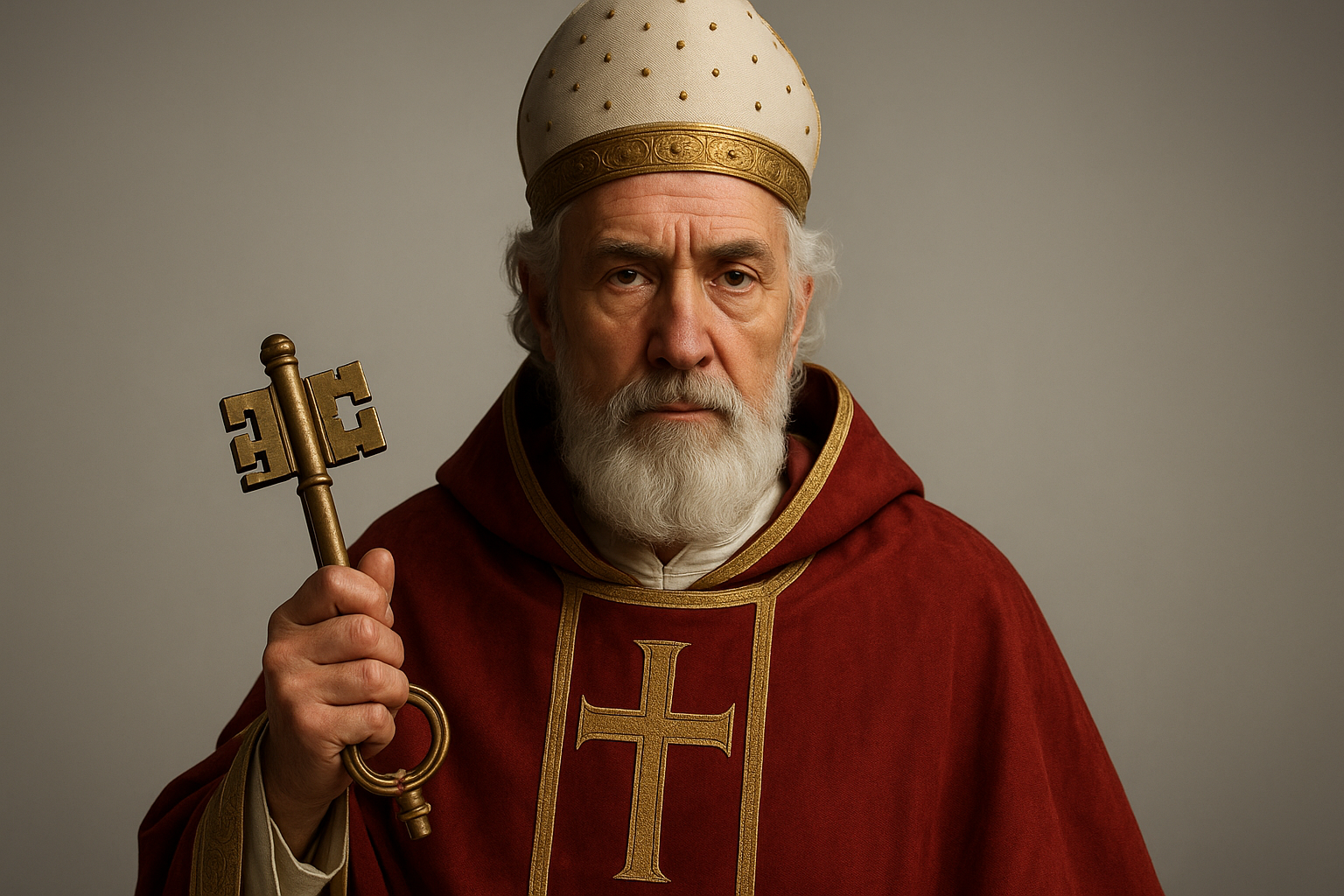
In the vast tapestry of Catholic history, certain figures stand out not just for their holiness, but for their profound impact on the very shape and identity of the Church. One such luminary is St. Leo the Great, a pontiff whose leadership during a tumultuous era earned him the singular title “the Great.” His story is one of unwavering faith, courageous diplomacy, and intellectual brilliance, set against a backdrop of barbarian invasions and deep theological debates. This article will delve into the remarkable life of Pope Leo I, exploring his early years, his pivotal role in defining Catholic doctrine, his extraordinary encounters with powerful adversaries, and the enduring spiritual legacy he left behind, offering insights and inspiration for believers today.
Quick Facts
| Category | Detail |
|---|---|
| Birth | Circa 400 AD, Tuscany, Italy |
| Death | November 10, 461 AD, Rome, Italy |
| Feast Day | November 10 (Western Church) |
| Patronage | Popes, voice professionals, spiritual leaders |
| Canonized | Officially recognized as a saint and Doctor of the Church by Pope Benedict XIV in 1754 |
Historical Context & Early Life
St. Leo the Great emerged onto the world stage during one of the most challenging periods in Roman and Church history. The mighty Western Roman Empire, once the undisputed master of the Mediterranean, was crumbling under the relentless pressure of barbarian invasions. Goths, Vandals, and Huns were carving up its territories, sacking its cities, and threatening the very heart of Rome. The imperial capital had already been sacked by the Visigoths in 410 AD, an event that sent shockwaves across the known world and deeply impacted the psyche of its citizens. In the East, the Byzantine Empire, though more stable, faced its own set of challenges, including theological disputes that threatened to tear the Church apart.
Amidst this geopolitical upheaval, the Christian Church was still relatively young, having only been granted legal status in the Roman Empire less than a century before, under Emperor Constantine. It was rapidly expanding but also grappling with internal divisions, particularly concerning the nature of Jesus Christ. Early Church Councils had already condemned heresies like Arianism, but new theological interpretations continued to emerge, requiring strong, unified leadership.
Leo was born around 400 AD, likely in Tuscany, Italy. Details about his family background and early life are scarce, a common challenge when researching figures from this distant past. However, we know that he received an excellent education, indicating that he came from a family of at least moderate means. His intellectual prowess and deep understanding of both secular law and Christian doctrine quickly became evident. He rose through the ranks of the Roman clergy, serving as a deacon under Pope Celestine I and Pope Sixtus III. Even before becoming pope, Leo was highly respected for his diplomatic skills, his clear theological insights, and his ability to mediate complex disputes. He was often entrusted with important missions, demonstrating his trusted position and significant influence within the Roman Curia. His extensive training and experience in Rome’s administrative and ecclesiastical affairs prepared him uniquely for the enormous responsibilities he would later bear.
Calling & Key Milestones
Leo’s life was a testament to a deep commitment to serving God and His Church, culminating in his election to the papacy. Each step in his journey built upon the last, preparing him for the monumental tasks that awaited.
From Deacon to Pontiff
By the 430s, Leo was a highly esteemed deacon in Rome, known for his administrative competence and theological acumen. He was often involved in important ecclesiastical matters, including correspondence with significant figures like St. Augustine and St. Cyril of Alexandria. His reputation was so strong that in 440 AD, while he was away on a diplomatic mission in Gaul (modern-day France) to resolve a dispute between two prominent generals, Pope Sixtus III died. Upon hearing the news, the clergy and people of Rome unanimously elected Leo as his successor. This speaks volumes about the respect and trust he commanded; he was chosen not just for his holiness, but for his exceptional leadership qualities and his ability to navigate complex political and spiritual landscapes. Leo returned to Rome and was consecrated Bishop of Rome on September 29, 440 AD, thus becoming Pope Leo I.
The Petrine Primacy and the Papal Office
One of Pope Leo’s most significant contributions was his articulate and robust defense of the Petrine Primacy – the belief that the Bishop of Rome, as the successor of St. Peter, holds a unique authority within the Church. He believed that Peter’s role as the chief Apostle, to whom Christ entrusted the keys of the Kingdom, was passed down to each subsequent Bishop of Rome. Leo didn’t just claim this authority; he exercised it with conviction, issuing numerous letters (known as “Sermons” or “Epistles”) that provided clear guidance on doctrinal matters and Church discipline. He saw the Pope as the “unworthy heir” of Peter, called to shepherd the entire Christian flock. This strong assertion of papal authority was crucial for maintaining unity and order in a fragmented world and established a precedent that would shape the papacy for centuries to come.
The Encounter with Attila the Hun
Perhaps the most famous episode in Leo’s pontificate occurred in 452 AD. Attila the Hun, a brutal and feared warrior known as the “Scourge of God,” had invaded Italy, laying waste to cities like Aquileia and Milan. With his sights set on Rome, the imperial government was helpless. In a desperate act, Pope Leo, accompanied by two prominent senators, ventured out to meet Attila at the Mincio River, south of Lake Garda. What transpired during this meeting is shrouded in some mystery, but the outcome was astonishing: Attila turned his forces back and spared Rome. Contemporary accounts suggest that Attila was awed by Leo’s presence, perhaps even influenced by a vision of Saints Peter and Paul standing beside the Pope. Regardless of the exact details, Leo’s courage, faith, and diplomatic skill averted a catastrophe, cementing his reputation as Rome’s savior and a figure of immense spiritual authority.
The Council of Chalcedon and the “Tome of Leo”
Theological controversy was a constant challenge in the 5th century. A major dispute centered on the nature of Christ, particularly the heresy of Monophysitism, which taught that Jesus had only one nature (divine) and not two distinct natures (divine and human) united in one person. To address this, Emperor Marcian called the Council of Chalcedon in 451 AD, one of the most important Ecumenical Councils in Church history. For the Council, Leo sent a lengthy doctrinal letter to Flavian, the Patriarch of Constantinople, which later became known as the “Tome of Leo.”
In this “Tome,” Leo meticulously articulated the Church’s understanding of Christ: that Jesus is one Person, truly God and truly man, with two perfect and distinct natures united without confusion, change, division, or separation. When Leo’s letter was read at Chalcedon, the bishops famously exclaimed, “Peter has spoken through Leo!” The Council adopted the “Tome” as the definitive statement of faith, condemning Monophysitism and solidifying the Christological doctrine that remains central to Catholic theology today. This was a monumental triumph for orthodoxy and a powerful demonstration of papal teaching authority.
The Sack of Rome by the Vandals
While Leo was successful in deterring Attila, he was less fortunate three years later. In 455 AD, the Vandal king Gaiseric led his forces to Rome. Leo again went out to meet the barbarian leader, appealing to him to spare the city from burning and its people from slaughter. Though Gaiseric agreed not to burn Rome, the Vandals plundered the city for fourteen days, carrying off immense wealth and many captives. While a terrible blow, Leo’s intervention is credited with preventing the total destruction and massacre that might have otherwise occurred, highlighting his continued role as a protector of his flock.
Spiritual Legacy & Theological Themes
St. Leo the Great’s spiritual legacy is profound and far-reaching, fundamentally shaping the identity and understanding of the Catholic Church. At its core, his pontificate emphasized several key virtues and theological themes that resonate deeply with Scripture and Catholic teaching.
One of his most significant contributions was his robust articulation of the **Petrine Primacy**. Leo firmly believed that Christ’s words to Peter in Matthew 16:18-19 – “You are Peter, and on this rock I will build my church… I will give you the keys of the kingdom of heaven” – established a unique and enduring authority for Peter and his successors, the Bishops of Rome. He saw the Pope not as an individual ruler, but as the servant of the servants of God, entrusted with a sacred responsibility to uphold the faith and unity of the entire Church. This understanding laid the groundwork for the papacy’s future role and its teaching authority.
Another central theme was **Christological clarity**. Through his “Tome” and numerous sermons, Leo tirelessly championed the doctrine of Christ’s two natures – fully divine and fully human – united in one person. This teaching, formalized at the Council of Chalcedon, is essential to understanding the Incarnation and the Atonement. It upholds that Jesus truly shared in our humanity to save us, while remaining fully God. This clarity prevented the Church from falling into various heresies that would diminish either Christ’s divinity or his humanity, ensuring a complete understanding of our Redeemer.
Leo also exemplified **courageous leadership** and a deep commitment to **pastoral care**. His willingness to confront Attila and Gaiseric, putting his own life at risk to protect his people, demonstrated a shepherd’s heart. He didn’t shy away from difficult situations but faced them head-on, trusting in God’s providence. This aligns with Christ’s description of the good shepherd who lays down his life for his sheep (John 10:11).
His influence extended to **liturgical development** and preaching. Many of the prayers and collects found in the Roman liturgy can be traced back to his time, reflecting his desire for clear, concise, and theologically sound expressions of faith. His numerous sermons, nearly a hundred of which survive, are masterpieces of pastoral instruction, explaining complex doctrines in accessible language and urging Christians to live virtuous lives rooted in charity, humility, and hope. These sermons were not just intellectual exercises; they were designed to nourish the spiritual lives of his flock, offering practical guidance for daily living.
In art, St. Leo is often depicted in papal vestments, wearing a tiara (though this specific headwear evolved much later, it symbolizes papal authority) and carrying a book or scroll, representing his authoritative writings, especially the “Tome.” He is frequently shown confronting Attila the Hun, with Saints Peter and Paul sometimes appearing supernaturally above him, signifying divine intervention in his diplomatic efforts. In jewelry, symbols might include the keys of St. Peter, representing his Petrine office, or a dove, symbolizing the Holy Spirit guiding his wisdom and words. These symbols convey his role as a spiritual leader, defender of the faith, and a courageous shepherd.
Devotion Today
While St. Leo the Great may not have the widespread popular devotion of some other saints, his impact on the Church is universally acknowledged, particularly among theologians, Church historians, and the papacy itself. His legacy is celebrated in specific, profound ways.
Many churches, particularly in Italy and Europe, bear his name, serving as places of worship and remembrance. In Rome, the Church of Santi Leo e Gallicano honors him. His feast day on November 10th is observed throughout the Latin Church, marked by special prayers and reflections on his life and teachings. He is also honored as a Doctor of the Church, a title bestowed upon saints whose writings and teachings have had a particularly significant and lasting impact on Catholic doctrine. This means that his works are studied in seminaries and theological institutions worldwide as foundational texts for understanding Christology and the nature of the papacy.
Popes throughout history have looked to St. Leo as a model of courageous and articulate leadership. His “Tome” remains a cornerstone of Christological doctrine, and his defense of the Petrine office continues to inform the understanding of papal authority. For those involved in diplomacy, interfaith dialogue, or challenging leadership roles within the Church, St. Leo offers a powerful example of how faith, reason, and courage can navigate the most complex of crises.
Pilgrimages specifically to shrines of St. Leo are less common than for, say, Marian shrines or places associated with widely venerated saints. However, pilgrims visiting Rome often encounter his influence and legacy in various historical and ecclesiastical sites, recognizing the city as the seat of the papacy he so powerfully shaped. His enduring presence is felt in the very structures of Catholic thought and governance, inspiring those who delve into the deep roots of their faith.
Reflections for Modern Readers
St. Leo the Great’s life, though lived over 1,500 years ago, offers timeless lessons that are remarkably relevant for us in the 21st century. His example provides guidance on how to live with faith, courage, and intellectual integrity in a world that often feels chaotic and uncertain.
- Courage in the Face of Adversity: Leo didn’t shrink from danger. When Attila the Hun approached Rome, instead of fleeing, he went out to meet the barbarian king. This teaches us the importance of facing our fears and challenges directly, not with naive optimism, but with prayer, wisdom, and a trust in God’s providence. In our own lives, this could mean speaking up for what is right in a difficult conversation at work, standing by our values when they are unpopular, or tackling a daunting personal challenge with a brave heart.
- Clarity and Conviction in Belief: In an era rife with theological confusion, Leo provided crystal-clear teaching on the nature of Christ. His “Tome” became the definitive statement of faith. For us, this highlights the value of understanding our beliefs clearly and being able to articulate them with conviction and charity. In a world of relativism and fleeting trends, having a firm grasp of truth, whether in faith or in personal ethics, provides a vital anchor. This might mean taking the time to truly learn the “why” behind our faith practices or patiently explaining our convictions to someone who disagrees.
- The Power of Diplomacy and Peaceful Resolution: Leo’s encounter with Attila wasn’t a battle of arms, but of persuasion and moral authority. He showed that peaceful dialogue, even with seemingly insurmountable adversaries, can yield extraordinary results. In our often-polarized world, this reminds us that seeking understanding, engaging in respectful conversation, and striving for reconciliation are powerful forces for good. It calls us to be peacemakers in our families, communities, and even online interactions, rather than fueling division.
- Steady Leadership in Times of Crisis: Leo guided the Church through barbarian invasions, imperial collapse, and deep theological schisms. His leadership was marked by consistency, wisdom, and an unwavering commitment to unity. This lesson is crucial for anyone in a leadership role, from parents to managers to community organizers. It teaches us the importance of remaining calm, focused, and morally upright when others are panicking, offering a steady hand and clear direction amidst confusion.
- The Responsibility of Authority: Leo understood his papal authority not as a personal privilege, but as a sacred trust and a heavy responsibility to serve the entire Church. For us, this means recognizing that any position of influence or power we hold, no matter how small, comes with a corresponding duty to use it for the good of others, not for personal gain. It encourages humility and service in all our interactions, remembering that true greatness lies in serving.
Common symbols and representations of St. Leo the Great in art and jewelry typically include:
- Papal Tiara or Miter: While the tiara evolved after Leo’s time, it symbolizes his role as Pope and his supreme authority within the Church. The miter is a bishop’s hat, representing his episcopal office.
- Scroll or Book: These items often accompany Leo, representing his theological writings, particularly the “Tome of Leo,” and his prolific sermons. They symbolize his intellectual prowess and his role as a Doctor of the Church.
- Lion: Sometimes, a lion is depicted near him, not only as a play on his name (“Leo” means lion) but also symbolizing his strength, courage, and leadership in defending the Church.
- Attila the Hun: Art often shows Leo confronting Attila, sometimes with Saints Peter and Paul appearing above Leo’s head. This powerful image captures his most famous diplomatic triumph and the divine protection believed to have been at play.
- Keys of St. Peter: These are a direct reference to Matthew 16:19 and the Petrine office, signifying the authority entrusted to Peter and passed down to his successors, including Leo.
These symbols remind us of St. Leo’s enduring impact as a courageous shepherd, a brilliant theologian, and a defender of the faith.
Timeline Summary
- Circa 400 AD: Born in Tuscany, Italy.
- Circa 430 AD: Becomes a prominent deacon in Rome, known for his administrative and theological skills.
- 440 AD (September 29): Unanimously elected Bishop of Rome (Pope Leo I) while on a diplomatic mission in Gaul.
- 440s-450s AD: Actively asserts the Petrine Primacy through sermons and letters, establishing the authority of the Roman See.
- 451 AD: Sends his famous “Tome” to Flavian, Patriarch of Constantinople, providing the definitive Christological statement.
- 451 AD (October): The Council of Chalcedon adopts the “Tome of Leo” as its doctrinal standard, condemning Monophysitism.
- 452 AD: Courageously confronts Attila the Hun at the Mincio River, persuading him to spare Rome from destruction.
- 455 AD: Meets Gaiseric, king of the Vandals, to appeal for the sparing of Rome; the city is plundered but not burned, and its inhabitants largely spared from massacre.
- 461 AD (November 10): Dies in Rome.
- 1754 AD: Declared a Doctor of the Church by Pope Benedict XIV.
Scripture for Reflection
St. Leo’s life and papacy profoundly reflect several key scriptural themes, especially those concerning leadership, truth, and courage.
Matthew 16:18-19: “And I tell you, you are Peter, and on this rock I will build my church, and the gates of hell shall not prevail against it. I will give you the keys of the kingdom of heaven, and whatever you bind on earth shall be bound in heaven, and whatever you loose on earth shall be loosed in heaven.”
Reflection: This passage, spoken by Jesus to St. Peter, forms the very foundation of St. Leo’s understanding and articulation of the papacy’s authority. Leo saw himself as Peter’s successor, entrusted with the sacred duty to safeguard the Church and its doctrines. His assertion of papal primacy was rooted in these words, guiding his governance and his role in major councils like Chalcedon.
John 10:11: “I am the good shepherd. The good shepherd lays down his life for the sheep.”
Reflection: St. Leo’s willingness to confront formidable enemies like Attila the Hun and Gaiseric, despite the personal danger, embodies the spirit of the good shepherd. He put himself between his flock and the wolves, demonstrating a profound pastoral care and courage, mirroring Christ’s own example of self-sacrificial love for His Church.
1 Timothy 4:16: “Keep a close watch on yourself and on the teaching. Persist in this, for by so doing you will save both yourself and your hearers.”
Reflection: Leo’s relentless pursuit of theological clarity and his articulate defense of orthodox doctrine, particularly on the nature of Christ, perfectly align with St. Paul’s exhortation to Timothy. He vigilantly guarded the sacred deposit of faith, ensuring that the Church’s teaching remained pure and true, thereby providing salvation and guidance not only for his contemporaries but for generations to come.
Prayers to St. Leo the Great
A General Prayer to St. Leo the Great:
O glorious St. Leo the Great, who by your profound wisdom and courageous leadership defended the Church in times of grave danger and taught with unparalleled clarity the true faith concerning our Lord Jesus Christ, we implore your intercession. You, who confronted barbarian hordes and championed truth against heresy, be our guide and protector.
Inspire all leaders, both in the Church and in the world, to govern with justice, wisdom, and a spirit of humble service. Help us to uphold the truth of Christ with unwavering conviction and charity, especially when faced with confusion or opposition. Grant us the courage to stand firm in our faith and to seek peaceful resolution in times of conflict.
May your example strengthen our trust in God’s providence and deepen our love for His Holy Church. Amen.
Collect for the Feast of St. Leo the Great (November 10):
O God, who never allow the gates of hell to prevail against your Church, firmly founded on the apostolic rock, grant her, we pray, that through the intercession of Pope Saint Leo, she may stand unshaken in your truth and so know lasting peace. Through our Lord Jesus Christ, your Son, who lives and reigns with you in the unity of the Holy Spirit, God, for ever and ever. Amen.