In the vast tapestry of Catholic saints, one figure shines brightly for his profound and unique contributions to Marian spirituality: St. Louis de Montfort. Born in 17th-century France, amidst a time of spiritual unrest and renewal, he emerged as a passionate missionary, a prolific writer, and a visionary who believed that the surest, easiest, shortest, and most perfect path to Jesus Christ was through His Mother, the Blessed Virgin Mary. His teachings, particularly on total consecration to Jesus through Mary, have not only shaped the spiritual lives of countless Catholics but have also deeply influenced popes and movements across centuries. This article delves into his fascinating life, his powerful legacy, and how his timeless wisdom continues to resonate with believers seeking a deeper walk with Christ today.
Quick Facts
| Category | Detail |
|---|---|
| Birth | January 31, 1673, Montfort-sur-Meu, France |
| Death | April 28, 1717, Saint-Laurent-sur-Sèvre, France |
| Feast Day | April 28 |
| Patronage | Preachers, missionaries, devotion to Mary |
| Canonized | July 20, 1947, by Pope Pius XII |
Historical Context & Early Life
The world into which Louis-Marie Grignion was born was one of significant contrasts and challenges, particularly in France. The late 17th and early 18th centuries in France, often called the “Grand Siècle,” were marked by the absolute monarchy of King Louis XIV, a period of immense cultural splendor, artistic flourishing, and military expansion. Yet, beneath this glittering surface, there was widespread poverty, social inequality, and profound religious debates that deeply affected the spiritual landscape of the nation.
Within the Church, several currents clashed. On one hand, there was the prevailing influence of Gallicanism, a movement advocating for greater autonomy of the French Church from papal authority. On the other, the rigorous and often pessimistic theological school of Jansenism had gained significant traction. Jansenism emphasized humanity’s fallen nature, the difficulty of salvation, and discouraged frequent reception of Holy Communion, fostering a climate of fear and spiritual austerity. Against this backdrop, St. Louis de Montfort championed a more optimistic and accessible spirituality, rooted in God’s mercy and the maternal mediation of Mary, which often put him at odds with the prevailing theological trends of his time.
Louis-Marie Grignion was born into an impoverished noble family in Montfort-sur-Meu, Brittany, the second of eighteen children. His father, Jean-Baptiste Grignion, was a lawyer and a man of volatile temper, while his mother, Jeanne Robert, was a deeply pious woman who instilled in her children a strong Catholic faith. Growing up in a large, often struggling family, Louis experienced firsthand the hardships of poverty, which undoubtedly fueled his later zeal for ministering to the poor and marginalized. From a young age, he displayed an unusual piety, a love for prayer, and a deep devotion to the Blessed Virgin Mary and the Holy Angels. His formative years included a crucial period of study at the Jesuit College of Saint Thomas in Rennes, followed by seminary training at Saint-Sulpice in Paris. These institutions were intellectual powerhouses, where he immersed himself in philosophy, theology, and the vibrant spiritual traditions of the “French School of Spirituality,” which emphasized the priesthood’s holiness and conformity to Christ.
Calling & Key Milestones
St. Louis de Montfort’s life was a testament to his unwavering commitment to his vocation, marked by periods of intense missionary work, profound spiritual writing, and the courageous founding of new religious communities. His journey was often fraught with challenges, misunderstandings, and opposition, yet his conviction in the power of God’s grace and Mary’s intercession never faltered.
Formation and Priesthood
Louis-Marie’s studies at the seminary of Saint-Sulpice in Paris were instrumental in shaping his spiritual vision. He was exposed to the rich theological traditions of the French School of Spirituality, which emphasized Christ’s kingship, the spiritual motherhood of Mary, and the importance of interior holiness for priests. It was during this time that his devotion to Mary deepened significantly, leading him to explore the idea of total consecration to Jesus through her. He absorbed the teachings of mystics and theologians, developing a profound understanding of Divine Wisdom and its central role in the Christian life. Ordained a priest on June 5, 1700, he immediately felt a burning desire to preach the Gospel to the poor, following in the footsteps of St. Vincent de Paul, and to live a life of evangelical poverty.
Missionary Work and the Poor
After his ordination, Montfort spent several years seeking guidance and direction for his ministry. He served in various capacities, including as a chaplain in a hospital, but his heart longed for the open road, to reach the common people who were often neglected or poorly catechized. He eventually became an itinerant missionary, traveling extensively through western France, primarily in Brittany and Poitou. His method involved preaching popular missions, which were intense periods of evangelization in parishes, often lasting several weeks. He would preach with fiery zeal, organize processions, hear countless confessions, instruct children, and work tirelessly to renew the spiritual life of towns and villages. His preaching style, deeply rooted in the Gospel and infused with his ardent Marian devotion, was simple yet powerful, direct and effective for his audiences. However, his passionate approach and emphasis on Marian consecration, which was sometimes misunderstood, often drew criticism and opposition from Jansenist-leaning clergy who viewed his methods as excessive or even heterodox. Despite facing numerous obstacles, bans, and even attempts on his life, Montfort persevered, sustained by his deep faith and trust in God’s providence.
Founding Religious Orders
Recognizing the need for structured support to continue his missionary work and to care for the poor, St. Louis de Montfort founded two religious congregations, though he often encountered difficulties in establishing them firmly during his lifetime:
- Daughters of Wisdom (Filles de la Sagesse): Co-founded in 1703 with Blessed Marie Louise Trichet, whom he had met in Poitiers. This congregation of sisters was dedicated to caring for the sick and the poor, particularly in hospitals, and to educating girls, especially those from disadvantaged backgrounds. The sisters aimed to embody Divine Wisdom through their service, radiating Christ’s love to those most in need.
- Missionaries of the Company of Mary (Montfort Missionaries): Montfort envisioned a community of priests and brothers who would continue his work of preaching missions and spreading devotion to Mary. Though formally established after his death, the foundations were laid during his lifetime, with a few companions committing to his vision. These missionaries were to be “apostles of the latter times,” totally dedicated to Jesus through Mary, striving to renew the Church and the world.
Writing and Spiritual Wisdom
Amidst his demanding missionary travels, St. Louis de Montfort poured his spiritual insights into several influential writings. Often composed in moments of solitude or while recuperating from illness, these works would become cornerstones of Catholic spirituality, though many remained hidden for decades after his death.
- Treatise on True Devotion to the Blessed Virgin (often simply called True Devotion to Mary): This is his most famous work, rediscovered only in 1853, more than a century after his death. It outlines his method of “total consecration” to Jesus through Mary. This “consecration” is not an act of worshiping Mary, but a complete gift of oneself – body, soul, goods, and spiritual merits – to Jesus, using Mary as the perfect intermediary. Montfort explains that Mary is the “safest, easiest, shortest and most perfect means” to reach Jesus, because she perfectly surrendered to God’s will and always leads us to her Son. He emphasizes that true devotion to Mary is always Christ-centered.
- The Secret of Mary: A shorter, more accessible version of the Treatise, explaining the essence of total consecration in a concise format.
- The Love of Eternal Wisdom: Considered by many to be his foundational theological work. In this book, Montfort explores the personification of Divine Wisdom, seeing it as Jesus Christ Himself, the uncreated Wisdom of God. He calls believers to seek, desire, and embrace this Eternal Wisdom, which leads to true holiness and union with God.
- The Secret of the Rosary: A guide to praying the Rosary, reflecting on its mysteries and spiritual benefits, and advocating for its regular recitation as a powerful spiritual weapon.
Spiritual Legacy & Theological Themes
St. Louis de Montfort’s spiritual legacy is immense, profoundly influencing Catholic piety and theology, particularly concerning Marian devotion. His teachings were rooted in core Catholic virtues and doctrines, always pointing to Christ as the ultimate goal.
The core virtues exemplified by Montfort himself, and which he urged upon others, were profound humility, complete detachment from worldly possessions and honors, an ardent love for God and neighbor, and an unshakeable zeal for souls. He lived a life of radical poverty, enduring physical hardship and spiritual opposition with serene trust in Divine Providence. These virtues align perfectly with Scriptural teachings on self-emptying (Philippians 2:5-8), loving one’s neighbor (Matthew 22:39), and persevering in faith despite trials (Romans 5:3-5).
His most enduring theological contribution lies in his unique understanding of Marian spirituality. Montfort’s devotion to Mary is not an end in itself; rather, it is always Christ-centered. He viewed Mary as the perfect model for discipleship and the most effective means to attain union with Jesus. His concept of “total consecration to Jesus through Mary” (sometimes called “holy slavery of love”) involves giving oneself entirely to Jesus, entrusting all to Mary’s spiritual care and guidance. This is not a literal slavery, but a profound spiritual freedom found in perfect surrender to God, mirroring Mary’s own “fiat” – her humble “yes” to God’s will (Luke 1:38). In this understanding, Mary acts as a spiritual Mediatrix – not a mediator in the same unique sense as Christ, who is the one mediator between God and humanity (1 Timothy 2:5), but as one who perfectly cooperates with Christ’s mediation, constantly leading souls closer to her Son.
Another central theme in Montfort’s spirituality is the pursuit of Divine Wisdom. For Montfort, Divine Wisdom is Jesus Christ Himself, the Second Person of the Holy Trinity. He passionately called all Christians to seek this Eternal Wisdom, to embody it in their lives, and to allow it to transform them. This quest for Wisdom, he believed, would lead to profound holiness and a deeper understanding of God’s plan for salvation.
Montfort’s lasting influence on liturgy, devotion, and even doctrine is undeniable. His *Treatise on True Devotion* was rediscovered in 1853 and quickly gained widespread popularity, becoming a foundational text for many Marian movements. Popes, from Pius IX to St. John Paul II, were deeply influenced by his teachings. St. John Paul II even adopted Montfort’s Marian motto, “Totus Tuus” (Totally Yours), as his episcopal motto, acknowledging the profound impact Montfort had on his own spiritual life. The religious orders he founded, the Daughters of Wisdom and the Missionaries of the Company of Mary, continue his work of evangelization, education, and care for the poor globally. Lay organizations like the Legion of Mary also draw heavily from his spirituality, promoting Marian devotion as a means of apostolic action and personal sanctification.
Devotion Today
Devotion to St. Louis de Montfort remains vibrant and widespread in the Catholic Church today, a testament to the enduring power and relevance of his spiritual message. His teachings continue to inspire countless individuals and movements seeking a deeper, more intimate relationship with Jesus Christ through His Blessed Mother.
The primary center of devotion to St. Louis de Montfort is the Basilica of Saint-Laurent-sur-Sèvre in France, where his tomb is located. This sacred site serves as a significant pilgrimage destination for those who wish to honor his memory, pray for his intercession, and connect with the origins of his spiritual legacy. Pilgrims often visit to make or renew their total consecration to Jesus through Mary, following his renowned method.
Indeed, the practice of total consecration, as outlined in his *Treatise on True Devotion*, is arguably the most significant aspect of his modern devotion. Many Catholics undertake a 33-day preparation period, culminating in an act of consecration on a Marian feast day. This spiritual exercise involves daily prayers, reflections, and renunciations, leading to a profound commitment to live as instruments of Mary for the glory of Jesus. This practice is widely promoted by various Catholic organizations and individuals who find in it a powerful path to spiritual growth and holiness.
The religious congregations founded by St. Louis de Montfort, the Missionaries of the Company of Mary (Montfort Missionaries) and the Daughters of Wisdom, continue their missions around the world. They serve in parishes, schools, hospitals, and missionary territories, embodying Montfort’s charism of zeal for souls, care for the poor, and intense Marian devotion. They organize retreats, publish spiritual materials, and spread the teachings of their founder.
Furthermore, St. Louis de Montfort’s influence is evident in numerous Marian movements and apostolates, most notably the Legion of Mary, one of the largest lay Catholic organizations in the world. The Legion draws inspiration from Montfort’s Marian theology, particularly his emphasis on working alongside Mary for the salvation of souls. Annual celebrations of his feast day on April 28 are observed globally, with special Masses, prayers, and events marking his profound impact on Catholic spirituality.
Reflections for Modern Readers
St. Louis de Montfort, though he lived centuries ago, offers timeless wisdom that can profoundly enrich the lives of modern Catholics navigating the complexities of the 21st century. His spirituality provides practical pathways to holiness and a deeper relationship with God.
-
Lesson 1: The Power of a Total “Yes” to God. Montfort’s concept of “total consecration” is fundamentally about surrendering everything to God through Mary. In a world that often prizes control, autonomy, and self-reliance, his teaching reminds us of the profound freedom found in trusting God completely. It’s about letting go of our own plans and anxieties, and humbly saying “yes” to God’s will, just as Mary did with her “fiat.”
Real-world example: A young adult grappling with career choices, feeling immense pressure to achieve worldly success. Montfort’s message encourages them to prayerfully discern God’s path, trusting that His plan for their life, even if it seems unconventional, will bring true fulfillment, rather than solely pursuing material gain. They might offer their talents and ambitions to God through Mary, seeking wisdom in their decisions.
-
Lesson 2: Finding Simplicity Amidst Complexity. Montfort lived in a turbulent religious landscape, yet he cut through the jargon and debates to offer a clear, accessible path to Christ. In our modern age of information overload, endless distractions, and spiritual fads, his focus on Jesus through Mary offers a refreshing simplicity and clarity. It’s a reminder that holiness doesn’t require intricate theological gymnastics but a sincere, humble heart.
Real-world example: A parent overwhelmed by the demands of work, family, and modern life. Instead of feeling guilty about not having hours for elaborate spiritual exercises, they can embrace Montfort’s simple path: consecrating their day, their family, their struggles to Jesus through Mary, finding peace and focus in this consistent, yet simple, spiritual practice.
-
Lesson 3: Missionary Zeal in Everyday Life. Montfort was an ardent missionary, never ceasing to preach the Gospel to the poor. We may not all be called to be itinerant preachers, but Montfort’s zeal reminds us that every Christian is called to be a missionary in their own sphere. This means living our faith authentically, witnessing to Christ through our actions, words, and love for others.
Real-world example: A person working in a secular environment might feel intimidated by the idea of “evangelizing.” Montfort’s spirit inspires them to be a missionary through their integrity, kindness, and commitment to justice at their workplace, allowing their faith to shine through their character, offering a quiet, compelling witness to their colleagues and clients.
-
Lesson 4: Perseverance in the Face of Adversity. St. Louis de Montfort faced constant opposition, rejection, and suffering throughout his ministry. Yet, he never wavered in his commitment to God’s will. His life is a powerful testament to the importance of perseverance, reminding us that challenges and setbacks are often part of the spiritual journey, not signs of failure.
Real-world example: Someone experiencing a personal crisis, a difficult family situation, or doubts about their faith. Montfort’s example encourages them to cling to prayer, trust in God’s plan, and persevere through the darkness, believing that grace will ultimately prevail and that even suffering can be offered up for spiritual growth.
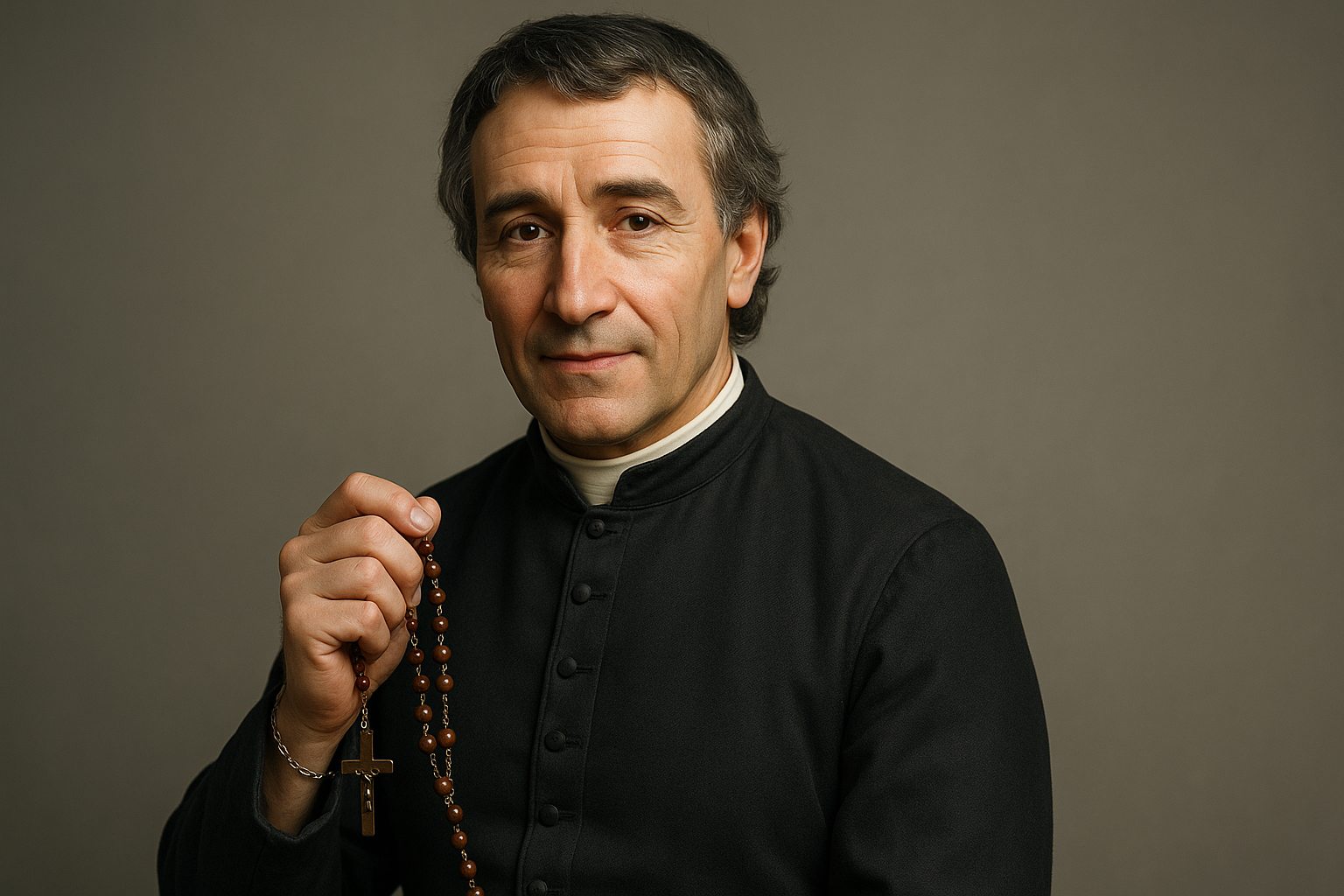
Common symbols and representations of St. Louis de Montfort in art and jewelry include:
- The Crucifix: Often depicted holding or looking at a crucifix, symbolizing his deeply Christocentric faith. Despite his profound Marian devotion, everything for Montfort ultimately led to Jesus and the Paschal Mystery.
- Chains or Shackles: This symbol represents the “slavery of love” or “holy slavery” to Mary, which is a core tenet of his spirituality. It signifies a spiritual surrender and total dedication to Christ through Mary, not literal servitude. It’s a reminder of the freedom found in giving oneself entirely to God.
- A Book (especially the *Treatise*): He is frequently shown holding a book, specifically alluding to his influential writings, especially the *Treatise on True Devotion to the Blessed Virgin*, which remains his most famous legacy.
- The Rosary: Given his ardent promotion of the Rosary as a powerful prayer, he is often depicted with a rosary in hand or around his neck, signifying his encouragement for this Marian devotion.
Timeline Summary
- 1673: Born Louis-Marie Grignion in Montfort-sur-Meu, Brittany, France.
- 1683: Begins studies at the Jesuit College of Saint Thomas in Rennes.
- 1693-1700: Studies at the Seminary of Saint-Sulpice in Paris, deepening his spiritual formation and Marian devotion.
- 1700: Ordained a priest on June 5.
- 1700-1706: Engages in various pastoral assignments, including chaplaincy at a hospital, while discerning his missionary call.
- 1706: Travels to Rome and is named “Apostolic Missionary” by Pope Clement XI, granting him authorization to preach throughout France.
- 1706-1716: Undertakes extensive itinerant missionary work, preaching popular missions throughout western France.
- 1712-1713 (approx.): Writes his most influential work, the *Treatise on True Devotion to the Blessed Virgin*, though it remains unpublished until much later.
- 1715: Formally founds the Daughters of Wisdom (Filles de la Sagesse) with Blessed Marie Louise Trichet.
- 1716: Lays the foundations for the Missionaries of the Company of Mary (Montfort Missionaries).
- 1717: Dies on April 28 in Saint-Laurent-sur-Sèvre, France, exhausted by his missionary labors.
- 1853: The *Treatise on True Devotion* is providentially rediscovered and published, gaining immediate acclaim.
- 1888: Beatified by Pope Leo XIII.
- 1947: Canonized a saint by Pope Pius XII on July 20.
Scripture for Reflection
St. Louis de Montfort’s spiritual insights are deeply rooted in Scripture, especially regarding the role of Mary and the pursuit of Divine Wisdom. Here are a few passages for reflection:
-
Luke 1:38 (Mary’s Fiat): “Mary said, ‘Behold, I am the handmaid of the Lord; let it be done to me according to your word.’ And the angel departed from her.”
Connection: This verse encapsulates the spirit of total surrender and “holy slavery” that Montfort advocates. Mary’s perfect “yes” to God’s will serves as the ultimate model for the consecration he teaches, inviting us to imitate her complete docility to the Holy Spirit and trust in God’s providence.
-
John 19:26-27 (Jesus gives Mary to John): “When Jesus saw his mother and the disciple whom he loved standing nearby, he said to his mother, ‘Woman, behold, your son!’ Then he said to the disciple, ‘Behold, your mother!’ And from that hour the disciple took her into his home.”
Connection: This passage highlights Mary’s universal spiritual motherhood, given by Christ Himself from the cross. Montfort emphasizes that just as John took Mary into his home (spiritually and physically), so too should all believers welcome Mary into their lives as their spiritual Mother, allowing her to lead them more perfectly to Jesus.
-
Proverbs 8:17 (Wisdom): “I love those who love me, and those who seek me find me.”
Connection: This verse speaks directly to Montfort’s profound love for and relentless pursuit of Divine Wisdom, which he identifies with Jesus Christ. His work *The Love of Eternal Wisdom* is a powerful call to seek and embrace this Wisdom, promising that those who earnestly desire it will indeed find it and be transformed by it.
Prayers to St. Louis de Montfort
Here is a popular prayer invoking the intercession of St. Louis de Montfort:
O God, who willed to enlighten your Church by the preaching and writings of Saint Louis Marie, grant that we, by following his example in venerating the Blessed Virgin Mary, may grow in Christian perfection and come to know Jesus Christ, your Eternal Wisdom. Through Christ our Lord. Amen.
Another prayer often prayed for his intercession:
Saint Louis Marie Grignion de Montfort, faithful servant of Jesus and Mary, you taught us the surest path to holiness through total consecration to Christ through His Blessed Mother. Inspire us with your burning zeal for souls and your profound love for Eternal Wisdom. Help us to imitate your virtues, especially your humility, detachment, and unwavering trust in divine providence. Intercede for us, that we may always remain faithful to our baptismal vows, offer ourselves entirely to God through Mary, and joyfully proclaim the Gospel in our lives. Amen.