
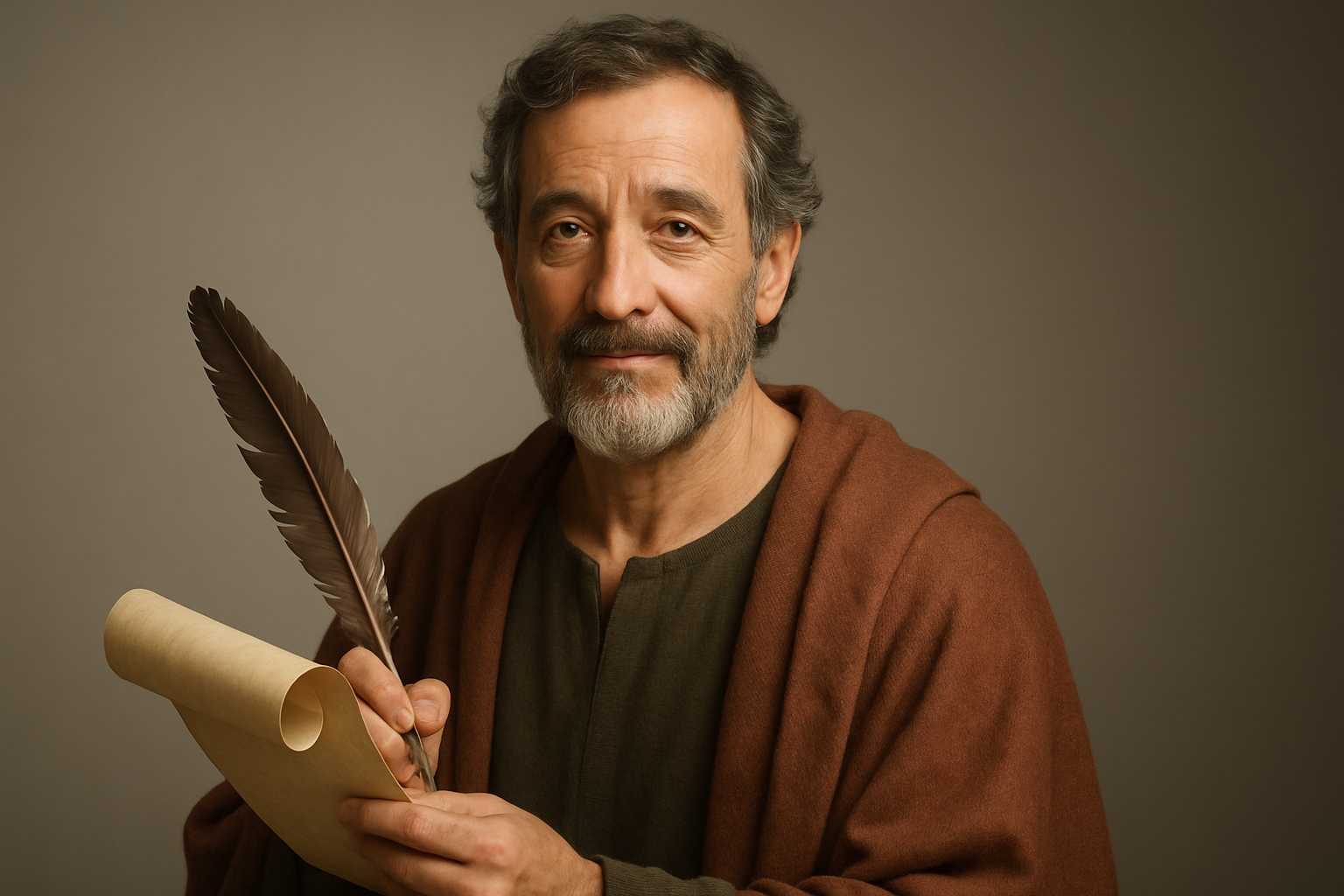
Step into the first century and discover a man whose quiet dedication shaped much of what we know about Jesus and the early Christian Church. St. Luke the Evangelist, often known as the “Beloved Physician” and the meticulous historian of the New Testament, offers us a unique window into the life of Christ and the beginnings of our faith. His writings, the Gospel of Luke and the Acts of the Apostles, reveal a profound compassion, an eye for detail, and a deep understanding of God’s universal love. This article will explore his historical context, his pivotal role as a writer and companion to St. Paul, his enduring spiritual legacy, and how his message continues to resonate with believers today, inviting us to see Jesus through his compassionate lens.
Quick Facts
| Category | Detail |
|---|---|
| Birth | Likely Antioch, Syria (modern-day Turkey), early 1st century AD |
| Death | Traditional accounts vary; Greece, perhaps around 84 AD |
| Feast Day | October 18 |
| Patronage | Physicians, surgeons, artists, sculptors, notaries, historians, butchers, bachelors, bookbinders, brewers, glass workers, lacemakers |
| Canonized | Pre-Congregation (Venerated since early Christianity) |
Historical Context & Early Life
St. Luke lived in a fascinating and turbulent period, the first century of the Roman Empire, a time when diverse cultures, philosophies, and religions converged. Born likely in Antioch, a major Hellenistic city in Syria (part of modern-day Turkey), Luke grew up in a vibrant intellectual and commercial hub. Antioch was one of the largest cities in the Roman Empire, a melting pot of Greek, Roman, and Jewish influences. It was also a critical center for early Christianity, where believers were first called “Christians” (Acts 11:26).
Unlike most of the other Gospel writers, Luke was not a Jew by birth but a Gentile, likely of Greek background. This fact is significant because it means he approached the story of Jesus from a different perspective, emphasizing themes that would resonate with a broader, non-Jewish audience. His excellent command of the Greek language, far superior to that of the other evangelists, suggests a highly educated background. Tradition, upheld by early Church Fathers like Eusebius and Jerome, tells us he was a physician, a detail also hinted at by St. Paul himself in his letter to the Colossians (Colossians 4:14), where he calls Luke “the beloved physician.”
As a physician, Luke would have been trained in the scientific and philosophical traditions of the Greek world. This background likely instilled in him a meticulous attention to detail, a desire for accurate observation, and a profound sense of compassion for the suffering. These qualities shine through in his writings, where he often focuses on healing, care for the marginalized, and the tender mercy of Jesus. His formative experiences in a diverse, intellectually rich environment would have prepared him to document the revolutionary message of Christianity in a way that bridged cultural divides, making it accessible and compelling to a wide audience.
Calling & Key Milestones
While we don’t have a detailed account of Luke’s conversion, it’s clear he became a devoted follower of Christ and a crucial figure in the early Church. His calling was not just to believe, but to meticulously record and transmit the story of salvation for future generations.
A Man of Learning and Observation
Luke’s profession as a physician likely influenced his approach to writing. He wasn’t an eyewitness to Jesus’s ministry, unlike Peter or John. Instead, as he states in the opening of his Gospel (Luke 1:1-4), he undertook careful research, consulting “eyewitnesses and ministers of the word.” This scholarly method, combined with his medical background, made him an ideal historian. He sought out reliable sources, cross-referenced accounts, and presented an orderly narrative. His Gospel is filled with precise details, often including diagnoses of illnesses and the specifics of miraculous healings, which would have come naturally to a physician.
Companion to St. Paul
One of the most defining aspects of Luke’s life was his close relationship with St. Paul. Luke joined Paul on at least parts of his second and third missionary journeys, and was with him during his imprisonment in Rome. We know this because of the “we” passages in the Acts of the Apostles (e.g., Acts 16:10-17, 20:5-15, 27:1-28:16), which strongly suggest that the author was a direct participant in these events. This partnership was vital: Luke provided medical care and companionship to Paul, who often faced hardships and illnesses. More importantly, he observed firsthand the expansion of the early Church among the Gentiles, an experience that deeply informed his writings. Paul clearly valued Luke, referring to him not only as “the beloved physician” but also as a faithful co-worker even when others deserted him (2 Timothy 4:11).
The Gospel of Luke: A Unique Perspective
Luke’s Gospel stands out for its unique emphasis on certain themes. Written probably between 60 and 80 AD, it presents Jesus as the compassionate Savior of all humanity, not just the Jewish people. Key themes include:
- Mercy and Compassion: Luke records parables found nowhere else, such as the Good Samaritan, the Prodigal Son, and the Lost Sheep, all highlighting God’s boundless mercy and love for sinners and outcasts.
- The Role of Women: Luke gives more attention to women than any other Gospel writer, featuring figures like Mary, Elizabeth, Anna, Mary Magdalene, and Martha. He portrays them as active participants and vital witnesses in Jesus’s ministry.
- Prayer: Jesus is often depicted in prayer in Luke’s Gospel, setting an example for believers. Luke records specific instances of Jesus praying before major events and teaches His disciples how to pray through the “Lord’s Prayer.”
- The Holy Spirit: The Holy Spirit plays a prominent role, empowering John the Baptist, Mary, Jesus, and the early Church.
- Universality: Luke traces Jesus’s lineage back to Adam, not just Abraham, signifying that Jesus’s salvation is for all people.
These emphases reveal Luke’s heart as a Gentile convert who understood the longing for salvation outside of traditional Jewish customs.
The Acts of the Apostles: The Church’s Birth Story
The Acts of the Apostles is often seen as the second volume of Luke’s work, continuing the story from Jesus’s ascension to Paul’s imprisonment in Rome. It is the only book of the New Testament that chronicles the early history of the Christian Church. Acts details the descent of the Holy Spirit at Pentecost, the bold preaching of Peter and the Apostles, the conversion of Paul, and the rapid spread of the Gospel throughout the Roman Empire. Luke’s meticulous reporting provides invaluable historical insight into the organizational challenges, missionary efforts, and theological developments of the nascent Church. It shows how the Good News, first proclaimed to Israel, truly became a message for the entire world, guided by the Holy Spirit.
Luke as an Artist?
A beautiful tradition, though not directly supported by Scripture, holds that St. Luke was also an artist, specifically an iconographer. Legend attributes to him the painting of several icons of the Blessed Virgin Mary, including the one known as “Our Lady of Czestochowa” in Poland and “Salus Populi Romani” in Rome. While concrete historical evidence for this tradition is scarce, it’s a testament to Luke’s reputation for careful depiction and profound reverence for Mary. This tradition has made him the patron saint of artists, and it speaks to the idea that faith can be expressed not only through words but also through visual beauty, helping people connect with the sacred.
Spiritual Legacy & Theological Themes
St. Luke’s spiritual legacy is immense and multifaceted. His writings are fundamental to understanding the breadth of God’s love and the mission of the Church.
The core virtues he exemplified and highlighted in his Gospel include compassion, mercy, and universality. Luke consistently portrays Jesus as reaching out to the marginalized: the poor, the sick, tax collectors, sinners, and women. This aligns perfectly with the scriptural teaching that “God is love” (1 John 4:8) and that Christ came “not to call the righteous but sinners” (Mark 2:17). Luke’s narrative invites us to cultivate a similar heart of empathy and to actively seek out those on the fringes of society, recognizing Christ in them.
His emphasis on prayer is another profound legacy. By showing Jesus praying at crucial moments—at His baptism, before choosing the Apostles, on the Mount of Transfiguration, and in Gethsemane—Luke teaches us that prayer is essential for discerning God’s will and sustaining spiritual life. This resonates with Christ’s own teachings on persistence in prayer (Luke 11:5-8, 18:1-8). For Luke, prayer isn’t just a religious duty; it’s a vital, transformative conversation with God.
Luke’s influence on liturgy, devotion, and art is undeniable. Many of the most beloved passages read during Mass and other liturgical services come from his Gospel, particularly during the Advent and Christmas seasons, with the stories of the Annunciation, the Visitation, and the Nativity. His descriptions of Mary have profoundly shaped Catholic devotion to the Blessed Mother, particularly the “Magnificat” (Luke 1:46-55), which is prayed daily in the Liturgy of the Hours, and the “Benedictus” (Luke 1:68-79) and “Nunc Dimittis” (Luke 2:29-32). The Marian title “Our Lady of Perpetual Help” is even linked by some traditions to an icon painted by Luke.
Theological themes that endure from Luke’s work include the radical inclusivity of the Gospel message and the transformative power of the Holy Spirit. He reminds us that salvation is for Gentile and Jew, rich and poor, male and female. The Acts of the Apostles serves as a foundational text for understanding the sacrament of Confirmation and the ongoing work of the Holy Spirit in the Church. Luke’s clear, orderly narrative style has also made his writings accessible and influential in catechesis and theological education throughout history.
Devotion Today
St. Luke the Evangelist continues to be a revered figure in the Catholic Church and beyond. His feast day on October 18 is celebrated with special Masses and reflections on his contributions.
While there are no major international pilgrimage sites solely dedicated to St. Luke in the same way as Lourdes or Fatima, his relics are venerated in several places. The Basilica of Santa Giustina in Padua, Italy, claims to hold his remains, attracting pilgrims who seek his intercession, particularly those in the medical profession or artists. Another significant reliquary is found in the Cathedral of St. Vitus in Prague, Czech Republic. These sites serve as points of devotion where believers can honor his memory and draw inspiration from his life.
Due to his patronage of physicians, many hospitals, medical schools, and healthcare organizations bear his name, such as St. Luke’s Medical Center. These institutions often invoke his intercession for healing and ethical medical practice. Guilds and associations for doctors, nurses, and other medical professionals frequently gather under his patronage.
Artists also honor St. Luke, often holding special Masses or exhibitions on his feast day. Art academies and workshops might have special prayers or customs related to him. His legendary status as an iconographer has inspired countless artists to dedicate their talents to sacred art, viewing their work as a continuation of Luke’s visual evangelization.
In homes and parishes, many faithful read his Gospel with particular fondness, drawn to its compassionate portrayal of Jesus and its emphasis on Mary. Families might have an icon or statue of St. Luke, often depicted with a bull or ox, a symbol explained below, or with a quill and scroll. Devotion to St. Luke serves as a reminder of the importance of evangelization, the value of scholarship in faith, and the call to compassion for all of humanity.
Reflections for Modern Readers
St. Luke’s life and writings offer profound lessons that are remarkably relevant for us in the 21st century:
-
Embrace Compassion and Inclusivity: Luke teaches us that God’s love extends to everyone, especially those society often overlooks. In a world frequently divided by class, race, or belief, Luke’s Gospel calls us to see Christ in the marginalized.
Example: When you encounter someone in need, perhaps a homeless person or a new immigrant struggling to adapt, reflect on Luke’s parables of the Good Samaritan or the Prodigal Son. How can you extend tangible mercy and welcome, reflecting God’s boundless compassion?
-
Value Meticulousness and Truth in Communication: As a historian, Luke diligently sought out reliable sources and presented an orderly account. This reminds us of the importance of truth, accuracy, and clear communication in an age of misinformation.
Example: Before sharing news or information online, especially about faith or important social issues, take a moment to verify its accuracy. Strive to be a source of reliable, well-researched information, just as Luke was for the early Church.
-
Prioritize Prayer as the Foundation of Action: Luke’s portrayal of Jesus constantly retreating to pray before major decisions underscores prayer’s necessity. It is the fuel for our spiritual life and the source of guidance.
Example: Before making a significant decision, starting a new project, or facing a challenge, pause and offer it to God in prayer, seeking His wisdom and strength, imitating Jesus’s example in Luke’s Gospel.
-
Recognize and Affirm the Contributions of All: Luke highlights the crucial roles played by women and other often-unacknowledged individuals in Jesus’s ministry and the early Church.
Example: Look around your parish, workplace, or community. Who are the quiet contributors, the unsung heroes whose efforts make a difference? Take time to acknowledge, thank, and uplift them, affirming their value as Luke affirmed the value of many.
Common Symbols and Representations of St. Luke:
- The Winged Ox or Bull: This is the most common symbol for St. Luke and is derived from the vision of Ezekiel (Ezekiel 1:10) and Revelation (Revelation 4:7), where four living creatures surround God’s throne. Early Church Fathers, like St. Jerome, assigned these creatures to the evangelists. The ox or bull symbolizes sacrifice and service, particularly fitting for Luke’s Gospel which begins with Zechariah’s service in the Temple and emphasizes Jesus as the ultimate sacrifice for humanity. It also highlights Jesus’s priestly role.
- A Book or Scroll (often with a pen/quill): This represents his role as an evangelist and historian, the author of the Gospel of Luke and the Acts of the Apostles. It signifies his scholarly nature and his dedication to recording the sacred narrative.
- A Paint Palette or Brush: This symbol reflects the tradition that Luke was an artist and painted icons of the Blessed Virgin Mary. It signifies his patronage of artists and the beauty he brought to the faith through visual representation.
- A Doctor’s Bag or Medical Instruments: Less common, but sometimes depicted, these symbols directly reference his traditional profession as a physician, highlighting his care for the sick and his scientific precision.
Timeline Summary
- Early 1st Century AD: Born in Antioch, Syria, likely a Gentile of Greek background.
- Mid-1st Century AD: Educated as a physician; converts to Christianity.
- c. 50-52 AD: Joins St. Paul during his second missionary journey, evidenced by the “we” passages in Acts (e.g., Philippi).
- c. 53-58 AD: Accompanies Paul on parts of his third missionary journey.
- c. 59-61 AD: Is with Paul during his imprisonment in Caesarea and journeys with him to Rome (Acts 27-28).
- c. 60-80 AD: Writes the Gospel of Luke and the Acts of the Apostles, likely while still a companion of Paul or shortly after Paul’s martyrdom.
- c. 67 AD: Is mentioned by Paul in 2 Timothy 4:11 as his faithful companion, “Luke alone is with me,” during Paul’s final imprisonment.
- Late 1st Century AD (Traditional): Dies, possibly in Greece, around 84 AD, though details are uncertain.
Scripture for Reflection
St. Luke’s writings are rich with passages that reflect his unique perspectives and the virtues he championed:
Luke 10:29-37 (The Parable of the Good Samaritan):
“But he wanted to justify himself, and said to Jesus, ‘And who is my neighbor?’ Jesus replied, ‘A man was going down from Jerusalem to Jericho, and he fell among robbers, who stripped him and beat him and departed, leaving him half dead. Now by chance a priest was going down that road, and when he saw him, he passed by on the other side. So likewise a Levite, when he came to the place and saw him, passed by on the other side. But a Samaritan, as he journeyed, came to where he was, and when he saw him, he had compassion. He went to him and bound up his wounds, pouring on oil and wine. Then he set him on his own animal and brought him to an inn and took care of him. And the next day he took out two denarii and gave them to the innkeeper, saying, ‘Take care of him, and whatever more you spend, I will repay you when I come back.’ Which of these three, do you think, proved to be a neighbor to the man who fell among the robbers?’ He said, ‘The one who showed him mercy.’ And Jesus said to him, ‘You go, and do likewise.'”
Connection: This parable, found only in Luke, is a powerful testament to the compassion and universal love that Luke emphasizes throughout his Gospel. It challenges us to extend mercy beyond social, ethnic, or religious boundaries, seeing every person in need as our neighbor. It perfectly encapsulates Luke’s message of inclusivity and active love for the marginalized.
Luke 11:1-4 (The Lord’s Prayer):
“Now Jesus was praying in a certain place, and when he finished, one of his disciples said to him, ‘Lord, teach us to pray, as John taught his disciples.’ And he said to them, ‘When you pray, say: ‘Father, hallowed be your name. Your kingdom come. Give us each day our daily bread, and forgive us our sins, for we ourselves forgive everyone who is indebted to us. And lead us not into temptation.'”
Connection: Luke’s Gospel is distinctive for its frequent depiction of Jesus at prayer and its teaching on prayer. This passage, where Jesus provides the foundational prayer for Christians, highlights Luke’s focus on the importance of an active, communicative relationship with God. It underscores that prayer is not merely a ritual but a vital, personal interaction with our heavenly Father.
Prayers to St. Luke the Evangelist
Prayer for the Intercession of St. Luke
O Holy St. Luke, beloved physician, whose Gospel records the tenderness and compassion of Jesus, and whose Acts tell us of the early Church’s mission to all nations, we implore your powerful intercession. You carefully researched and faithfully transmitted the life-giving words of our Savior. Inspire all who seek to spread the Good News to do so with diligence, accuracy, and unwavering love.
As the patron of physicians, watch over all who dedicate their lives to healing the sick. Grant them wisdom, skill, and compassion in their noble work, that they may alleviate suffering and bring comfort to those in distress. Help them to see Christ in every patient and to serve with joyful hearts.
As the patron of artists, inspire all who create beauty for the glory of God. Guide their hands and minds, that their works may uplift the spirit, draw souls closer to truth, and reflect the divine artistry of our Creator. May their art serve as a window to the sacred, just as you, with your pen, painted a vivid portrait of our Lord.
St. Luke, faithful companion of St. Paul, intercede for us that we may persevere in our faith amidst trials, and always remain steadfast in our love for God and neighbor. Through your example, may we be diligent in studying the Scriptures, fervent in prayer, and zealous in sharing the message of salvation with all people. Amen.
Short Invocation to St. Luke
St. Luke, Evangelist and Physician, pray for us.