In a world often divided by race, class, and prejudice, there once lived a man whose life became a radiant testament to God’s universal love and the transformative power of humble service. This man was St. Martin de Porres, a Dominican lay brother from 17th-century Peru, whose story continues to inspire millions. Born of mixed heritage in a society steeped in social stratification, Martin de Porres rose above the limitations placed upon him, embracing a life of profound charity, tireless compassion, and miraculous intercession. His journey from an illegitimate child facing societal scorn to a revered saint known for healing and justice offers us a powerful reminder that holiness can flourish in the most unexpected places, touching hearts and minds across centuries. This article will explore his early life and historical context, his extraordinary calling and key milestones, his enduring spiritual legacy, and how his example continues to resonate with believers today.
Quick Facts
| Attribute | Detail |
|---|---|
| Birth | December 9, 1579, Lima, Viceroyalty of Peru |
| Death | November 3, 1639, Lima, Viceroyalty of Peru |
| Feast Day | November 3 |
| Patronage | Social justice, racial harmony, mixed-race people, barbers, hairdressers, public health workers, hotel keepers, poor people, Peru |
| Canonized | May 6, 1962, by Pope John XXIII |
Historical Context & Early Life
To truly appreciate the life of St. Martin de Porres, one must understand the tumultuous world into which he was born. The late 16th century in Lima, the capital of the Viceroyalty of Peru, was a melting pot of cultures under Spanish colonial rule. It was a society rigidly structured by a caste system known as the “castas,” which determined one’s social standing, opportunities, and even legal rights based on racial lineage. At the top were the peninsulares (Spaniards born in Spain), followed by criollos (Spaniards born in the Americas). Below them were mestizos (mixed European and Indigenous), and then various other mixed-race groups, including mulatos (mixed European and African), Indigenous peoples, and enslaved Africans. This system was not merely social; it permeated every aspect of life, including access to education, professions, and even religious orders.
Martin was born on December 9, 1579, an illegitimate child to Don Juan de Porres, a Spanish knight and governor from Burgos, and Ana Velázquez, a freed enslaved woman of African and Indigenous descent from Panama. This heritage placed Martin squarely within the disadvantaged mulato class. Though his father initially denied paternity, he later acknowledged Martin and his younger sister, Juana, providing some financial support. However, Don Juan’s frequent travels and eventually his departure to Guayaquil left Ana to raise her children in poverty. From a young age, Martin experienced the sting of prejudice. His darker skin color and mixed heritage meant he was often looked down upon, despite his father’s noble lineage. This early exposure to discrimination, however, did not embitter him; instead, it seemed to foster a deep sense of empathy for the marginalized and a profound humility.
As a boy, Martin was apprenticed to a barber, which at the time was a profession that combined hair cutting with minor surgery, dentistry, and pharmacy. This practical training provided him with invaluable skills in healing and caring for the sick, which would later become central to his ministry. Even in these formative years, Martin displayed an unusual piety and a remarkable generosity. He would often give away the meager earnings he received, sometimes even his own clothes, to help those poorer than himself. He spent hours in prayer, especially before the Blessed Sacrament, nurturing a spiritual life that sought to transcend the societal barriers surrounding him. His compassion for the suffering, coupled with his innate humility, laid the groundwork for the extraordinary life of service he was destined to lead.
Calling & Key Milestones
A Deepening Vocation Amidst Obstacles
From a young age, Martin felt a powerful call to serve God, but his mixed-race background presented significant obstacles to formal religious life. At the time, Dominican convents in Peru typically did not accept individuals of African descent as full religious brothers or priests. Undeterred, Martin sought to join the Dominicans at the Convent of the Most Holy Rosary in Lima. In 1594, at the age of 15, he was accepted as a “donado,” a volunteer who performed menial tasks in exchange for room and board, wearing a simple habit but not taking formal vows. This position allowed him to live within the convent walls, devoting himself to prayer and service, even as he was denied full membership due to the prevailing racial biases.
From Donado to Lay Brother
For eight long years, Martin served as a donado, diligently performing the most undesirable chores: cleaning, sweeping, laundry, and gardening. He embraced these tasks with extraordinary humility and cheerfulness, seeing them as opportunities to serve Christ. His dedication, profound piety, and remarkable charity eventually softened the hearts of the friars. Recognizing his exceptional spiritual gifts and undeniable virtue, the Prior of the convent, Father Juan de Lorenzana, pushed for an exception to the discriminatory rules. In 1603, Martin was finally allowed to become a “cooperator brother” or “lay brother,” taking simple vows of poverty, chastity, and obedience. This was a significant step, albeit still not the full priesthood, and it allowed him to dedicate his life entirely to God within the Dominican order.
Tireless Ministry to the Poor and Sick
As a lay brother, Martin was put in charge of the infirmary, leveraging his earlier training as a barber-surgeon. His compassion knew no bounds. He tended to the sickest and most destitute people of Lima, often bringing them back to the convent to care for them personally, even if they suffered from highly contagious diseases. He established an orphanage and a children’s hospital, funded through his own humble begging and the kindness of others. Martin’s care extended beyond the physical; he offered spiritual comfort, prayed with the dying, and tirelessly sought to alleviate suffering wherever he found it. His infirmary became a haven for the outcast, embodying Christ’s command to care for “the least of these.”
Miraculous Gifts and Intercession
Accounts of St. Martin’s life are filled with reports of extraordinary spiritual gifts. He was said to possess the gifts of healing, bilocation (being in two places at once), levitation, and even miraculous knowledge. He was renowned for his ability to communicate with animals, famously depicted with a dog, cat, and mouse eating peacefully from the same dish. These miracles were never for show or personal glory but always to serve others, bring comfort, or glorify God. People from all walks of life, including colonial officials and bishops, sought his prayers and advice, drawn by his holiness and genuine concern. His intercession was believed to be so powerful that he was often called upon to solve disputes, heal the gravely ill, and provide for the desperately poor.
The “Miracle of the Broom”
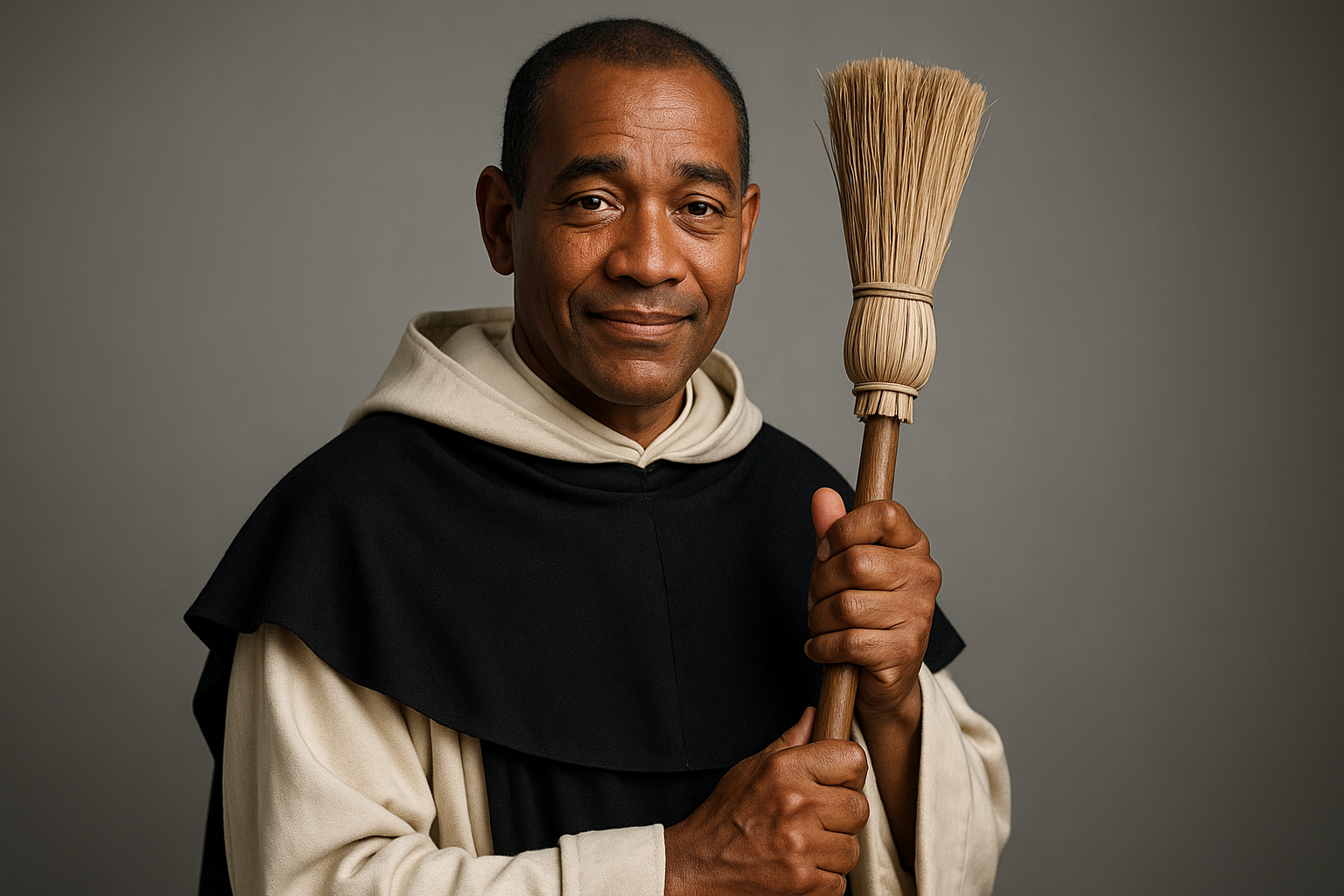
One of the enduring images of St. Martin de Porres is him holding a broom. This seemingly mundane object symbolizes his profound humility and his belief that even the lowliest tasks could be sanctified and offered to God. He famously said, “I assure you, brother, that I should deem myself fortunate if, after all the mercies I have received from God, I should be able, like a poor slave, to die sweeping the infirmary of my convent.” He found holiness not in grand gestures but in faithful, humble service, elevating the ordinary to the extraordinary through his love for God and neighbor.
Spiritual Legacy & Theological Themes
St. Martin de Porres’ spiritual legacy is immense, radiating virtues that profoundly resonate with Scripture and Catholic teaching. At his core, Martin exemplified radical humility, seeing himself as the least among God’s servants. This humility was not self-deprecation but a deep understanding of his dependence on God and a willingness to embrace menial tasks without complaint or desire for recognition. His life eloquently preached that true greatness in God’s eyes lies not in power or status, but in selfless service.
Perhaps his most striking virtue was boundless charity. Martin’s love for God was manifest in his extraordinary love for his neighbor, especially the poor, the sick, and the marginalized. He practiced the corporal works of mercy—feeding the hungry, sheltering the homeless, visiting the sick—with an intensity that knew no social or racial boundaries. He saw Christ in every suffering person, embodying the Gospel message of Matthew 25:40: “Whatever you did for one of the least of these brothers and sisters of mine, you did for me.” His charity was inclusive, challenging the prejudices of his time by treating everyone, regardless of their background, with dignity and respect.
Martin also demonstrated profound obedience and perseverance. Despite the initial societal and institutional barriers to his religious vocation, he persisted in his desire to serve God, accepting the humble role of a donado and later a lay brother. His faithfulness to his vows and his Dominican rule, coupled with his unceasing prayer life, reveal a deep trust in divine providence. He found holiness not by fighting the system directly, but by radiating such intense love and virtue that the system eventually made an exception for him.
Theologically, St. Martin de Porres serves as a powerful symbol of racial justice and unity in Christ. In a colonial society that rigidly enforced racial divisions, Martin’s sanctity transcended these artificial barriers. He demonstrated that grace knows no color, and that holiness is accessible to all who sincerely seek it, regardless of their ancestry. His life is a living refutation of prejudice, proclaiming the inherent dignity of every human person as created in the image of God. He is a testament to the Catholic Church’s teaching that all people are united in the mystical Body of Christ, called to love and serve one another without discrimination.
His influence has spread globally, particularly in communities where issues of racial inequality and poverty are prevalent. He has become a patron saint for those working for social justice and for people of mixed heritage, offering hope and inspiration. Through his example, the Church is reminded of its mission to be a voice for the voiceless and a haven for the oppressed. Devotion to St. Martin continues to encourage believers to find holiness in their daily duties, no matter how small, and to extend Christ’s love to all people, especially those society often overlooks.
Devotion Today
St. Martin de Porres continues to be one of the most beloved saints in the Catholic Church, with devotion spanning continents. His message of humility, charity, and social justice resonates deeply in the modern world.
The primary center of devotion to St. Martin de Porres remains in Lima, Peru, particularly at the Convent of Santo Domingo (also known as the Basilica and Convent of Our Lady of the Rosary), where he lived, worked, and is now entombed. Pilgrims from around the world visit his humble cell, the infirmary where he cared for the sick, and his crypt to venerate his relics and seek his intercession. The atmosphere in the convent is one of profound peace and reverence, inviting visitors to reflect on his simple yet powerful life of service. The Convent also houses a museum dedicated to his life and the lives of other Peruvian saints like St. Rose of Lima.
Outside of Peru, devotion to St. Martin is particularly strong in the Americas, especially in the United States, where he is a powerful symbol for racial harmony and justice. Numerous parishes, schools, and social service organizations are named in his honor. Many communities hold special Masses, novenas, and feast day celebrations on November 3rd. These celebrations often include elements of cultural diversity, reflecting his patronage of mixed-race people and his message of unity.
His image is widely found in homes, churches, and chapels, often depicted with his iconic broom, a dog, cat, and mouse, or tending to the sick. The popular Novena to St. Martin de Porres is prayed by many seeking his intercession for healing, employment, and relief from poverty. His life also inspires numerous charitable initiatives and outreach programs dedicated to helping the poor and promoting racial equality, ensuring that his legacy of practical charity continues to thrive in the 21st century.
Reflections for Modern Readers
St. Martin de Porres’ life, lived centuries ago in a very different world, holds profound lessons that are remarkably relevant for us today. His example calls us to examine our own lives and find ways to integrate his virtues into our daily existence.
1. Embrace Humble Service: Martin found holiness in sweeping floors, caring for the sick, and doing the most overlooked tasks. In our modern society, where glamor and recognition are often highly valued, Martin reminds us that true dignity and spiritual growth can be found in humble, selfless service. Think about the “invisible” tasks in your own home, workplace, or community. How can you perform them with greater care and a spirit of love, offering them up to God? A simple act of cleaning up a shared space without being asked, or helping a colleague quietly, can be a modern “sweeping of the infirmary.”
2. Practice Radical Charity: Martin’s love knew no bounds, no racial barriers, no social status. He cared for everyone, especially the poorest and most despised. In a world often marked by division and indifference, his example challenges us to expand our circle of compassion. How can we reach out to those on the fringes of society, whether they are experiencing homelessness, loneliness, or discrimination? This could mean volunteering at a local shelter, offering a kind word to someone overlooked, or supporting organizations that advocate for social justice. Even small acts of genuine kindness can transform a day, or a life.
3. Persevere Through Prejudice: Martin faced significant discrimination due to his mixed heritage, yet he never allowed bitterness or anger to define him. Instead, he met prejudice with patience, humility, and an unwavering commitment to God. This offers a powerful lesson for navigating our own experiences with injustice or misunderstanding. When faced with unfairness, how can we respond with grace and integrity, trusting in God’s ultimate justice, rather than retaliating with anger? Martin’s life encourages us to be agents of reconciliation and understanding.
4. Find Holiness in the Ordinary: St. Martin de Porres is a powerful testament to the idea that holiness isn’t reserved for priests or nuns, or for those who perform grand, public acts. It’s available to everyone, in every profession, in every daily routine. He found God in the convent’s infirmary, in the garden, and in the streets of Lima. For us, this means seeing our jobs, our family duties, our studies, and even our leisure as opportunities to glorify God and grow in virtue. Every moment, every interaction, can be a prayer if offered with love and intention.
Common Symbols and Their Meanings:
- Broom: This is perhaps his most iconic symbol, representing his profound humility and his dedication to performing even the most menial tasks with love and devotion. It signifies finding holiness in ordinary work.
- Dog, Cat, and Mouse Eating from the Same Dish: This symbolizes his miraculous rapport with animals and his ability to bring harmony and peace even among natural adversaries. It also represents unity, peace, and the breaking down of divisions.
- Crucifix/Rosary: These symbols reflect his deep spiritual life, his devotion to Christ’s passion, and his constant prayer.
- Basket of Food/Bread: Represents his charity and his tireless efforts to feed the hungry and provide for the poor.
- Doctor’s Bag/Medical Instruments: Reflects his training as a barber-surgeon and his compassionate care for the sick and infirm.
- Dominican Habit: Identifies him with his religious order and his commitment to its charism of preaching and service.
Timeline Summary
- 1579 (December 9): Born in Lima, Viceroyalty of Peru, to Don Juan de Porres and Ana Velázquez.
- c. 1590: Apprenticed to a barber-surgeon in Lima, learning medicine and pharmacy.
- 1594: Enters the Dominican Convent of the Most Holy Rosary in Lima as a “donado” (volunteer servant).
- 1603: Professes simple vows as a cooperator (lay) brother, overcoming racial barriers.
- 1603-1639: Serves tirelessly in the convent infirmary, caring for the sick and poor; establishes an orphanage and children’s hospital.
- 1639 (November 3): Dies in Lima at the age of 59.
- 1837: Beatified by Pope Gregory XVI.
- 1962 (May 6): Canonized by Pope John XXIII, becoming the first black saint of the Americas.
Scripture for Reflection
St. Martin de Porres’ life beautifully embodies several key scriptural themes, offering powerful insights for reflection.
- Philippians 2:3-4: “Do nothing out of selfish ambition or vain conceit. Rather, in humility value others above yourselves, not looking to your own interests but each of you to the interests of the others.” This passage perfectly captures Martin’s radical humility and his profound focus on the needs of others, constantly valuing the well-being of the sick and poor above his own comfort or recognition.
- Matthew 25:35-40: “For I was hungry and you gave me something to eat, I was thirsty and you gave me something to drink, I was a stranger and you invited me in, I needed clothes and you clothed me, I was sick and you looked after me, I was in prison and you came to visit me… Truly I tell you, whatever you did for one of the least of these brothers and sisters of mine, you did for me.” This is the very blueprint of Martin’s ministry. He saw Christ in every suffering person he served, tirelessly performing the corporal works of mercy without discrimination.
- Galatians 3:28: “There is neither Jew nor Gentile, neither slave nor free, nor is there male and female, for you are all one in Christ Jesus.” In a society rigidly divided by race and status, Martin’s life and universal charity stood as a living testament to this truth. He treated all people as equals, demonstrating that in Christ, all superficial distinctions fade away, and we are united in love.
Prayers to St. Martin de Porres
Here are some popular prayers to St. Martin de Porres:
Prayer for Humility and Service
To you, St. Martin de Porres, we prayerfully have recourse. You, who were so humble and holy, whose heart burned with the love of God and neighbor, and who showed compassion to all, regardless of their social standing or race. We implore you to intercede for us before the throne of God. Inspire us to embrace humility, to serve others with a generous heart, and to seek holiness in our daily tasks, no matter how small. Help us to overcome prejudice and to see Christ in every person we encounter, especially the poor and the marginalized. Amen.
Prayer for Justice and Peace
O Glorious St. Martin de Porres, who though of humble birth, was endowed with the choicest gifts of Heaven, and who, with burning charity, constant humility, and unflagging patience, worked for the glory of God and the salvation of souls. We appeal to you for your powerful intercession. Inspire us to follow your example in seeking justice for the oppressed, fostering racial harmony, and extending compassion to all suffering humanity. May we, through your prayers, contribute to a world where love triumphs over hatred, and peace reigns supreme. Amen.