In the vast tapestry of Catholic tradition, certain figures shine with an enduring light, illuminating pathways of faith, healing, and divine guidance. Among them stands St. Raphael the Archangel, a celestial messenger whose story, rooted in the ancient Scriptures, continues to resonate with believers today. Unlike many saints whose lives unfolded in specific historical eras, Raphael’s presence is primarily revealed in the biblical Book of Tobit, offering a unique glimpse into the unseen world of angelic intervention. His name, meaning “God heals,” perfectly encapsulates his divine mission as a compassionate companion, a powerful healer, and a steadfast guide. This article will delve into the rich narrative of St. Raphael, exploring his biblical origins, his profound spiritual legacy, and how his timeless virtues continue to inspire devotion and offer hope in the modern world.
Quick Facts
| Category | Detail |
|---|---|
| Existence | Archangel (a pure spirit, created by God before time) |
| Nature | Immortal (does not experience human birth or death) |
| Feast Day | September 29 (shared with Sts. Michael and Gabriel) |
| Patronage | Travelers, pilgrims, blind people, happy meetings, nurses, physicians, medical workers, young people, engaged couples, marriage, drug stores, eye problems, Christian marriage, purity, love, guardian angels. |
| Canonized | Not applicable (Archangel; recognized as holy through divine revelation in Scripture) |
Historical Context & Early Life
To understand St. Raphael, we must journey back to the historical and cultural landscape of the Second Temple Jewish period, roughly between 516 BC and AD 70. This was a time of significant religious and political upheaval for the Jewish people, marked by exile, foreign domination, and a fervent yearning for divine intervention and restoration. During this era, the concept of angels, as God’s divine messengers and protectors, became more prominent in Jewish thought, drawing from earlier biblical texts and developing through oral traditions and intertestamental writings.
The story of Raphael is primarily found in the Book of Tobit, a deuterocanonical (or apocryphal, depending on tradition) book of the Old Testament. While not accepted by all Christian denominations as canonical, it is held as inspired Scripture by the Catholic and Orthodox Churches. The Book of Tobit offers a captivating narrative that reflects the hopes, fears, and daily lives of devout Jews living in diaspora, specifically during the Assyrian exile (8th-7th centuries BC). It paints a vivid picture of a faithful family facing profound trials: blindness, poverty, and demonic affliction. Within this challenging world, the presence of angels like Raphael provided a profound sense of hope and a tangible connection to God’s active involvement in human affairs.
As an archangel, Raphael does not have an “early life” in the human sense. Angels are pure spiritual beings, created by God outside of time and space, possessing intellect and will, but without physical bodies (though they can assume them). They are not born, nor do they die. Their existence is eternal, and their “calling” is inherent in their nature: to serve God, praise Him, and act as His messengers and agents in the created world. St. Raphael, along with St. Michael and St. Gabriel, is one of only three angels mentioned by name in the canonical books of the Bible, signifying his unique and important role in salvation history.
The context of the Book of Tobit underscores key theological themes prevalent at the time: the importance of prayer, almsgiving, trusting in divine providence, and the ever-present reality of spiritual warfare. It is into this world of human struggle and divine care that Raphael descends, a testament to God’s compassionate watch over His faithful children.
Calling & Key Milestones
St. Raphael’s entire mission and “calling” are beautifully unfolded in the Book of Tobit. He is sent by God specifically to bring healing and deliverance to two deeply troubled individuals: Tobit, a righteous but blind and impoverished elder, and Sarah, a young woman plagued by a demon who causes the death of her seven husbands on their wedding nights.
The Mission to Tobit and Sarah
The story begins with Tobit, a devout Jew living in Nineveh, who has fallen blind and is struggling with poverty. He prays fervently to God, asking for death. At the same time, in Media, Sarah, tormented by the demon Asmodeus, also prays for death. God hears both prayers and, in His infinite mercy, dispatches Raphael. The Archangel’s intervention is a powerful demonstration of God’s active involvement in the lives of His suffering children, often working through unseen spiritual agents.
The Journey with Tobias
Tobit, remembering a sum of money he had deposited in Media, sends his son, Tobias, to retrieve it. Unbeknownst to Tobit, the journey is perilous. Raphael, disguised as a human kinsman named Azariah, offers to accompany Tobias as a guide and protector. This disguise is significant; it shows how divine help often comes in unexpected and seemingly ordinary forms. During their journey, Raphael instructs Tobias to catch a large fish from the Tigris River and preserve its heart, liver, and gall. These seemingly mundane items become crucial instruments in God’s plan of healing.
The Healing of Tobit and the Deliverance of Sarah
Raphael guides Tobias to the home of Raguel, Sarah’s father. Knowing Sarah’s predicament, Raphael encourages Tobias to marry her, assuring him that God intends them to be together. Following Raphael’s instructions, Tobias burns the fish’s heart and liver, whose smoke drives away the demon Asmodeus, breaking the curse that had afflicted Sarah. The wedding is joyful, and Tobias receives the money Tobit had stored. Upon their return, Raphael instructs Tobias to rub the fish gall on Tobit’s eyes, restoring his sight. These miracles are not mere magic; they are tangible signs of God’s power working through His chosen messenger and through the humble obedience of His human servants.
Revealing His Identity
Once all tasks are accomplished – Tobit’s sight restored, Sarah freed, the money retrieved, and Tobias and Sarah happily married – Tobit and Tobias offer Raphael payment for his services. It is at this moment that Raphael reveals his true identity: “I am Raphael, one of the seven holy angels who present the prayers of the saints and enter into the presence of the glory of the Holy One” (Tobit 12:15). He explains that he was sent by God to test their faith and to heal them, emphasizing that his actions were not for personal gain but for God’s glory. After delivering this profound message, Raphael ascends, returning to God’s presence. This dramatic revelation underscores the unseen spiritual reality that surrounds human life and the active role angels play as God’s emissaries.
Spiritual Legacy & Theological Themes
St. Raphael’s story is rich with spiritual insights and enduring theological themes that continue to inspire Catholics worldwide. His legacy is one of divine providence, compassionate care, and powerful intercession.
Guidance and Companionship: One of Raphael’s most prominent virtues is his role as a guide and companion. He travels with Tobias, offering advice, protection, and reassurance every step of the way. This exemplifies the Catholic teaching on guardian angels, who are believed to accompany and protect individuals throughout their lives. Raphael shows that God does not abandon us in our journeys but sends help, often in unexpected forms, to light our path.
Healing and Restoration: Raphael’s name itself – “God heals” – points to his primary mission. He brings both physical healing to Tobit (restoring his sight) and spiritual/emotional healing to Sarah (freeing her from demonic oppression). This highlights God’s desire for our holistic well-being – healing not just our bodies, but our minds, spirits, and relationships. Raphael symbolizes God’s restorative power and His compassion for the suffering.
Divine Providence and Trust: The entire Book of Tobit is a testament to God’s providential care. Tobit, Sarah, and Tobias face seemingly insurmountable obstacles, yet through their prayers and trust, God intervenes through Raphael. This teaches us to have faith that God is always at work, even when circumstances seem bleak, and that His plans unfold in His own perfect timing.
Prayer and Almsgiving: Raphael explicitly states that he carries the prayers of Tobit and Sarah to God (Tobit 12:12). This reinforces the power of prayer and the intercessory role of angels. Additionally, Tobit’s consistent practice of almsgiving and charity, even in poverty, is shown to be pleasing to God and a factor in His intervention. The story encourages us to live lives of prayer, charity, and fidelity to God’s commandments.
Sacramental Marriage and Purity: Raphael actively facilitates the marriage of Tobias and Sarah, emphasizing prayer and purity before their marital union. He helps them prepare spiritually for marriage, underscoring the sacredness of this covenant. He is often invoked as a patron for those seeking a spouse, for engaged couples, and for the purity and sanctity of marriage.
Raphael’s lasting influence on devotion is profound. He is revered as the patron of travelers, reminding us of the spiritual journey of life and the need for divine protection. As the “healer of God,” he is a powerful intercessor for the sick, for medical professionals, and for all those involved in the ministry of healing. His story reminds us that heaven and earth are intimately connected, and that God’s angels are always ready to assist those who call upon Him in faith.
Devotion Today
Devotion to St. Raphael the Archangel continues to thrive in the Catholic Church, finding expression in various forms across the globe. He is particularly beloved for his association with healing, safe journeys, and happy unions.
Many hospitals, medical centers, and hospices around the world are named after St. Raphael, recognizing his patronage of medical workers and the sick. These institutions often have chapels dedicated to him, where patients and staff can seek his intercession for healing and comfort. Pilgrimages specifically dedicated to St. Raphael are less common than for some other saints, but his presence is deeply felt at healing shrines and churches that emphasize the sacrament of the Anointing of the Sick.
His feast day, September 29th, is celebrated alongside Sts. Michael and Gabriel, honoring the three archangels mentioned by name in Scripture. On this day, special prayers are offered, and homilies often reflect on their roles as divine messengers and protectors. Many individuals keep holy cards or statues of St. Raphael in their homes, especially by their bedside or in their vehicles, as a reminder of his protective care.
Travelers frequently invoke St. Raphael before embarking on journeys, praying for his guidance and protection. Students in medical fields, nurses, doctors, and all caregivers often pray to him for wisdom, compassion, and skill in their vocations. Engaged couples and those seeking a spouse also turn to St. Raphael, inspired by his role in facilitating the virtuous and blessed marriage of Tobias and Sarah. Novenas (nine-day prayers) to St. Raphael are popular, particularly for intentions related to health, travel, or finding a life partner.
In essence, devotion to St. Raphael today is a living testament to the belief that God sends His angels to assist us in our earthly pilgrimage, bringing light into darkness, healing into sickness, and companionship into loneliness. He serves as a powerful reminder that we are never truly alone, and that divine help is always available through prayer and faith.
Reflections for Modern Readers
St. Raphael’s ancient story holds surprisingly potent lessons for individuals navigating the complexities of the 21st century. His narrative, though fantastical, grounds us in timeless truths about faith, human relationships, and divine care.
-
Embrace God’s Providence in the Unexpected: Raphael’s arrival in Tobit’s story is entirely unexpected. He appears as a simple guide, yet he orchestrates profound healing and restoration. For modern readers, this teaches us to remain open to God’s hand working in surprising ways. When faced with challenges or uncertainties – a job loss, a difficult diagnosis, a relationship struggle – look for the “Azariah” in your life: the unexpected mentor, the timely friend, the new opportunity that emerges from difficulty. Real-world example: A young professional struggling to find direction after graduation might feel lost. Then, a seemingly random networking event leads to a conversation that sparks a new career path, or an old friend connects them with a perfect opportunity. This isn’t just luck; it can be God’s providence, working through ordinary channels, just as Raphael worked through Azariah.
-
Seek Holistic Healing: Raphael brings healing not just physically (Tobit’s blindness) but also spiritually and emotionally (Sarah’s torment). In an age focused heavily on physical and mental health, Raphael reminds us of the interconnectedness of our being. We are called to seek healing in all aspects of our lives – through medical care, therapy, prayer, spiritual direction, and healthy relationships. Real-world example: Someone struggling with chronic illness might meticulously follow their doctor’s advice, but also finds solace and strength in prayer groups, spiritual reading, or counseling, recognizing that true healing encompasses more than just the body.
-
Value True Companionship and Mentorship: Raphael served as a guide, protector, and mentor to Tobias. His journey highlights the immense value of having wise and trustworthy companions in life. In our increasingly isolated digital world, the story encourages us to cultivate deep, supportive relationships and to be willing to both seek and offer mentorship. Real-world example: A student facing a significant life decision might seek advice from a trusted teacher, family member, or spiritual director. Like Raphael, these individuals offer wisdom, protection from pitfalls, and encouragement to make virtuous choices.
-
Pray for and Recognize Spiritual Assistance: Raphael’s revelation reminds us that we are not alone in our struggles. God has sent angels to assist us. This reflection calls us to greater awareness of the spiritual realm and to cultivate a habit of prayer, asking for angelic intercession and divine guidance. Real-world example: Before a challenging interview or a difficult conversation, someone might silently offer a prayer to St. Raphael for clarity, wisdom, and a “happy meeting.” While we may not see angels, trusting in their intercession can bring a profound sense of peace and confidence.
Common Symbols and Representations of St. Raphael:
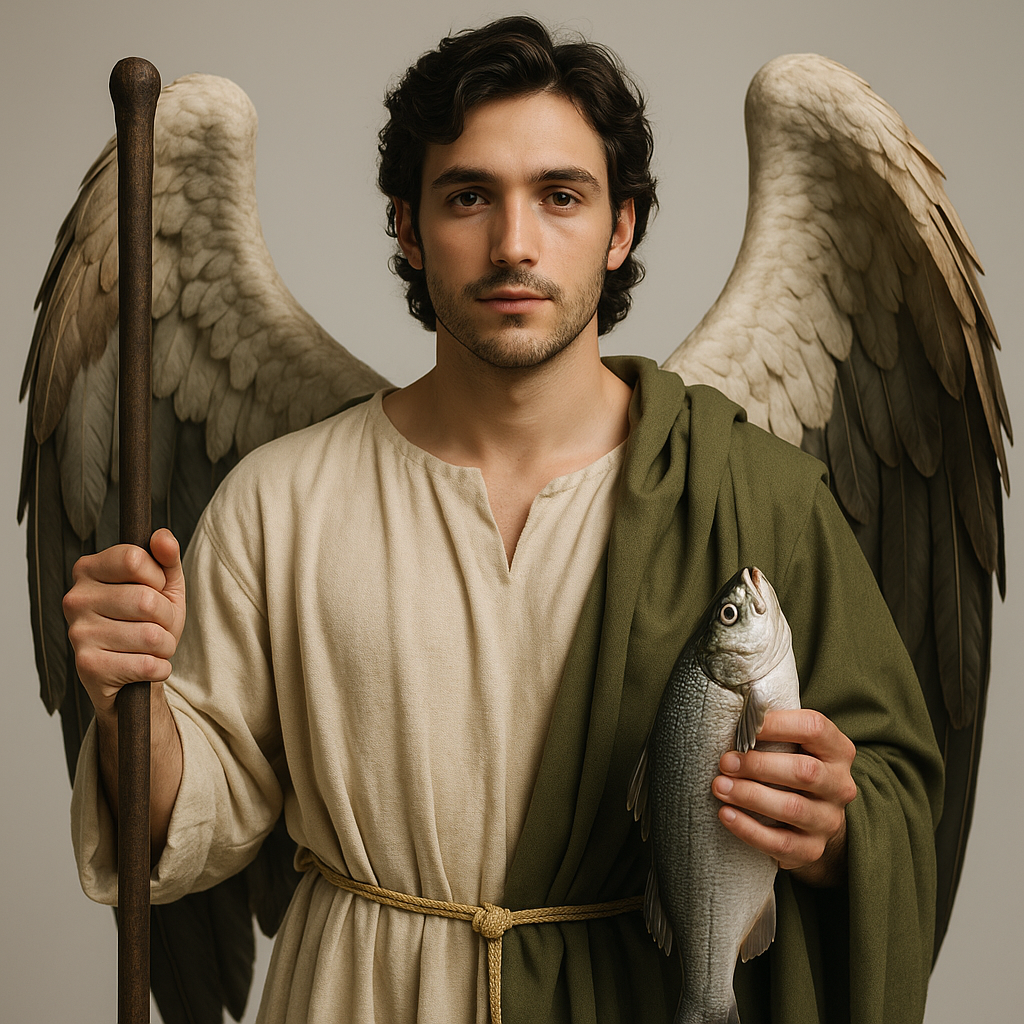
- Staff or Pilgrim’s Staff: This is a primary symbol, representing his role as a guide and protector of travelers and pilgrims. It signifies direction, support, and a safe journey.
- Fish: The fish is directly from the Book of Tobit. It symbolizes healing (the gall healed Tobit’s blindness), deliverance from evil (the heart and liver drove away the demon), and provision. It’s a reminder of God’s power working through humble means.
- Flask or Vial: Often depicted carrying a flask or vial, this symbolizes his role as a healer and his association with medicine. It can also represent the anointing oil used in healing.
- Youthful Appearance: St. Raphael is often depicted as a beautiful, youthful angel, sometimes with wings, to emphasize his heavenly nature and the vigor with which he carries out God’s will.
- Scallop Shell: While often associated with St. James, the scallop shell can also be seen with Raphael due to his patronage of pilgrims and travelers.
Timeline Summary
- Ancient Times (Pre-Exile): God creates Raphael as an Archangel, a pure spirit destined to serve and praise Him.
- Assyrian Exile (circa 8th-7th Century BC): Tobit, a devout Jew, lives in Nineveh, falls blind, and prays for death. Sarah, in Media, is tormented by a demon and also prays for death.
- God Hears Prayers: God sends Raphael to heal Tobit and deliver Sarah.
- Tobias’s Journey (Disguised Companionship): Tobit sends his son Tobias to retrieve money in Media. Raphael appears disguised as Azariah, a human kinsman, and offers to accompany Tobias.
- Encounter with the Fish: During the journey, Raphael instructs Tobias to catch a fish and preserve its heart, liver, and gall.
- Marriage to Sarah & Deliverance: Raphael guides Tobias to Raguel’s home. He instructs Tobias to burn the fish’s heart and liver, driving away the demon Asmodeus and freeing Sarah. Tobias and Sarah marry.
- Return and Healing of Tobit: Tobias returns with Sarah and the money. Following Raphael’s instructions, Tobias applies the fish gall to Tobit’s eyes, restoring his sight.
- Raphael Reveals His Identity: After his mission is complete, Raphael reveals his true angelic nature, stating he is “Raphael, one of the seven holy angels who present the prayers of the saints.” He then ascends.
- Early Christian Era: The Book of Tobit is included in the Septuagint and later accepted into the canon of the Catholic and Orthodox Churches, solidifying Raphael’s place in tradition.
- Medieval Period: Devotion to angels, including Raphael, grows, with theological treatises and artistic representations becoming more common.
- 16th Century: Feast day for St. Raphael is established by Pope Clement VIII.
- 20th Century: Feast day unified with Sts. Michael and Gabriel on September 29th, recognizing the collective importance of the Archangels.
- Present Day: St. Raphael continues to be revered as the patron of travelers, healers, and happy meetings, inspiring prayers for guidance, healing, and holy matrimony.
Scripture for Reflection
The primary source for understanding St. Raphael is the Book of Tobit. Here are a few passages that beautifully illuminate his role and the spiritual themes he embodies:
Tobit 12:6-7:
“Then the angel said to them, ‘Bless God; give thanks to him; proclaim his greatness and praise him in the presence of all the living for what he has done for you. It is good to praise God and to exalt his name, worthily to proclaim his works with reverence. Therefore, do not be slow to give him thanks. It is good to guard the secret of a king, but gloriously to reveal the works of God. Do good, and evil will not overtake you.'”
Reflection: This passage, spoken by Raphael while still in disguise, emphasizes the importance of giving thanks and praising God, even amidst hardship. It reminds us that our good deeds are a way of glorifying God and that divine protection is often linked to our fidelity and trust.
Tobit 12:12-15:
“When you and Sarah prayed, it was I who presented the record of your prayer before the glory of the Lord; and likewise whenever you would bury the dead. And because you were trying God and were righteous, I was sent to test you. And now God has sent me to heal you and Sarah your daughter-in-law. I am Raphael, one of the seven holy angels who present the prayers of the saints and enter into the presence of the glory of the Holy One.”
Reflection: This is Raphael’s powerful revelation. It highlights his direct role as an intercessor, bringing our prayers before God. It also reveals that even trials can be a test of faith from which God intends good, and that angels are actively involved in God’s plan of healing and salvation.
Tobit 12:20:
“So now bless the Lord on earth, and give thanks to God. Behold, I am ascending to him who sent me; write down all these things that have happened to you.”
Reflection: Raphael’s final instruction reinforces the call to continuous praise and thanksgiving. His ascension reminds us that angels are messengers from a higher realm, and their work ultimately points us back to God, the source of all good.
Prayers to St. Raphael the Archangel
Prayer for Travelers
Glorious Archangel St. Raphael, great prince of the heavenly court, you are illustrious for your gifts of wisdom and grace. You are a guide of those who journey by land or sea or air, consoler of the afflicted, and refuge of sinners. I entreat you, assist me in all my needs and in all the sufferings of this life, as you once helped young Tobias on his travels. Because you are the “medicine of God,” I humbly pray you to heal the many infirmities of my soul and the ills that afflict my body. I especially ask of you the favor of (mention your intention here), and the grace of purity so that I may be made fit to be the temple of the Holy Spirit. Amen.
Prayer for Healing
Blessed Saint Raphael, Archangel of God, I call upon you for your assistance. You are known as the divine healer and a guide on our earthly pilgrimage. Just as you restored sight to Tobit and drove away the demon from Sarah, I ask for your intercession in my life and for those I love. I pray for physical healing, for spiritual strength, and for emotional peace. Be my companion on life’s journey, protecting me from all harm and leading me closer to God’s will. Through your prayers, may I experience the healing grace of God and grow in faith and love. Amen.