In the vast tapestry of Catholic saints, few shine with the serene yet powerful light of St. Scholastica. Often overshadowed by her more famous twin brother, St. Benedict, Scholastica nevertheless stands as a pivotal figure in the history of Christian monasticism, particularly for women. Her life, though less documented, is a testament to the profound strength found in prayer, sisterly love, and unwavering dedication to God. This article will delve into the historical backdrop of her era, trace her spiritual journey, explore her enduring legacy, and offer reflections that speak to the hearts of modern believers, illuminating why this sixth-century abbess continues to inspire devotion and contemplation today.
Quick Facts
| Category | Detail |
|---|---|
| Birth | c. 480 AD in Nursia (modern Norcia, Italy) |
| Death | c. 543 AD near Monte Cassino, Italy |
| Feast Day | February 10 |
| Patronage | Benedictine nuns, sisters, women in religious orders, children, convulsive children, storms, rain |
| Canonized | Pre-Congregation (Venerated as a saint from ancient times) |
Historical Context & Early Life
St. Scholastica was born around the year 480 AD in Nursia, a town nestled in the Sabine Mountains of what is now central Italy. This was a tumultuous period in European history. The mighty Roman Empire, once the dominant power, had officially fallen in the West just a few years before Scholastica’s birth, giving way to a fragmented landscape of barbarian kingdoms and shifting allegiances. While political structures crumbled, the Christian Church emerged as a beacon of stability and spiritual guidance, often filling the vacuum left by imperial decline.
In this era of change and uncertainty, a new spiritual movement was gaining momentum: monasticism. Individuals sought to escape the chaos of the world and dedicate themselves fully to God through prayer, solitude, and communal living. Scholastica’s family, part of the Roman nobility, provided a fertile ground for this spiritual inclination. Her parents were devout and well-respected, instilling in their children a deep faith and a commitment to virtuous living. Scholastica was the twin sister of St. Benedict of Nursia, who would become one of the most influential figures in Western monasticism. From an early age, both siblings displayed an extraordinary piety and a profound longing for God, sensing a higher calling beyond the comforts of their aristocratic upbringing.
While details of Scholastica’s early childhood are scarce, it is reasonable to assume she received a good education, typical for noble Roman daughters of her time. More importantly, she was deeply influenced by her brother, Benedict. As Benedict grew and eventually renounced his worldly prospects to live a life of prayer and asceticism, Scholastica’s own spiritual path began to clarify. Their bond was not merely familial but profoundly spiritual, a sacred connection that would shape the course of Western monasticism for centuries to come.
Calling & Key Milestones
Following Her Brother’s Path
Inspired by her brother Benedict’s commitment to a life dedicated entirely to God, Scholastica too felt a powerful call to religious life. While Benedict established his first monasteries for men, eventually settling at Monte Cassino, Scholastica chose a similar path of consecration. She gathered a community of like-minded women, establishing a convent about five miles from her brother’s monastery at Monte Cassino. This community is traditionally recognized as the first monastery for Benedictine nuns, making Scholastica a pivotal co-founder of the Benedictine Order for women. Her commitment reflected a growing desire among women in the early Church to live lives of prayer, study, and service outside of traditional family structures, dedicating themselves wholly to God.
Founding the First Benedictine Nunnery
Scholastica’s decision to found a women’s community was a significant milestone. It provided a structured, communal environment where women could pursue their spiritual aspirations in imitation of the desert mothers and fathers, adapting the monastic ideal to their specific needs and capacities. While the exact rules she followed are not as explicitly documented as Benedict’s Rule, it is widely believed that her community lived by a rule very similar to, if not directly based upon,, her brother’s guidance, emphasizing prayer, work, and communal life. Her leadership was characterized by wisdom, gentleness, and an unshakeable faith, fostering an environment where spiritual growth could flourish. This foundation laid the groundwork for countless women’s religious communities that would follow, spreading the Benedictine charism throughout Europe.
The Annual Meeting
Despite living in separate communities, Scholastica and Benedict maintained their deep spiritual bond and brotherly-sisterly affection. It became their custom to meet once a year. Because women were not permitted within the confines of the monastery proper, their meetings took place at a house nearby, where they would spend the day in prayer, spiritual conversation, and theological discussion. These meetings were sacred times for both, opportunities to share insights, strengthen each other in faith, and discuss the spiritual life and the challenges of leading their respective communities. These encounters highlight not only their personal devotion but also the importance of spiritual companionship and guidance in the early monastic movement.
The Miracle of the Storm
The most famous story concerning St. Scholastica, and one that beautifully encapsulates her spiritual power, occurred during their final annual meeting. As evening approached, Benedict, ever mindful of his monastic rule, prepared to depart. Scholastica, however, feeling an intuitive sense that this would be their last meeting on earth, pleaded with him to stay until morning so they could continue their spiritual conversation. Benedict, adhering strictly to his own rules, refused, explaining that he could not spend the night outside his monastery.
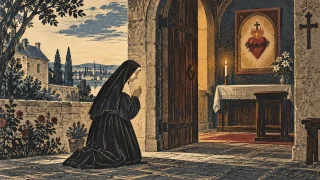
Undeterred by his refusal, Scholastica bowed her head and earnestly prayed to God, asking for divine intervention. Immediately, the sky, which had been perfectly clear, erupted into a violent thunderstorm. Lightning flashed, and torrential rain poured down, making it impossible for Benedict and his companions to leave the house. Seeing this sudden and powerful storm, Benedict exclaimed, “May Almighty God forgive you, sister, what have you done?” Scholastica, with a serene smile, replied, “I asked you, and you would not listen; I asked my Lord, and He did listen. Now go, if you can, leave me and return to your monastery.” Benedict and his monks were forced to remain until morning, allowing the twins to continue their profound spiritual discourse.
This miracle, recounted by Pope St. Gregory the Great in his Dialogues, is more than just a tale of a sudden storm. It illustrates the immense power of prayer, especially prayer fueled by love and fervent desire. It suggests that, in God’s eyes, the bond of spiritual love and companionship can sometimes take precedence over even the strictest human rules. It also highlights Scholastica’s deep intimacy with God, demonstrating that her faith was so profound that God heard and answered her plea in a dramatic and undeniable way.
Holy Death and Heavenly Vision
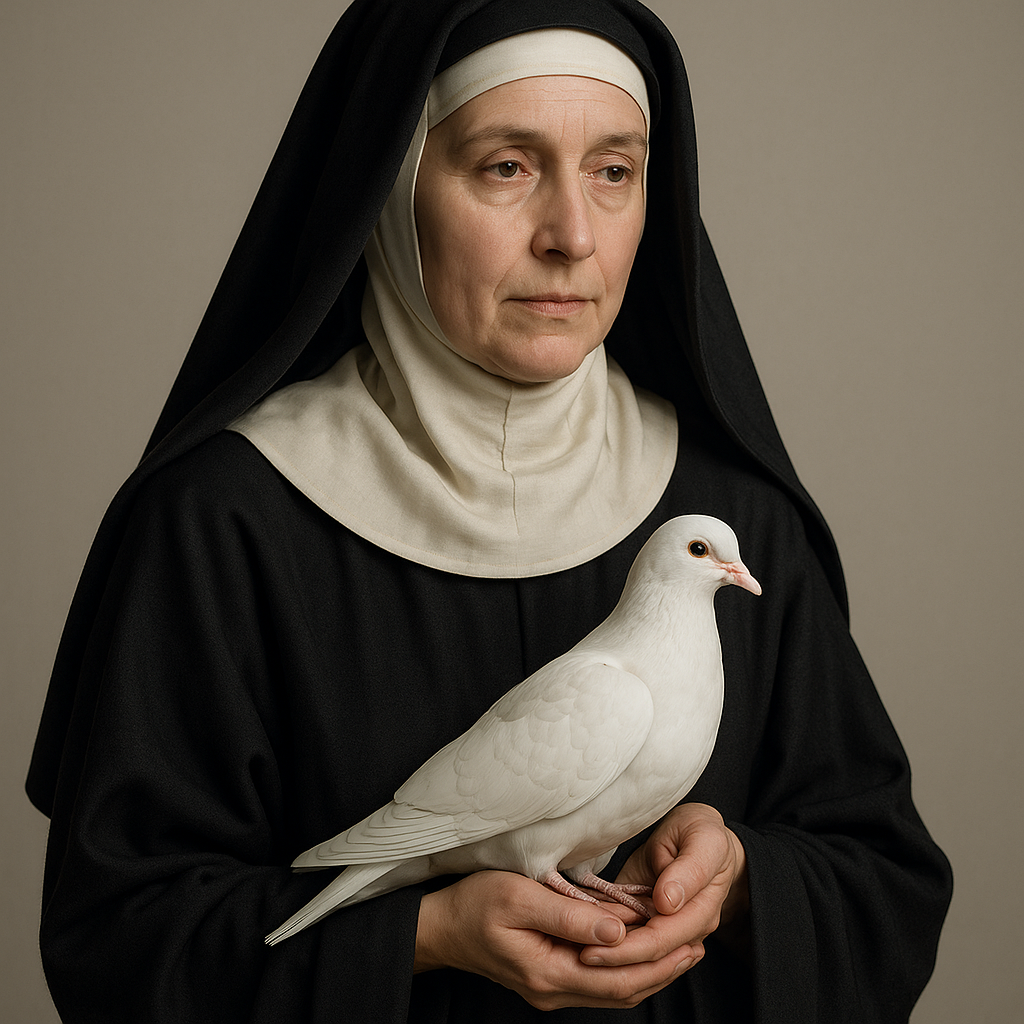
Three days after their last meeting, St. Scholastica passed away. As she breathed her last, St. Benedict, who was in his cell at Monte Cassino, had a remarkable vision. He saw his sister’s soul, transformed into a dazzling white dove, ascending to heaven. This vision was a powerful confirmation for Benedict of Scholastica’s sanctity and her immediate entry into eternal glory. He immediately sent his monks to retrieve her body, which was then laid to rest in his own tomb at Monte Cassino, a testament to their enduring spiritual connection and his recognition of her holiness. Their shared tomb symbolizes their shared spiritual journey and their integral roles in the foundation of Western monasticism.
Spiritual Legacy & Theological Themes
St. Scholastica’s spiritual legacy is profound, though often understood through the lens of her brother’s more extensive writings and influence. She embodies several core virtues that resonate deeply with Scripture and Catholic teaching, offering a powerful model for all Christians.
Sisterly Love and Spiritual Friendship: The most striking aspect of Scholastica’s story is her deep, spiritual bond with Benedict. Their annual meetings and the miracle of the storm emphasize that genuine, holy friendship, especially between those dedicated to God, is a profound gift. This love extends beyond mere affection; it is a spiritual communion that strengthens faith and fosters growth, echoing the Christian call to love one another (John 13:34-35).
The Power of Prayer: Scholastica’s ability to call down a storm through prayer is a dramatic illustration of the efficacy of fervent, faith-filled prayer. It teaches us that God truly listens to the petitions of His faithful, especially those offered with a pure heart and for a good spiritual purpose. This aligns with Jesus’ teaching that “whatever you ask in prayer, believe that you have received it, and it will be yours” (Mark 11:24).
Contemplation and the Interior Life: Like her brother, Scholastica embraced the monastic ideal, dedicating her life to prayer, meditation, and seeking God in solitude and community. She exemplifies the importance of the contemplative life, recognizing that true strength and wisdom come from an intimate relationship with God, nurtured through silence and reflection. Her life teaches us the value of “choosing the better part,” like Mary at the feet of Jesus, prioritizing spiritual nourishment over worldly distractions (Luke 10:38-42).
Obedience to God’s Will: While Benedict adhered to his monastic rule, Scholastica, through her prayer, sought God’s will above human regulations. Her action, though seemingly defiant of Benedict’s rules, was an act of profound obedience to a higher spiritual impulse – the desire for deeper communion with God and her spiritual sibling. This highlights that true obedience is ultimately to God’s promptings within the heart.
Her lasting influence is most visible in the continued existence and flourishing of Benedictine nuns and sisters around the world. She is seen as the mother and patroness of women’s monasticism within the Benedictine tradition. Her story has inspired countless women to embrace consecrated life, providing a template for communal prayer, spiritual discipline, and devotion. In art, she is frequently depicted alongside her brother, emphasizing their joint contribution to monasticism, or with a dove, symbolizing her pure soul and divine favor.
Devotion Today
St. Scholastica continues to be a beloved and revered saint in the Catholic Church, particularly within Benedictine communities. Her feast day, February 10th, is celebrated with special reverence in monasteries and convents worldwide, often marked by prayer services, reflections on her life, and communal meals. She is frequently invoked as a patroness of Benedictine nuns, sisters, and all women in religious orders, serving as an inspiring model of dedication, spiritual leadership, and profound faith.
Although there are no major pilgrimage sites exclusively dedicated to St. Scholastica distinct from her brother’s, her presence is deeply felt at Monte Cassino in Italy, where she is buried alongside St. Benedict. Pilgrims to Monte Cassino inevitably pay homage to both saints, recognizing their intertwined legacies. Her sacred relics are venerated there, drawing pilgrims who seek her intercession for spiritual guidance, for strength in religious vocation, or for her patronage against storms and for rain.
Beyond monastic circles, devotion to St. Scholastica is widespread among the faithful. Many individuals pray to her for assistance in fostering spiritual friendships, for the gift of perseverance in prayer, and for guidance in discerning God’s will. She is also a popular patron saint for children, particularly those suffering from convulsions, and is invoked in times of severe weather, reflecting the miracle of the storm attributed to her powerful intercession. Her story serves as a reminder of the quiet yet immense power of a life lived for God, nurtured by prayer and holy love.
Reflections for Modern Readers
St. Scholastica, though living in a vastly different world, offers timeless lessons that resonate powerfully with contemporary believers. Her life speaks to the universal human search for meaning, connection, and divine intimacy.
1. Prioritize Spiritual Friendship: Scholastica’s relationship with Benedict highlights the profound importance of spiritual friends—people who uplift our faith, challenge us to grow, and walk with us on our journey to God. In an age of digital connections, we are called to cultivate genuine, faith-centered relationships that nourish our souls. For example, actively seek out a friend or a small group with whom you can share your faith struggles and triumphs, supporting each other in prayer and good works.
2. Embrace the Power of Persistent Prayer: The miracle of the storm reminds us that fervent, heartfelt prayer is incredibly powerful. When facing difficult decisions, personal challenges, or the needs of others, Scholastica teaches us to pray with unwavering faith, trusting that God hears and responds, perhaps not always in the way we expect, but always for our ultimate good. Instead of giving up when prayers aren’t immediately answered, follow Scholastica’s example and persist, pouring out your heart to God with confidence.
3. Seek Balance Between Structure and Spirit: Benedict was bound by his monastic rule, while Scholastica, through her prayer, sought a deeper spiritual connection. This tension reminds us that while rules, routines, and disciplines are valuable for spiritual growth, they should never overshadow the living, dynamic relationship with God or the promptings of divine love. Modern readers can reflect on balancing their daily commitments and structured religious practices with moments of spontaneous prayer, quiet contemplation, and acts of love inspired by the Holy Spirit.
4. Recognize God’s Presence in the Everyday: Scholastica’s life, though culminating in a dramatic miracle, was primarily one of quiet dedication and prayer. Her story shows that sanctity isn’t just for those who perform grand public acts, but for those who faithfully live out their calling each day. We can find holiness in our daily tasks, our interactions with family and colleagues, and our moments of personal prayer, transforming the ordinary into opportunities for divine encounter.
5. Trust in Divine Providence: Scholastica’s unwavering faith during her final request to Benedict demonstrates deep trust that God’s plan would unfold, even if it meant a miraculous intervention. This encourages us to trust in God’s loving providence during times of uncertainty, believing that He is at work in all circumstances for our good.
Common Symbols and Their Meaning:
- Dove: The most common symbol, representing her soul ascending to heaven as seen by St. Benedict, signifying purity, peace, and the Holy Spirit.
- Crozier or Abbess’s Staff: Symbolizes her role as an abbess and spiritual leader of her community of nuns.
- Book of Rules (often with a lily): Represents her adherence to monastic life, often presumed to be a rule similar to Benedict’s, with the lily symbolizing purity.
- Rain or Storm Clouds: Directly references the miracle she performed, showing the power of her prayer.
Timeline Summary
- c. 480 AD: Born in Nursia, Italy, twin sister of St. Benedict.
- Early 6th Century: Dedicates her life to God, inspired by her brother’s monastic calling.
- c. 520s-530s AD: Establishes a community of nuns near Monte Cassino, traditionally recognized as the first Benedictine nunnery.
- Annually: Meets with St. Benedict at a house near Monte Cassino for spiritual discussion.
- c. 543 AD: Has her final meeting with St. Benedict; performs the miracle of the storm through prayer, preventing his departure.
- c. 543 AD (Three days after the miracle): Dies peacefully; St. Benedict witnesses her soul ascending to heaven as a white dove.
- c. 543 AD: Buried in St. Benedict’s own tomb at Monte Cassino.
- Ancient Times: Universally venerated as a saint.
Scripture for Reflection
Luke 10:38-42 (The Story of Mary and Martha):
“Now as they went on their way, Jesus entered a village; and a woman named Martha received him into her house. And she had a sister called Mary, who sat at the Lord’s feet and listened to his teaching. But Martha was distracted with much serving; and she went to him and said, ‘Lord, do you not care that my sister has left me to serve alone? Tell her then to help me.’ But the Lord answered her, ‘Martha, Martha, you are anxious and troubled about many things; one thing is needful. Mary has chosen the good portion, which shall not be taken away from her.'”
Connection: This passage beautifully reflects Scholastica’s emphasis on the contemplative life and prioritizing spiritual communion with God. Like Mary, Scholastica chose the “better part”—a life dedicated to listening to God, prayer, and deep spiritual intimacy, even when practical matters (like Benedict’s monastic rule) seemed to demand her brother’s departure. Her life reminds us of the profound value of stillness and presence before God.
James 5:16b (The Power of Prayer):
“…The prayer of a righteous person has great power as it is working.”
Connection: This verse directly illuminates the miracle of the storm attributed to St. Scholastica. Her fervent, righteous prayer, stemming from a life consecrated to God, had immense power, prompting a dramatic divine response. It affirms the Catholic teaching on the intercessory power of saints and the efficacy of earnest prayer from those close to God.
Prayers to St. Scholastica
Prayer to St. Scholastica
O Glorious St. Scholastica,
You who opened your heart to God in profound prayer
and who loved your brother, St. Benedict,
with a true spiritual affection,
we come to you today seeking your powerful intercession.
You who through your tearful plea brought forth a mighty storm,
demonstrating the power of unwavering faith and love,
hear our humble prayers.
We ask you, dear saint, to intercede for us before the throne of God.
Help us to grow in faith, hope, and charity.
Inspire us to seek a deeper relationship with God through prayer and contemplation,
and to cultivate holy friendships that nourish our souls.
Protect us from spiritual and physical storms,
and grant us the grace to always choose what is pleasing to God
above all earthly considerations.
May your example lead us to a life of peace, holiness, and constant devotion.
Through Christ our Lord. Amen.
Another Short Prayer to St. Scholastica
St. Scholastica, glorious virgin, twin sister of St. Benedict,
you were innocent in life,
a profound mystic in prayer,
and powerful with God.
Intercede for us in our needs,
especially for a deeper love of God
and for the grace of spiritual friendship.
Teach us to persist in prayer and to trust in God’s loving providence.
Amen.