In the vibrant, sometimes turbulent, dawn of Christianity, a man named Stephen emerged as a shining example of faith and courage. He wasn’t one of the original twelve apostles, but his story is foundational to understanding the early Church. St. Stephen is revered as the Protomartyr – the very first person to die for his belief in Jesus Christ. His life, a powerful testament to service and truth, and his death, a dramatic witness to unwavering devotion, continue to inspire believers across the globe. This article will delve into his historical context, his significant calling, his lasting spiritual legacy, and how his extraordinary story still resonates with us in the modern world, offering timeless lessons in faith, forgiveness, and selfless service.
Quick Facts
| Category | Detail |
|---|---|
| Birth | Circa early 1st century AD (exact date unknown), likely in Judea or the Hellenistic diaspora. |
| Death | Circa 34 AD, Jerusalem (stoned to death). |
| Feast Day | December 26th (the day after Christmas). |
| Patronage | Deacons, stonemasons, headaches, casket makers, victims of stoning, horses. |
| Canonized | By acclamation of the early Church (Pre-Congregation). |
Historical Context & Early Life
To truly appreciate St. Stephen, we must transport ourselves back to Jerusalem in the years immediately following Jesus’s Resurrection and Ascension. This was a time of intense spiritual fervor and rapid growth for the fledgling Christian community. The Holy Spirit had descended at Pentecost, empowering the Apostles and drawing thousands into belief. However, this period was also fraught with challenges, both internal and external.
Internally, the early Church was a diverse group, primarily composed of Jews who had converted to Christianity. There were two main linguistic and cultural groups: the “Hebrews,” who spoke Aramaic (the local language) and followed Jewish customs closely, and the “Hellenists,” who were Greek-speaking Jews from the diaspora. The Hellenists often felt marginalized, particularly when it came to the daily distribution of food and aid to the widows and the poor. This was a significant issue, as the early Christians practiced communal living, sharing their resources to support all members.
Externally, the nascent Christian movement faced suspicion and hostility from the established Jewish authorities, particularly the Sanhedrin (the high court) and the Sadducees, who saw the Christians’ teachings about Jesus as a threat to their religious traditions and political standing with the Roman Empire. The Roman Empire, while generally tolerant of various religions, kept a watchful eye on any movement that could incite unrest.
Stephen himself was a Hellenistic Jew, meaning he likely grew up speaking Greek and was familiar with Greek culture, even if he lived in Jerusalem. His background gave him a unique perspective and perhaps made him particularly sensitive to the needs of the Hellenistic widows within the Christian community. We know little about his family background or specific formative experiences before he appears in the Acts of the Apostles, but his eloquence and deep understanding of Jewish Scripture suggest a robust religious education. He was clearly a man of profound faith and spiritual insight, qualities that would soon be put to the ultimate test.
Calling & Key Milestones
Chosen as a Deacon
The first major milestone in Stephen’s life, as recorded in Acts 6, came as a direct response to the internal tensions within the early Church. As the number of disciples grew, a complaint arose among the Hellenistic Jews: their widows were being overlooked in the daily distribution of food. The Apostles, recognizing that their primary mission was “prayer and the ministry of the word,” realized they couldn’t effectively manage both spiritual leadership and practical administration. They called upon the community to “select from among you seven men of good reputation, full of the Spirit and of wisdom, whom we may appoint to this task” (Acts 6:3).
Stephen was among the seven chosen, prominently listed first. The description of him as “a man full of faith and the Holy Spirit” highlights his exceptional spiritual qualities. These men, often considered the first deacons, were brought before the Apostles, who prayed over them and laid their hands on them – an act of ordination that formally consecrated them for this new ministry of service. This moment was crucial, establishing a new order of ministry within the Church focused on charitable service and practical assistance, allowing the apostles to focus on preaching and teaching.
Ministry of Charity and Preaching
While the deacons were initially appointed to serve tables, Stephen’s ministry quickly expanded beyond this administrative role. Acts 6:8 states, “And Stephen, full of grace and power, was performing great wonders and signs among the people.” He became a powerful evangelist, using his eloquence and deep knowledge of Scripture to proclaim the Gospel. His Greek background allowed him to engage effectively with other Hellenistic Jews in their synagogues, debating and persuading them about Jesus as the Messiah. His arguments were so compelling and his wisdom so evident that his opponents “were unable to cope with the wisdom and the Spirit with which he was speaking” (Acts 6:10).
The Charges and Trial
Stephen’s powerful preaching and the “wonders and signs” he performed inevitably drew the ire of those who resisted the Christian message. Certain members of the “Synagogue of the Freedmen” (Jews who had been slaves and were now free, likely from Cyrene, Alexandria, Cilicia, and Asia) rose up against him. Unable to defeat him in debate, they resorted to false accusations. They secretly instigated men to claim that Stephen was speaking “blasphemous words against Moses and against God” (Acts 6:11). They stirred up the people, the elders, and the scribes, leading to Stephen’s arrest. He was brought before the Sanhedrin, the same high court that had condemned Jesus.
At his trial, false witnesses testified, alleging that Stephen had said Jesus would destroy the Temple and change the customs handed down by Moses. As Stephen stood before his accusers, the members of the Sanhedrin “saw his face like the face of an angel” (Acts 6:15), a detail that emphasizes his divine composure and inner peace in the face of grave danger.
Stephen’s Powerful Defense
Stephen’s response to the charges is recorded in Acts 7 and is the longest speech in the book of Acts. It’s not a simple denial but a masterclass in biblical interpretation and prophetic indictment. He meticulously recounts the history of Israel from Abraham through Moses, the patriarchs, and the prophets, demonstrating God’s consistent intervention and Israel’s repeated resistance to His will and His messengers. He argues that God’s presence is not confined to the Temple, citing Solomon’s own words that “the Most High does not dwell in houses made by human hands” (Acts 7:48).
His speech culminates in a scathing rebuke of his accusers: “You stiff-necked people, uncircumcised in heart and ears, you are forever opposing the Holy Spirit; you are just like your ancestors. Which of the prophets did your ancestors not persecute? They killed those who announced beforehand the coming of the Righteous One, whose betrayers and murderers you have now become” (Acts 7:51-52). This bold declaration connected their rejection of Jesus with a long history of rejecting God’s prophets.
Martyrdom: The First Witness
Stephen’s words struck his listeners with fury. As they gnashed their teeth, Stephen, “full of the Holy Spirit, gazed into heaven and saw the glory of God, and Jesus standing at the right hand of God” (Acts 7:55). He proclaimed his vision, a profound experience of Christ’s triumph and his own impending communion with Him. This declaration was the final straw for the Sanhedrin; to them, it was outright blasphemy.
They rushed at him, dragged him out of the city, and began to stone him, the traditional Jewish punishment for blasphemy. As the stones rained down, Stephen, echoing the very words of Jesus on the cross, prayed, “Lord Jesus, receive my spirit!” and then, kneeling down, he cried out with a loud voice, “Lord, do not hold this sin against them!” (Acts 7:59-60). Having uttered these words of forgiveness, he died. Among those present, consenting to his death, was a young man named Saul, who would later become the great Apostle Paul, a detail that adds profound irony and significance to Stephen’s martyrdom. Stephen’s death was not just an end but a powerful beginning, igniting a wave of persecution that scattered Christians and, paradoxically, spread the Gospel even further.
Spiritual Legacy & Theological Themes
St. Stephen’s life and death left an indelible mark on the early Church and continue to inform Catholic theology and devotion today. He epitomized several core virtues that align deeply with Scripture and Catholic teaching.
Unwavering Faith and Courage: Stephen’s entire narrative is a testament to profound faith. From his selection as a deacon, filled with the Holy Spirit, to his powerful preaching and, ultimately, his serene acceptance of martyrdom, he never wavered. His vision of Jesus at the right hand of God before his death underscores the reality of his faith, providing him supernatural strength in his final moments. This courage, rooted in faith, is a powerful reminder of Christ’s words: “Do not be afraid of those who kill the body but cannot kill the soul” (Matthew 10:28).
Selfless Service (Diakonia): As one of the first deacons, Stephen embodies the spirit of diakonia, or service. While his role expanded to preaching, his initial calling was to serve the practical needs of the community, ensuring justice for the vulnerable. This highlights the Church’s commitment to both spiritual and corporal works of mercy, showing that service to others is not secondary but integral to the Christian life. Deacons today continue this legacy, serving in liturgy, word, and charity.
Witness to Truth (Martyrdom): Stephen is the Protomartyr, meaning “first witness.” The Greek word for witness is martyria, from which we get “martyr.” His death wasn’t just a tragic event but a supreme act of witness to the truth of Christ’s resurrection and divinity. He bore witness not only through his words but through his willingness to die for those words. This act established the enduring theme of martyrdom in Christian history, where shedding one’s blood for Christ is seen as the ultimate act of fidelity and love, participating in Christ’s own sacrifice.
Forgiveness of Enemies: Perhaps one of Stephen’s most profound acts was his final prayer: “Lord, do not hold this sin against them!” This echoes Jesus’s prayer from the cross (“Father, forgive them, for they know not what they do” – Luke 23:34). It demonstrates a complete spiritual transformation, showing that true Christian love extends even to those who persecute and kill. This act of forgiveness is a cornerstone of Christian ethics and a challenging, yet essential, call to all believers.
Stephen’s lasting influence is immense. He set the precedent for Christian martyrdom, inspiring countless saints throughout history. His story cemented the role of the deacon in the Church, highlighting the dignity and importance of serving the community. The dramatic account of his death, with Saul (Paul) looking on, is also seen as a crucial moment in the narrative of St. Paul’s conversion, suggesting that Stephen’s witness, though initially rejected, planted a seed that would later blossom into the conversion of one of Christianity’s greatest apostles. His eloquent defense before the Sanhedrin also stands as a powerful example of how to articulate Christian faith within a hostile environment, using Scripture and historical context to make a compelling case for Jesus Christ.
Devotion Today
St. Stephen’s prominence as the Protomartyr has ensured his enduring veneration throughout Christian history, particularly within the Catholic Church. His feast day, celebrated on December 26th, the day after Christmas, is strategically placed to emphasize the link between Christ’s birth and the sacrifice of His followers. It serves as a stark reminder that the joy of Christmas is intertwined with the call to discipleship, which can entail suffering for the faith.
Devotion to St. Stephen is widespread. Numerous churches around the world are dedicated to him, many of them ancient, particularly in the Holy Land, Rome, and throughout Europe. One of the most significant sites is the Church of St. Stephen in Jerusalem, traditionally built over the site of his martyrdom. Another prominent site is the Basilica di Santo Stefano Rotondo al Celio in Rome, one of the oldest circular churches, which once housed his relics. Pilgrims to these sites often reflect on his unwavering faith and courage.
As the patron saint of deacons, stonemasons, and those suffering from headaches (due to the stoning), he is frequently invoked. Deacons, especially, look to him as their archetypal model of service and evangelization. Many Catholic families name their children Stephen in his honor, and his feast day is a beloved tradition in many cultures, sometimes including acts of charity or special prayers. His story is also a staple in catechesis, teaching young people about the sacrifices made by early Christians and the call to courageous witness.
Reflections for Modern Readers
St. Stephen’s story, though set nearly two millennia ago, offers profound and actionable lessons for us living in the 21st century. His life and death challenge us to examine our own faith and how we live it out in a complex world.
- Speak Truth with Courage and Charity: Stephen didn’t shy away from proclaiming the truth about Jesus, even when it was unpopular and dangerous. In a world often confused by conflicting messages, we are called to articulate our faith clearly and lovingly, using our intellect and the guidance of the Holy Spirit. This doesn’t mean being aggressive, but rather being firm in our convictions, much like Stephen, who spoke with both wisdom and grace. For example, in conversations about difficult moral issues, we can share Catholic teaching with compassion and clarity, rather than shying away or being confrontational.
- Embrace Service to the Vulnerable: Stephen was chosen to serve the poor and neglected. This foundational act reminds us that genuine faith is active. In our busy lives, it’s easy to overlook those in need. Stephen’s example calls us to actively seek out opportunities to serve, whether it’s volunteering at a food bank, advocating for the marginalized, or simply being attentive to the needs of our neighbors. It reminds us that Christian service isn’t just for ordained ministers; it’s a call for all believers.
- Practice Forgiveness, Even Towards Opponents: Stephen’s final prayer for his persecutors is perhaps his most powerful legacy. In a world often driven by retribution and division, his act of forgiveness stands as a radical challenge. When we encounter conflict, injustice, or even personal attacks, Stephen’s example encourages us to pray for those who wrong us, to release bitterness, and to seek reconciliation rather than retaliation. This doesn’t mean condoning evil, but it frees our own hearts and reflects Christ’s love. For instance, in a heated online debate, instead of responding with anger, we can choose to pray for the person who offends us and respond with grace.
- Live as a Witness to Christ’s Presence: Stephen’s face shone like an angel, and he saw Jesus in heaven even as he was being stoned. His entire life was a witness to Christ, culminating in his death. For us, witnessing means living a life that reflects our faith, allowing Christ’s light to shine through our actions, words, and attitudes. It’s about demonstrating peace, joy, and hope, even amidst challenges, so that others might see Christ in us. This could be as simple as maintaining a positive attitude at work, being honest in all dealings, or offering encouragement to someone who is struggling.
Symbols and Representations:
In art and jewelry, St. Stephen is often depicted with several key symbols:
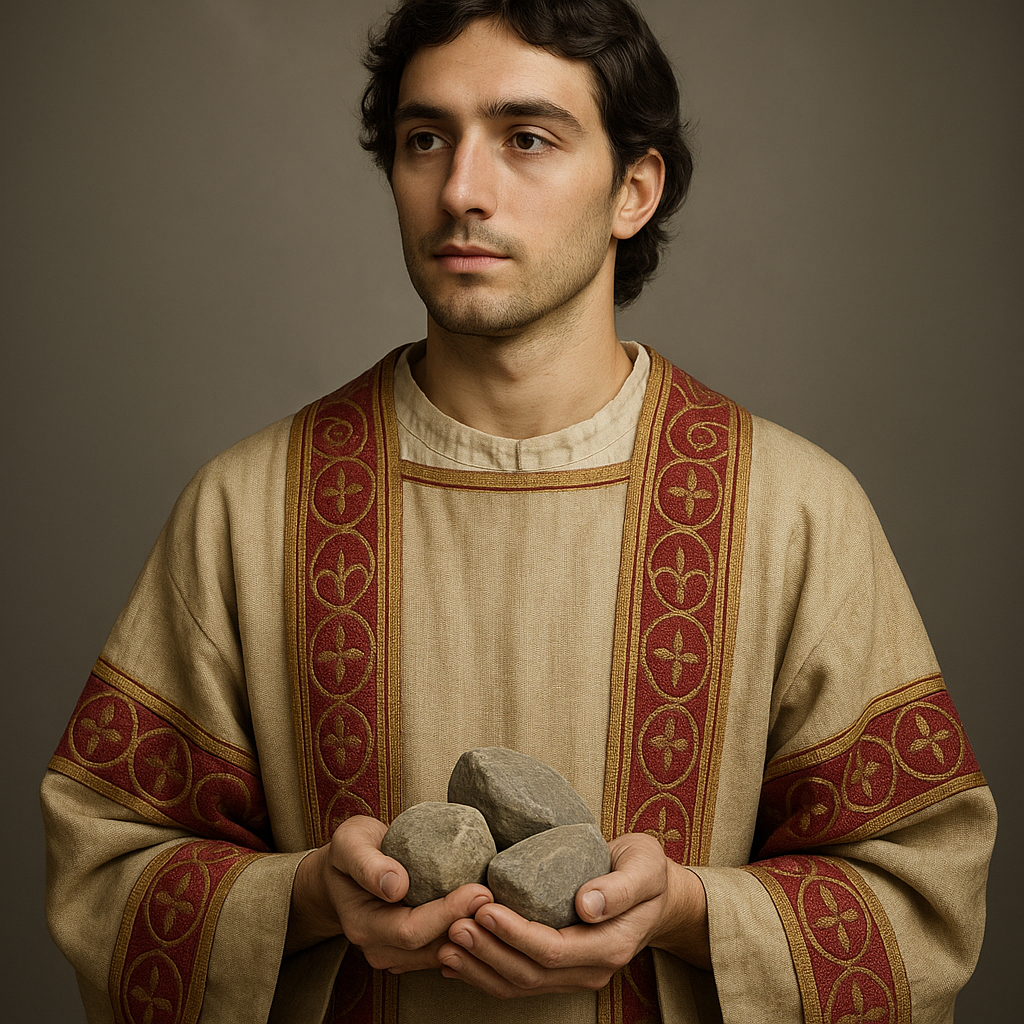
- Stones: The most common symbol, representing the manner of his martyrdom. He is often shown with stones on his head, shoulders, or in his hands.
- Palm Branch: A universal symbol of martyrdom, signifying victory over death through faith.
- Dalmatic: He is frequently shown wearing a dalmatic, the liturgical vestment of a deacon, emphasizing his role as one of the first deacons.
- Censer: Sometimes, he is shown holding a censer, a vessel for burning incense, which is used in liturgical worship and represents prayer rising to God, a function often performed by deacons.
- Book of Gospels: Less common but sometimes present, signifying his powerful preaching and defense of the Gospel.
These symbols not only help us identify St. Stephen but also serve as visual reminders of his virtues and his ultimate sacrifice for Christ.
Timeline Summary
- Circa early 1st Century AD: Stephen is born, likely a Hellenistic Jew.
- Circa 33-34 AD: Following Pentecost, the early Christian community grows rapidly in Jerusalem.
- Acts 6:1-6: Stephen is chosen as one of the first seven deacons to address the needs of Hellenistic widows, ordained by the Apostles.
- Acts 6:8-10: Stephen, full of grace and power, performs wonders and signs, and preaches with great wisdom, defeating opponents in debate.
- Acts 6:11-15: False witnesses are brought against Stephen, accusing him of blasphemy against Moses and the Temple. He is brought before the Sanhedrin, and his face shines like an angel’s.
- Acts 7:1-53: Stephen delivers his long, powerful defense before the Sanhedrin, recounting Israel’s history and rebuking his accusers for resisting the Holy Spirit and persecuting prophets.
- Acts 7:54-60: Stephen sees a vision of Jesus at the right hand of God, declares it, and is dragged out of the city and stoned to death. He prays for his persecutors and for Jesus to receive his spirit.
- December 26th: His feast day is established, becoming one of the oldest and most prominent saints’ feast days after the Apostles.
Scripture for Reflection
The story of St. Stephen is primarily found in the Acts of the Apostles, offering direct insights into his life and spiritual significance.
Acts 6:3-5 (The Call to Service):
“Therefore, friends, select from among yourselves seven men of good standing, full of the Spirit and of wisdom, whom we may appoint to this task. But we will devote ourselves to prayer and to serving the word.” What they said pleased the whole community, and they chose Stephen, a man full of faith and the Holy Spirit, together with Philip, Prochorus, Nicanor, Timon, Parmenas, and Nicolaus, a proselyte from Antioch.
This passage illustrates Stephen’s initial calling and the foundational principle of diaconal ministry within the Church – a ministry rooted in service, wisdom, and the Holy Spirit. It reminds us that spiritual gifts are given for the benefit of the community, especially the most vulnerable.
Acts 7:55-60 (Vision and Forgiveness):
But filled with the Holy Spirit, he gazed into heaven and saw the glory of God and Jesus standing at the right hand of God. “Look,” he said, “I see the heavens opened and the Son of Man standing at the right hand of God!” But they cried out with a loud shout and stopped their ears and rushed together against him. Then they dragged him out of the city and began to stone him; and the witnesses laid their coats at the feet of a young man named Saul. While they were stoning Stephen, he prayed, “Lord Jesus, receive my spirit.” Then he knelt down and cried out in a loud voice, “Lord, do not hold this sin against them.” When he had said this, he died.
This powerful excerpt captures the climax of Stephen’s life – his divine vision, his courageous proclamation, and his Christ-like act of forgiveness towards his persecutors. It underscores the ultimate witness of martyrdom and the transforming power of the Holy Spirit, allowing Stephen to mirror Jesus’s own prayer from the cross.
Matthew 5:44 (Love of Enemies):
But I say to you, love your enemies and pray for those who persecute you.
While not directly about Stephen, this verse from Jesus’s Sermon on the Mount perfectly illuminates Stephen’s final act of forgiveness. Stephen lived out this challenging command of Christ to its fullest, offering a concrete example of what it means to love one’s enemies and pray for those who inflict harm, even in the face of death.
Prayers to St. Stephen
Prayer to St. Stephen, First Martyr
O glorious Saint Stephen,
who, full of faith and the Holy Spirit,
didst serve the poor and proclaim the truth of Christ;
who didst behold the heavens opened and Jesus standing at the right hand of God;
and who didst bravely endure a martyr’s death,
forgiving your persecutors even as they stoned you.
Inspire us, we pray, to emulate your courage in bearing witness to Christ,
to serve with selfless love, especially those in need,
and to embrace the spirit of forgiveness in our hearts.
Grant us steadfast faith in times of trial,
and fill us with the Holy Spirit,
that we may always strive to live according to God’s will,
and one day join you in seeing the glory of God.
Through Christ our Lord. Amen.