In a world grappling with immense intellectual shifts and the darkest shadows of war, one woman’s journey stands as a beacon of profound truth-seeking and unwavering faith. St. Teresa Benedicta of the Cross, born Edith Stein, traversed an extraordinary path from brilliant philosopher and atheist to a Catholic convert, Carmelite nun, and ultimately, a martyr. Her life, marked by an intense pursuit of knowledge and a deep surrender to God’s will, offers invaluable lessons for navigating complex questions of faith, reason, and suffering. This article will explore her fascinating early life, her pivotal conversion, her profound spiritual legacy, and how her enduring witness continues to inspire devotion and reflection in our modern world.
Quick Facts
| Category | Detail |
|---|---|
| Birth | October 12, 1891, Breslau, German Empire (now Wrocław, Poland) |
| Death | August 9, 1942, Auschwitz concentration camp |
| Feast Day | August 9 |
| Patronage | Europe; Loss of parents; Martyrs; Converts; Philosophers; Jewish people; victims of genocide; those seeking truth. |
| Canonized | October 11, 1998, by Pope John Paul II |
Historical Context & Early Life
Edith Stein was born into a German-Jewish family in Breslau, a bustling industrial and cultural city in the German Empire, on Yom Kippur, the holiest day of the Jewish calendar. Her birth in 1891 placed her squarely in a period of immense change in Europe. The early 20th century was an era of unprecedented intellectual ferment, scientific advancement, and philosophical upheaval. Traditional religious beliefs were increasingly questioned in the wake of Darwinian science and new psychological theories. Intellectuals often gravitated toward secularism or new philosophical movements that sought to find meaning outside established religious frameworks.
In Germany, a rising sense of nationalism and underlying antisemitism, though not yet fully manifest in the horrors of Nazism, simmered beneath the surface of what was considered an enlightened society. Edith’s family was well-to-do and deeply respected in the Jewish community. Her father, a successful timber merchant, died when she was just two, leaving her remarkable mother, Auguste Stein, to raise eleven children and manage the family business. Auguste was a devout, intelligent, and strong-willed woman whose faith deeply influenced the family’s life, though Edith herself would later recount her early childhood as being very observant but losing her faith during adolescence. By her teenage years, Edith declared herself an atheist, driven by an acute intellectual honesty and a frustration with what she perceived as religious formalities without substance. Despite this, the values of hard work, intellectual rigor, and social responsibility were deeply ingrained in her.
From an early age, Edith displayed an extraordinary intellect. She excelled in school, demonstrating a passion for philosophy, psychology, history, and German literature. Her independent spirit and keen mind led her to university studies at a time when higher education for women was still a relatively new concept. She studied at the University of Breslau, Göttingen, and Freiburg, becoming a brilliant student of phenomenology, a philosophical school founded by Edmund Husserl. This rigorous intellectual training would shape her lifelong pursuit of truth, even as it initially led her away from, rather than towards, religious belief.
Calling & Key Milestones
Early Academic Career & Philosophy
Edith Stein’s academic journey began with a fierce dedication to philosophy. She became a student and later an assistant to Edmund Husserl, one of the most influential philosophers of the 20th century. Phenomenology, which focused on the direct experience of phenomena and sought to describe the structures of consciousness, captivated her. Her doctoral dissertation, “On the Problem of Empathy,” completed in 1916 with Husserl as her supervisor, was a groundbreaking work that explored how we understand the inner lives of others. It remains an important contribution to philosophy and psychology today. She was a prominent figure in Husserl’s “Göttingen Circle” of students and colleagues, known for her sharp intellect and profound insights. Despite her brilliance, as a woman and a Jew, her path to a professorship was blocked in the male-dominated and often antisemitic German academic world of her time.
Conversion to Catholicism
The turning point in Edith’s life came dramatically in the summer of 1921. While visiting friends, she picked up the autobiography of St. Teresa of Ávila, a 16th-century Spanish Carmelite mystic. She read it through the night. “When I had finished the book,” she later recalled, “I said to myself: This is the truth.” This moment marked a profound shift from her intellectual search for truth to a spiritual encounter with it. St. Teresa’s candid account of her spiritual journey, her struggles, and her intimate relationship with God resonated deeply with Edith’s own existential questions. She realized that the truth she had sought so diligently in philosophy was ultimately found in God, revealed through the Catholic faith.
This was not a sudden emotional conversion but the culmination of years of intellectual searching and exposure to various forms of Christian spirituality through friends and colleagues. She was baptized into the Catholic Church on January 1, 1922. Her conversion brought both immense joy and sorrow, particularly for her beloved mother, who struggled to understand her daughter’s departure from Judaism.
Baptism & Teaching Career
Following her baptism, Edith desired to enter religious life immediately, specifically with the Discalced Carmelites, drawn by the same spirit that had called St. Teresa of Ávila. However, her spiritual directors advised her to postpone this, believing her intellectual gifts could serve the Church more effectively in the secular world. For the next eleven years, from 1923 to 1933, she taught at a Dominican girls’ school in Speyer. During this period, she also dedicated herself to extensive studies in Catholic theology and philosophy, translating St. Thomas Aquinas’s “De Veritate” (On Truth) and deepening her own philosophical and theological writings. She lectured widely on women’s issues, education, and the relationship between phenomenology and scholastic philosophy, challenging prevailing secular views and advocating for a holistic approach to human development rooted in faith.
Entry into Carmel
As the political situation in Germany darkened with the rise of Nazism, Edith’s opportunities to teach and lecture diminished. In 1933, the Nazis enacted laws that barred “non-Aryans” from civil service positions, which effectively ended her teaching career. Sensing the escalating danger and feeling a renewed call to contemplative life, she sought permission to enter the Carmelite monastery in Cologne. On October 14, 1933, she entered the convent, taking the religious name Sister Teresa Benedicta of the Cross (Teresa Blessed by the Cross). This name profoundly reflected her understanding of Christian life – embracing suffering as a path to union with Christ. She saw her entry into Carmel not as an escape from the world’s troubles, but as a deeper engagement with them through prayer and sacrifice, specifically offering herself for the Jewish people.
Writings & Theological Contributions
Within the cloister, Sister Teresa Benedicta continued her profound intellectual work, now deeply integrated with her spiritual life. Her major work, “Finite and Eternal Being” (Endliches und Ewiges Sein), completed in 1936, was a synthesis of Husserlian phenomenology and Thomistic metaphysics, exploring the relationship between human existence and God’s being. She also translated St. John Henry Newman’s “Letters and Journals.” Her final, unfinished work, “The Science of the Cross” (Kreuzeswissenschaft), was a study of St. John of the Cross, written while she was experiencing her own “dark night.” These works demonstrate her unique ability to bridge secular philosophy and Catholic theology, making her an important intellectual figure in the Church.
Persecution & Martyrdom
As the Nazi persecution of Jews intensified, the safety of Jewish converts even within convents became precarious. In 1938, as a direct response to Kristallnacht, when synagogues and Jewish businesses were destroyed throughout Germany and Austria, Sister Teresa Benedicta’s superiors transferred her to the Carmelite monastery in Echt, Netherlands, hoping she would be safer there. However, the Netherlands was invaded by the Nazis in May 1940. In 1942, in retaliation for a pastoral letter read in Dutch churches condemning the Nazi treatment of Jews, all Catholic converts of Jewish origin in the Netherlands were arrested. Sister Teresa Benedicta and her sister Rosa, who had also converted and was working at the convent, were arrested by the Gestapo on August 2, 1942. Eyewitnesses described her composure and strength during her arrest, comforting others. She was sent to the transit camp of Westerbork and then deported to Auschwitz. Sister Teresa Benedicta of the Cross, along with her sister and hundreds of other Jewish converts, was murdered in the gas chambers of Auschwitz on August 9, 1942. She died offering her life for her people and for Christ, truly living out the name she had chosen.
Spiritual Legacy & Theological Themes
St. Teresa Benedicta of the Cross exemplified several core virtues that align deeply with Scripture and Catholic teaching. Foremost among these was her relentless pursuit of truth. From her early philosophical investigations to her conversion and profound theological writings, she sought truth with an uncompromising intellectual honesty. This aligns with Christ’s declaration, “I am the way, and the truth, and the life” (John 14:6), demonstrating that all truth ultimately leads to God.
Another central theme of her life was redemptive suffering. Her chosen religious name, “Benedicta of the Cross,” underscored her conviction that suffering, united with Christ’s passion, has immense redemptive power. She lived this belief fully, offering her life as a sacrifice for her people and for peace. This resonates with St. Paul’s teaching: “Now I rejoice in my sufferings for your sake, and in my flesh I am filling up what is lacking in Christ’s afflictions for the sake of his body, that is, the church” (Colossians 1:24).
Her life also represents a powerful synthesis of faith and reason. She believed that genuine faith could embrace rigorous intellectual inquiry, and that true reason could lead one to God. Her work integrated phenomenology with scholastic theology, showing that philosophy and theology are not at odds but can mutually enrich each other, a theme consistently upheld by the Church, notably in Pope John Paul II’s encyclical Fides et Ratio.
Finally, her witness of courage and solidarity in the face of immense evil stands as a powerful testament to Christian love. She could have potentially escaped the Holocaust, but she chose to remain with her people, both Jewish and Christian. Her life and death were an act of profound solidarity, embodying the Gospel call to love one’s neighbor and even one’s enemies, and to lay down one’s life for others.
Her lasting influence is multifaceted. She is a revered figure for intellectuals, demonstrating how a powerful mind can serve God. She is a patron of Europe, her life bridging cultures and embodying the hope for reconciliation. Her witness is crucial for interfaith dialogue, particularly between Catholics and Jews, highlighting the shared roots and complex history. Her mystical theology continues to guide those seeking a deeper understanding of prayer and union with God, making her a “Doctor of the Church” in spirit, if not yet in title. Her writings offer a rich resource for understanding the human person, God, and the integration of the spiritual and intellectual life.
Devotion Today
Devotion to St. Teresa Benedicta of the Cross continues to grow, particularly among scholars, converts, and those committed to interfaith dialogue. Her feast day on August 9th is observed globally, marking the day of her martyrdom. Many Carmelite monasteries around the world hold special Masses and prayers in her honor. Her life’s journey from a Jewish atheist philosopher to a Catholic nun and martyr makes her a unique and compelling figure for modern devotion.
There are several significant places of pilgrimage associated with her. The Carmelite monastery in Cologne, Germany, where she entered religious life, is a special place of remembrance. The Carmelite monastery in Echt, Netherlands, where she sought refuge, also holds a deep significance, as it was her last monastic home before her arrest. Perhaps the most poignant site is the Auschwitz-Birkenau Memorial and Museum in Poland, where she perished. While not a traditional pilgrimage site in the devotional sense, many visit it to bear witness to the unspeakable horrors of the Holocaust and to remember the millions, including St. Teresa Benedicta, who died there. Her former home in Breslau (Wrocław, Poland) is now a museum and a center for dialogue and education, further cementing her legacy.
Her story is frequently shared in educational settings, from Catholic schools to university philosophy and theology departments, inspiring students to pursue truth fearlessly and to integrate their faith with their intellectual lives. She is often invoked by individuals facing difficult decisions, those struggling with faith, or those grappling with the mystery of suffering, offering a powerful example of trust in God’s plan.
Reflections for Modern Readers
St. Teresa Benedicta of the Cross offers profound lessons for contemporary life:
- Embrace the Search for Truth: Edith Stein’s journey began with an insatiable intellectual curiosity that led her through philosophy and eventually to the Catholic faith. For modern readers, this means being open to exploring difficult questions, even if they challenge our preconceptions. It encourages us to seek truth diligently in all areas of life, trusting that genuine inquiry will ultimately lead us closer to God. For instance, in an age of misinformation, her commitment to rigorous intellectual honesty is a powerful reminder to seek out verifiable truth rather than settling for easy answers or echo chambers.
- Find Meaning in Suffering: Her final years were marked by intense suffering, which she embraced as a participation in Christ’s passion. This teaches us that suffering, though painful, can be transformed into a source of grace and redemptive power when united with Christ. In a world that often tries to avoid or numb pain, St. Teresa Benedicta invites us to look for God’s presence even in our darkest moments, offering our difficulties for the good of others or the Church. For someone facing chronic illness or personal loss, her example can provide a framework for finding spiritual purpose amidst hardship.
- Integrate Faith and Reason: As both a brilliant philosopher and a profound mystic, she bridged the gap between intellect and spirituality. She shows us that faith is not a blind leap, but a reasonable choice that can be deeply enriched by thoughtful reflection and study. This is vital in a secularized world that often pits science against religion. We can follow her example by engaging thoughtfully with our faith, studying theology, and seeing intellectual pursuits as ways to glorify God, rather than fearing they will undermine belief. For example, a Catholic scientist can see their work as uncovering God’s creation, rather than a challenge to their faith.
- Live with Courage and Conviction: In the face of overwhelming evil, St. Teresa Benedicta held firm to her faith and her identity, ultimately sacrificing her life. Her courage reminds us to stand firm in our convictions, to speak out against injustice, and to live authentically, even when it is difficult or dangerous. Her witness challenges us to examine where we might compromise our values for convenience or comfort. For a young person navigating social pressures or moral dilemmas, her unwavering integrity provides a powerful role model.
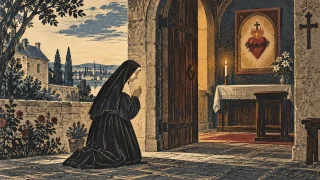
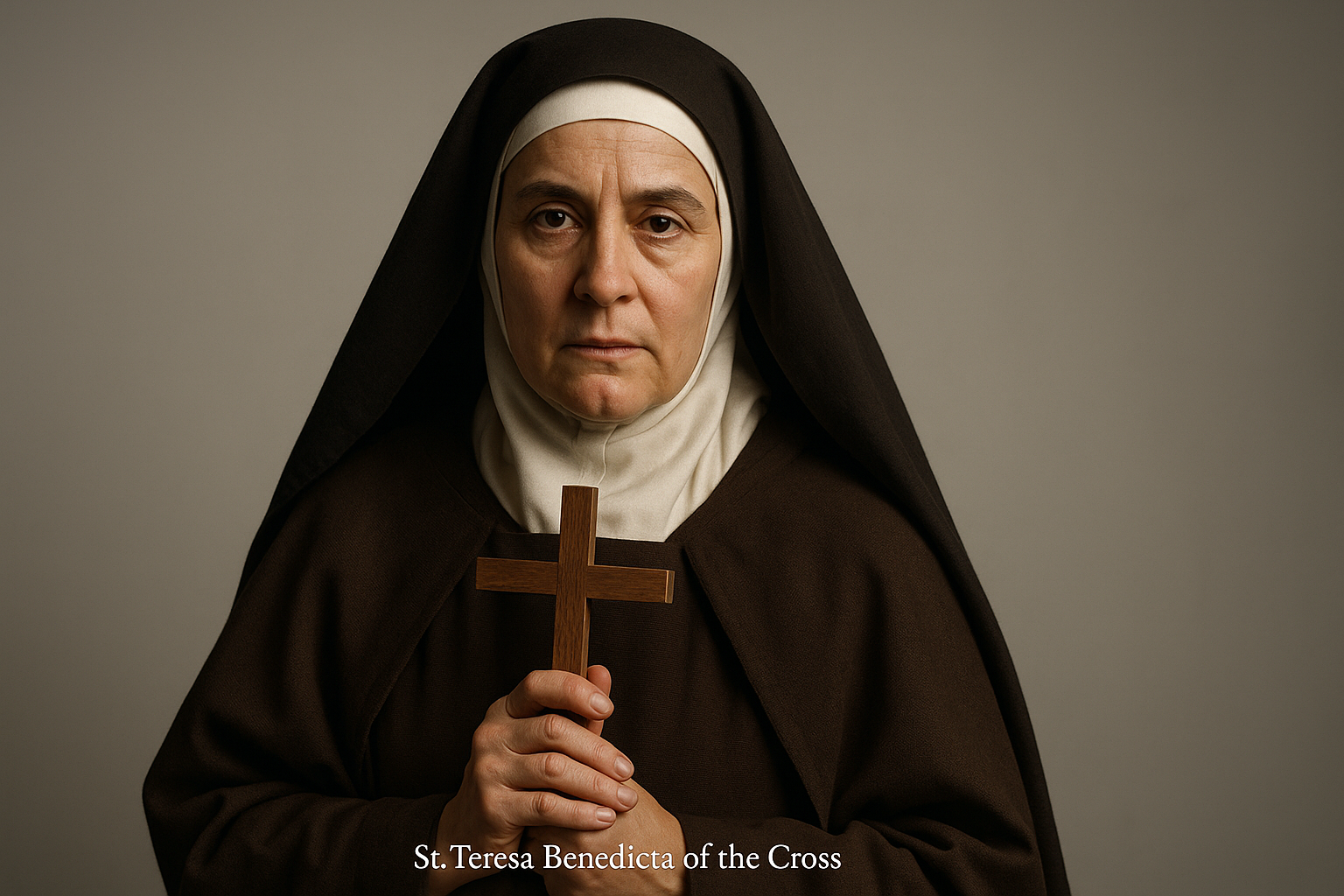
In art and jewelry, St. Teresa Benedicta of the Cross is often depicted in her Carmelite habit, symbolizing her religious vocation and her commitment to a contemplative life. She is also frequently shown with a cross, sometimes prominently held, representing her chosen name “Benedicta of the Cross” and her profound theology of redemptive suffering. The Star of David may appear in some representations, subtly acknowledging her Jewish heritage and the tragic circumstances of her martyrdom, bridging her two identities. Often, she is portrayed with books or scholarly scrolls, signifying her intellectual prowess and her contributions to philosophy and theology. Less common, but potent, are images that hint at her final days, perhaps a faint outline of a concentration camp fence in the background, reminding us of her ultimate sacrifice and her solidarity with all victims of persecution.
Timeline Summary
- 1891 (October 12): Born Edith Stein in Breslau, German Empire, on Yom Kippur.
- 1911: Begins studies at the University of Breslau, later moving to Göttingen to study with Edmund Husserl.
- 1916: Completes her doctoral dissertation, “On the Problem of Empathy,” summa cum laude, under Husserl at Freiburg.
- 1917-1918: Serves as Husserl’s assistant, works on his papers.
- 1921 (Summer): Reads St. Teresa of Ávila’s autobiography, leading to her decision to convert.
- 1922 (January 1): Baptized into the Catholic Church.
- 1923-1931: Teaches at the Dominican sisters’ school in Speyer, Germany.
- 1932: Becomes a lecturer at the Institute for Scientific Pedagogy in Münster.
- 1933 (April): Forced to resign from her teaching position due to Nazi anti-Jewish laws.
- 1933 (October 14): Enters the Carmelite monastery in Cologne, taking the name Sister Teresa Benedicta of the Cross.
- 1936: Completes her major philosophical work, “Finite and Eternal Being.”
- 1938 (December 31): Transferred to the Carmelite monastery in Echt, Netherlands, for safety after Kristallnacht.
- 1942 (August 2): Arrested by the Gestapo in Echt, along with her sister Rosa and other Jewish converts.
- 1942 (August 9): Murdered in the gas chambers at Auschwitz-Birkenau.
- 1987 (May 1): Beatified by Pope John Paul II in Cologne.
- 1998 (October 11): Canonized as a saint by Pope John Paul II in Rome.
- 1999 (October 1): Proclaimed a co-patroness of Europe by Pope John Paul II.
Scripture for Reflection
St. Teresa Benedicta’s life powerfully illuminates several scriptural themes:
- John 14:6: “Jesus said to him, ‘I am the way, and the truth, and the life. No one comes to the Father except through me.'” Edith Stein’s relentless intellectual search for truth ultimately led her to Christ. This passage reflects her conviction that all authentic inquiry, when pursued with integrity, ultimately points towards the ultimate Truth found in Jesus.
- Colossians 1:24: “Now I rejoice in my sufferings for your sake, and in my flesh I am filling up what is lacking in Christ’s afflictions for the sake of his body, that is, the church.” This verse perfectly encapsulates St. Teresa Benedicta’s theology of redemptive suffering, particularly her offering of her life for her Jewish people and for the Church. She understood her personal suffering not as an end, but as a participation in Christ’s saving work.
- Philippians 3:7-8: “But whatever gain I had, I counted as loss for the sake of Christ. Indeed, I count everything as loss because of the surpassing worth of knowing Christ Jesus my Lord. For his sake I have suffered the loss of all things and count them as rubbish, in order that I may gain Christ.” This passage resonates with Edith Stein’s radical surrender of her brilliant academic career and worldly prospects to follow Christ in the poverty and sacrifice of Carmel, finding ultimate fulfillment in Him alone.
Prayers to St. Teresa Benedicta of the Cross
Prayer to Saint Teresa Benedicta of the Cross (Edith Stein)
O Holy Saint Teresa Benedicta of the Cross, you were led by grace through the path of scholarly inquiry to the fullness of faith in Christ and the radical embrace of His Cross in Carmel. In your life, you integrated the profound search for truth with deep contemplation and courageous witness. You offered your life in a spirit of sacrifice for the redemption of your people and the peace of the world.
Inspire us to seek truth with an open and honest mind, to find God in all things, and to bravely unite our sufferings with Christ’s passion. Help us to integrate our faith and reason, and to live with unwavering conviction in the face of challenges and persecution. May your example strengthen our commitment to justice, solidarity, and love for all, especially those who suffer.
Through your intercession, may we grow in holiness, courage, and surrender to God’s will, following your path of faith and love, unto eternal life. Amen.
(Optional) Short Invocation:
Saint Teresa Benedicta of the Cross, patroness of Europe and truth-seeker, pray for us.