In a world often swayed by convenience and compromise, the figure of St. Thomas More stands as an enduring beacon of integrity, conscience, and unwavering faith. A brilliant lawyer, a devoted family man, a celebrated author, and Lord Chancellor of England, More’s life epitomized the complexities and triumphs of Christian witness in the face of immense pressure. His story, set against the tumultuous backdrop of the English Reformation, is not merely a historical account but a profound testament to the power of conviction, offering timeless lessons for navigating moral dilemmas and upholding truth, even at the cost of one’s own life. This article will delve into the rich tapestry of his early life, remarkable career, ultimate martyrdom, and profound spiritual legacy, illuminating why he remains a revered saint and a compelling guide for modern believers.
Quick Facts
| Attribute | Detail |
|---|---|
| Birth | February 7, 1478, London, England |
| Death | July 6, 1535, Tower Hill, London, England |
| Feast Day | June 22 (with St. John Fisher) |
| Patronage | Statesmen, politicians, lawyers, civil servants, adopted children, difficult marriages |
| Canonized | May 19, 1935, by Pope Pius XI |
Historical Context & Early Life
Thomas More was born into a vibrant, changing London on February 7, 1478. His childhood unfolded at the cusp of the Renaissance and the Reformation, a period of immense intellectual, cultural, and religious upheaval across Europe. England, under the Tudor dynasty, was emerging as a powerful nation, but beneath the surface, profound challenges to traditional authority, both secular and ecclesiastical, were brewing. The Catholic Church, though still dominant, was facing internal critiques and external pressures that would soon erupt into schism.
More’s father, Sir John More, was a respected lawyer and judge, ensuring young Thomas grew up in a household deeply immersed in law and public service. This environment undoubtedly shaped his keen intellect and moral compass. At a young age, More was sent to live in the household of John Morton, the Archbishop of Canterbury and Lord Chancellor of England. This was a common practice for promising boys from good families, offering an informal but rigorous education in etiquette, governance, and the workings of the highest offices in the land. Morton, a wise and influential figure, recognized More’s exceptional abilities, famously remarking, “This child here waiting at the table, whosoever shall live to see it, will prove a marvelous man.”
More pursued formal education at St. Anthony’s School in London and later at Oxford University. At Oxford, he immersed himself in Greek and Latin literature, philosophy, and theology, becoming proficient in the humanist studies that were then sweeping Europe. Humanism, for More and his contemporaries like Erasmus, was not antithetical to faith but rather a means to deepen understanding of Christian texts and ethics through classical learning. After two years at Oxford, his father, eager for him to follow in the family profession, called him back to London to study law at New Inn and then Lincoln’s Inn. More quickly excelled in legal studies, demonstrating a formidable grasp of logic, rhetoric, and justice. During his legal training, he seriously considered a monastic vocation, spending four years living near the Carthusian monks of London Charterhouse, sharing in their spiritual exercises and disciplined life. Though he ultimately chose a life in the secular world, this period of intense spiritual discernment left an indelible mark on his soul, grounding him in deep piety and ascetic practices that he maintained throughout his life.
In 1505, he married Jane Colt, and they had four children: Margaret, Elizabeth, Cecily, and John. Tragically, Jane died young in 1511. Within a month, More married Alice Middleton, a widow with her own daughter, to provide a mother for his young children. Though some found Alice’s temperament less intellectual than More’s, he was a loving and devoted husband and father, deeply invested in the education and spiritual well-being of all his children, a rarity for the time, especially in the education of his daughters.
Calling & Key Milestones
A Brilliant Legal and Political Career
Thomas More quickly rose through the ranks of the English legal system. His sharp intellect, impeccable ethics, and persuasive oratory skills made him an exceptional barrister. He gained a reputation for fairness and efficacy, often taking cases of the poor without charge. His legal acumen soon brought him into public life, and he was elected to Parliament in 1504. In 1510, he became Undersheriff of London, a significant judicial and administrative post that allowed him to adjudicate disputes and uphold justice in the bustling capital.
More’s growing prominence eventually attracted the attention of King Henry VIII, who recognized his extraordinary talents. Despite More’s initial reluctance to become too entangled in court politics, fearing it might compromise his conscience, he was gradually drawn into royal service. He undertook several diplomatic missions for the King, proving himself a shrewd negotiator. His masterpiece of political philosophy, Utopia, published in Latin in 1516, cemented his reputation as one of Europe’s leading intellectuals. In 1521, Henry VIII knighted him, and More continued to climb the ladder of royal favor, serving as Speaker of the House of Commons and Chancellor of the Duchy of Lancaster.
The pinnacle of his secular career came in 1529 when King Henry VIII appointed him Lord Chancellor of England, the highest judicial office in the realm. He succeeded Cardinal Thomas Wolsey and was the first layman to hold the post in over a century. More served with distinction, implementing reforms, presiding over cases with renowned impartiality, and earning widespread respect. Contemporaries lauded him for clearing the backlog of cases in the Chancery court and for his unwavering commitment to justice. Yet, even in this exalted position, More maintained a simple, prayerful life, often beginning his day with Mass and frequenting daily prayers with his household.
The King’s “Great Matter” and Conscience
More’s illustrious career was inextricably linked to the volatile politics of Henry VIII, specifically the King’s desperate desire for a male heir and his “Great Matter”—his pursuit of an annulment from his first wife, Catherine of Aragon. Henry believed his marriage to Catherine, his brother Arthur’s widow, was invalid under biblical law (Leviticus 20:21) and therefore sinful. He sought an annulment from the Pope, intending to marry Anne Boleyn, with whom he had fallen deeply in love.
Thomas More, as a staunch Catholic and a brilliant canon lawyer, understood the gravity of the King’s demands. The Pope, Clement VII, after much deliberation and political pressure from Catherine’s nephew, Emperor Charles V, refused to grant the annulment, upholding the validity of the marriage. More’s conscience was clear: the Pope’s authority in matters of marriage and faith was supreme, and the marriage between Henry and Catherine, having been duly dispensed by a previous Pope, was legitimate in the eyes of God and the Church. He tried to remain neutral and avoid direct involvement, hoping his silence would suffice.
Resignation and Steadfast Refusal
As Henry VIII grew more impatient and determined, he began to assert his authority over the Church in England. He pressured the English clergy to declare him “Supreme Head of the Church of England” and passed legislation to limit papal jurisdiction. More, seeing the inevitable conflict, resigned from his position as Lord Chancellor in May 1532, citing ill health. He did so rather than participate in any actions that would undermine the Pope’s authority or the Catholic Church’s teaching on marriage.
His resignation was a clear act of conscience, signaling his dissent without openly defying the King—a perilous tightrope walk. However, Henry VIII would not tolerate even passive resistance. In 1534, Parliament passed the Act of Supremacy, formally declaring the King “the only supreme head on earth of the Church of England.” Concurrently, the Act of Succession was passed, requiring all subjects to swear an oath acknowledging the legitimacy of Henry’s marriage to Anne Boleyn and the succession of their children, thereby implicitly denying the Pope’s authority and the validity of Henry’s first marriage. More refused to take the oath. He was willing to accept the succession as determined by Parliament but could not swear an oath that contradicted his conscience and his deeply held belief in the spiritual supremacy of the Pope.
Imprisonment and Martyrdom
More’s refusal to take the Oath of Supremacy led to his arrest on April 17, 1534, and his imprisonment in the Tower of London. For over a year, he endured harsh conditions, deprived of books and even writing materials, while his family faced financial ruin and immense pressure to convince him to conform. Yet, More remained steadfast. His beloved daughter, Margaret Roper, frequently visited him, bravely advocating for her father and preserving his letters, which reveal his profound peace and unwavering faith.
In July 1535, St. Thomas More was brought to trial on a trumped-up charge of treason. The primary evidence against him was the perjured testimony of Richard Rich, the Solicitor General, who claimed More had denied the King’s supremacy during a private conversation. More eloquently defended himself, arguing that his silence could not be construed as treason and that no temporal law could override the laws of God and the Church. He famously declared, “I am not bound to give account of my belief to any man but God.”
Despite his brilliant defense, the verdict was predetermined: guilty. Upon hearing the sentence, More finally spoke openly, affirming his belief in the Pope’s spiritual authority and the unity of the Catholic Church. He said he died “the King’s good servant, but God’s first.” On July 6, 1535, St. Thomas More was led to the scaffold on Tower Hill. Even in his final moments, his characteristic wit and profound faith shone through. He reportedly told the executioner, “Pluck up thy spirits, man, and be not afraid to do thine office; my neck is very short.” After kneeling to pray, he laid his head on the block. His head was then publicly displayed on London Bridge as a warning, but his daughter Margaret bravely retrieved it years later for burial.
Spiritual Legacy & Theological Themes
St. Thomas More’s life and martyrdom offer a rich tapestry of spiritual virtues and theological insights that resonate deeply within Catholic teaching and beyond. His legacy is one of profound integrity, intellectual rigor, and an unwavering commitment to truth.
At the core of More’s witness was the **primacy of conscience**. He understood that there are moral limits to state authority and that one’s ultimate allegiance belongs to God. His refusal to take the Oath of Supremacy was not an act of political rebellion but a profound assertion of individual conscience, formed by faith and reason, against a state demanding absolute spiritual obedience. This aligns perfectly with Catholic teaching on the dignity of the human person and the necessity of following a well-formed conscience, even when it leads to suffering. He exemplified the Scriptural principle from Acts 5:29: “We must obey God rather than human beings!”
More also embodied **unwavering faithfulness to the Catholic Church and the See of Peter**. In an era when many succumbed to pressure and accepted the King’s new religious order, More stood firm as a defender of the papacy and the universal Church. His martyrdom was a direct consequence of his belief in the Pope’s spiritual supremacy, a cornerstone of Catholic ecclesiology. He saw the Church not as a mere human institution, but as the Mystical Body of Christ, guided by the Holy Spirit, with the Pope as its visible head, preserving doctrinal unity and apostolic succession.
Another striking virtue was his **humility, coupled with intellectual brilliance**. Despite his extraordinary intellect and high office, More remained a man of deep personal prayer and asceticism. He wore a hair shirt beneath his fine robes and sought spiritual direction from his confessor. His famous “Prayer for Good Humor” reveals a self-awareness and a desire for grace to face life’s challenges with cheerfulness and a humble spirit. This virtue is beautifully illustrated by Matthew 16:26: “What good will it be for someone to gain the whole world, yet forfeit their soul? Or what can anyone give in exchange for their soul?” More chose the soul over the world’s highest honors.
His **devotion as a family man** also forms a crucial part of his legacy. More’s household was a model of Christian humanism, where intellectual pursuits were intertwined with deep piety and loving familial bonds. His letters from prison to his beloved daughter Margaret, filled with tenderness and spiritual counsel, demonstrate his profound love for his family and his desire for their salvation, even as he faced his own death.
St. Thomas More’s lasting influence is immense. He is widely recognized as the patron saint of **statesmen, politicians, and lawyers**, offering a powerful example of how to live a life of integrity in public service. His story has inspired countless individuals to stand for truth against tyranny, making him a symbol of intellectual freedom and moral courage. His work, particularly Utopia, continues to be studied for its insights into society and justice, while his personal witness endures as a powerful argument for the preeminence of spiritual values over temporal power. He serves as a timeless reminder that true freedom lies in conforming one’s will to God’s.
Devotion Today
The devotion to St. Thomas More has only grown stronger through the centuries, reaching a peak with his canonization in 1935 by Pope Pius XI, along with his fellow martyr, St. John Fisher. In 2000, Pope John Paul II declared him the “heavenly Patron of Statesmen and Politicians,” underscoring his enduring relevance for those in public life seeking to integrate faith and reason in their service.
St. Thomas More’s feast day is celebrated annually on June 22 in the Catholic Church, shared with St. John Fisher, to commemorate their shared martyrdom for the Catholic faith. Numerous churches, schools, and legal organizations around the world bear his name, particularly in English-speaking countries. He is especially revered by lawyers, judges, and government officials who look to him as a model of ethical conduct and principled decision-making.
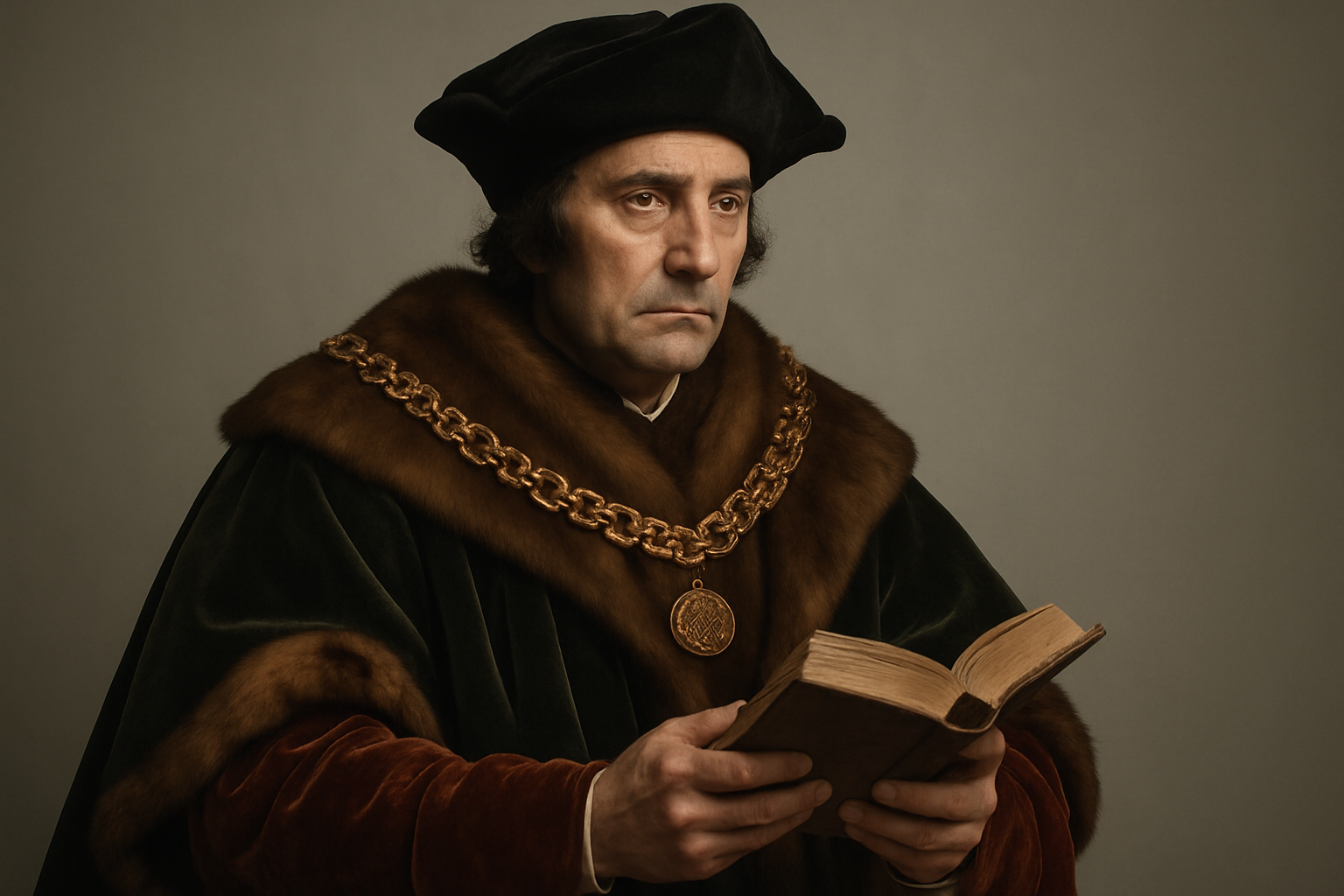
While there are no major pilgrimage sites in the traditional sense, a significant place of devotion is St. Dunstan’s Church in Canterbury, England, where his head, retrieved by his daughter Margaret Roper, is believed to be buried in the Roper vault. Many pilgrims and admirers visit this church to honor his memory. Statues and stained-glass windows depicting him are common in churches and cathedrals, often showing him in his Lord Chancellor’s robes, holding a book (representing his intellect and writings), or a palm branch (a symbol of martyrdom).
His story continues to be retold in books, plays, and films, most notably Robert Bolt’s play and subsequent film adaptation, A Man for All Seasons, which vividly portrays his courage and integrity, bringing his witness to a broad audience and cementing his popular image as the ultimate man of conscience.
Reflections for Modern Readers
St. Thomas More’s life, though lived centuries ago, offers profound and actionable lessons for individuals navigating the complexities of the 21st century. His unwavering integrity and spiritual depth provide a roadmap for living a life of purpose and conviction.
- Stand Firm in Your Conscience: In a world that often pressures conformity or moral relativism, More teaches us the paramount importance of forming a well-informed conscience and then courageously following it. When faced with ethical dilemmas at work, in social circles, or in personal decisions, ask yourself: “What is truly right, even if it’s unpopular or difficult?” Just as More refused to compromise his deepest beliefs for political expediency, we are called to uphold truth, even when it demands sacrifice. For example, if you witness unethical behavior in your workplace, More’s example encourages you to speak up or refuse to participate, rather than remain silent for fear of repercussions.
- Prioritize God’s Kingdom Over Worldly Gain: More held the highest secular office in England but willingly relinquished it and ultimately his life, rather than betray his faith. This teaches us about discerning true priorities. While ambition and success are not inherently bad, More reminds us that they should never come at the expense of our spiritual well-being or our relationship with God. In our fast-paced, consumer-driven society, this might mean intentionally setting aside time for prayer and family, even when professional demands are high, or choosing a career path that aligns with your values over one that promises greater wealth but compromises your integrity.
- Cultivate a Deep Inner Life: St. Thomas More’s remarkable strength in prison came from his deeply cultivated spiritual life. He wore a hair shirt, prayed regularly, and sought spiritual counsel long before his trials began. This pre-existing foundation sustained him in the face of immense suffering. For modern readers, this emphasizes the importance of consistent prayer, regular reception of the sacraments, and spiritual reading. Building these spiritual habits in times of peace prepares us to face inevitable challenges with grace and fortitude. For instance, committing to daily personal prayer or weekly Mass attendance provides a spiritual anchor in an often turbulent world.
- Integrate Faith and Reason in All Aspects of Life: As a leading humanist, scholar, lawyer, and statesman, More seamlessly integrated his deep faith with his intellectual pursuits and public service. He demonstrated that faith is not relegated to Sundays but informs every decision and interaction. For us, this means striving to live out our Christian values in all our roles—as students, employees, parents, citizens—seeking to bring justice, compassion, and truth to bear on all we do. It means thinking critically about societal issues from a Catholic perspective and engaging thoughtfully in public discourse, rather than compartmentalizing our faith.
In art and jewelry, St. Thomas More is commonly depicted with several powerful symbols that reflect his life and martyrdom:
- Lord Chancellor’s Robes and Chain: These symbolize his high office and the immense worldly power he possessed, which he willingly sacrificed for his faith. They represent his distinguished public service and the personal cost of his conviction.
- Book or Pen: These denote his profound intellect, his extensive writings (including Utopia), his legal profession, and his role as a scholar and humanist. They signify the power of his mind and his contributions to literature and philosophy.
- Axe or Execution Block: These are direct references to his martyrdom, the instrument of his death. They are stark reminders of the ultimate sacrifice he made for his conscience and his unwavering fidelity to Christ and His Church.
- Palm Branch: This is a traditional symbol for all martyrs, signifying victory over death through Christ and entry into eternal life. It highlights his triumph through suffering.
Timeline Summary
- 1478: Born in London, England.
- c. 1490-1492: Attends Oxford University.
- 1496: Begins legal training at Lincoln’s Inn.
- 1504: Elected to Parliament.
- 1505: Marries Jane Colt, with whom he has four children.
- 1510: Becomes Undersheriff of London.
- 1511: Jane Colt dies; marries Alice Middleton.
- 1516: Publishes his famous work, Utopia.
- 1521: Knighted by King Henry VIII.
- 1523: Becomes Speaker of the House of Commons.
- 1529: Appointed Lord Chancellor of England by Henry VIII.
- 1532: Resigns as Lord Chancellor due to disagreement with the King over his proposed annulment and challenge to papal authority.
- 1534 (April): Refuses to take the Oath of Succession and is imprisoned in the Tower of London.
- 1535 (July 1): Tried for treason.
- 1535 (July 6): Executed on Tower Hill for refusing to acknowledge King Henry VIII as the Supreme Head of the Church of England.
- 1886: Beatified by Pope Leo XIII.
- 1935: Canonized by Pope Pius XI.
- 2000: Declared the “heavenly Patron of Statesmen and Politicians” by Pope John Paul II.
Scripture for Reflection
St. Thomas More’s life profoundly illustrates several key scriptural principles that emphasize fidelity to God above all earthly powers, the value of one’s soul, and the importance of a clear conscience.
- Matthew 10:28: “Do not be afraid of those who kill the body but cannot kill the soul. Rather, be afraid of the One who can destroy both soul and body in hell.”
This verse directly speaks to More’s ultimate sacrifice. He faced death for his convictions, demonstrating that his fear of God and concern for his immortal soul far outweighed any fear of temporal punishment from the King. It underscores his belief that true life transcends physical existence.
- Acts 5:29: “We must obey God rather than human beings!”
This powerful declaration by Peter and the apostles before the Sanhedrin encapsulates the very essence of More’s stand against Henry VIII. When the King demanded an oath that violated More’s conscience and the teachings of the Church, More, like the apostles, chose to obey divine authority over human decrees, even at the cost of his life.
- Matthew 16:26: “What good will it be for someone to gain the whole world, yet forfeit their soul? Or what can anyone give in exchange for their soul?”
St. Thomas More’s life was a living commentary on this passage. He had achieved the pinnacle of worldly success and influence as Lord Chancellor. Yet, he willingly surrendered all of it—his position, his wealth, his freedom, and his life—to safeguard his eternal soul and his relationship with God. He chose the imperishable over the transient, proving that no earthly gain is worth the loss of one’s integrity and faith.
Prayers to St. Thomas More
A Prayer for Integrity and Conscience (adapted from traditional prayers)
O glorious St. Thomas More, you are honored as a patron of statesmen, politicians, and lawyers, a witness to the profound dignity of conscience, and a martyr for the unity of the Church. You chose the path of integrity over worldly compromise, standing firm in your faith and loyalty to God even unto death. We humbly implore your intercession.
Help us, we pray, to cultivate a conscience as well-formed as yours, enlightened by faith and reason. Grant us the courage to follow its dictates, especially when it leads to unpopular choices or demands personal sacrifice. Inspire all who serve in public life to uphold justice, to serve with honesty and wisdom, and to never forget their ultimate accountability to God.
May your example strengthen us to be faithful children of the Church, to defend the truth with charity, and to live lives rooted in prayer and virtue. Teach us to face trials with your serene humor and unwavering trust in Divine Providence. We ask this through Christ our Lord. Amen.