Before sunrise on December 12, candles flicker, guitars strum softly, and hearts lean forward as if the whole Church is about to hear good news all over again. The Feast Day of Our Lady of Guadalupe isn’t just a story from long ago—it’s a living invitation: God still speaks, the lowly are still seen, and hope still takes flesh.
Summary: Our Lady of Guadalupe reveals Mary’s tender motherhood and Christ’s nearness through rich symbolism—light and stars, a womb and a promise, humility and mercy. In a world that often feels loud, divided, and exhausted in 2025, her message remains quietly radical: draw near to Jesus, protect the vulnerable, honor every culture, and build unity without erasing difference.
What We Celebrate on December 12
The feast commemorates Mary’s appearances to St. Juan Diego in 1531 near Tepeyac Hill (in present-day Mexico City). She asked for a church to be built so that people could encounter her Son. As a sign, she arranged roses in Juan Diego’s tilma; when he opened it before the bishop, an image of Mary was revealed—an image that has drawn generations to prayer, conversion, and trust in God.
From the beginning, Guadalupe has been a Gospel proclamation in a visual language: Mary points beyond herself to Christ and speaks with the tenderness of a mother who knows the wounds of her children.
The Heart of Her Message: “Am I Not Here, I Who Am Your Mother?”
At the center of Guadalupe is not spectacle, but relationship. Mary’s words to Juan Diego are maternal and profoundly theological: she does not replace Christ—she brings us to Him. She comforts the fearful, strengthens the weak, and reminds the Church that the Gospel lands most deeply when it is delivered with mercy.
Guadalupe is also a lesson in how God works: He chooses a humble messenger, speaks in a way people can understand, and reveals heaven’s closeness in the middle of ordinary life.
The Symbols That Speak Without Words
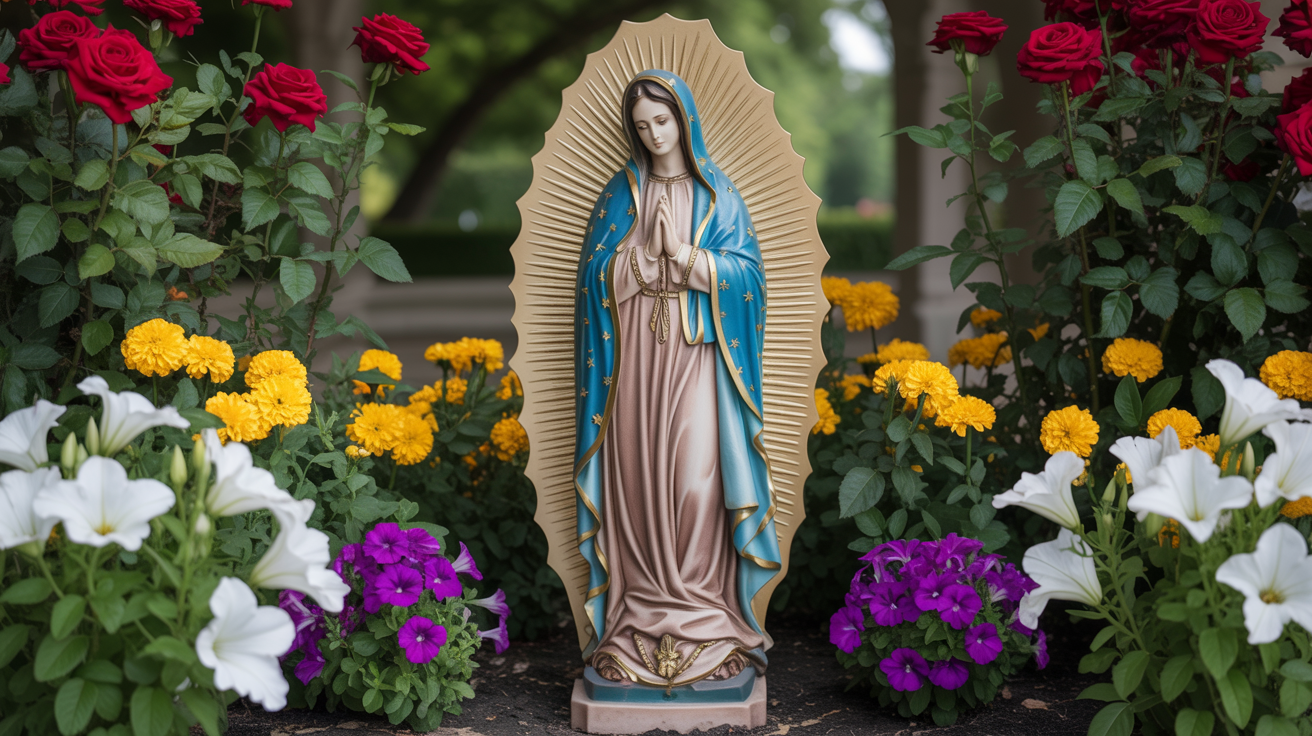
The tilma image is a catechism you can see. Even without knowing every historical detail, the symbols echo biblical truths: God is Creator, Mary is His servant, Christ is the center, and salvation is for every people.
| Symbol on the tilma | What it proclaims | How it meets the world in 2025 |
|---|---|---|
| Stars on her mantle | Heaven is real; God’s plan is bigger than our fear. | When anxiety and bad news feel constant, Guadalupe teaches us to look up and live with hope, not doom. |
| The crescent moon under her feet | God is Lord over all created powers; Mary belongs to Him. | In a culture chasing “ultimate” identities and ideologies, she reminds us: we are not owned by trends—only by love. |
| The black sash at her waist (pregnancy sign) | She bears Life—Jesus Christ—into the world. | In debates about dignity and worth, she calls us to protect life and accompany mothers, fathers, and families with real support. |
| Hands folded in prayer | She intercedes; she is not a goddess—she points to God. | When spirituality becomes “self-made,” Guadalupe teaches humble prayer and surrender to Christ. |
| The angel beneath her | She is carried by heaven, sent on mission. | In a world hungry for meaning, she reminds every Catholic: you are sent—into your home, parish, and neighborhood. |
Why Guadalupe Matters So Much to the Church
Our Lady of Guadalupe is honored as a mother to the peoples of the Americas, and her feast has become a spiritual home for millions. But the reason runs deeper than culture alone: Guadalupe is a portrait of evangelization done God’s way—patient, personal, and merciful.
She models what the Church is called to be: a place where people are welcomed as they are, spoken to with dignity, and invited to a living encounter with Jesus.
Guadalupe and the World of 2025
In 2025, many people feel pulled apart—by politics, by economic pressure, by loneliness, by an always-on digital life, and by real fears about the future. Guadalupe doesn’t offer a shallow optimism; she offers a mother’s steady presence and a disciple’s clear direction: go to Jesus, and bring others with you.
- For a divided culture: Guadalupe teaches unity that doesn’t erase identity. She meets people in their language, their story, their struggle—and gathers them toward Christ.
- For migration, displacement, and uncertainty: She is a sign that God draws near to those who feel invisible. Her message strengthens the Church’s call to welcome the stranger and defend the dignity of every person.
- For a “performance” society: Juan Diego’s weakness did not disqualify him. Guadalupe reminds us that holiness is not perfection—it’s fidelity, humility, and trust.
- For the crisis of loneliness: “Am I not here?” is a spiritual answer to isolation. The Church becomes credible when parishes become places of real belonging.
How to Live the Feast Day in a Practical, Parish-Shaped Way
You don’t have to travel far to celebrate deeply. The feast can be lived wherever you are—at Mass, at home, and in works of mercy.
- Go to Mass (or a parish celebration with singing, procession, and prayer). Offer the day for someone who feels forgotten.
- Pray a Rosary for unity in your family and healing in your community. If you want help getting started, use the Interactive Rosary Guide.
- Open Scripture and pray with Mary’s “yes” (Luke 1) and her song of justice and mercy (Luke 1:46–55). You can read and compare translations using the Free Full Bible.
- Bring roses or an act of charity—not as a performance, but as a sign that love is concrete. Visit someone lonely, forgive a grudge, donate, or volunteer.
Resources to Go Deeper
If you’d like to keep exploring (or share with your parish group), here are a few helpful places to continue:
- Catholic News and Resources for faith-building guides and articles.
- Catholic News Archive for ongoing stories and issues affecting the Church today.
- Interactive Rosary Guide to pray step-by-step, alone or with family.
- Free Full Bible to read Scripture and pray with the Word.
A Closing Prayer
Our Lady of Guadalupe, Mother of the true God, draw us closer to Jesus. Teach us to listen with humility, to love with courage, and to welcome the forgotten with tenderness. In a world that feels hurried and divided, help us become a Church that is truly a home—where mercy is real, truth is spoken with charity, and hope is stronger than fear. Amen.