
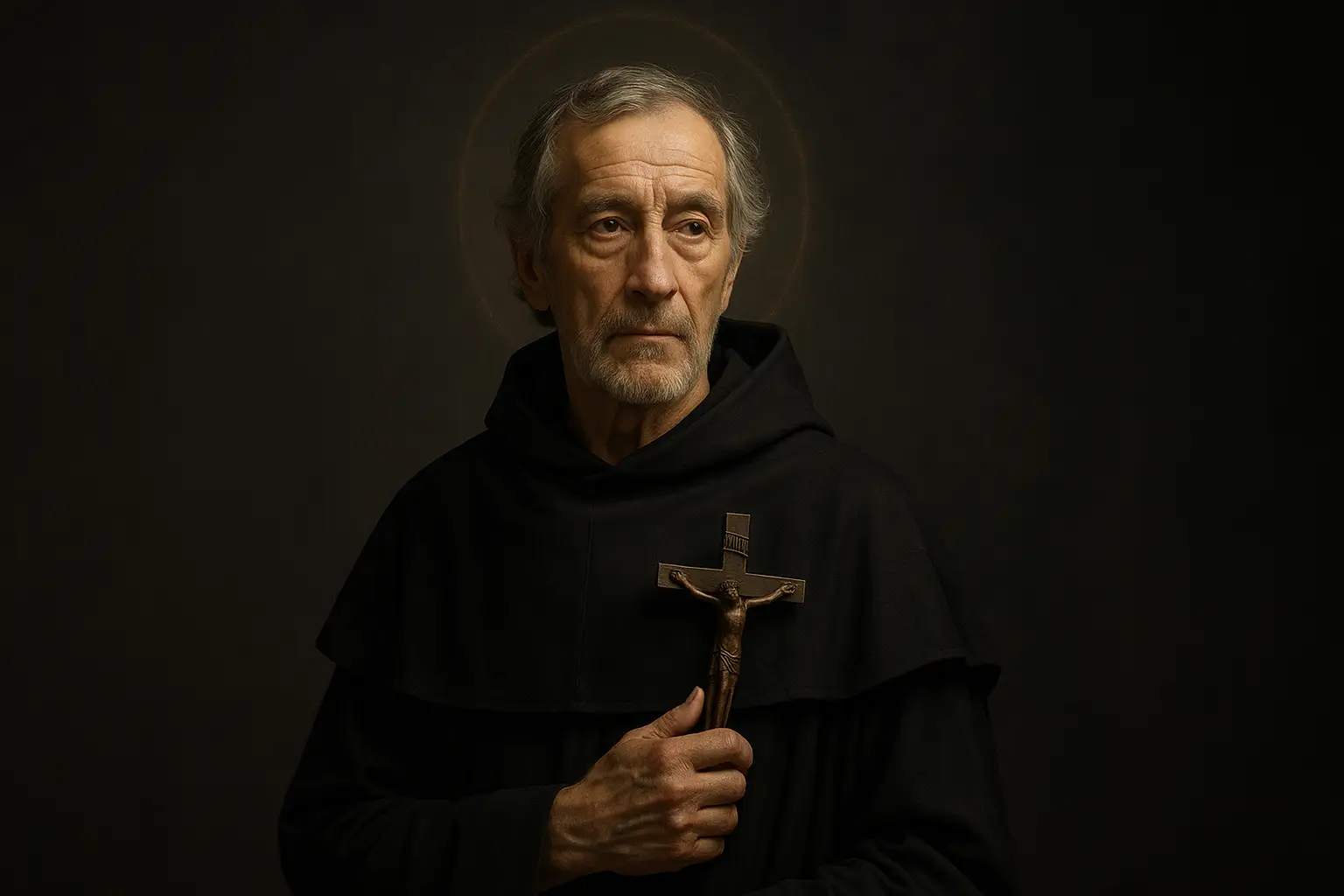
Discover the dramatic story of St. Peregrine, the patron saint of cancer patients, whose own miraculous healing offers profound hope and inspiration for those in trial.
Quick Facts
| Key | Detail |
| Birth | c. 1260 in Forlì, Italy |
| Death | May 1, 1345 in Forlì, Italy |
| Feast Day | May 1 |
| Patronage | Sufferers of cancer, foot ailments, skin diseases, AIDS, and any incurable illness. |
| Canonized | 1726 by Pope Benedict XIII |
Historical Context & Early Life
To understand the fire in young Peregrine Laziosi’s heart, we must step into the turbulent world of 13th-century Italy. This was an era defined by fierce political rivalry between two major factions: the Guelphs, who supported the authority of the Pope, and the Ghibellines, who backed the Holy Roman Emperor. This was not a distant political debate; it was a bitter, often violent, street-level conflict that pitted city against city and neighbor against neighbor.
Peregrine was born around 1260 into a wealthy Ghibelline family in Forlì, a city fiercely loyal to the imperial cause and known for its anti-papal sentiment. Raised in this environment, Peregrine grew into a passionate, rebellious young man, deeply involved in the local politics. He was known for his fervor for the Ghibelline cause, likely participating in the public brawls and political disruptions that characterized the time.
Around 1283, the Pope sent a special peacemaker to Forlì in an attempt to reconcile the warring factions. This envoy was St. Philip Benizi, the Prior General of a relatively new religious community called the Order of Servants of Mary, or the Servites. As St. Philip preached in the city square, he was met with heckling and harassment from the anti-papal Ghibellines, led by the fiery Peregrine. In a moment of uncontrolled fury, Peregrine walked up to Philip and struck him forcefully across the face.
The holy friar’s response changed the course of Peregrine’s life forever. Instead of retaliating, St. Philip turned the other cheek and offered Peregrine his forgiveness on the spot. This radical act of Christian charity struck Peregrine like a bolt of lightning. The friar’s humility shattered the young man’s pride. Overwhelmed with shame and remorse, Peregrine’s life was irrevocably altered by this encounter with true, living holiness.
Peregrine’s conversion was not a slow, gradual process; it was immediate and total. His journey from a violent political activist to a saint of patience is one of the most dramatic in Church history.
From Rebel to Penitent
Haunted by his assault on a holy man, Peregrine sought out St. Philip to beg for forgiveness, which was freely given. This encounter sparked a profound spiritual awakening. Tradition holds that Peregrine had a vision of the Blessed Virgin Mary, who instructed him to go to Siena and join the very order St. Philip led: the Servites. He obeyed without hesitation. Leaving behind his wealth, status, and political allegiances, he traveled to Siena and was accepted into the Servite Order as a lay brother.
Peregrine dedicated his new life to penance to atone for his old one. He embraced humility and service, undertaking the most menial tasks in the friary. For thirty years, he imposed a particularly severe penance on himself: he remained standing whenever it was not necessary to sit, leaning against the choir stalls for rest. While born of a penitential spirit, this extreme practice likely contributed to the varicose veins and circulatory problems that would later plague him.
The Miraculous Healing
After many years, Peregrine returned to his hometown of Forlì to found a new Servite house. There, he was beloved for his powerful preaching and his work as a confessor, drawing many back to the faith.
In his sixties, a painful sore developed on his leg, which was eventually diagnosed as a cancerous tumor. The wound became ulcerated, foul-smelling, and agonizingly painful. The local physician, after consulting with other doctors, determined that the only course of action was to amputate the leg.
The night before the scheduled surgery was to be a night of torment for Peregrine. He dragged himself to the friary chapel and positioned himself before a large crucifix. There, he spent hours in intense prayer, uniting his suffering with the Passion of Christ on the cross. He begged the Lord not for a cure, but for the strength to endure the trial. Overcome by pain and exhaustion, he fell into a light sleep. In a dream, he saw Jesus descend from the cross, reach out, and touch his diseased leg.
When Peregrine awoke, the intense pain was gone. He reached down to touch his leg and found, to his astonishment, that the wound had completely vanished. The cancerous tissue was gone, the skin was whole, and there was no trace of the disease. When the surgeon arrived the next morning to perform the amputation, he found a perfectly healthy leg. The doctor, amazed at what he saw, helped spread the news of the miracle throughout the region. This event earned Peregrine the title of “The Wonder-Worker.”
A Life of Service
Peregrine lived for another twenty years after his healing, his holiness now confirmed by a public miracle. He continued his ministry of preaching and hearing confessions, offering spiritual counsel to all who sought him out. He died on May 1, 1345, reputedly on the very day and hour he had predicted.
Spiritual Legacy & Theological Themes
St. Peregrine’s life offers a powerful testimony to several core Christian truths. His story is a vibrant illustration of radical conversion. He shows that no one is beyond God’s mercy, and a past of anger and sin can be transformed into a future of holiness and service.
His life also gives profound meaning to suffering. Before his healing, he embraced penance as a way to unite himself more closely with Christ. After his diagnosis, his willingness to unite his pain with Jesus’s Passion is a perfect example of redemptive suffering—a key Catholic teaching that our struggles, when offered to God, can become spiritually fruitful for ourselves and others. He didn’t just endure his cancer; he prayed through it, turning his place of agony into a place of encounter with God.
His legacy is one of perseverance and hope. For those facing a frightening diagnosis, his story is a powerful reminder to never give up hope, to persevere in prayer, and to trust in a God who can bring healing and peace even in the most dire circumstances.
Symbols and Iconography
The way St. Peregrine is depicted in art and on medals is rich with meaning, telling his story visually. When you see his image, look for these key symbols:
- The Servite Habit: He is almost always shown wearing the traditional black habit of the Servite Order. This immediately identifies him as a member of the community he joined after his conversion.
- The Exposed Leg: This is his most prominent symbol. Statues and paintings depict him pulling back his habit to reveal his leg, which often shows a graphic wound or a clean scar. This directly points to the cancerous sore and his miraculous healing.
- The Crucifix: A crucifix is often present in the scene. This is a crucial element, as it was before a crucifix in the chapel that he prayed all night and received his healing. It symbolizes that his miracle came through the power of Christ’s Passion and death.
- An Angel: In many depictions, an angel is shown physically touching or tending to Peregrine’s leg. The angel represents the divine intervention and the miraculous nature of his cure, a messenger of God’s healing power.
- A Book or Skull: Less commonly, he might be shown with a book (representing his wisdom as a confessor) or a skull (a traditional symbol of penance and reflection on mortality).
You can see these symbols combined in statues at shrines, on holy cards given to the sick, in stained-glass windows in churches, and on small medals worn by those praying for his intercession against cancer. Each element serves as a visual reminder of his powerful story of conversion, suffering, and divine healing.
Devotion Today
Devotion to St. Peregrine has grown immensely worldwide, especially in the last century as cancer has become a more prevalent and understood disease.
- Shrines: The primary center for devotion in North America is the National Shrine of St. Peregrine in Chicago, Illinois, run by the Servite Friars. It is a major pilgrimage site where thousands come each year to pray, attend healing Masses, and be blessed with St. Peregrine oil.
- St. Peregrine Oil: This oil, blessed by a priest and touched to a relic of the saint, is a popular sacramental (a holy object or action that prepares us to receive grace). The faithful often apply it to afflicted areas of the body while praying for the saint’s intercession.
- Prayers and Novenas: Many turn to St. Peregrine in their time of need. A common prayer captures the essence of his patronage:
“O God, who gave to Saint Peregrine an Angel for his companion, the Mother of God for his teacher, and Jesus as the physician of his malady, grant, we beseech You, through his merits, that we may on earth intensely love our holy Angel, the blessed Virgin Mary, and our Savior, and in heaven bless them forever. Grant that we may receive the favor for which we now ask. We ask this through the same Christ our Lord. Amen.”
Reflections for Modern Readers
St. Peregrine’s 14th-century life speaks directly to our 21st-century struggles. Here are a few lessons we can draw from his witness:
- Your Past Does Not Define Your Future. Peregrine began as an angry, violent young man. His story is the ultimate proof that a single moment of grace and a heartfelt “yes” to God can change everything. It’s a powerful message of hope for anyone who feels trapped by past mistakes.
- Turn to God in Your Darkest Hour. The night before his scheduled amputation was Peregrine’s darkest hour. Instead of despairing, he turned to the one place he knew he could find strength: the foot of the cross. His example teaches us to bring our greatest fears and pains directly to God in prayer.
- Don’t Be Afraid to Ask for a Miracle. While we must always pray for the grace to accept God’s will, St. Peregrine’s story encourages us to also have the bold faith to pray for healing and intervention. He reminds us that God is still a God of miracles.
- Embrace the Power of Forgiveness. The turning point of Peregrine’s life was not the blow he delivered, but the forgiveness he received from St. Philip. It shows how an act of mercy can shatter pride and open a heart to grace, both for the one forgiving and the one being forgiven.
Timeline Summary
- c. 1260: Peregrine Laziosi is born into a wealthy Ghibelline family in Forlì, Italy.
- c. 1283: As a young political activist, he strikes the papal peacemaker, St. Philip Benizi. Struck by Philip’s forgiveness, Peregrine experiences a profound conversion.
- c. 1283-1284: Following a vision of the Virgin Mary, he travels to Siena and joins the Servite Order.
- c. 1284-1325: He lives a life of extreme penance and prayer, eventually returning to Forlì to help found a new Servite community.
- c. 1325: At around age 60, he develops a cancerous, gangrenous sore on his leg. Amputation is scheduled as the only remedy.
- c. 1325: The night before the surgery, he prays before a crucifix and is miraculously healed by Christ in a dream-vision.
- 1325–1345: He lives for another 20 years as “The Wonder-Worker,” renowned for his holiness and counsel.
- May 1, 1345: Peregrine dies in Forlì at the age of 85.
- April 12, 1726: He is formally canonized as a saint by Pope Benedict XIII.
Further Reading & References
- “Saint Peregrine Laziosi.” The National Shrine of Saint Peregrine, Order of Friar Servants of Mary, USA Province, www.stperegrine.org/sps-saint-peregrine.htm.
- “St. Peregrine Laziosi.” Catholic Encyclopedia. New Advent, www.newadvent.org/cathen/11671a.htm.
- Di Zinno, Joseph M., OSM. St. Peregrine Laziosi: The Wonder-Worker. The National Shrine of St. Peregrine, 1999.
- Farmer, David. The Oxford Dictionary of Saints. 5th ed., Oxford University Press, 2011.
- Catechism of the Catholic Church. 2nd ed., Libreria Editrice Vaticana, 2012, paras. 1500-1510 (on sickness) and 1674-1676 (on sacramentals).





