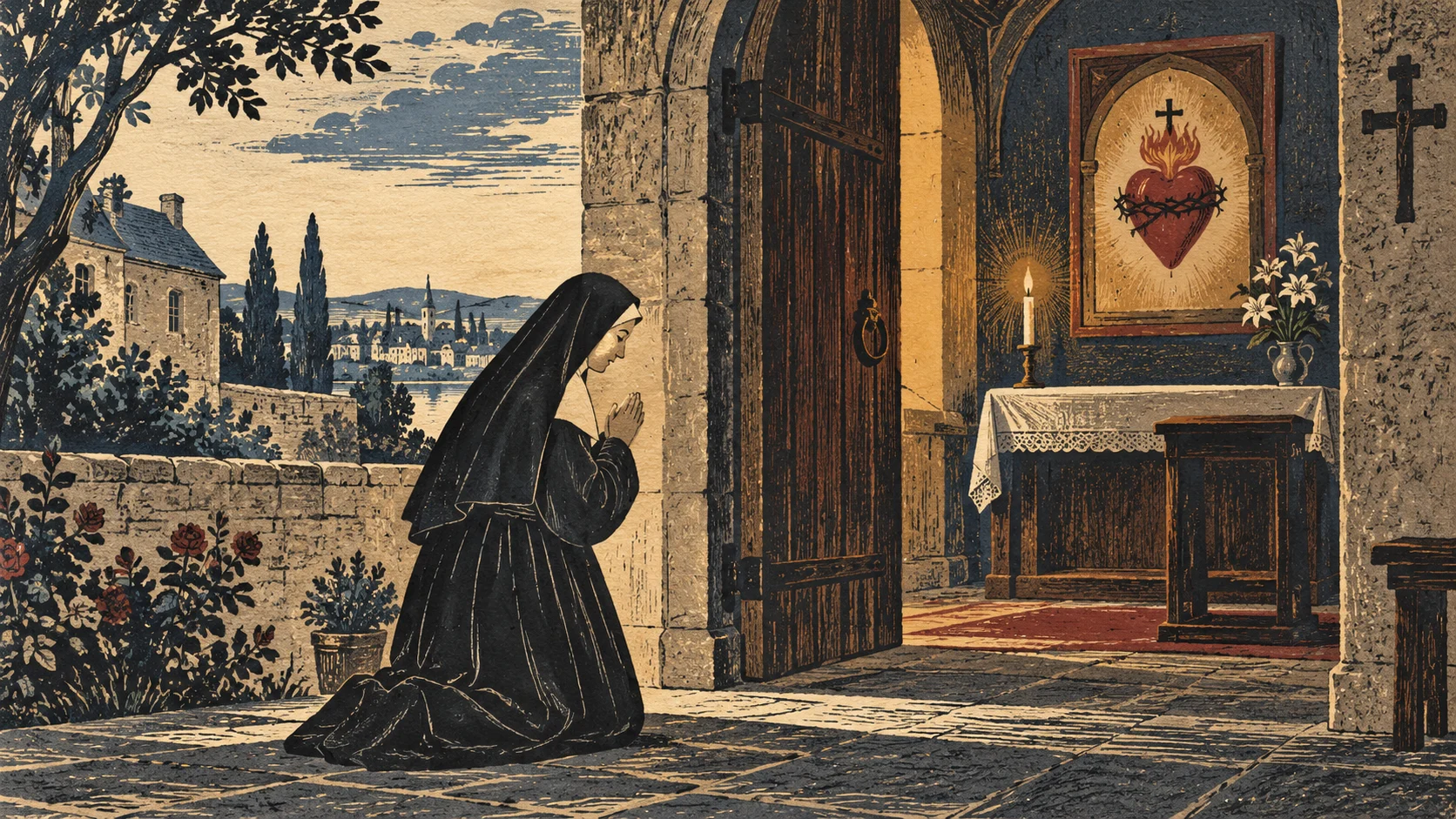
The Sacred Heart is often pictured surrounded by flame and crowned with thorns. St. Margaret Mary Alacoque helps explain why that image became so familiar in Catholic homes: it invites a response to the love of Christ. Her story also raises a practical question. What would change if prayer received our attention before the day received our complaints?
Who was St. Margaret Mary Alacoque?
Margaret Mary was born in Burgundy in 1647 and entered the Visitation community at Paray-le-Monial as a young adult. She reported encounters with Christ that became closely associated with devotion to his Sacred Heart. Her life remained that of a religious sister, with the ordinary demands of community as well as extraordinary spiritual experiences. She died in 1690 and was canonized in 1920. Her liturgical commemoration is October 16. Vatican News recounts her life and vocation.
Looking at the image without rushing past it
A useful way to approach Sacred Heart imagery is to pause before interpreting every detail. The heart directs attention toward Christ’s love; the wounds keep that love connected to the suffering of the Passion. The image asks for more than admiration of a beautiful religious object. It invites a person to receive love and then to answer it in action.
For a household, that response might be an apology delivered without excuses, a phone call to someone who has become isolated, or time given to a child without checking a screen. These are contemporary suggestions, not incidents from Margaret Mary’s biography. They make a devotional practice concrete enough to enter an ordinary Tuesday.
A five-minute prayer practice
- Arrive. Put the phone out of reach and sit before a crucifix or Sacred Heart image.
- Notice. Name one place where you received love today, even if the day was difficult.
- Be honest. Tell Christ where you have been impatient, withdrawn, or afraid. Avoid turning this into a performance of self-criticism.
- Choose a response. Decide on one act of care you can actually carry out.
- Return tomorrow. A small practice repeated faithfully is easier to sustain than an elaborate plan that exhausts you.
You can adapt this for children by asking two questions: “Who helped you today?” and “Who could we help tomorrow?” Leave room for silence and for answers that surprise you.
When devotion starts to feel like another obligation
Do not turn a missed prayer into a reason to abandon prayer altogether. Choose a manageable time, begin again, and ask a trusted priest about practices you do not understand. If a devotional promise is presented online as an automatic transaction, seek its context before building your spiritual life around it. Christian prayer is a relationship with God, not a way to control outcomes.
Margaret Mary’s feast can become a useful annual check-in: is there a visible connection between what our home displays and how we treat the people who enter it? A Sacred Heart picture near the kitchen table can be a reminder to make that connection, one conversation at a time.
Continue reading
For another approach to everyday faithfulness, read our guide to St. Thérèse of Lisieux and her Little Way.