In the sweeping tapestry of Christian history, few figures shine as brightly and uniquely as Saint Hildegard of Bingen. A true polymath of the Middle Ages, Hildegard was not only a Benedictine abbess but also a visionary mystic, a gifted composer, an influential writer, a pioneering herbalist, and a fearless theologian. Her life, spanning much of the 12th century, was a testament to extraordinary spiritual insight and unwavering courage, leaving an indelible mark on both the Church and the broader world. Known as the “Sybil of the Rhine,” her prophetic visions, profound theological works, and ethereal music continue to inspire and challenge us today, earning her the rare distinction of being declared a Doctor of the Church by Pope Benedict XVI in 2012. This article delves into the remarkable life, profound legacy, and enduring relevance of Saint Hildegard, offering insights into her spiritual journey and the timeless wisdom she imparts.
Quick Facts
| Category | Detail |
|---|---|
| Birth | 1098, Bermersheim, Holy Roman Empire (present-day Germany) |
| Death | September 17, 1179, Rupertsberg, Holy Roman Empire |
| Feast Day | September 17 |
| Patronage | Musicians, writers, naturalists, scientists, environmentalists, artists, creative people, migraine sufferers |
| Canonized | May 10, 2012 (formal canonization by Pope Benedict XVI, followed by declaration as Doctor of the Church on October 7, 2012) |
Historical Context & Early Life
Saint Hildegard of Bingen was born in 1098 into a noble German family in Bermersheim, situated within the Holy Roman Empire. She was the tenth child of Hildebert and Mechthild of Bermersheim, a detail that was significant in her life as it aligned with the custom of offering a “tithe” – the tenth child – to the Church. This practice, common among aristocratic families, aimed to gain divine favor and secure prayers for the family’s lineage.
From a very young age, Hildegard began to experience profound spiritual visions, which she later described as a “shadow of the living light.” These weren’t fleeting images but comprehensive, immersive experiences of divine revelation, often accompanied by intense physical and emotional reactions. However, she kept these visions mostly private for many years, struggling with whether they were true divine insights or mere illusions.
At the tender age of eight, Hildegard was entrusted to the care of Jutta of Sponheim, an anchoress (a woman who lives a reclusive life of prayer and contemplation) attached to the Benedictine monastery of Disibodenberg. Jutta became Hildegard’s spiritual mentor and teacher, instructing her in the Scriptures, liturgical practices, and the monastic way of life. This isolated upbringing within the confines of an anchoress’s cell provided Hildegard with a rigorous intellectual and spiritual foundation, while also fostering an environment where her unique contemplative gifts could develop, albeit in secret. She took her vows as a Benedictine nun around the age of 14.
Life in the monastery during the 12th century was a blend of spiritual rigor, intellectual pursuit, and practical administration. Monasteries served as centers of learning, healthcare, and agricultural production. The Church itself was undergoing a period of reform, grappling with issues of clerical discipline and lay involvement, setting the stage for Hildegard’s later outspoken calls for reform. Her early life, marked by illness and profound spiritual experiences, prepared her for the extraordinary mission that awaited her, shaping her into a figure who would bridge the spiritual and the practical, the mystical and the mundane.
Calling & Key Milestones
Hildegard’s life was a series of profound awakenings and courageous decisions, each milestone building upon her unique spiritual gifts and her dedication to God.
The Call to Write Her Visions
For decades, Hildegard kept her extraordinary visions largely to herself, sometimes confiding in Jutta or a trusted monk, Volmar, who would become her lifelong secretary and confessor. She feared judgment and misunderstanding, questioning the source and meaning of these intense experiences. However, at the age of 42, a pivotal moment arrived. Overwhelmed by severe illness, she received a powerful divine command: “Write down what you see and hear!” This commandment, coupled with the exacerbation of her physical suffering when she resisted, convinced her that it was God’s will for her to share her mystical experiences with the world. With the support of Volmar and the eventual encouragement of her abbot, Kuno, she began the daunting task of recording her visions.
Scivias: “Know the Ways of the Lord”
The first major fruit of her obedience was Scivias, meaning “Know the Ways of the Lord,” a monumental work compiled over ten years (1141-1151). This book, consisting of 26 visions, weaves together theological explanations, moral exhortations, and prophetic warnings, offering a panoramic view of salvation history from creation to the Last Judgment, with a particular focus on the Church and its role. News of her visions and writings reached Pope Eugene III. At the Synod of Trier (1147-1148), the Pope himself read from Scivias and, after careful examination, officially approved her writings, declaring that her visions came from God. This papal endorsement was a critical turning point, legitimizing Hildegard’s prophetic voice and elevating her status from a humble nun to a respected spiritual authority throughout Christendom.
Founding Rupertsberg Monastery
Despite her growing fame, life at Disibodenberg became restrictive for Hildegard and her growing community of nuns. The male monks had authority over them, and Hildegard felt called to establish an independent monastery where her nuns could live according to a more stringent rule and where her visionary work could flourish without interference. Around 1150, after much resistance from her abbot and the monks, and facing another period of severe illness, she received permission to move her community to Rupertsberg, a hill near Bingen. This bold move showcased her remarkable leadership and her determination to create a spiritual haven tailored to her community’s needs. Later, in 1165, she would found a second monastery at Eibingen, demonstrating her enduring commitment to the monastic life and the welfare of her sisters.
Musical Compositions and Ordo Virtutum
Beyond her theological writings, Hildegard was an extraordinary composer. She created a vast body of liturgical music, including chants and hymns, often integrated into her larger visionary works. Her music is characterized by wide melodic leaps, soaring lines, and an ethereal quality that reflects the heavenly nature of her visions. One of her most remarkable achievements was the creation of Ordo Virtutum (Play of the Virtues), the earliest known morality play. This allegorical drama, performed by her nuns, uses music and dialogue to portray the struggle between the Virtues and the Devil for the human soul. Hildegard saw music as a pathway to the divine, a way to remember humanity’s original harmonious state before the Fall.
Correspondence and Preaching Tours
Hildegard’s influence extended far beyond the walls of her monasteries. She engaged in extensive correspondence with kings, emperors, popes, archbishops, abbots, and common people across Europe. Her letters offered spiritual counsel, political advice, and stern warnings, particularly to those in power who she felt were neglecting their duties or promoting corruption. Remarkably for a woman of her era, Hildegard also embarked on four extensive preaching tours, delivering sermons in public forums, churches, and cathedrals. She preached on themes of Church reform, justice, and the importance of living a virtuous life, demonstrating a prophetic courage and authority that captivated her audiences and challenged the norms of her time.
Spiritual Legacy & Theological Themes
Saint Hildegard’s spiritual legacy is incredibly rich and multifaceted, embodying a profound integration of faith, nature, and human experience. Her contributions resonate deeply with Scripture and Catholic teaching, offering timeless insights into the divine and the human condition.
One of the core virtues Hildegard exemplified was prophetic courage. Guided by her visions, she fearlessly spoke truth to power, admonishing corrupt clergy, advising popes, and challenging secular rulers. Her willingness to confront societal and ecclesiastical ills aligns with the prophetic tradition found throughout the Old Testament, where figures like Isaiah and Jeremiah called God’s people back to righteousness. Her bold independence, especially as a woman in a male-dominated age, speaks volumes about the conviction she drew from her direct communion with God.
A central theological theme in Hildegard’s work is “Viriditas,” or “greenness” or “verdancy.” This concept, which she saw in her visions, refers to the divine life force, vitality, and freshness that permeates all of creation. It’s the inherent goodness and fruitfulness of nature, reflecting God’s own creative power. For Hildegard, human flourishing and spiritual health were intrinsically linked to this cosmic “greenness.” When humans live virtuously and care for creation, they enhance Viriditas; when they sin and exploit, they diminish it. This theme anticipates modern ecological theology and underscores the Catholic Church’s teaching on stewardship of creation, rooted in Genesis and reiterated in encyclicals like Pope Francis’s Laudato Si’.
Hildegard also deeply explored the mystery of the Incarnation and the redemption of humanity through Christ. Her visions often depicted Christ as the “cosmic man,” uniting heaven and earth, bridging the divine and the human. She emphasized humanity’s unique dignity as created in God’s image, capable of both great sin and great holiness. Her writings illuminate the journey of salvation, the role of the sacraments, and the mystical union of the soul with God, echoing the teachings of early Church Fathers and mystics on theosis (divinization).
Her lasting influence on liturgy, devotion, and art is significant. Her musical compositions, particularly her hymns and chants, are increasingly being rediscovered and performed, offering a unique sonic landscape for prayer and contemplation. She saw music as a means to re-establish the original harmony lost in the Fall, a path to spiritual healing and ascent. Her vivid descriptions of her visions, often accompanied by her own intricate illustrations (as seen in the Riesen Codex of Scivias), have inspired countless artists. Her recognition as a Doctor of the Church places her alongside intellectual giants like Saint Thomas Aquinas and Saint Catherine of Siena, affirming the profound theological depth and universal applicability of her insights for all faithful. Her holistic approach to health, encompassing diet, herbs, and spiritual balance, also laid groundwork for future holistic wellness practices, demonstrating her understanding of the interconnectedness of body, mind, and spirit.
Devotion Today
The devotion to Saint Hildegard of Bingen has experienced a significant resurgence in recent decades, particularly since her formal canonization and declaration as a Doctor of the Church in 2012. Her feast day, September 17th, is celebrated by Catholics worldwide, often with special Masses and reflections on her life and teachings.
The primary centers of devotion remain in Germany, particularly around the Rhine Valley where she lived and worked. The former site of her monastery at Rupertsberg, though largely destroyed, is still a place of historical significance for pilgrims. More importantly, the Abbey of St. Hildegard in Eibingen, founded by Hildegard herself, continues to thrive as an active Benedictine community for nuns. Here, her relics are venerated, and pilgrims can participate in daily prayer, learn about her life, and experience the spiritual atmosphere she cultivated. The abbey also houses a museum and promotes the study of her works, including her music and insights into natural medicine.
Beyond formal pilgrimage sites, Hildegard’s influence is evident in several areas:
- Music: Her compositions, especially her ethereal chants and the Ordo Virtutum, are widely performed and recorded by choirs and musicians globally. She is celebrated as one of the earliest known composers in Western music history, and her unique style continues to captivate new audiences, offering a meditative pathway to prayer.
- Herbal Medicine and Holistic Health: “Hildegard medicine,” based on her writings on natural remedies, diet, and a balanced lifestyle, has gained popularity. Many natural health practitioners and enthusiasts study and apply her ancient wisdom for well-being, focusing on the healing properties of herbs, stones, and a harmonious relationship with nature.
- Ecological Spirituality: Her concept of “Viriditas” resonates strongly with contemporary concerns about environmental stewardship and ecological spirituality. She is increasingly seen as a patron and inspiration for those working to protect creation and foster a deeper connection with the natural world.
- Feminist Theology and Women’s Spirituality: As a powerful and independent female voice in a patriarchal era, Hildegard is revered by many as a symbol of women’s spiritual strength and intellectual capabilities within the Church. Her life inspires women to embrace their gifts and roles in Christian ministry and leadership.
Saint Hildegard’s timeless wisdom and diverse contributions ensure her continued relevance and veneration among a broad spectrum of believers and seekers today.
Reflections for Modern Readers
Saint Hildegard of Bingen’s life, though lived centuries ago, offers profound and actionable takeaways for modern readers navigating the complexities of the 21st century. Her multifaceted genius and unwavering faith provide a rich source of inspiration.
1. Embrace Your Unique Gifts, Even if They Seem Unusual: Hildegard initially hesitated to share her visions, fearing ridicule or misunderstanding. Yet, when she finally obeyed God’s call, her unique spiritual insights transformed not only her life but also the Church. For us, this means recognizing and developing our own God-given talents, no matter how unconventional they might seem. Are you a gifted artist, a compassionate listener, a natural organizer? Don’t hide your light under a bushel. The world needs your unique contribution.
2. Cultivate a Holistic Approach to Well-being: Hildegard understood the deep connection between spiritual health, physical health, and our relationship with the natural world. Her concept of “Viriditas” encourages us to seek “greenness” or vitality in all aspects of life. In a world often compartmentalized, we can learn from her to integrate our spiritual practices with mindful eating, engaging with nature, and finding creative outlets. Consider taking a walk in a park, preparing a nourishing meal, or spending time in quiet reflection to reconnect with your inner and outer “greenness.”
3. Find Courage to Speak Truth to Power: Hildegard was not afraid to challenge corruption or injustice, whether in the Church or in secular society. She wrote letters of admonition to powerful figures, urging them toward righteousness. While most of us may not be advising popes, we all face situations where we must stand up for what is right, whether it’s speaking out against prejudice, advocating for the vulnerable, or simply holding ourselves and others accountable in our daily lives. Her example reminds us that true integrity sometimes requires uncomfortable conversations.
4. Discover God’s Presence in Creation: Hildegard’s visions were deeply intertwined with the natural world, seeing God’s artistry and power in everything from the smallest plant to the vast cosmos. In our fast-paced, urbanized lives, it’s easy to lose this connection. Take time to observe the beauty around you – a sunrise, a blooming flower, the intricate patterns of a leaf. See these as glimpses of divine creativity, and let them draw you into deeper prayer and gratitude. This deep reverence for nature can also inspire us to be better stewards of our planet.
5. Harmonize Faith and Reason, Spirituality and Creativity: Hildegard seamlessly wove together theology, philosophy, music, and natural science. She shows us that faith is not opposed to intellect or creativity, but rather inspires and enriches them. Whether you’re a scientist, an artist, a writer, or a homemaker, look for ways to integrate your faith into your profession or hobbies, allowing your spiritual life to infuse all your endeavors with purpose and beauty.
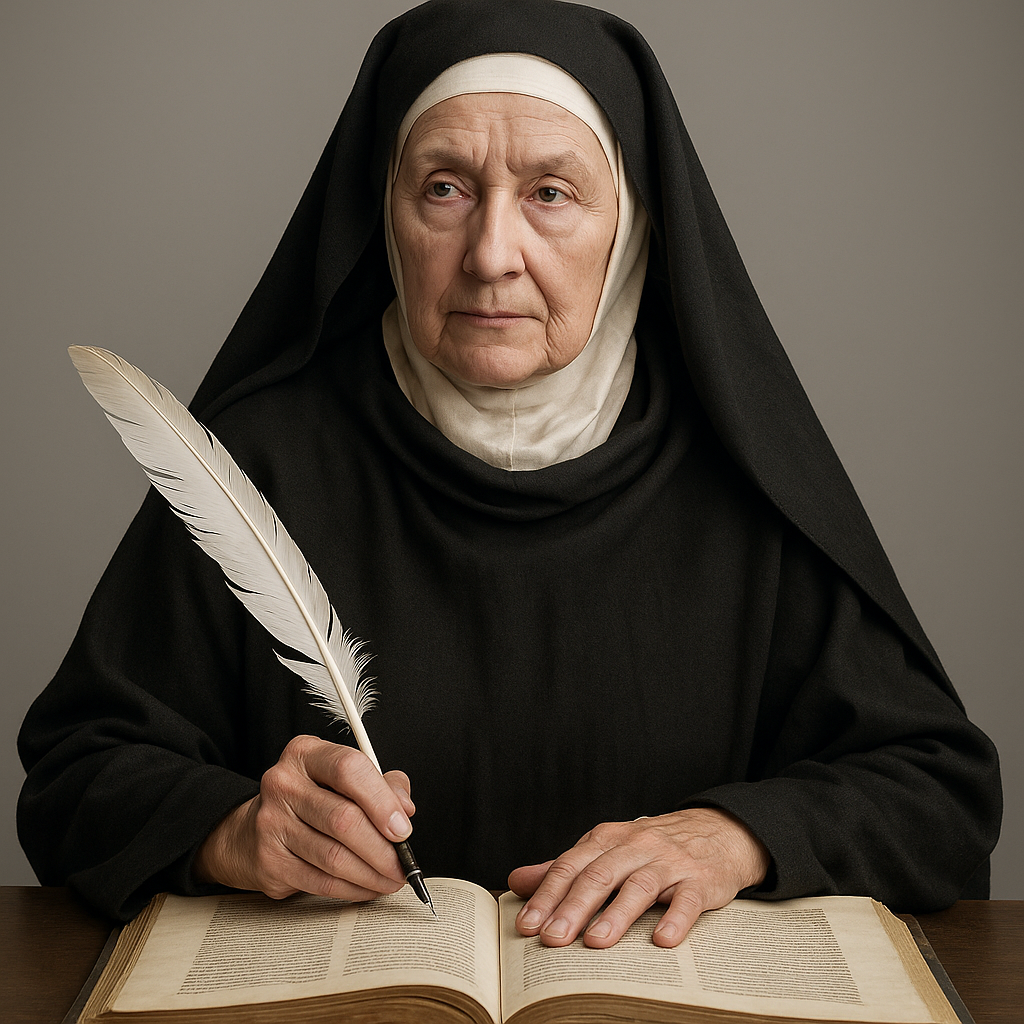
Common Symbols and Representations: In art and jewelry, Saint Hildegard is often depicted with a quill pen or a book, symbolizing her prolific writings and prophetic insights, especially Scivias. She may also be shown with a lyre or musical notes, representing her groundbreaking compositions. Sometimes, she is shown with flames or a radiating light around her head, signifying the divine inspiration of her visions. Plants, herbs, or scientific instruments can also be included to symbolize her knowledge of natural medicine and cosmology. These symbols highlight her roles as a Doctor of the Church, a composer, a mystic, and a pioneering naturalist, inviting us to contemplate the interconnectedness of divine revelation, artistic expression, and the natural world.
Timeline Summary
- 1098: Born in Bermersheim, Holy Roman Empire.
- c. 1106: At age eight, offered as a tithe to the Church and placed under the care of Jutta of Sponheim at Disibodenberg Monastery.
- c. 1114: Takes monastic vows as a Benedictine nun.
- 1136: Becomes Abbess of the Benedictine community at Disibodenberg after Jutta’s death.
- c. 1141: Receives a divine command to write down her visions; begins compiling her first major work, Scivias.
- 1147-1148: Scivias is approved by Pope Eugene III at the Synod of Trier, legitimizing her prophetic revelations.
- c. 1150: Establishes a new, independent monastery for her community at Rupertsberg, near Bingen, after significant resistance.
- 1158-1163: Writes her second major theological work, Liber Vitae Meritorum (Book of Life’s Merits), a collection of visions on virtues and vices.
- 1165: Founds a second monastery at Eibingen to accommodate new vocations.
- 1163-1173: Completes her third major theological work, Liber Divinorum Operum (Book of Divine Works), an extensive cosmic and anthropological vision.
- 1179: Dies peacefully at her monastery in Rupertsberg on September 17.
- 2012: Formally canonized by Pope Benedict XVI on May 10; subsequently declared a Doctor of the Church on October 7, recognizing her profound theological contributions.
Scripture for Reflection
Saint Hildegard of Bingen’s life and teachings beautifully reflect several biblical themes, offering deep connections to the Word of God.
1 Corinthians 12:4-7: “Now there are varieties of gifts, but the same Spirit; and there are varieties of service, but the same Lord; and there are varieties of activities, but it is the same God who empowers them all in everyone. To each is given the manifestation of the Spirit for the common good.”
Hildegard exemplified this passage through her extraordinary and diverse gifts – prophecy, music, writing, administration, and natural healing. She used all these manifestations of the Spirit, not for her own glory, but for the common good of the Church and humanity, enriching the spiritual and intellectual life of her time.
Psalm 104:24: “O Lord, how manifold are your works! In wisdom have you made them all; the earth is full of your creatures.”
This psalm resonates deeply with Hildegard’s concept of “Viriditas” – the divine greenness and vitality found throughout creation. She saw the natural world as a reflection of God’s wisdom and an outpouring of His life-giving Spirit. Her reverence for nature and her studies of its healing properties underscore this scriptural praise for the Creator’s magnificent works.
Jeremiah 1:4-9: “Now the word of the Lord came to me, saying, ‘Before I formed you in the womb I knew you, and before you were born I consecrated you; I appointed you a prophet to the nations.’ Then I said, ‘Ah, Lord God! Truly I do not know how to speak, for I am only a youth.’ But the Lord said to me, ‘Do not say, “I am only a youth”; for to all to whom I send you, you shall go, and whatever I command you, you shall speak. Do not be afraid of them, for I am with you to deliver you, declares the Lord.'”
Like the prophet Jeremiah, Hildegard initially hesitated and felt inadequate to fulfill the divine command to speak and write her visions. Yet, God empowered her, and she became a fearless prophetic voice, admonishing powerful figures and guiding the faithful, demonstrating that God equips those whom He calls, regardless of their perceived limitations or societal expectations.
Prayers to Saint Hildegard of Bingen
As a Doctor of the Church, Saint Hildegard offers profound wisdom and intercession for those seeking spiritual insight, creative inspiration, healing, and a deeper connection with God’s creation. Here is a prayer for her intercession:
Prayer to Saint Hildegard of Bingen
O glorious Saint Hildegard, Sybil of the Rhine, Doctor of the Church,
You who were blessed with profound visions of God’s wisdom and creation, and courageously shared them with the world through your writings, music, and teachings.
We ask for your intercession for all who seek truth, beauty, and goodness in their lives. Inspire us to open our hearts to the divine light, to understand the mysteries of faith, and to embrace the sacred interconnectedness of all creation.
Help us, like you, to cultivate “Viriditas,” the greening power of God, in our souls and in the world around us. Guide those who are artists, musicians, writers, and scientists, that they may use their gifts for God’s glory and the good of humanity.
Strengthen us to speak truth with charity, to live with integrity, and to pursue holiness with unwavering dedication, even in the face of challenges. Through your example, teach us to find healing for our bodies and spirits, and to live in harmony with God’s magnificent design.
Saint Hildegard, pray for us, that we may grow in wisdom, grace, and courage, and always seek to know the ways of the Lord. Amen.