
In the vast tapestry of Catholic history, few figures shine as brightly or as steadfastly as Saint Athanasius of Alexandria. Often hailed as a “Pillar of the Church” and a valiant defender of the faith, Athanasius lived through an era of intense theological debate and political upheaval in the 4th century. His life was a testament to unwavering conviction, marked by repeated exiles and relentless struggle to preserve what he believed to be the foundational truth of Christianity: the divinity of Jesus Christ. This article will journey through his remarkable early life and the turbulent historical landscape he navigated, explore the pivotal moments that defined his calling, delve into his profound spiritual and theological legacy, and reflect on how his courage and intellectual rigor continue to inspire believers today. We’ll also examine how devotion to this great saint is expressed and what lessons his extraordinary life holds for modern readers.
Quick Facts
| Attribute | Detail |
|---|---|
| Birth | c. 296 – 298 AD, Alexandria, Egypt |
| Death | May 2, 373 AD, Alexandria, Egypt |
| Feast Day | May 2 |
| Patronage | Theologians, church fathers |
| Canonized | Immediately recognized as a saint after his death (Pre-Congregation) |
Historical Context & Early Life
To truly appreciate the life of Saint Athanasius, we must first understand the tumultuous world into which he was born around 296-298 AD. The Roman Empire, though vast, was in a period of significant transition. The age of intense Christian persecution, exemplified by the Diocletianic persecution just before Athanasius’s birth, was slowly giving way to an era of imperial tolerance, culminating in Emperor Constantine’s Edict of Milan in 313 AD. Christianity was rapidly growing, moving from the catacombs into public life, which brought new challenges. With freedom came the need to define core beliefs more clearly, leading to widespread theological discussions and, at times, fierce arguments.
Athanasius grew up in Alexandria, Egypt, one of the ancient world’s most vibrant intellectual and cultural centers. It was a melting pot of Greek philosophy, Jewish tradition, and burgeoning Christian thought. The city boasted a renowned catechetical school, a hub for Christian scholarship that had shaped many prominent theologians. Though details of his family background are scarce, it’s believed he came from a reasonably well-off Christian family, allowing him access to a superior education. He was well-versed in Greek literature, philosophy, and rhetoric, skills that would prove invaluable in his later theological debates.
His early formation also involved a crucial spiritual influence: Saint Anthony the Great, often considered the father of Christian monasticism. As a young man, Athanasius spent time in the desert with Anthony, learning firsthand about asceticism, spiritual discipline, and profound devotion. This experience deeply shaped his character, instilling in him a profound spiritual grounding that would sustain him through decades of conflict and exile. He saw the practical application of faith in the lives of the desert fathers, not just in abstract theological arguments. This blend of rigorous intellectual training and deep spiritual experience prepared Athanasius for a destiny far beyond what anyone could have imagined.
Calling & Key Milestones
Athanasius’s life was a dramatic saga of unwavering commitment to Christian truth, marked by pivotal moments that shaped the very definition of the Church’s faith.
The Rise of Arianism and the Council of Nicaea (325 AD)
Athanasius was ordained a deacon by Bishop Alexander of Alexandria around 319 AD. It was during this time that a new theological dispute, known as Arianism, began to shake the foundations of the Church. Arius, a presbyter from Alexandria, taught that Jesus Christ, while divine, was not truly God in the same sense as God the Father. Instead, Arius claimed that Christ was a created being, “the firstborn of all creation,” and therefore subordinate to the Father. This teaching directly challenged the core Christian belief in the divinity of Jesus, and by extension, the doctrine of the Holy Trinity (God as three Persons in one divine nature).
Bishop Alexander recognized the danger of Arianism and brought Athanasius, his bright young deacon, to the first ecumenical (worldwide) council of the Church, convened by Emperor Constantine in Nicaea (modern-day Turkey) in 325 AD. Though only a deacon, Athanasius played a significant role in defending the orthodox position. He argued passionately for the belief that Jesus was “consubstantial” with the Father – that is, of the same divine substance or essence. This became the central tenet of the Nicene Creed, which declared Jesus to be “God from God, Light from Light, true God from true God, begotten, not made, consubstantial with the Father.” The Council condemned Arianism, but the battle was far from over.
Bishop of Alexandria and the Five Exiles
Upon Bishop Alexander’s death in 328 AD, Athanasius was chosen as his successor, becoming the Patriarch of Alexandria. This was a position of immense spiritual and political power, but it also placed him squarely in the crosshairs of Arian sympathizers, including powerful bishops and even emperors. For the next 45 years, Athanasius became the unwavering champion of Nicene orthodoxy, often standing alone against a world that seemed determined to embrace Arianism. This commitment led to a series of astonishing and traumatic events: he was exiled no fewer than five times, spending a total of seventeen years away from his episcopal see. These exiles were not mere vacations; they were periods of genuine danger, forcing him to flee into the deserts of Egypt, often taking refuge with his beloved desert monks, or seeking asylum in Rome.
Each exile was orchestrated by powerful political and ecclesiastical factions opposed to him. He was accused of everything from murder and treason to magic and tyrannical rule. Yet, with each return, often due to shifts in imperial policy or the intervention of supportive popes, Athanasius reasserted his authority and continued his tireless work defending the Nicene faith. His resilience earned him the moniker “Athanasius contra mundum” – “Athanasius against the world.”
Prolific Writings and Theological Contributions
Despite the constant turmoil, Athanasius was a prolific writer, producing numerous theological treatises, letters, and historical accounts. His most famous work is “On the Incarnation of the Word,” written early in his career, which brilliantly articulates the necessity of Christ’s full divinity and full humanity for the salvation of humankind. He argued that if Christ were not truly God, He could not bridge the infinite gap between God and humanity; and if He were not truly human, He could not truly represent humanity. Through the Incarnation, God entered into human nature to “deify” humanity – to bring us into communion with His divine life.
Another significant work is “The Life of Saint Anthony,” which popularized monasticism throughout the Christian world. This biography wasn’t just a historical account; it was a spiritual treatise, presenting Anthony as an ideal Christian hero whose ascetic life and struggle against evil spirits mirrored the inner spiritual battles of every believer. This work was highly influential, inspiring countless men and women to embrace the monastic way of life.
Spiritual Legacy & Theological Themes
Saint Athanasius’s legacy is immense, shaping the very bedrock of Christian doctrine and spiritual life. His core virtues were unwavering faith, profound courage, intellectual brilliance, and an indomitable spirit in the face of adversity. These virtues were not merely personal traits; they were deeply rooted in his understanding of Scripture and Catholic teaching.
The central pillar of Athanasius’s theology was the absolute divinity of Jesus Christ. He saw this as the non-negotiable truth upon which all Christian hope and salvation rested. His famous phrase, “God became human so that humans might become God,” encapsulates his understanding of salvation as theosis or deification – humanity’s participation in the divine life through Christ. He believed that if Christ were anything less than fully God, He could not truly save us or make us partakers of the divine nature. This aligns perfectly with scriptural passages like 2 Peter 1:4, which speaks of becoming “partakers of the divine nature.” His steadfastness in defending this truth, even when it meant facing the wrath of emperors and the scorn of many bishops, exemplifies the virtue of fortitude.
His influence on Christian doctrine is unparalleled. The Nicene Creed, which is recited in Catholic Masses and many other Christian services worldwide, stands as a direct testament to his fight for Christ’s consubstantiality with the Father. He also played a crucial role in establishing the New Testament canon, explicitly listing the 27 books we recognize today in his 39th Paschal Letter in 367 AD, thus contributing to the authoritative basis of Christian teaching.
Athanasius’s work on the Incarnation also profoundly influenced our understanding of who Jesus is, not just as a historical figure, but as the divine Son of God who willingly embraced human nature for our salvation. This doctrine shapes liturgy, art, and devotion, emphasizing Christ as both accessible and transcendent, fully human and fully divine. His promotion of monasticism through “The Life of Saint Anthony” also had a lasting impact on Christian spirituality, inspiring generations to seek deeper communion with God through asceticism and prayer, influencing spiritual practices and the development of religious orders for centuries to come.
Devotion Today
While not a saint widely known for specific Marian shrines or global pilgrimages in the same vein as Lourdes or Fatima, devotion to Saint Athanasius is deeply rooted within theological circles and among those who value intellectual rigor in faith. He is revered by all major Christian traditions that accept the Nicene Creed, including Roman Catholics, Eastern Orthodox, Oriental Orthodox, and many Protestant denominations.
Numerous churches and theological institutions worldwide are named in his honor, serving as centers of worship and learning that continue his legacy of defending orthodox Christian teaching. His feast day on May 2nd is observed in the Roman Catholic Church, and he is also celebrated on various dates in Eastern Christian calendars. In many places, the liturgy on his feast day emphasizes his role as a teacher and defender of the faith, encouraging believers to imitate his courage and intellectual integrity.
For theologians and students of Church history, Athanasius remains an intellectual guide and a spiritual hero. His writings, especially “On the Incarnation,” are still studied extensively, offering profound insights into Christology and the nature of salvation. While there might not be grand public processions specifically dedicated to him, his influence pervades the very prayers and creeds of the Church, making him a constant, if sometimes unseen, presence in Christian devotion.
Reflections for Modern Readers
Saint Athanasius offers powerful lessons that resonate deeply with modern challenges, providing a blueprint for living a faith-filled life in a complex world.
- Stand Firm for Truth: Athanasius famously stood “against the world” to defend the truth of Christ’s divinity. In an age of relativism and shifting values, his life reminds us of the importance of discerning and upholding fundamental truths, even when it’s unpopular or difficult. For a modern reader, this could mean speaking out against injustice, defending Catholic moral teachings in a secular environment, or simply living authentically according to one’s convictions, even when pressured to conform.
- Courage in Adversity: His five exiles were not theoretical; they were real threats to his life and ministry. Yet, he never wavered. This teaches us resilience and courage. When we face setbacks, opposition, or personal struggles, Athanasius’s example encourages us to persevere, trusting that God will sustain us. For instance, a student facing bullying for their faith, or an individual navigating a difficult health diagnosis, can draw strength from Athanasius’s steadfastness.
- Integrate Faith and Reason: Athanasius was both a brilliant theologian and a man of deep prayer, influenced by the desert fathers. He showed that intellect and spirituality are not opposing forces but complementary paths to knowing God. In today’s world, where science and faith are often pitted against each other, Athanasius reminds us that a robust faith engages with reason and seeks understanding, while intellectual pursuits are enriched by spiritual grounding. This might inspire someone to delve deeper into theology or philosophy to better understand their faith, or to find ways to integrate their spiritual life with their professional or academic pursuits.
- The Centrality of Christ: At the heart of all Athanasius’s struggles was his conviction about who Jesus is. His life calls us to continually place Christ at the center of our lives – our decisions, our values, and our hopes. It encourages us to ask, “How does this reflect Christ’s teaching?” in our daily interactions, from family conversations to online engagements.
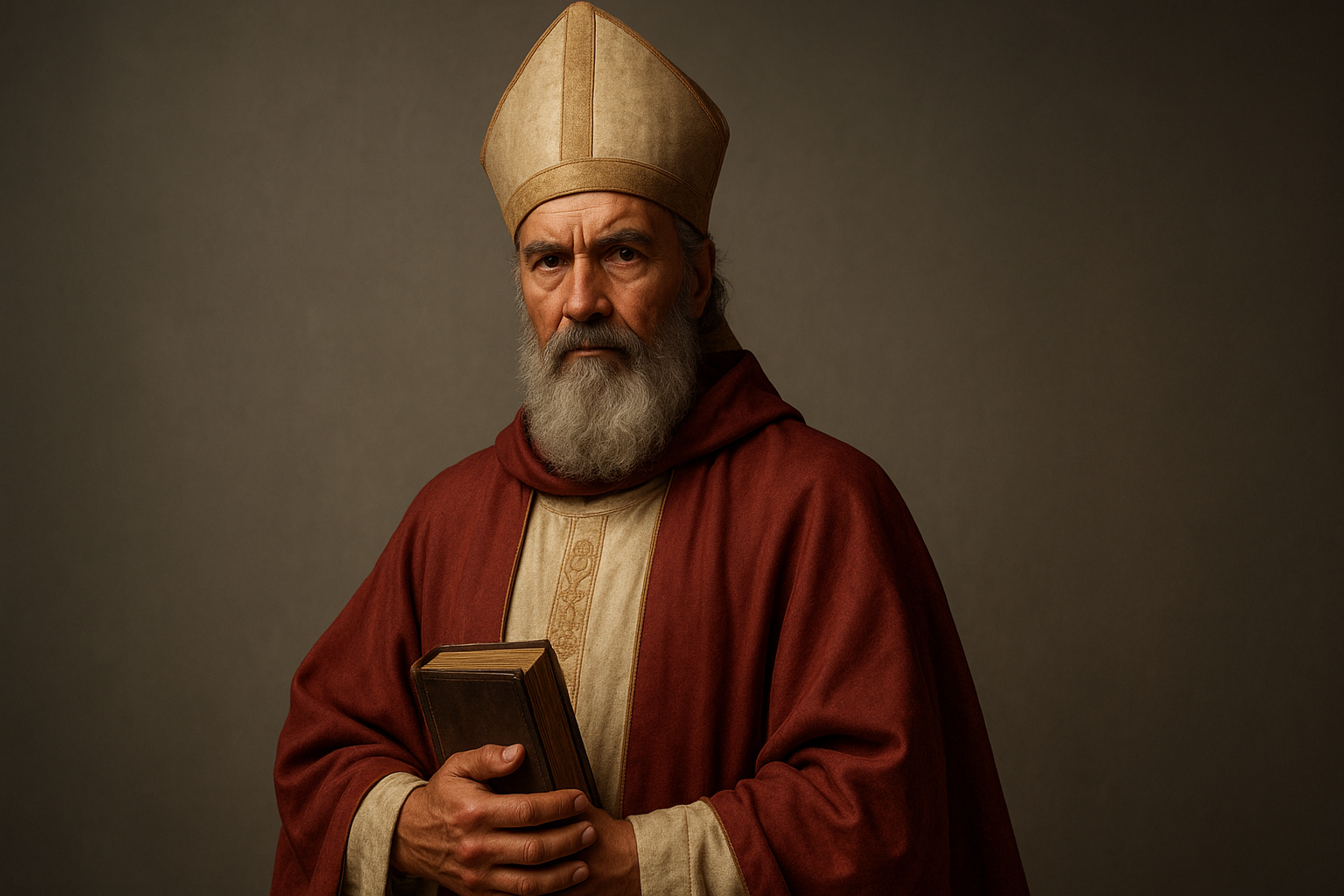
In art and jewelry, Saint Athanasius is often depicted with symbols that highlight his intellectual and spiritual contributions. He is typically shown in the vestments of a bishop, sometimes with a miter and crozier, signifying his episcopal office. He is frequently holding a book or a scroll, representing his prolific writings and his role as a Doctor of the Church. The book often symbolizes his defense of true doctrine. In some depictions, he might be shown trampling on a figure or a serpent, symbolizing his triumph over the Arian heresy. Less common, but still found, is the image of a ship, representing the Church sailing through stormy seas, with Athanasius as its steadfast pilot. These symbols remind us of his enduring legacy as a courageous leader, a profound theologian, and an unwavering defender of the Catholic faith.
Timeline Summary
- c. 296-298 AD: Born in Alexandria, Egypt.
- c. 319 AD: Ordained a deacon by Bishop Alexander of Alexandria.
- 325 AD: Attends the Council of Nicaea with Bishop Alexander, passionately defending Christ’s divinity against Arianism.
- 328 AD: Succeeds Bishop Alexander as Patriarch of Alexandria.
- 335-337 AD: First exile to Trier (modern-day Germany) by Emperor Constantine.
- 339-346 AD: Second exile, spending time in Rome.
- 356-361 AD: Third exile, forced to flee into the Egyptian desert, taking refuge with monks.
- 362 AD: Briefly returns, only to be exiled for a fourth time by Emperor Julian the Apostate.
- 363 AD: Returns after Julian’s death.
- 365-366 AD: Fifth and final exile, lasting only a few months, under Emperor Valens.
- 367 AD: In his 39th Paschal Letter, provides the first full list of the 27 books of the New Testament canon.
- May 2, 373 AD: Dies peacefully in Alexandria, after decades of defending the Nicene faith.
Scripture for Reflection
Saint Athanasius’s life and work were deeply rooted in Scripture, particularly passages that affirm Christ’s divinity and the transformative power of the Incarnation. Here are a few that resonate with his legacy:
- John 1:1, 14: “In the beginning was the Word, and the Word was with God, and the Word was God… And the Word became flesh and dwelt among us, full of grace and truth; we have beheld his glory, glory as of the only Son from the Father.”
Athanasius based his entire theology on the belief that Jesus, the “Word” or “Logos,” is truly divine and co-eternal with God the Father. This passage perfectly encapsulates the truth of the Incarnation – that God Himself entered human history in the person of Jesus.
- Philippians 2:5-8: “Have this mind among yourselves, which is yours in Christ Jesus, who, though he was in the form of God, did not count equality with God a thing to be grasped, but emptied himself, taking the form of a servant, being born in the likeness of men. And being found in human form, he humbled himself and became obedient unto death, even death on a cross.”
This passage speaks to both the divinity (“in the form of God”) and the humanity (“emptied himself, taking the form of a servant”) of Christ, a core tenet Athanasius fiercely defended. It also reflects the humility of the Incarnation, which leads to our salvation.
- Romans 8:37-39: “No, in all these things we are more than conquerors through him who loved us. For I am sure that neither death nor life, nor angels nor principalities nor powers, nor things present nor things to come, nor height nor depth, nor anything else in all creation, will be able to separate us from the love of God in Christ Jesus our Lord.”
Athanasius endured immense suffering and opposition for his faith. This passage beautifully captures the unshakeable confidence in God’s love and the ultimate triumph that comes from steadfast faith, a truth he lived out over decades of struggle.
Prayers to St. Athanasius
While there isn’t one universally known “official” prayer to Saint Athanasius like some other saints, we can invoke him through prayers that reflect his virtues and contributions. Here is a prayer inspired by his life and spiritual legacy:
Prayer to Saint Athanasius, Defender of the Faith
O glorious Saint Athanasius, steadfast defender of the Incarnate Word,
whose unwavering courage shone brightly amidst a world adrift in error,
we humbly seek your intercession.
You stood as a pillar of truth, affirming the divine majesty of Jesus Christ,
true God from true God, begotten, not made, consubstantial with the Father.
Grant us, we pray, a portion of your intellectual clarity and spiritual fortitude.
Help us to discern truth from falsehood in our own challenging times,
to hold fast to the deposit of faith, and to proclaim with conviction
the saving mystery of Christ’s divinity and humanity.
Through your prayers, may we never be separated from the love of God,
and may we, like you, persevere in faith until our last breath.
Amen.





