
In the vibrant tapestry of Catholic saints, few figures resonate with such melodious grace and unwavering courage as St. Cecilia. Revered as the patroness of musicians, her name itself seems to hum with ancient hymns and soaring melodies. Yet, beneath the artistic reverence lies a powerful story of faith, purity, and martyrdom that shines as a beacon from the early days of the Church in Rome. This article will journey through the historical landscape of her time, explore her remarkable life and steadfast witness, delve into her profound spiritual legacy, and discover how her inspiring example continues to echo in the hearts of believers and artists today.
Quick Facts
| Category | Details |
|---|---|
| Birth | Circa 2nd or 3rd century AD, Rome, Roman Empire |
| Death | Circa 2nd or 3rd century AD, Rome, Roman Empire (Martyred) |
| Feast Day | November 22 |
| Patronage | Musicians, poets, singers, composers, instrument makers, churches, archdiocese of Omaha (among others) |
| Canonized | Pre-Congregation (recognized as a saint from early Church tradition) |
Historical Context & Early Life
St. Cecilia’s life unfolded during a tumultuous period for early Christians within the vast Roman Empire. While the exact dates are debated by historians, tradition places her story in the 2nd or 3rd century AD, a time when Christianity was still a minority religion, often viewed with suspicion and, at times, subjected to brutal persecution. Rome was the center of an empire that prided itself on its pagan gods, elaborate rituals, and a social structure that demanded loyalty to the emperor above all else. Christians, with their monotheistic faith and refusal to worship idols or deify the emperor, were seen as subversive and disloyal. Their gatherings were often held in secret, and their commitment to Christ frequently tested by imperial decrees.
Into this challenging world, Cecilia was born to a noble and wealthy Roman family. Details of her early life are largely drawn from the traditional accounts known as the “Acts of St. Cecilia,” a hagiographical text that emerged centuries after her death. These accounts paint a picture of a young woman raised with all the advantages of her aristocratic status: education, comfort, and societal standing. However, even from a young age, Cecilia’s heart was drawn not to the fleeting pleasures of the world or the pagan gods of her ancestors, but to the one true God she had come to know through the burgeoning Christian community in Rome. She secretly embraced Christianity, finding solace and strength in its teachings. Her profound faith led her to make a personal vow of perpetual virginity, dedicating her life and purity solely to Christ, even as societal expectations for noble Roman women revolved around marriage and procreation.
Calling & Key Milestones
Her Vow of Virginity
From a very early age, Cecilia distinguished herself not by outward display but by an interior resolve rooted in her deep Christian faith. Recognizing the transient nature of worldly honors and the eternal promise of God’s love, she consecrated her life to Christ through a vow of perpetual virginity. This was a radical commitment in Roman society, where women of her noble standing were typically expected to marry and produce heirs. Her vow was a testament to her profound personal relationship with God, a private covenant made in the depths of her soul.
Marriage to Valerian
Despite her sacred vow, Cecilia’s parents, adhering to Roman custom, arranged her marriage to a young nobleman named Valerian. On her wedding day, as the sounds of musical instruments filled the air—an image that would later define her patronage—Cecilia remained steadfast in her heart. She wore a sackcloth beneath her wedding dress as a sign of penance and devotion, and she prayed fervently, asking God to protect her purity and guide her path. According to tradition, during the wedding feast, while the music played, she sang in her heart to the Lord, “Let my heart be undefiled, so that I may not be confounded.”
When the moment came for her to be alone with Valerian, she courageously revealed her vow and told him that an angel of God protected her virginity. She explained that if he respected her vow and converted to Christianity, he too would see this angel. Valerian, initially shocked, was moved by her sincerity and the power of her conviction. He agreed to be baptized by Pope Urban I, who was then living in hiding due to persecution. Upon his baptism, Valerian returned to Cecilia and, true to her word, he saw the angel, standing beside her, crowned with roses and lilies, symbols of martyrdom and purity.
Tiburtius’ Conversion & Martyrdom
The conversion of Valerian was just the beginning. Inspired by his brother’s transformation and Cecilia’s unwavering faith, Valerian’s brother, Tiburtius, also sought instruction from Pope Urban I and was baptized. Both brothers, now devout Christians, dedicated themselves to works of charity, particularly burying the bodies of martyred Christians who had been left unburied in defiance of Roman law. This act was highly dangerous, as it openly defied imperial authority and marked them as Christians.
Their charitable work did not go unnoticed. Eventually, Valerian and Tiburtius were arrested for their faith and for refusing to offer sacrifices to the Roman gods. They were brought before the Prefect Almachius, who demanded they recant their Christianity. They bravely refused, proclaiming their belief in Christ, and were subsequently condemned to death. Before their execution, they were given into the custody of a Roman officer named Maximus. During their imprisonment, Valerian and Tiburtius, through their fervent faith and courageous witness, converted Maximus and his entire household to Christianity. Soon after, Valerian and Tiburtius were martyred by beheading, sealing their testimony with their blood.
Cecilia’s Martyrdom
After the martyrdom of her husband and brother-in-law, Cecilia continued her mission, burying their bodies and openly preaching the Gospel. Her actions quickly drew the attention of Prefect Almachius, who ordered her arrest. When brought before him, Cecilia faced her accuser with remarkable composure and spiritual fortitude. She refused to renounce Christ or offer sacrifices to pagan idols, boldly declaring her faith. Enraged by her defiance and her eloquent defense of Christianity, Almachius condemned her to death.
Her execution was ordered to take place in her own home, where she was placed in a boiling bath, designed to suffocate and burn her to death. Miraculously, despite being subjected to the intense heat for a day and a night, Cecilia remained unharmed. God protected her, and she emerged from the bath unscathed, praising Him. Frustrated by this divine intervention, Almachius then commanded a soldier to behead her. The executioner struck her neck three times with a sword, but was unable to fully sever her head, which was the Roman law’s limit for striking. According to tradition, Cecilia lingered for three days after the botched execution, during which time she continued to preach the Gospel, convert souls, and distribute her remaining wealth to the poor. She finally died, offering her life as a perfect sacrifice to God.
Discovery of Her Remains
Centuries after her death, in 820 AD, during the pontificate of Pope Paschal I, Cecilia’s tomb was discovered in the Catacombs of Callixtus. Her body was found to be remarkably preserved, lying uncorrupted and still clothed in the same garments she wore at the time of her martyrdom. This miraculous preservation was seen as a powerful sign of her sanctity and God’s favor. Pope Paschal I had her remains translated to the church built in her honor, the Basilica of Santa Cecilia in Trastevere, Rome, where they rest to this day. In 1599, during a renovation of the basilica, her tomb was opened again, and her body was once more found incorrupt, lying on her side, a wound visible at her neck. This event inspired the famous sculpture by Stefano Maderno, depicting her body in the same pose as it was found.
Spiritual Legacy & Theological Themes
St. Cecilia stands as a testament to profound Christian virtues, embodying core tenets of Scripture and Catholic teaching. Her life exemplifies unwavering faith, a steadfast trust in God’s power even in the face of death. Her commitment to a vow of purity, maintained through divine intervention, speaks to the sacredness of the body as a temple of the Holy Spirit. Her courageous witness and open proclamation of Christ, even under threat of torture and execution, perfectly illustrate the virtue of fortitude and the call to be an authentic Christian disciple. Her story also highlights the transformative power of the Gospel; her conversion of Valerian, Tiburtius, and Maximus demonstrates the magnetic pull of authentic Christian living.
Theologically, Cecilia’s story resonates with several key themes. Her martyrdom places her within the early Church’s rich tradition of giving one’s life for Christ, echoing the words of Jesus: “Whoever loses his life for my sake will find it” (Matthew 10:39). Her ability to convert others through her words and example reflects the New Testament emphasis on evangelization and bearing witness to the truth (Acts 1:8). The miraculous preservation of her body further reinforces the Catholic understanding of relics and the veneration of saints, seen as intercessors and models of holiness. Her association with music, though perhaps initially anecdotal, has evolved to symbolize the harmony and beauty of a life lived in tune with God’s will, where every action becomes a song of praise.
Her lasting influence is perhaps most profoundly felt in the arts. As the patroness of music, countless composers, poets, and painters have been inspired by her story. From masterpieces of Baroque music like Handel’s “Ode for St. Cecilia’s Day” to poems by Dryden and Chaucer, her legend has fueled artistic creativity, demonstrating how sacred narratives can transcend their historical origins to inspire beauty and reflection across centuries. Her legacy encourages us to dedicate our talents, whatever they may be, to the glory of God.
Devotion Today
St. Cecilia’s legacy continues to thrive across the globe, especially within the realms of music and Christian devotion. The most significant center of pilgrimage and veneration remains the Basilica of Santa Cecilia in Trastevere in Rome. This ancient church, built over what is traditionally believed to be her home, houses her sacred remains and offers a tangible connection to her life and martyrdom. Pilgrims visit to pray, reflect, and seek her intercession, particularly those involved in musical professions.
Her feast day, November 22nd, is a particularly vibrant occasion. Around the world, churches, schools, and musical societies celebrate with special Masses, concerts, and festivals. Choirs often dedicate their performances to her, and musicians find inspiration in her unwavering faith, asking for her intercession for their talents and ministries. Many Catholic parishes and schools are named in her honor, serving as local hubs for devotion. Additionally, various musical associations, academies, and guilds bear her name, continuing to foster artistic excellence in a spirit of faith.
While specific global pilgrimages directly associated with St. Cecilia are less common than, say, Fatima or Lourdes, her spiritual presence is strongly felt wherever music is offered to God. Individuals often keep small statues, medals, or icons of St. Cecilia in their homes or studios, seeing her as a comforting intercessor for their musical endeavors and a reminder of a life lived harmoniously with divine will.
Reflections for Modern Readers
St. Cecilia’s ancient story offers surprisingly timely lessons for navigating the complexities of the 21st century. Her steadfastness and dedication provide a powerful blueprint for Christian living today.
- Stand Firm in Your Faith (Even When It’s Unpopular): Cecilia lived in a society that demanded conformity to pagan beliefs. She risked everything for her conviction in Christ. In our modern world, where Christian values can sometimes be challenged or deemed unfashionable, Cecilia reminds us to be courageous witnesses. For instance, a young person facing peer pressure to compromise their moral beliefs can draw strength from Cecilia’s resolve to remain pure and faithful to God’s teachings, knowing that true integrity comes from within.
- Use Your Talents for God’s Glory: Though her direct connection to music might be legendary, her patronage encourages us to dedicate our gifts and abilities to a higher purpose. Whether you’re a musician, a teacher, an engineer, or a parent, every talent can be offered back to God. Think of a software developer who uses their skills to create an app that helps people connect with faith resources, or a baker who shares their creations with a local charity. Like Cecilia, who sang to the Lord in her heart, we can turn our daily work into an act of worship.
- Witness Through Your Actions (and Words): Cecilia’s quiet faith blossomed into bold proclamation, converting her husband, his brother, and even her jailer. Her life demonstrates the ripple effect of genuine Christian witness. We don’t need to preach from a pulpit to share our faith. Living a life of kindness, honesty, and compassion in our workplaces, schools, and communities can be a powerful testimony. For example, consistently showing integrity in a competitive business environment can speak volumes about your values.
- Embrace Purity of Heart and Intention: Cecilia’s vow of virginity was a radical commitment to God. For modern readers, this isn’t necessarily a call to celibacy, but rather a deeper challenge to cultivate purity of heart – focusing our intentions, desires, and actions on what is good, true, and holy. In a world saturated with distractions and superficiality, striving for purity means seeking genuine relationships, engaging in meaningful pursuits, and dedicating our inner lives to Christ. It might look like choosing to spend less time mindlessly scrolling social media and more time in prayer or serving others.
Symbols and Representations of St. Cecilia:
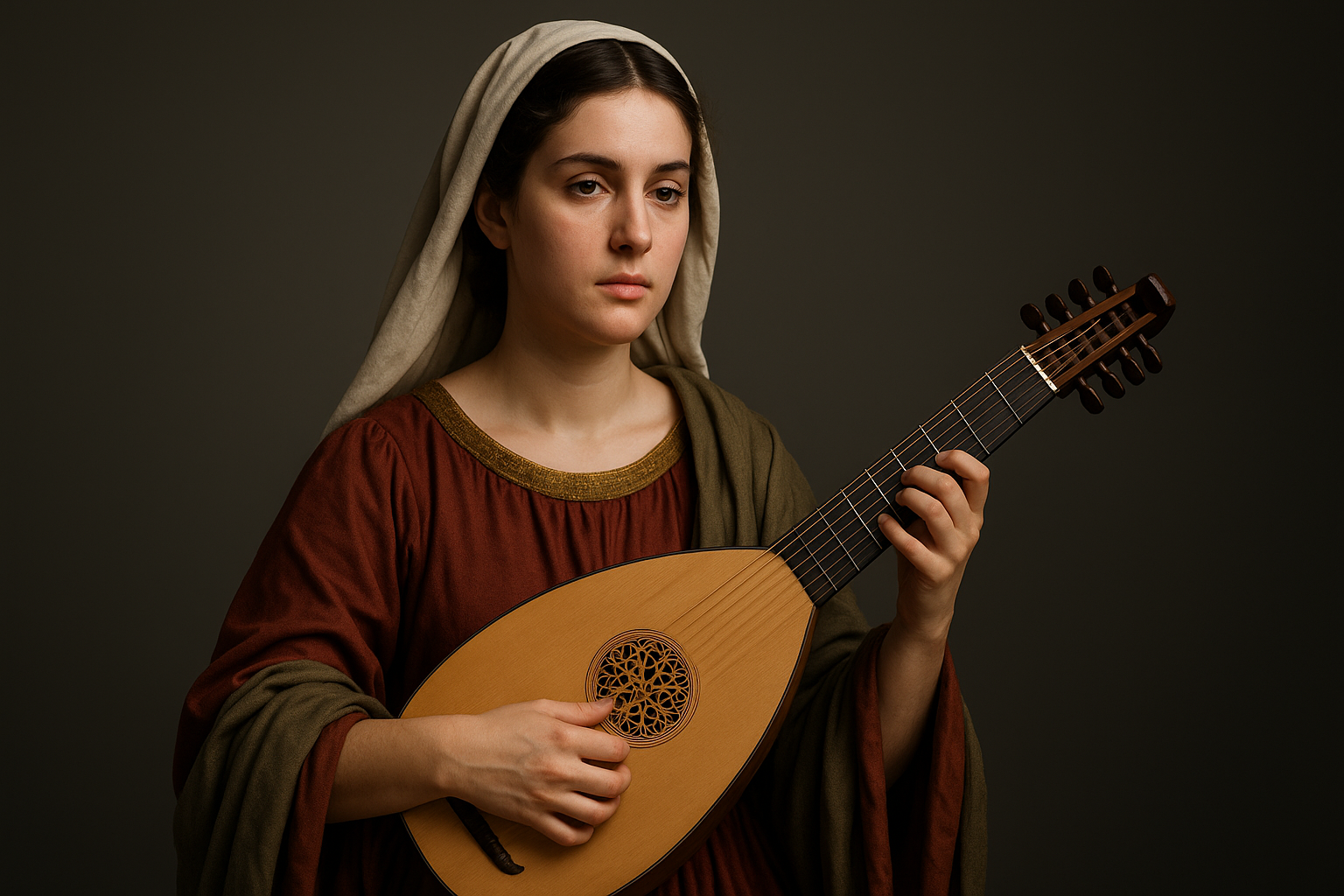
- Musical Instruments (Organ, Lute, Harp): The most recognizable symbols. She is often depicted playing an organ or another instrument, sometimes even singing, despite the tradition that she sang only in her heart. This symbolizes her patronage of musicians and the belief that music can elevate the soul to God.
- Palm Branch: A universal symbol of martyrdom, representing her triumph over persecution and death for her faith.
- Rose and Lily: Often seen in depictions with St. Cecilia or the angel who protected her. The rose symbolizes her fervent love for God and martyrdom, while the lily represents her purity and virginity.
- Sword: Less common, but sometimes present, symbolizing the instrument of her attempted execution and her ultimate martyrdom by beheading.
- Wound on Her Neck: In the famous sculpture by Maderno, and other art inspired by the discovery of her body, a visible wound on her neck depicts the three strikes from the executioner’s sword. This is a direct reference to the details of her martyrdom.
Timeline Summary
- Circa 2nd or 3rd Century AD: Birth of Cecilia to a noble Roman family.
- Early Life: Secretly converts to Christianity and makes a private vow of perpetual virginity.
- Wedding Day: Forced into an arranged marriage with Valerian; prays fervently and sings in her heart to the Lord.
- Conversion of Valerian: Reveals her vow to Valerian, who, after seeking instruction from Pope Urban I and being baptized, sees an angel protecting her.
- Conversion of Tiburtius: Valerian’s brother, Tiburtius, is also converted and baptized after witnessing the brothers’ transformation.
- Martyrdom of Valerian and Tiburtius: Both brothers are arrested for burying Christian martyrs, refuse to sacrifice to pagan gods, and are beheaded. They convert Maximus, their jailer, before their death.
- Cecilia’s Arrest and Trial: Cecilia is arrested for her faith and for burying the martyrs. She boldly defends Christianity before Prefect Almachius.
- Boiling Bath: Condemned to death, she miraculously survives a day and a night in a boiling bath without harm.
- Attempted Beheading: An executioner strikes her three times with a sword, but fails to sever her head.
- Three Days of Witness: Cecilia lives for three more days, continuing to preach, convert, and distribute her wealth to the poor before finally dying.
- 820 AD: Her uncorrupted body is discovered by Pope Paschal I in the Catacombs of Callixtus and translated to the Basilica of Santa Cecilia in Trastevere.
- 1599 AD: Her tomb is opened during renovations, revealing her body still incorrupt, inspiring Stefano Maderno’s famous sculpture.
Scripture for Reflection
St. Cecilia’s life beautifully illuminates several scriptural passages, underscoring the timeless nature of faith and sacrifice.
Matthew 5:8 (Purity of Heart): “Blessed are the pure in heart, for they shall see God.”
Cecilia’s unwavering commitment to purity, both physically through her vow of virginity and spiritually through her singular devotion to Christ, perfectly embodies this beatitude. Her story illustrates how a heart focused solely on God can perceive divine truths and experience spiritual intimacy, even to the point of seeing angels, as Valerian did through her purity.
Romans 12:1-2 (Living Sacrifice and Non-Conformity): “I appeal to you therefore, brothers, by the mercies of God, to present your bodies as a living sacrifice, holy and acceptable to God, which is your spiritual worship. Do not be conformed to this world, but be transformed by the renewal of your mind, that by testing you may discern what is the will of God, what is good and acceptable and perfect.”
Cecilia’s entire life was a “living sacrifice.” She refused to conform to the pagan world around her, dedicating her body and soul to God. Her martyrdom was the ultimate act of presenting herself as holy and acceptable to God. Her story challenges us to undergo a similar transformation, resisting worldly pressures and aligning our minds and wills with God’s perfect plan.
1 Peter 3:15 (Be Ready to Give an Account): “Always be prepared to give an answer to everyone who asks you to give the reason for the hope that you have. But do this with gentleness and respect.”
When brought before Prefect Almachius, Cecilia boldly and eloquently articulated her faith in Christ, demonstrating her readiness to give an account for the hope within her. She did so with a strength that, though not described as “gentle” in the face of tyranny, certainly commanded respect. Her example encourages us to be knowledgeable about our faith and prepared to share it when opportunities arise, always striving to do so with conviction and charity.
Prayers to St. Cecilia
Prayer to St. Cecilia, Patroness of Musicians
O glorious St. Cecilia, virgin and martyr, you who chose to sing God’s praises even amidst the sounds of pagan festivities, we honor you as the patroness of musicians. We pray for all who use their talents to create beautiful music for the glory of God and the uplifting of humanity. Inspire them, O heavenly patroness, to ever higher levels of artistry and devotion, so that through their music, hearts may be drawn closer to the divine.
Help us, like you, to always sing God’s praises in our hearts, even in times of trial and tribulation. May our lives be a symphony of faith, hope, and charity, harmonious with God’s holy will. Intercede for us, that we may remain steadfast in our convictions, pure in heart, and courageous in proclaiming our faith, just as you did, even to the shedding of your blood.
Through your powerful intercession, we ask for the grace to use our gifts, whatever they may be, for the greater glory of God and the salvation of souls. Amen.





